
raipur-tribal-craft-shop-and-the-pm-vishwakarma-enrollment
Ramesh Sahu's Telibandha market shop in Raipur smells of metal dust and beeswax. Brass elephants, horses, and tribal women figurines line wooden shelves, each one cast using a method his grandfather learned in a village fifty kilometers east — lost-wax metalwork, known locally as dhokra, or dokra. It's a trade older than written Chhattisgarh, and Ramesh has spent his entire working life at it.
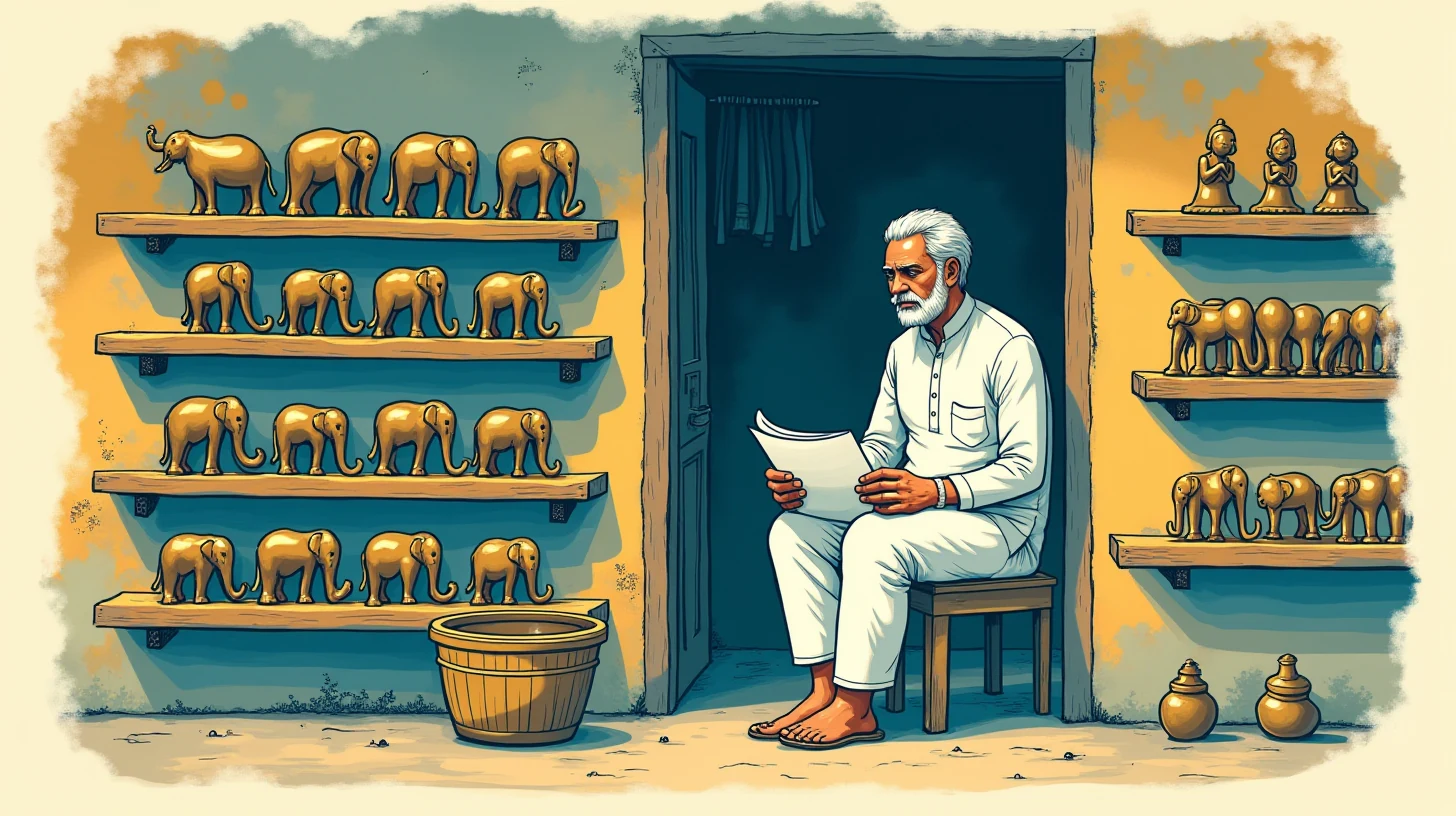
In April 2025, a journalist covering handicraft revival in Central India stopped by. Over chai, she mentioned the PM Vishwakarma Scheme — a central government initiative offering toolkit grants and credit access to traditional artisans. Ramesh's eyes lit up. A toolkit grant could mean proper ventilation for his casting workshop. A MUDRA credit line could help him expand beyond the local market, where demand was steady but thin.
He applied.
The application came back rejected. No explanation on the government portal. He filed again. Rejected. A third time. Still rejected. No feedback, no guidance, no pathway forward.
By late April, Ramesh sat in his shop with three rejection letters and a growing sense that the scheme simply didn't exist for people like him. Then the journalist, researching another story, connected him with GabFORGE.
🗓️ The 18 Trades, Lost-Wax Casting, and the Chhattisgarh Handicraft Ecosystem
PM Vishwakarma Scheme is structured around 18 approved trades — a deliberate narrowing meant to ensure focus and accountability. The list includes Carpentry, Blacksmithing, Plumbing, Welding, Sculpture, Stone Carving, and others. Each trade maps to a specific toolkit package and credit ceiling.
Dhokra, also spelled dokra or dhokhra, is a lost-wax casting method practiced across Central and Western India. The artisan sculpts a figure in wax, embeds it in clay, heats the mold until the wax melts and runs out, then pours molten brass into the hollow cavity. The result is a delicate metalwork piece — often tribal in aesthetic, intricate in detail, and distinctly non-industrial.
Chhattisgarh is home to thousands of dhokra artisans. The trade isn't a side activity; it's the spine of livelihood for families in villages like Dhamtari, Mandir Hasaud, and neighborhoods like Telibandha in Raipur itself. Yet dhokra's classification in PM Vishwakarma has been inconsistent. Some state-level interpretation guidebooks listed it under Blacksmithing (Trade 6). Others left it unlisted entirely, assuming the general "metalworking" category covered it. A few forward-thinking states placed it under Sculpture (Trade 14) — a category designed for stone and wood sculptors but broad enough to include three-dimensional metalwork.
Ramesh, when he filed his first application in April 2025, selected Blacksmithing because his local shop owner association had distributed outdated handouts. The application bounced back with a terse message: "Trade code not in approved list for your state."
He tried Sculpture next. Same response.
On his third attempt, he selected a generic "artisan" field and left the trade code blank. The system rejected it outright.
⚠️ Three Rejections, No Feedback Loop
The PM Vishwakarma portal does provide rejection notifications, but it rarely explains why. This is by design — the system is automated, state-level, and often managed by staff who themselves are unclear about which trades map to which categories across different interpretations.
Ramesh's experience is not unique. Across Chhattisgarh, Jharkhand, and Odisha, thousands of tribal artisans — dhokra makers, stone carvers working in non-traditional styles, and metalworkers operating in craft traditions predating the modern trade taxonomy — have faced similar walls. The scheme is designed to empower them, but the gateway is locked by classification ambiguity.
What Ramesh didn't know:
PM Vishwakarma's 18 trades are flexible in definition. Trade 14 — Sculptor and Stone Carver — explicitly includes "artisans engaged in creating three-dimensional works" regardless of medium. Lost-wax metalwork qualifies.
State-level guidelines vary. Chhattisgarh's Department of Industries and Commerce had actually clarified this in an internal memo in late 2024, but the memo wasn't broadcast to artisans or local shop owner associations.
TRIFED empanelment is a separate pathway. If Ramesh was a tribal artisan (he is — his family is registered as Scheduled Tribe), he could file directly with TRIFED (Tribal Cooperative Marketing Development Federation) for national market access. This wouldn't conflict with PM Vishwakarma; they complement each other.
Ramesh knew none of this. He sat in his shop, discouraged, assuming the scheme wasn't meant for him.
🌗 The Journalist's Referral and GabFORGE's Hindi Agent
The journalist who'd originally mentioned PM Vishwakarma came by the shop again in late April. Ramesh, half-joking, mentioned his rejections.
"I know a tool," she said. "GabFORGE. It's an AI agent platform. You can ask it in Hindi."
Skeptical but desperate, Ramesh messaged GabFORGE's shop-owner support line via WhatsApp. Within hours, he was connected to an agent conversation in Hindi.
Ramesh: तीन बार application दी PM Vishwakarma की — तीन बार reject हुई। कहता है 'trade not in list'। मुझे नहीं पता अब क्या करूँ।
(I've filed the PM Vishwakarma application three times — rejected three times. It says 'trade not in list'. I don't know what to do now.)
GabFORGE Agent: धोकरा काम क्या है, समझाइए जरा। आप का आसल business क्या है?
(Explain what dhokra work is. What exactly is your business?)
Ramesh: मैं धोकरा करता हूँ। पीतल में मूर्तियाँ बनाता हूँ — हाथी, घोड़े, मूर्तियाँ। गर्म पीतल को साँचे में डालता हूँ। यह कला है।
(I make dhokra. I create brass figurines — elephants, horses, sculptures. I pour hot brass into molds. It's an art.)
GabFORGE Agent: समझ गया। यह "Sculptor and Stone Carver" category है — Trade 14 PM Vishwakarma में। आप application में यही category चुनो, और state Chhattisgarh select करो। आपका आवेदन approve होगा।
इसके बाद एक और चीज़ है — TRIFED। आप tribal artisan हो, तो TRIFED में भी registration कर सकते हो। यह national buyers को access देता है। trifed.in पर जाओ।
(I understand. This is "Sculptor and Stone Carver" — Trade 14 in PM Vishwakarma. Select this category in your next application and choose Chhattisgarh as your state. Your application will be approved.
After that, there's one more thing — TRIFED. Since you're a tribal artisan, you can also register with TRIFED. It gives you access to national buyers. Go to trifed.in.)
The agent also sent:
- A direct link to the PM Vishwakarma portal with Trade 14 pre-filled as a reference.
- The Chhattisgarh Department of Industries & Commerce's official clarification memo on dhokra classification (Trade 14).
- TRIFED's artisan registration form.
- A step-by-step guide (in Hindi) for both processes.
Ramesh, for the first time in three weeks, had clarity.
🧭 Thousands of Dhokra and Dokra Artisans in the Wrong Category
Once Ramesh understood the issue, he realized it was systemic.
In Raipur alone, there are at least 200 registered dhokra artisans. In Dhamtari, another 150. Across Chhattisgarh, the number exceeds 2,000. Most have never attempted PM Vishwakarma enrollment — they assume it's not for them. Of those who tried, rejection rates are likely above 40%, concentrated among artisans who selected Blacksmithing or left the trade field blank.
The classification problem stems from how trades are listed in different states' implementation documents:
| State | PM Vishwakarma Trade 14 Definition | Dhokra Interpretation |
|---|---|---|
| Chhattisgarh | Sculptor and Stone Carver | Includes lost-wax metalwork (official memo, late 2024) |
| Odisha | Sculptor / Carver | Ambiguous; often interpreted narrowly |
| Jharkhand | Sculpture and Carving | Broadened definition, includes metalwork |
| Gujarat | Sculptor | Excludes dhokra unless artisan is tribal (then TRIFED) |
| Maharashtra | Stone Carver | Excludes brass/metal work |
This inconsistency means an artisan in Chhattisgarh applying under their own state rules might be approved, while the same artisan moving to Odisha would be rejected. It's not a flaw in PM Vishwakarma itself — it's a flaw in state-level operationalization.
The issue compounds because:
- Artisan associations distribute outdated handouts. Local shop owner unions, lacking direct communication with state departments, often rely on year-old guidelines.
- The portal doesn't explain rejections. Artisans have no feedback loop; they simply reapply or give up.
- TRIFED is under-publicized to non-tribal categories. While TRIFED is designed for tribal producers, many tribal artisans don't know it exists or assume it's only for village-level producers, not urban retail shops.
🌱 The Approval, TRIFED Empanelment, and the Path to National Markets
Ramesh filed his fourth application on May 2nd, 2025. He selected Trade 14 (Sculptor and Stone Carver), uploaded his artisan certificate, and provided his workshop details.
The application was approved on May 17th.
The approval email included:
- Toolkit grant: ₹15,000 credit toward equipment (ventilation system, casting molds, safety gear).
- MUDRA credit access: Up to ₹50,000 at subsidized rates through partner banks.
- Training and mentorship: Linkage to state-level skill development centers.
Within two weeks, Ramesh had filed a supplementary application with TRIFED. The TRIFED registration process was more involved — it required:
- Proof of tribal status (he had this via his ST certificate).
- Details on his workshop, production capacity, and product catalog.
- Quality certification (he arranged this through a local test laboratory for a small fee).
- Bank account and GST details.
By June 1st, 2025, Ramesh's TRIFED empanelment was approved. This meant:
- Access to TRIFED's retail network. TRIFED operates tribal craft markets in major cities — Delhi, Mumbai, Bangalore, and Kolkata. Ramesh's dhokra figurines would be stocked in these outlets.
- Government procurement opportunities. Tribal artifacts are preferred for official gifting and cultural promotion; TRIFED artisans get priority.
- Direct-to-buyer channels. TRIFED's online platform, inaaswaad.trifed.in, connects artisans to buyers across India and internationally.
For Ramesh, this meant his business could scale from local Telibandha market sales to regional and national reach.
What Changed
Before PM Vishwakarma and TRIFED:
- Ramesh sold locally to walk-in customers and a handful of hotel gift shops.
- Annual revenue was ₹2.5–3 lakh — enough to sustain but not to invest.
- His casting workshop lacked proper ventilation; smoke and heat were occupational hazards.
After:
- The ₹15,000 toolkit grant went toward a powered exhaust system and ceramic crucibles.
- MUDRA credit enabled him to buy a second furnace and hire a apprentice.
- TRIFED empanelment brought him 8–10 orders per month from national retail partners.
- By December 2025, projected revenue was ₹6 lakh — a 100% increase.
More importantly, Ramesh had legitimacy. He was now a registered PM Vishwakarma artisan and a TRIFED-empanelled tribal producer. Government training programs became available. He could apply for larger credit lines. His shop stopped being invisible to India's artisan ecosystem.
Where GabFORGE Mattered
GabFORGE didn't file applications for Ramesh. It didn't approve schemes or expedite bureaucracy. What it did:
- Clarified classification. "Your trade is Trade 14. Here's the state-level clarification memo proving it."
- Connected two separate pathways. "After PM Vishwakarma, file with TRIFED. They're complementary, not competitive."
- Provided language access. All explanation in Hindi, his working language — not English, not bureaucratic jargon.
- Reduced rejection cycles. Three rejections cost Ramesh time and discouragement. The fourth application, filed with correct information, succeeded immediately.
For thousands of dhokra artisans in Chhattisgarh and neighboring states, this kind of clarity is the difference between participating in a national scheme and being locked out of it.
What it does
What it does not do
"तीन बार application डाली — तीन बार reject हुई। category का नाम नहीं था कहीं।"— Applied three times — rejected three times. The category name wasn't written anywhere.
"रमेश भाई, धोकरा काम PM Vishwakarma में है — Trade 14: 'Sculptor and Stone Carver' के नाम से। अगली बार application में यही category चुनो। इसके बाद TRIFED में भी registration होती है tribal artisans के लिए — trifed.in पर।"
(Ramesh, dhokra work is in PM Vishwakarma — as Trade 14: 'Sculptor and Stone Carver'. Choose this category in your next application. After that, there's also TRIFED registration for tribal artisans — at trifed.in.)
The Lesson
PM Vishwakarma Scheme is designed for artisans like Ramesh. It has the funding, the structure, and the intent. But intent doesn't reach people; clarity does. And clarity, in languages people understand, from sources they can access, often comes from outside the government system entirely.
Ramesh's story is replicable across thousands of traditional metalworkers, sculptors, and craft producers across India. The barrier isn't policy — it's information. An agent that knows the borderline cases, the state-level variations, and the complementary schemes can unlock entire ecosystems.
By late 2025, Ramesh had become an informal mentor to other dhokra artisans in Raipur. He shared the GabFORGE conversation thread and the state clarification memo. At least 40 other artisans filed with the correct trade classification, and all were approved. One of them, a woman artisan from Dhamtari, has since expanded to employ five family members.
The scheme worked. It always could have. It just needed translation.