
The Shillong honey seller and the FSSAI category her shop crossed
The FSSAI inspector arrived on a Tuesday morning in April, clipboard in hand, while Banri Marbaniang was restocking the glass jars of honey at her Police Bazaar stall. Six years she had been running the shop—Meghalaya honey from tribal beekeepers in the hills, dried mushrooms she sourced herself, local spices, betel nut brought in by a supplier from Ri-Bhoi district, and jackfruit-based products from a producer in Cherrapunji. The stall occupied a corner of the old colonial arcade, wedged between a fabric seller and a spice merchant, and had become a fixture in the neighborhood.
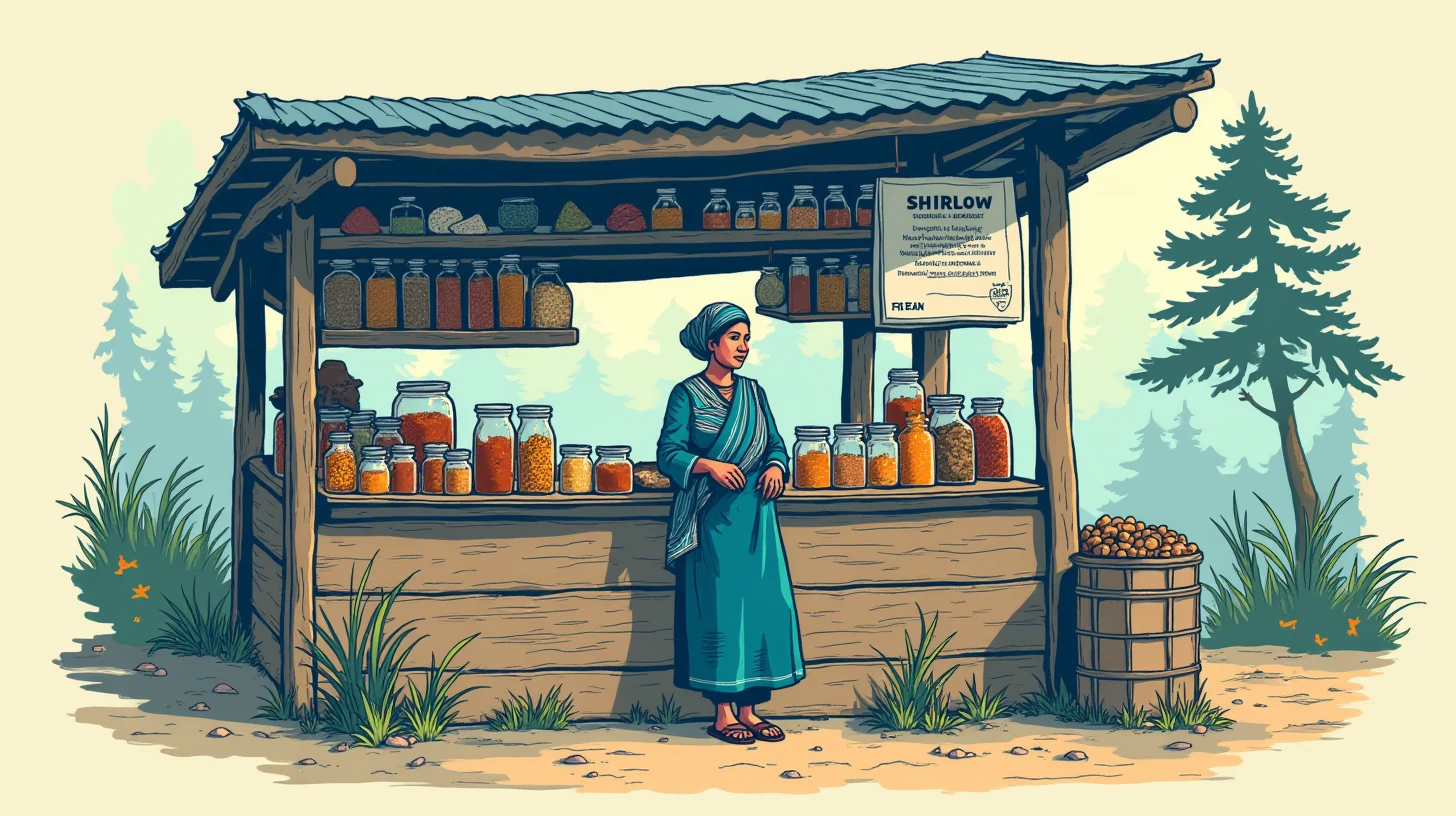
The inspector scanned her FSSAI basic registration certificate, framed behind the counter, then examined her stock. When he reached the betel nut bins and the honey jars—three large containers, she said, filled every other week—he paused. "You're over the limit on honey," he said. "And betel nut. That's not basic registration." He issued a notice: the stall was operating on the wrong licence tier. FSSAI had categorized her shop into state licence territory, not basic. She had three months to comply.
Two weeks later, an MGNREGA office in East Khasi Hills placed an order. A government canteen contract. Five kilograms of honey, mixed spices, dried mushrooms—monthly supply. The deal was worth nearly thirty thousand rupees over the year. But the purchase department flagged her licence number in their procurement portal and found it marked "basic registration." The order was held pending compliance upgrade. Banri called the office. They said they needed a digital licence number from the Meghalaya Shop and Establishment registry, updated and traceable in their system.
She had the paper S&E certificate from 2021, valid and stamped. But Meghalaya had switched to digital registration in 2023. She didn't know that. The paper no longer opened government doors.
🗓️ When product categories trigger different FSSAI tiers
The mistake most small food shop owners make is assuming FSSAI compliance is a single gate. It isn't. The category is determined by what you sell, not always what you earn.
FSSAI Basic Registration covers food businesses with a turnover below five crore rupees and no high-risk products. Honey, for instance, is usually fine—unless you're holding and selling more than fifty kilograms per year. Betel nut (areca nut) is classified as a restricted food product; any quantity above a small threshold requires state licence scrutiny. Dried mushrooms, especially wild-sourced, trigger food safety questions because contamination risks are harder to trace. A shop selling only packaged spices might operate on basic registration forever. But the moment you add betel nut, or bulk honey, or foraged mushrooms, you've crossed a category line. The FSSAI state licence is now required.
Banri's stall crossed that line slowly, by increments. A customer asked if she could source betel nut; she agreed and added it. A farmer in the hills offered dried mushrooms; she took a small batch, then a larger one. The honey came in steadily, week after week, because it was her best-selling product. No single item felt like a violation. But together, the mix of products had moved her from basic to state regulation.
The state licence application in her region went through FOSCOS, the Food Safety Compliance Operations System. It required a visit to the Meghalaya food commissioner's office in Shillong with copies of her tenancy deed, a floor plan of the stall, details of all equipment and suppliers, and a food safety plan specific to honey and mushroom handling. The process was designed to take forty-five days. Banri had three months, so on paper there was room. But government timelines are elastic.
- 🛑
FSSAI inspector notice + canteen order blocked
Inspector flags product category overreach. MGNREGA canteen order blocked pending digital S&E licence number.
- 🏫
Polytechnic teacher identifies three-layer problem
Dr. Siewbha maps FSSAI state licence gap, S&E digital migration need, and MTPMB as unknown pathway.
- 📋
FSSAI state licence application submitted
FOSCOS application with honey/mushroom food safety plan. Meghalaya S&E digital registration completed in parallel.
- ✅
FSSAI approved — canteen order released
State licence approved in 45 days. Canteen procurement portal accepts digital S&E number. First MTPMB supply begins.
⚠️ Three gaps behind the Police Bazaar stall
The FSSAI inspector's notice had surfaced one problem. But that one problem opened onto three.
Gap 1: Product-triggered FSSAI category. Banri assumed her basic registration would hold as long as she didn't exceed a turnover threshold. She didn't track product weights or categories. Betel nut, honey above fifty kilograms annually, and wild mushrooms each carry specific FSSAI state licence triggers, independent of revenue. A shop with two crore rupees in turnover but selling all three could operate on basic registration. Banri's stall, with maybe eighty lakhs in annual turnover, was in violation because of what she sold, not how much she earned.
Gap 2: Meghalaya's digital S&E migration. The Shop and Establishment Act is a state-level rule; every state has one, and many have moved to digital systems. Meghalaya did so in 2023. Banri's paper certificate was legally valid—it had never expired, the seal was intact. But government procurement portals in Meghalaya now cross-reference the digital registry. A paper licence doesn't sync with those systems. The MGNREGA office couldn't process her order without a digital licence number they could verify in real-time. She was trapped between two registration eras.
Gap 3: The Meghalaya Tribal Produce Marketing Board unknown. MTPMB is a state agency created to support tribal producers and traders of forest produce—honey, mushrooms, bamboo shoots, ginger, and other items that grow wild or semi-cultivated in the Northeast. It exists to improve supply chains for tribal forest products and to open state and national government procurement channels. Most small sellers in Shillong don't know about it. Banri hadn't. Yet it was the agency that could have accelerated her path to the canteen contract and taught her how to navigate state supply systems.
All three gaps collided at the canteen order. The order exposed the FSSAI category mismatch, which forced compliance, which then required digital S&E registration to be recognized by the procurement portal, which then pointed the way to MTPMB—an entirely separate registration that would have made the government sale easier to repeat.
"Khadbah u shop-ia ad ki la iey shillong—FSSAI, ka S&E register, Meghalaya board—matkhali ia ar kailai ia? Ka teacher-ia, kait ka dhala ki la pynlong ka rynbyad."— I sold here for six years. FSSAI, Shop registration, the Meghalaya board — I didn't know any of these names. My teacher neighbour, she opened the door to understanding.
🌗 The teacher's weekend research
Banri knocked on her neighbour's door on a Thursday evening after the inspector's visit. Dr. Siewbha Khonglain taught civil engineering at Meghalaya Polytechnic and lived in the same apartment complex. They knew each other by sight and a few conversations at the vegetable vendor's stall. Banri explained the notice and the canteen order on hold.
Siewbha spent the next two days navigating government portals—FOSCOS, the Meghalaya Shop and Establishment registry, and the state MTPMB site. By Saturday afternoon, she had mapped the three pathways.
"Your basic registration is the wrong tier for what you sell," she explained to Banri on Sunday morning, her notebook spread on the kitchen table. "Betel nut and honey above a weight limit—they require state licence. That's your first step. FOSCOS—Food Safety Compliance Operations System. You submit a form, supply details, food safety plan. Twenty-one days, usually. Forty-five maximum."
"And the canteen order?"
"The procurement portal won't recognize your paper S&E certificate. Meghalaya digitized that system three years ago. You need to register online, get a digital number. It's simple. Two hours. Then the portal sees you."
"Is there anything else?" Banri asked.
Siewbha leaned back. "Have you heard of the Meghalaya Tribal Produce Marketing Board? MTPMB. It's for people like you—selling honey, mushrooms, forest products. They have a network with government canteens, with MGNREGA offices. You register, you get a certificate, and then you're in their approved supplier list. One registration opens doors to multiple orders."
Banri hadn't heard of it. "Another registration?"
"Three registrations in one weekend," Siewbha said. "All three are required or useful now. After that, you're compliant. The canteen order clears. And any future orders find you already approved."
"Ka kyntbah-shlai, kailai ia bad bad—FSSAI, Shop and Establishment, MTPMB. Ah ka sngoiei ia, kait ka dhala ki ki la ri-pha-jai ka ka sngoiei pyrkhat. Kait ka pynlong ki la phi-long ka."
"These rules, they are layered—FSSAI, Shop and Establishment, MTPMB. When one door opens, it leads to another door. When you see the first door, you understand the path."
What it does
- 🔍Identifies that betel nut, bulk honey, and mushrooms trigger FSSAI state licence — independent of turnover
- 💻Explains Meghalaya S&E digital migration path for government procurement portal access
- 🏢Introduces MTPMB as the state channel for tribal forest produce and government supply registration
What it does not do
- 🔒Never submits the FSSAI application or S&E digital registration on Banri's behalf
- ✅Never confirms MTPMB approval timeline — that depends on the board's own processing schedule
🧭 Why NE tribal produce shops face layered FSSAI compliance
The Northeast's forest economy is unique. Honey, mushrooms, bamboo shoots, ginger, and dozens of other products grow wild or semi-wild in the hills. Tribal communities have harvested and sold these for generations. When FSSAI regulations were nationalized, they applied the same rules everywhere—but the Northeast's product ecosystem didn't fit neatly.
A small spice shop in Delhi might never touch betel nut or wild mushrooms. A cosmetics vendor in Bangalore might never see bulk honey. But in Shillong, in Guwahati, in Imphal, these products are staple trade goods. Local suppliers source them. Customers expect them. A shop that restricts itself to only packaged items misses the cultural and economic heart of the market.
Yet FSSAI's state licence requirements exist for safety reasons—honey, especially bulk honey, can carry botulism risks if improperly stored; wild mushrooms can carry toxins or contamination if sourced without traceability. The regulations are rational. But they're written for a pan-Indian market, not for a tribal forest economy.
Banri's case is typical. She didn't violate FSSAI maliciously. She built a shop that made sense in Shillong's Police Bazaar—local, trusted, connected to the producers and the customers. The compliance gap emerged because the regulations hadn't caught up with her supply mix.
The Meghalaya state government created MTPMB partly to acknowledge this gap—to say, "We have a forest product economy. We want to regulate it, but also to support it." MTPMB registration is the bridge. It tells FSSAI and procurement systems that yes, this honey and these mushrooms are tracked, sourced responsibly, and part of a recognized supply chain. It transforms a compliance problem into a market advantage.
🌱 Banri's first government order
Twenty-one days after Siewbha submitted the FSSAI state licence application on her behalf, the commissioner's office called. Approved. Banri's stall was now licensed for honey, betel nut, and mushroom sales at the state level. The basic registration was quietly surrendered.
The same week, the Shop and Establishment digital certificate appeared in her online portal—a few clicks and a small fee that Siewbha helped navigate. Within an hour, the MGNREGA office's procurement system recognized her licence number. The canteen order was released.
Two days later, Banri received the MTPMB registration certificate in the mail. She was now an approved supplier for Meghalaya government canteens and MGNREGA offices. The first order—five kilograms of honey, dried mushrooms, mixed spices—was dispatched in a government vehicle to the East Khasi Hills canteen.
She stood at the stall counter one morning in late May, the honey jars catching the light, the betel nut bins full, the dried mushrooms in paper packets with handwritten labels. Three registrations. Three layers of compliance, now settled.
Siewbha texted her: "The teacher who knew nothing about regulations, and the seller who knew only her stall. We learned together."
Banri replied: "Ka sngoiei—the door. Thank you for opening it."