
The Varanasi saree shop and the three notices that went in the drawer
Rohit Vishwakarma is 34, and he sells sarees from a shop in Chowk Varanasi — a narrow lane branching off the main bazaar, the kind of lane where the light arrives sideways and the sound of looms carries from the workshops above. His shop holds 300 to 400 pieces at any time: katan silk, georgette, organza, kadhwa-buti work — the kind of inventory that turns over at ₹40 to 50 lakh a year. It's not large money, but it's honest money, and it's been his family's money for longer than the Indian state has existed.
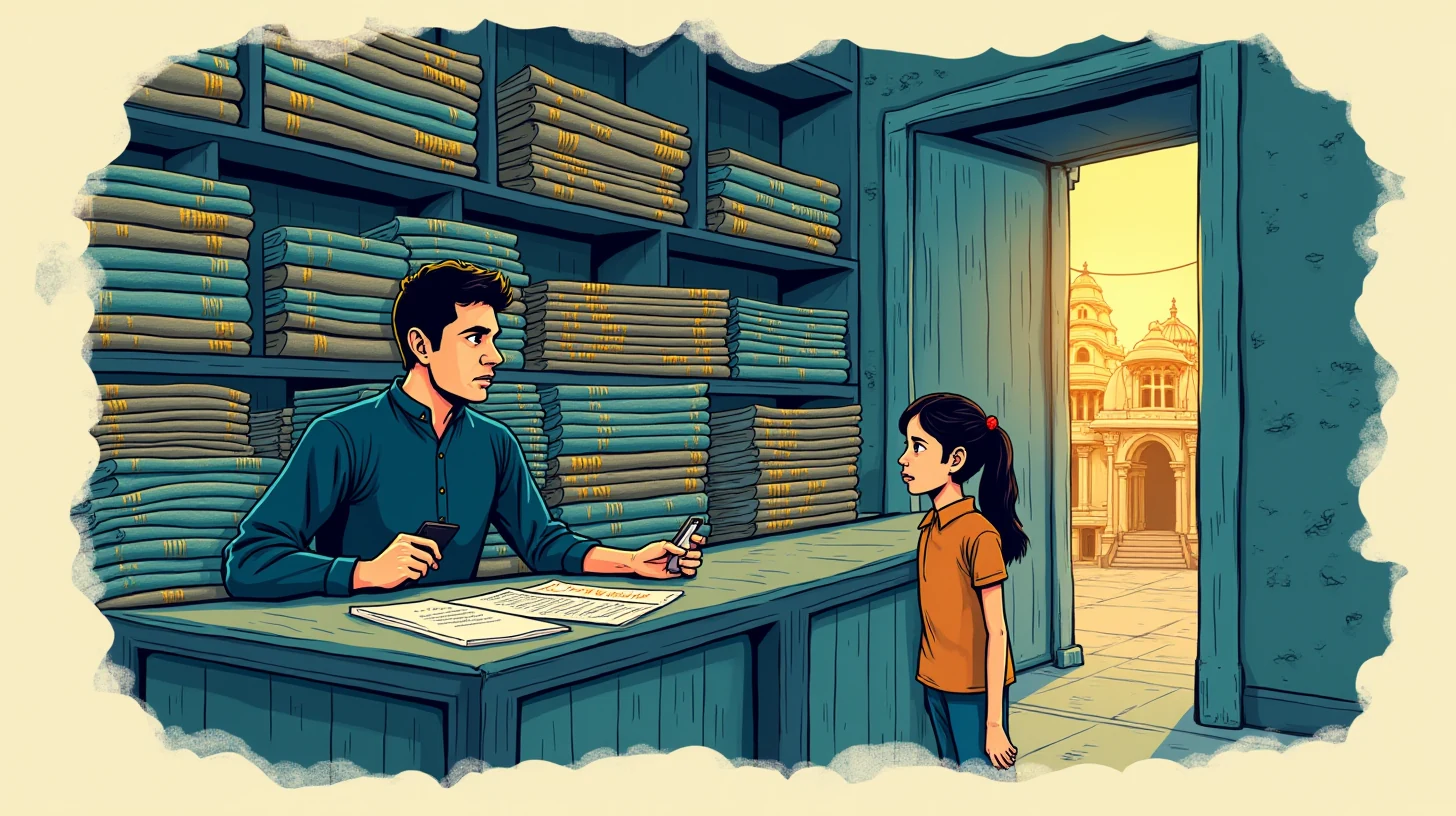
Rohit is not a weaver. The weaving happens in the workshops above and outside the city — in the hands of the bunkaar and karigar. Rohit is a naathabhai, a retailer, a middleman between the loom and the customer. His grandfather was a bunkaar, a master weaver who supervised the work and signed off on quality. But Rohit's father chose the shop, and Rohit followed. The family trade shifted one generation down from the loom to the counter.
His wife Sunita handles the accounts — a physical ledger and WhatsApp messages to customers. His brother Ramesh helps on weekends and during wedding season. His daughter Pooja is 15, in Class 9 at a convent school in Sigra, and she uses AI for homework — which is to say she takes a photograph of her math problem and gets an explanation back while her father is still counting bills.
In October, November, and December of last year, Rohit received three pieces of paper. All three were notices. All three went into a drawer.
🗓️ What the GI tag means to Rohit
The Banarasi Saree has been a Geographical Indication since 2005. This means that the government recognizes that sarees woven and finished in Varanasi have qualities that come from the soil, the water, the tradition, and the skill of the place. A Banarasi saree is to Varanasi what Champagne is to Champagne, or Darjeeling tea is to Darjeeling. The GI tag is a legal boundary: the name "Banarasi Saree" belongs to the producers and traders of Varanasi, not to anyone selling a saree anywhere else.
This is good for Rohit, because it protects his legitimacy. It is also complicated for him, because the GI Registry — the office in Chennai that manages GI tags — requires that every producer and trader who sells under the Banarasi Saree tag must register, and that registration must be renewed.
Rohit had registered long ago, when the tag was new and the paperwork seemed straightforward. But registrations expire. His had expired in 2019.
⚠️ October: the drawer
The first notice came from the GI Registry in Chennai. It said, in Registry English, that Rohit's Banarasi Saree producer registration had expired in 2019 and that he had a 60-day window to renew it. The notice used words like "inter alia" and "Schedule II of the GI Act 1999". The notice was three pages long. It listed what Rohit would need to submit: a GST registration certificate, an invoice bearing the GI logo of the Banarasi Saree, and a letter from the weaving cooperative confirming that the sarees being sold were from registered weavers.
October in Varanasi is wedding season. Weddings mean customers, and customers mean the shop is full. Rohit put the notice in a drawer. Registry English is a language designed to be precise and to create a record that will hold up in court. It is not a language designed to be understood by a man selling sarees in a lane off Chowk.
The second notice came in November. It was from the UP GST department. A shipment of sarees worth ₹1,68,000 had been sent to a customer in Bhopal. The e-way bill — the digital record that allows goods to move across state lines — had been misfiled. The billing GSTIN (the tax ID on the invoice) didn't match the delivery address (the customer's home, not her business address). The GST department wanted a response within 15 days, with an explanation.
Rohit's accountant, Mishra-ji, said this was "aam baat" — a common thing, happens all the time. Mishra-ji didn't file a response. The 15-day window closed.
The third notice came in December. It was about a Mudra Tarun loan that Rohit had applied for — a small collateral-free loan, up to ₹10 lakh, intended for micro-enterprises. The loan had been approved, but it was blocked. The reason: Rohit's MSME registration was from 2019, and it had not been migrated to the new Udyam portal. The old MSME portal had been deprecated. The registration, from the government's point of view, no longer existed.
All three notices went into the drawer.
🌗 December, January, February: the photograph
In December, Pooja photographed the GI Registry notice. She typed the text into her phone and sent it to an agent — not a person, but a piece of software that lives on her father's phone, something she had set up a few weeks earlier to help her organize her homework assignments.
The agent read the notice in English. It replied in Hindi.
"पिताजी, यह notice GI Registry Chennai से है — 'Banarasi Saree' के निशान के बारे में। आपका producer registration 2019 में expire हो गया था। 60 दिन में renewal form भरना है। इसमें चाहिए: GST registration का certificate, एक invoice जिसमें Banarasi Saree का GI symbol हो, और आपके बुनकर या cooperative का एक पत्र। क्या हम checklist बनाएं?"
(Pitaji, this notice is from the GI Registry in Chennai — about the 'Banarasi Saree' tag. Your producer registration expired in 2019. You need to fill the renewal form within 60 days. It needs: GST registration certificate, an invoice showing the Banarasi Saree GI symbol, and a letter from your weaver or cooperative. Shall we make a checklist?)
Rohit nodded. They made a checklist.
The GST certificate was in a file. The invoice with the GI symbol — Rohit had printed those invoices years ago, when the renewal was current. They were in a ledger. The cooperative letter was the hard part. The Banarasi sarees that Rohit sells come from several workshops, some of them registered with the Lohta Weaving Cooperative, some independent. To renew his GI registration, he needed a letter from the cooperative. That meant a visit to the Lohta office.
The first visit, they said "come back next week." The second visit, they said they needed to see the notice. The third visit — which was a WhatsApp photograph of the notice, not a visit at all — they said they could write the letter. It took three weeks.
On the same day that Pooja photographed the GI notice, the agent also looked at the other two pieces of paper.
For the Udyam registration, the agent said: this is not complicated. Go to udyamregistration.gov.in. Fill in the form. You will need your PAN, your Aadhar, your GST GSTIN, and your business address. It will take one afternoon. This was a Friday afternoon in December. Rohit did it. The registration was live by Monday.
For the e-way bill response, the agent said: you have already missed the 15-day window. But file a response anyway, with an explanation. The GST department may accept a late response if the explanation is reasonable. Rohit and Mishra-ji filed the response on day 14 after the notice (so, one day late, having missed the window).
In January, with the GST certificate, the GI invoice, and the cooperative letter all gathered, Rohit filed the GI renewal. The Registry in Chennai has not yet replied. It is now May. Rohit is not worried. These things take time. The registration is in the system. The notice has been addressed. The drawer is empty.
In February, with the Udyam certificate in hand, Rohit went to Canara Bank and spoke to Shrivastava-ji, a manager there. He applied for the Mudra Tarun loan. The application is pending, waiting for the bank's internal approval process. When it clears, he plans to use the money to purchase kadhwa-buti pieces — the hand-embroidered silk sarees that command higher margins but require more capital to hold in stock.
"तीन कागज़ आए थे एक ही मौसम में। तीनों दराज में थे। बेटी ने पहला निकाला।"— Three notices arrived in the same season. All three were in the drawer. My daughter took out the first one.
🧭 The translation gap
The GI Registry is a real office doing real work. It maintains a list of who is allowed to sell under the Banarasi Saree tag. It enforces the boundary. It is not corrupt, and it is not designed to trap small traders. It is designed to protect the name, which protects everyone who uses it fairly.
The Udyam portal is also a real system doing real work. It has consolidated all MSME registrations into a single database. It allows the government to track small business activity and direct lending to them. It is functional. It works.
The problem is not the systems. The problem is that Rohit — a man educated in Hindi, with a shop in a lane, with a wedding-season calendar — does not read Registry English. And no one translates the notices before they go out. The notices arrive in the mail (or, now, on email), and they sit in a drawer because the language is not one that a retailer can parse during the busy season.
Pooja reads Registry English because she is 15 and she has been to convent school. She also reads her homework assignments to an agent on her phone, and the agent reads them back to her in Hindi. So when she photographed the GI notice, it took her five minutes to understand it. For Rohit, it would have taken hours, or it would not have happened at all.
The gap is not in the law. The gap is in the translation, and in the time. The gap is between the official world and the trader's world.
What it does
What it does not do
Mishra-ji is still the accountant. He still files the taxes. He still knows when the GST department is likely to be stricter, and when it will overlook small mistakes. He still keeps track of the ledger and the compliance calendar. What the agent does is translate and remind. It reads the official English and explains it in the Hindi of the shop. It picks out the deadlines from the notices and tells Rohit before they close. It builds a checklist so that a 60-day window is not spent wondering what to do next.
Rohit set up the agent on his phone by January. Now Pooja sends him work reminders from school, and the agent gathers them and reminds him on Friday afternoons. In the beginning, he asked Pooja, "This is just a reminder thing?" She said yes. "So," Rohit said, "kaam jo wahi hai. Yeh bas reminder deta hai." — The work is the same. It just reminds me.
He said: "Kaafi hai." It is enough.
🌱 The kadhwa-buti loan
The Mudra Tarun scheme was designed for people like Rohit. It allows a micro-enterprise to borrow up to ₹10 lakh without collateral. The interest rates are subsidized. The scheme assumes that the business is already running, that the owner knows the trade, and that the money will go to something that will increase revenue — more inventory, better tools, training for a family member.
Rohit's Mudra application was for kadhwa-buti pieces. These are heavy silk sarees, hand-embroidered with gold and silver thread. They are expensive — each piece costs ₹8,000 to ₹15,000 at wholesale. A shop like Rohit's can only hold 8 to 10 pieces in stock without the capital to carry them. Each piece sits for months, waiting for a customer who wants to spend ₹25,000 to ₹40,000 for a saree that will last fifty years.
With a Mudra loan, Rohit could stock 20 pieces. The margin on each sale would be ₹5,000 to ₹8,000. Twenty pieces, even if only five sell in a quarter, generates ₹25,000 to ₹40,000 in extra margin. That is the logic of the loan.
The loan was blocked because of the Udyam registration. The Udyam registration was blocked because no one had told Rohit that the old MSME portal was deprecated. The notice about the deprecation came from the government, as part of a system migration, and it went to a registry somewhere, but it did not go to Rohit's phone or his drawer.
When Pooja's agent identified the Udyam issue and Rohit re-registered, the loan unblocked. It took one afternoon. The loan is now in the hands of the bank, waiting for internal approvals. Rohit expects a reply in June or July.
"Kaam jo pending tha," he said to Pooja, "ab dikh raha hai." — The work that was pending is now visible. It has a place in the system. The shopkeeper and the government are no longer talking past each other.
This is what the translation did. It did not change the law. It did not change the deadline. It did not make the Lohta weaving cooperative faster. It simply made the work visible, and it gave a deadline a shape that Rohit could hold in his hands — a checklist, a date, a list of documents, a step that could be done on a Friday afternoon.
The three notices are out of the drawer now. The GI renewal is in process. The e-way bill response was filed. The Udyam registration is live. The Mudra loan is pending. None of these outcomes would have happened without the photograph, and the agent, and a daughter who reads Registry English because she is 15 and her school teaches her that language.
Rohit still goes to the shop. The sarees still arrive from the workshops. The customers still come. The trade is the same as it was when his grandfather was a bunkaar and signed off on the looms.
But now there is a piece of paper in his hand that says the work is moving, that the government can see him, and that it is possible to be a Banarasi saree retailer in Varanasi without letting three notices pile up in a drawer.
That is enough.