
The Vijayawada medical shop and the drug licence portal that didn't know her pharmacist
Asha Reddy unlocked the blue metal shutter of her medical store on Governorpeta main road at 8:15 on a Tuesday morning, just as she had on 4,380 mornings before this one. Twelve years running, no surprises. The shelves behind the glass counter still held the same tidy rows of Crocin, Dolo, Flagyl, and Aspirin she had stocked when she first rented the shop in 2014. Her husband Ravi appeared on weekends to handle billing when the walk-in traffic peaked. Her daughter, now in Class 11, studied in the back room during her afternoon breaks from college. The rhythm worked.
That morning she opened her email.
The AP Drug Control Administration had sent a notification: her retail drug licence (Form 20B under the Drugs & Cosmetics Act 1940) was due for renewal in six weeks. A link to the new online renewal portal. She clicked it.
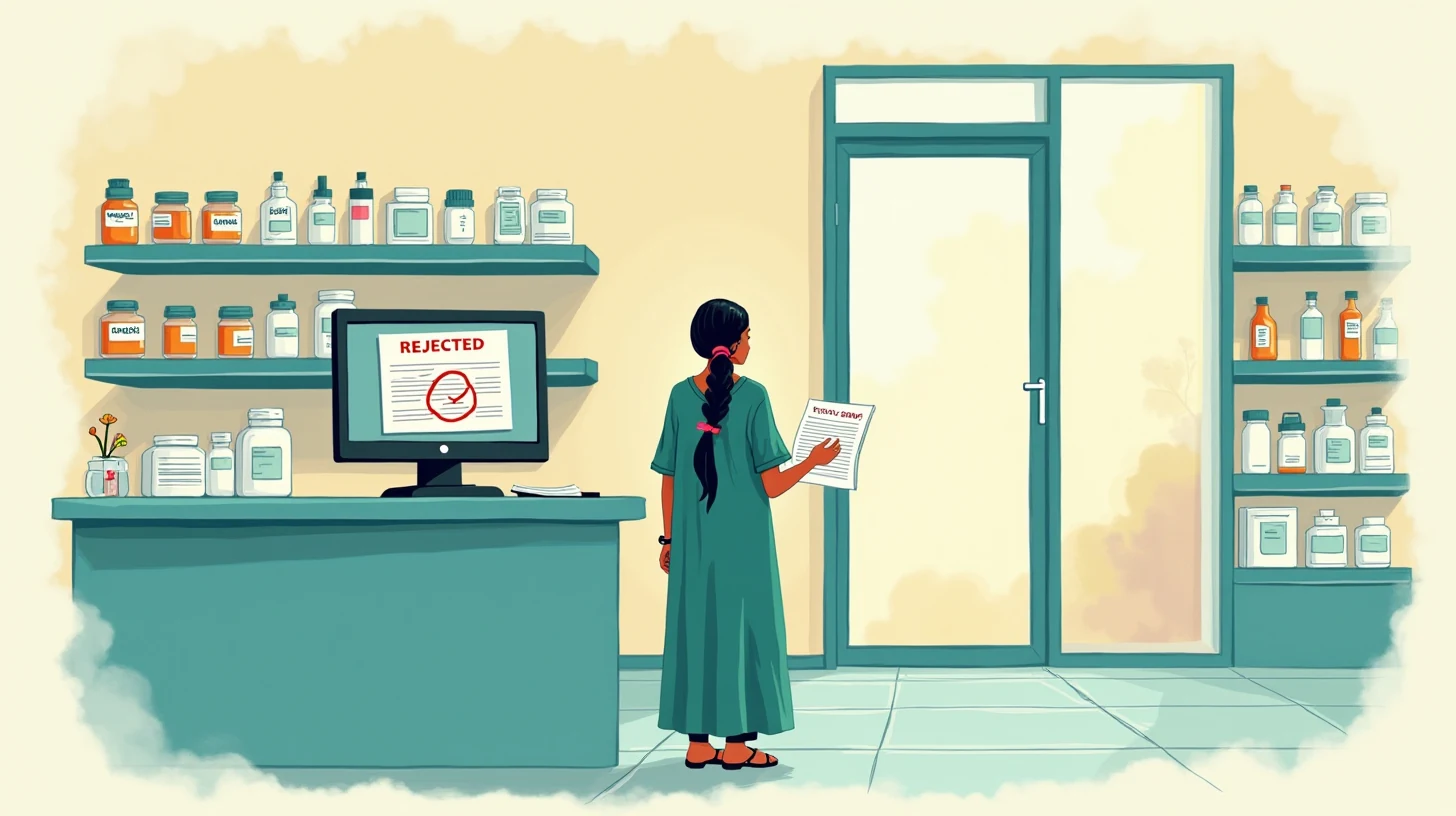
The portal was sleek. Required fields in red. A step-by-step wizard asking for Aadhaar number, GSTIN, pharmacist competency certificate, pharmacy owner's KYC document, bank account details. She uploaded her old Form 20B certificate—the one she had renewed every five years without incident. The system processed. Then, in red text, a rejection:
KYC mismatch. Pharmacist record not found in state database. Upload failed.
Asha stared at the screen. She had been running this shop for twelve years. The Drug Control Office had inspected her. She had never been late on a renewal. Her pharmacist had been working with her for nine years. What was "pharmacist record not found"?
🗓️ How drug licence renewal worked before — and what changed in 2024
Until late 2023, retail drug licences in Andhra Pradesh were renewed via a paper-based, file-based system. The shop owner would submit Form 20B (the renewal form prescribed under the Drugs & Cosmetics Act 1940) at the District Drug Control Office, along with proof of payment (a local bank draft), a copy of the previous licence, and a declaration from the pharmacy's employed or contracted pharmacist confirming that they remained in charge of the pharmacy operations.
That pharmacist declaration—a handwritten or typed letter, often just a few lines—had worked for decades. The Drug Control Office in Vijayawada would receipt the file, schedule a one-day inspection to verify that the medicines on the shelf matched the licenced scope, and approve the renewal within 4–6 weeks. Asha had done this without fail since 2014.
In early 2024, the AP Drug Control Administration rolled out a new digital renewal portal aligned with the Drugs and Cosmetics Act. The goal: faster processing, better transparency, state-level data integrity. No longer would files sit in a cabinet. Every pharmacy owner and pharmacist would have a digital profile. Every document would be uploaded to a central database. KYC (know-your-customer) standards from GST and fintech had arrived in pharmaceutical regulation.
That was good in theory. In practice, the portal required a pharmacist competency certificate in a new format—digitally signed, with the pharmacist's unique state ID, issued after the pharmacist completed an online verification module on the AP Drugs portal itself. Old paper certificates, no matter how legitimate, would be rejected.
Asha's pharmacist, Murali, had never been asked to create a profile on the AP Drugs portal. He had worked for her in person, compliant, never flagged by the Drug Control Office. But he had no digital footprint in the new system. Hence the rejection: "Pharmacist record not found."
The portal, in other words, had no memory of the twelve years of history that the paper system preserved. It only saw the present. And in the present, Asha's pharmacist did not exist.
⚠️ Portal rejection, KYC mismatch error, three visits to the Drug Control Office
Asha printed the rejection notice and took it to the District Drug Control Office in Vijayawada the next day, during her lunch break. The office was on the fourth floor of a government complex, a single counter with two officers and a backlog of fifteen files ahead of her.
"The portal says pharmacist record not found," she told the officer, handing over the printout.
The officer glanced at it without reading it carefully. "Re-upload your Aadhaar. KYC might be fuzzy. Try again."
She went home and re-uploaded her Aadhaar, along with a clean copy of her PAN card. The portal rejected it again, same error code.
Three days later, she returned. A different officer was at the desk.
"The pharmacist certificate," the officer said, not looking up. "You need the new format. Old format doesn't work anymore."
"What new format?" Asha asked.
"The digital format. It should say 'competency certificate' and have a digital signature from the pharmacist. The old paper one—doesn't work." He handed her a printed PDF sheet. It was a one-page guide, dated December 2023, explaining the new format. But it didn't say how to get the certificate or how the pharmacist was supposed to apply for it on the portal.
She asked Murali, her pharmacist, that evening. He had never heard of a digital competency certificate. He had never registered on any AP Drugs portal. "I have my degree certificate," he said. "I've been working for you since 2014. What more do they need?"
A week later, Asha made a third visit to the Drug Control Office, this time with Murali. She had spent the intervening days calling other pharmacy owners in Vijayawada. Most of them hadn't renewed yet—they were waiting, confused, hoping the portal glitches would be fixed. One woman had gone to a pharmacist consultant and paid 2,500 rupees for advice. The consultant had told her the same thing: get the new certificate, but the path to getting it was opaque.
The third officer at the desk—a different one again—spent five minutes explaining to Murali how to register on the AP Drugs portal, create a profile, upload his educational credentials, and then apply for a "competency certificate attestation" which would be digitally signed by a state-designated verifier. The process would take 5–7 working days, the officer said.
Murali nodded. He said he would do it. But he looked uncertain. Asha noticed his fingers trembling slightly as he wrote down the steps on the back of an old receipt.
🌗 A retired pharmacist customer shows Asha a phone
Three days later, a regular customer came in to buy his diabetes medication. Dr. Kiran, a retired district pharmacist who had worked in the AP Drug Control Administration for twenty-three years before retiring in 2019. He came to Asha's shop because her store was close to his house and she knew his dosage by heart.
"How's the renewal going?" he asked, making conversation as Asha counted out his tablets.
Asha found herself venting. The portal, the rejection, the pharmacist certificate, the three visits to the office, Murali's confusion. Dr. Kiran listened carefully.
"Have you heard of GabFORGE?" he asked. He pulled out his phone and opened it. A conversational interface appeared, asking what he needed help with in Telugu. He typed: "AP Drugs portal Form 20B renewal, pharmacist competency certificate, KYC mismatch, what documents needed?"
The agent responded in Telugu, clear and methodical. It explained that the AP Drugs portal rejection was occurring because the pharmacist competency certificate was in the old format. Under the 2024 update, the certificate had to be:
- Applied for by the pharmacist on the AP Drugs portal itself (via a "Competency Certificate Attestation" form)
- Digitally signed by a state-designated verifier
- Issued in the new AP standard format
The agent also explained that the "pharmacist record not found" error was a downstream symptom: the system couldn't verify the pharmacist's credentials because the pharmacist didn't yet have a state-verified competency certificate in the new system.
The solution was sequential: first, Murali had to get the competency certificate. Then, Asha would upload it to her Form 20B renewal. Then, the renewal would process.
The agent provided the step-by-step navigation for Murali's side of the process, including the exact URL to the Competency Certificate Attestation form on the AP Drugs portal.
Dr. Kiran showed Asha the responses. "This is what you need," he said. "Not guesses. Clear steps."
Asha asked Dr. Kiran to show her how to use GabFORGE. He did. She asked the same question, and the agent responded in Telugu again, this time tailored for a pharmacy owner's perspective rather than a pharmacist's. The agent listed what she needed to do versus what the pharmacist needed to do.
For Asha:
- Do not re-submit Form 20B yet. Wait for the pharmacist to complete his competency certificate.
- Once Murali has the certificate (5–7 working days), download it and upload it to your Form 20B renewal on the AP Drugs portal.
- Your KYC Aadhaar and GSTIN are fine; the rejection was specifically about the pharmacist's credentials, not yours.
- Once uploaded, the renewal should process within 10 working days.
For Murali (which the agent explained so Asha could tell him):
- Go to https://apdrugs.ap.gov.in and log in with your pharmacist registration number (or phone number + OTP).
- Navigate to "Competency Certificate Attestation" under the Renewals section.
- Upload your educational degree certificate (or mark-sheet).
- The system will send it for digital verification. A state verifier will review and sign it within 5–7 working days.
- Once signed, download the digitally signed competency certificate.
- Give it to Asha, who will upload it to her Form 20B renewal.
The agent also provided a separate note: "If Murali's pharmacist registration number is not in the system, he may need to first register as a pharmacist on the AP Drugs portal. This is a one-time step."
Asha went home and called Murali. She read him the steps from her phone. This time, they made sense. Murali had a clear path. The next morning, he registered on the AP Drugs portal. By afternoon, he had uploaded his degree certificate to the Competency Certificate Attestation form.
The state verifier signed and issued the digitally signed competency certificate within four working days—faster than expected, perhaps because the backlog of pending pharmacists was still clearing.
Murali forwarded the PDF to Asha. She downloaded it, logged into the AP Drugs portal renewal section, and uploaded it to her Form 20B renewal on a Friday morning.
The system acknowledged the upload. No error. The form now showed "Under Review" instead of "Rejected."
Ten working days later, on a Tuesday, the portal sent her an approval notification. Her retail drug licence was renewed for five years. She could print the new certificate immediately.
🧭 Thousands of independent pharmacies in AP facing the same portal migration
Asha's problem was not unusual. Across Andhra Pradesh, hundreds of independent pharmacy owners were experiencing the same rejection in June and July 2024. The Drug Control Administration had migrated the entire renewal system to digital in one swift change, but the communication to pharmacists had been minimal. Most pharmacists didn't know they needed to register and apply for a competency certificate first.
The Drug Control Office had become a bottleneck. Owners lined up at the counter with printed rejection notices, asking the same questions Asha had asked. The officers, following a new protocol they themselves were still learning, gave inconsistent guidance. Some told owners to re-upload documents. Some told them to wait for a pharmacist certificate. None had a comprehensive answer.
The problem revealed a deeper translation gap: the paper system had trusted human relationships. A pharmacist worked in a shop for years; the Drug Control Office knew the arrangement through inspection reports and personal familiarity. The digital system, by contrast, required formal credentials in a specific format, registered in a central database, before it would acknowledge the arrangement's legitimacy.
A shop owner with twelve years of flawless history meant nothing to a database that had never been told about those twelve years. The system didn't know Murali had ever existed until he registered and uploaded a competency certificate.
This gap was fixable—as Asha's case showed—but only if the owner understood what was required and the sequence in which it had to happen. The Drug Control Office, caught between an old system's wisdom and a new system's inflexibility, couldn't articulate that sequence clearly.
An agent could. Because an agent could explain both the old and new systems, understand the mapping between them, and provide a step-by-step path that honored both the history and the new requirements.
What it does
What it does not do
"పన్నెండు సంవత్సరాలు లైసెన్సు తిరస్కరణ లేదు. కొత్త పోర్టల్ వచ్చింది, పాత పత్రాలు చెల్లవు అన్నారు."— Twelve years, no licence rejection. The new portal came, and they said the old documents don't count.
"అమ్మా, AP Drugs portal లో reject కావడానికి కారణం pharmacist competency certificate — 2024 తర్వాత కొత్త format కావాలి, digital signature తో. పాత format accept కాదు. మీ pharmacist దగ్గర నుండి కొత్త format certificate తీసుకోండి, portal లో upload చేయండి — 10 working days లో approve అవుతుంది."
(The reason for rejection on the AP Drugs portal is the pharmacist competency certificate — after 2024 a new format is required, with digital signature. Old format is not accepted. Get the new format certificate from your pharmacist, upload to the portal — it will be approved in 10 working days.)
🌱 Licence renewed, margins redrawn, and a path forward
Asha framed her new retail drug licence certificate and hung it next to the old one on the wall behind the counter. It had a hologram now, a security feature the old one lacked. The date stamped on it was five years forward: renewal wouldn't be due until 2029.
But something else had changed. During one of her conversations with GabFORGE—using the agent to research what else might improve her shop—she learned about the Pradhan Mantri Bharatiya Janaushadhi Pariyojana (PMBJP), a government scheme to promote generic medicines through empanelled Janaushadhi Kendras.
The margins on branded medicines in her shop were tight—typically 15–20% after GST—because customers often came in with prescriptions from local doctors who wrote brand names. She had to stock them or lose the customer. But generic medicines, sold under the PMBJP scheme, carried much better margins and attracted a new customer segment: the price-conscious, informed buyer who wanted quality generics at half the branded price.
The PMBJP empanelment came with a list of requirements: separate stock shelves for generic medicines, additional staff training (which Murali could provide), a digital bill counter, and a 30–50 rupee registration fee to the government. The scheme's portal would provide her with a list of about 1,500 approved generic medicines that she could stock, sourced from PMBJP-listed manufacturers.
Asha asked GabFORGE about the eligibility and application process. The agent provided a checklist in Telugu, itemizing every requirement and the exact steps to apply on the PMBJP portal (https://janaushadhi.gov.in). Because Asha's retail drug licence was now renewed and in good standing, she was eligible.
She filed the PMBJP empanelment application that same week, attaching her new drug licence certificate as proof. The application was approved within two weeks. A month later, her medical store became an official PM Janaushadhi Kendra.
She carved out a shelf with a blue label—the PMBJP brand colors—and stocked fifty generic medicines to start: generic paracetamol, ibuprofen, metformin, lisinopril, sertraline, and others. Within a month, generics accounted for 8% of her sales. Within three months, 18%.
The margin on a 10-tablet strip of generic paracetamol (60 rupees) was nearly 12 rupees. The same strip of a branded equivalent (120 rupees) carried a margin of only 18–20 rupees. But the volume on generics was higher—more walk-in customers, more prescriptions from younger doctors recommending generics. By the end of the quarter, the incremental profit from generics had exceeded the cost of the empanelment.
More importantly, Asha's shop had evolved. It was no longer just a retail pharmacy serving a neighborhood. It was now a government-empanelled channel for affordable medicines, certified by two separate digital systems (the new AP Drugs portal and the PMBJP network), and recognized as such by the customers who came in.
She still renewed her licence on time. But the system that checked on her now was not a single officer with an inspection clipboard. It was a distributed network of digital records, pharmacist credentials, and government empanelments, all of which she could navigate because she had learned to read the new language—the language the portal spoke.
And the next time the system changed, she knew where to turn. Not to the Drug Control Office counter, where guidance was inconsistent. But to an agent that could explain the old and new systems in Telugu, in sequence, with the clarity of someone who had seen this migration from many angles.
Twelve years of trust, rendered digital. A certificate that now lived in the cloud. And a shop owner who had learned, at forty-two, that the future of compliance was not about fighting bureaucracy—it was about understanding the portal's logic and walking through it, one step at a time.