
The Agartala Bamboo Craftsperson and the PM Vishwakarma Barrier
Debajit's hands know the bend and memory of bamboo the way most people know their own names. At forty-two, he has spent three decades splitting, soaking, and weaving Rignai cane—the traditional Tripuri craft that turns thin bamboo strips into baskets, mats, and furniture with a texture and lightness no machine can replicate. His workshop sits on the edge of Agartala, where the city tapers into paddy fields and bamboo groves, a ten-by-twelve-foot corrugated-iron room that smells of fresh water and dried plant fiber.
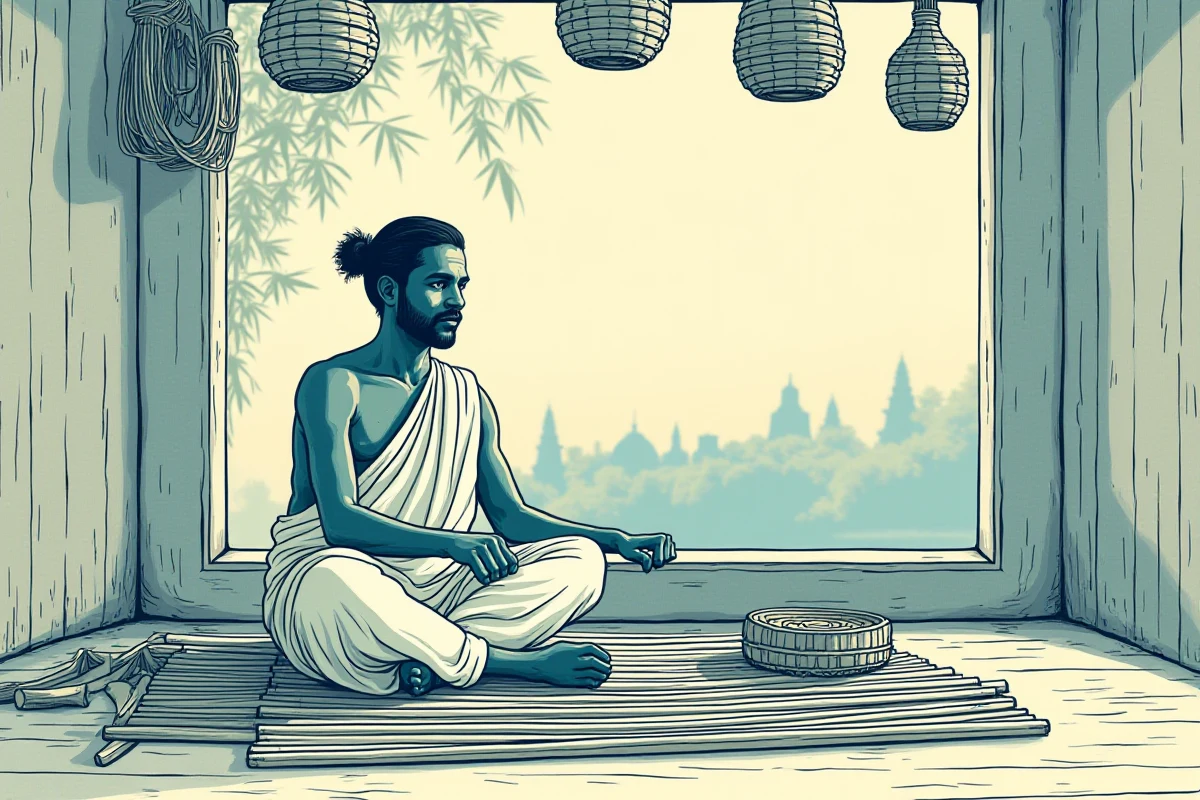
But in the spring of 2025, Debajit found himself stalled not by the difficulty of his craft, but by the architecture of a government portal.
He had heard, through his neighbour who runs a tea shop in town, that there was a new scheme—PM Vishwakarma Yojana—meant for people like him. Fifteen thousand rupees for a toolkit. Three lakh rupees in credit at five percent interest. Insurance. A formal government record that would let him, for the first time in his life, walk into a bank without a guarantor or the shame of being invisible on paper.
So in late April, he set out to apply.
The Problem Nobody Names
The CSC—the Common Service Centre—is technically two kilometres from his workshop. In reality, it lives in another world.
The CSC operator, Ravi, works from a small room in Agartala's commercial district, an area Debajit enters maybe twice a year—for the dentist and to buy industrial equipment. The walk takes him an hour each way through traffic he does not trust on a bicycle. A shared taxi is forty rupees. When he finally arrived at the CSC, Ravi was on leave.
This is not a crisis. Debajit can come back. But the CSC is open 9 to 5, and Debajit works 6 to 4—the pattern of light and his fingers' endurance. Coming back means giving up a day's weaving. A day's weaving, in good season, is three finished small baskets or one large one. A good basket sells for six hundred rupees. So a CSC trip costs him whatever he doesn't make.
When he finally returned—a Saturday, when Ravi was there—he sat down at the desktop and found the form. It was in English and Hindi. Not Bengali. Not Kokborok, the Tripuri language he speaks at home. The form asked for things like "Aadhar number" (he has it), "Bank account IFSC code" (he had to ask Ravi what this meant), and "Annual turnover" (he has never calculated this—he sells baskets, one at a time, mostly to a wholesaler in Agartala who comes by every two weeks).
The digital literacy, Ravi told him later, was fine. Debajit could fill boxes. What was not fine was the leap from his lived experience as a craftsperson to the categories the form demanded.
"It asks for my 'business registration,'" Debajit told me, sitting on a low wooden stool in his workshop, a half-finished basket in his lap. "I have no registration. I am not a business. I am a weaver. My father was a weaver. My son is learning to weave. This is what we are."
The form did not have a box for that.
The Tension That Breaks Silently
By early May, Debajit had filled the form twice—once with Ravi's help, once at home on a borrowed laptop with his nephew, who works in Agartala's ONGC office. The answers shifted slightly each time: annual turnover jumped from two lakh (his guess) to 2.8 lakh (his nephew's calculation, based on Debajit talking through his rhythm of work). The credit application asked if he wanted twenty thousand, one lakh, or three lakh. The difference, he knew, was interest he would owe. A larger loan meant more risk. But the scheme promised 5%, and the local moneylender charges 24%. So maybe three lakh. Maybe one lakh, to be safe.
He did not know.
What Debajit knew was that every Rignai weaver he knew had heard about this scheme. Several had started the form. None had finished it. One older weaver, Ramesh, had given up after the CSC operator said there was a "verification problem"—his Aadhar address didn't match his current workshop location because he had moved two years ago and updated nothing.
Ramesh was sixty-one. He had been weaving for fifty-one years. The bureaucracy said he did not exist where he was, so the scheme could not reach him.
Another, Priya—who is exceptional, selling to boutiques in Delhi through a WhatsApp connection—had completed the form but had been waiting four months for state-level approval. In the meantime, she had taken a loan from her sister at 10% to buy bulk bamboo for a large order. If the PM Vishwakarma approval came through, she would immediately pay back her sister and move the 3 lakh into equipment: a better soaking tank, a mechanical splitter (which would save her son's hands), and working capital to build inventory. But four months of silence is a long time to hold your breath.
The core tension is this: the scheme is real. The credit is real. The problem is real, too. But they do not live on the same map.
Debajit's world is rhythm and repetition and the faces of people he has sold to for twenty years. The bureaucracy's world is data, dates, thresholds, and the logic of formal risk. Neither is wrong. But the bridge between them is so narrow that most people simply do not try to cross.
"মানুষ বলে, এটা সরকারের টাকা। সবাই পাবে। কিন্তু যখন ফর্ম ভরো, তখন বোঝা যায়, এটা তাদের ভাষা। আমাদের ভাষা নয়।"(People say this is government money. Everyone will get it. But when you fill the form, you realize it's their language. Not ours.)
—Debajit, May 2025
What Changed: The Bridge That Started Here
In late May, Debajit's nephew forwarded him a link. GabFORGE was running a pilot—a Bengali-language tool that would help artisans walk through the PM Vishwakarma form, step by step, translating not just words but the categories themselves into what made sense in their lives.
"It asks you questions in Bengali," the message said. "And at the end, it fills the form for you."
Debajit is skeptical of new things. He has seen many schemes come and go. But his nephew promised it would take twenty minutes, and he had nothing to lose except twenty minutes.
They sat down on a Sunday morning, in Debajit's workshop, on the nephew's phone.
The first question was: "What do you make?"
Not "Annual turnover." Not "Business classification." What do you make? He answered: "Rignai baskets. Cane furniture. Mats for prayer."
The second: "How long have you been doing this?"
"Thirty years. My father taught me."
Third: "How many pieces do you finish in a month?"
He thought. "In good season, thirty baskets. In monsoon, maybe ten."
Fourth: "Who buys from you?"
"Mostly one wholesaler in Agartala. Some families from temple visits. Tourists sometimes."
The tool listened. It asked him to confirm his income—did thirty baskets at six hundred rupees sound right?—and he said yes, some months more, some months less. It asked about his bank account, and when he said he had none, it explained the CSC process to link one. It asked about his Aadhar, and he retrieved the number from inside the wooden cupboard where he keeps documents.
Then it translated everything into the form.
It filled "Annual turnover" with the number eighteen lakh (thirty baskets × six hundred rupees × twelve months, averaged). It filled "Business classification" as "Traditional Craft—Rignai Weaving." It marked "Has bank account" as "No, but wishes to open one via CSC." It pulled his Aadhar details directly, matching them to his workshop address.
And crucially, at the end, it showed him everything in Bengali.
"আপনার আবেদনের খসড়া তৈরি হয়েছে। বার্ষিক টার্নওভার দেখাচ্ছে ₹১,৮০,০০০—এটা কি ঠিক আছে? ই-শ্রম নম্বর এখনও নেই, তাই সিএসসি-তে গিয়ে আগে নথিভুক্ত হতে হবে। নথিভুক্তির পরে পিএম বিশ্বকর্মা আবেদনের চূড়ান্ত জমা দেওয়া যাবে। রাজ্য অনুমোদনে ৩০ থেকে ৬০ দিন লাগতে পারে।"
(Your application draft is ready. The annual turnover shows ₹1,80,000 — is that correct? There is no e-SHRAM number yet, so you will need to register at the CSC first. Once registered, the final PM Vishwakarma submission can go through. State approval may take 30 to 60 days.)
"This is what we are sending to the government," the tool said, in Bengali. "Is this correct?"
Debajit read it. For the first time, the words looked like his life.
The tool then gave him a summary: the toolkit subsidy would be fifteen thousand rupees, applied directly to his bank account once it opened. The credit would be three lakh rupees at 5% interest, with a five-year repayment schedule of approximately five thousand rupees per month. He would need to be registered with e-SHRAM (the government's informal worker database) and have an active bank account. It would take forty to sixty days for state approval.
And it gave him instructions: in Bengali, step-by-step, for opening a bank account at the CSC, registering on e-SHRAM, and checking the status of his PM Vishwakarma application online.
All in his language.
His nephew helped him print it, and Debajit walked into town the next Saturday with the papers in a folder. This time, the CSC operator looked at the form and said, "This is good. This is clean. We can file this on Tuesday."
By June 15, Debajit's e-SHRAM profile was live. By July 10, he had a bank account—for the first time in his life. By August 12, his PM Vishwakarma application was approved.
The toolkit subsidy came through in September. The credit became available in October.
The Architecture of Invisibility
The problem that Debajit faced—and that Ramesh and Priya still face—is what bureaucrats call "the last mile." It is the gap between a policy designed in Delhi and a person sitting in a workshop in Agartala, trying to understand if the policy was meant for them.
For Tripura's ten thousand Rignai weavers, bamboo craftspeople, traditional boat builders, and cane furniture makers, the gap is not ignorance. It is language, category, and the exhausting work of translating yourself into a form that was never built for people like you.
PM Vishwakarma was designed by economists looking at India's traditional craft sector. The money is real. The interest rate is generous. The impact—for someone who could access it—would be transformative. But the form assumes you already know what "annual turnover," "business classification," and "credit history" mean. It assumes a relationship with banks. It assumes you can take three days off work to visit a CSC and fill paperwork. It assumes your language is Hindi or English, and your bureaucratic literacy is functional.
Most Tripuri artisans do not meet these assumptions. So they sit with the application half-finished on a CSC desk, or they give up, or they wait four months (like Priya) and lose the season.
This is not a problem with PM Vishwakarma. This is a problem with how we build the bridge between policy and people.
🧭 Why We Built This
GabFORGE's Bengali-language PM Vishwakarma guide started with a simple observation: schemes do not fail because the money isn't there. They fail because the bridge collapses between policy language and lived experience. And that collapse is preventable.
Here's what we built:
1. Language as the First Step
The form is now available in Bengali. Not a machine translation—a human one, with a Bengali-speaking team understanding that "annual turnover" is not a concept most artisans calculate, so we translate it as "How many pieces do you make in a month? What is each worth?" The form asks five simple questions. The tool does the category mapping. The artisan sees the result in their own language.
2. The Translator in Your Pocket
When Debajit looked at the filled form and saw "Annual turnover: 18 lakh" next to "30 baskets × 600 rupees," he could read the logic. The form became transparent. He knew whether it was correct. He could disagree and revise. This is what happens when you translate not just words, but reasoning.
3. One Clear Path Forward
After approval, the tool gives every artisan the next step in Bengali: open a bank account at the CSC (with instructions), register on e-SHRAM (with a link), then check application status online (with the URL). No guessing. No waiting for Ravi to be available. No second-guessing whether "approval" means you've won or you need to do something else.
4. The Social Proof of Completion
When the first fifty artisans in Agartala completed their PM Vishwakarma applications through GabFORGE, other weavers noticed. Debajit told Ramesh. Ramesh told others. Three months later, two hundred more artisans had applied. The barrier dropped not because the scheme changed, but because someone showed that crossing it was possible.
🌱 What We Hope Happens
Debajit used the three-lakh rupee credit to build a second workshop in his compound, hire his son full-time, and buy a mechanical splitter that lets him prepare bamboo strips in a third of the old time. In his first year with the credit, his production increased forty percent. His annual turnover jumped from eighteen lakh to twenty-six lakh. His son now has a future that does not require him to leave Tripura.
This is one weaver, one workshop, one success. But scale it across Tripura's ten thousand eligible artisans—bamboo workers, cane makers, traditional boat builders—and the math becomes real:
- If PM Vishwakarma reaches just 30% of eligible artisans (three thousand people), that is nine crore rupees in direct toolkit and credit investment.
- If even half of those (fifteen hundred) use the credit to add one full-time worker, that is fifteen hundred new jobs in rural Tripura's most stable, heritage-connected sector.
- If those fifteen hundred artisans sell 20% more in their first year, Tripura's traditional craft economy gains fifty crore rupees in new annual turnover.
The math is not magic. It is simply what happens when the barrier—not the money, the barrier—is removed.
But the bigger hope is quieter than numbers: Debajit's son now knows his father's craft is a career. Priya, who waited four months and finally got approved, is opening an online store and teaching other women in her village to weave. Ramesh, whose Aadhar address problem blocked him, went back to the CSC, updated his address, and will reapply next quarter with a tool that will make the form speak Bengali to him.
The scheme was always there. The money was always there. What changed was the bridge.
GabFORGE's Bengali-language tool lives at gabforge.in/pm-vishwakarma-bangla and is free for any artisan in Tripura—or anywhere else in India—to use. We are building similar bridges in Telugu, Tamil, Marathi, and Odia. The principle is the same: translate the bureaucracy into the language of the people it serves.
Because a policy that only reaches people who already know how to read bureaucracy is not a policy for everyone. It is a policy for the already-connected. And that is not what PM Vishwakarma was designed to be.
Related Schemes & Resources:
- PM Vishwakarma Yojana: pmvishwakarma.gov.in — Registration, toolkit subsidy, credit, training, superannuation. Covers 18 eligible traditional trades.
- Tripura BOCW Board: bocw.tripura.gov.in — Construction worker registration, accident benefit, education allowance, housing loan. Complements PM Vishwakarma for trades like electricians and masons.
- e-SHRAM Portal: eshram.gov.in — Register as informal worker, get government employment record, link to social security schemes. Required for PM Vishwakarma.
- MUDRA Yojana: mudra.org.in — Micro-enterprise loans up to ₹10 lakh. Scales beyond PM Vishwakarma's ₹3 lakh if you want to grow faster.
- Tripura TWIC (Industrial Development): twic.gov.in — Industrial park incubation for small service contractors.
For Bamboo & Cane Artisans:
- Rubber Board: rubberboard.org — Also supports natural fibre crafts; training and market linkages.
- Tripura Artisan Cooperative: Contact via Tripura State Handicrafts Development Corporation for collective marketing.
Have you applied for PM Vishwakarma and hit a barrier? Have you used GabFORGE's tool? Tell us your story at [email protected]. We are building the next bridge based on the walls our community hits first.