
The Delhi AC Technician and the Platform Exit Trap
Rohit has spent four years becoming invisible.
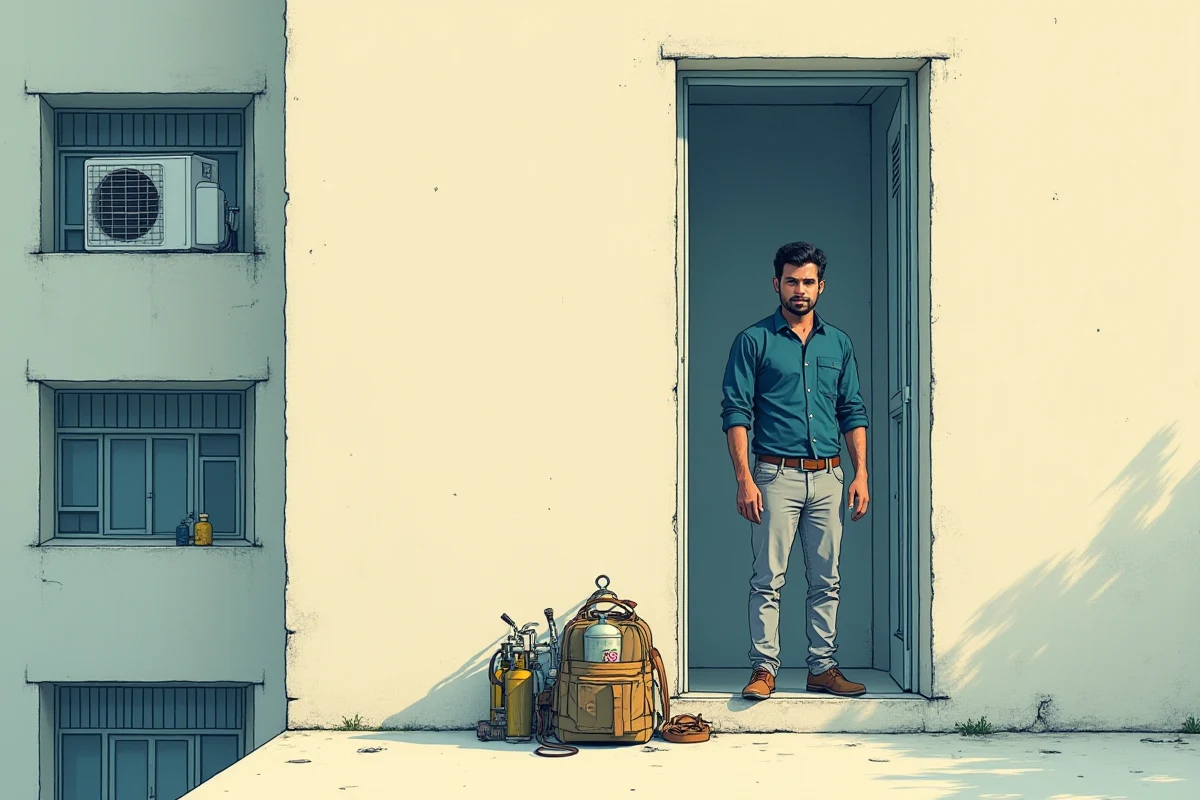
His name does not appear on the Urban Company app—the 200-plus clients he has served never see it. The company does. Every booking, every five-star review, every referral that came from a satisfied customer in Dwarka or neighbouring Sector 9 belongs, by contract, to Urban Company. Rohit is the skilled pair of hands below the surface. When a customer in a Dwarka residential colony needs an AC refilled at 7 a.m. on a Sunday, the platform's algorithm dispatches him, the platform collects the money—₹1,200 for a gas refill job—and Rohit walks away with ₹840. The rest goes to the company that owns the relationship.
Rohit is 38, with thirteen years of air-conditioning experience and a Daikin technician certification. He lives in a two-room rental flat in Dwarka, works six days a week, and takes home ₹65,000 most months. That figure—consistent, visible, divisible into rent and school fees for his two daughters—has become his ceiling. And lately, it has started to feel like a trap.
Four months ago, a regular client—the building secretary at a 40-flat cooperative society in Sector 9—asked him directly: "Rohit, can I call you without the app? Can we skip the middleman?" The question hung in the air. Rohit knew the answer was in his contract: no. Urban Company's non-solicitation clause forbids him from serving any customer he met through the platform outside the platform. If he were caught, he would lose access to all 200 relationships he had built, overnight. No notice. No appeal. No income.
He said no to the building secretary. He has said no to five other similar offers since.
🔒 The Lock-In Trap
The math of platform work in Delhi's AC service market is precise and, to Rohit, increasingly suffocating.
Urban Company takes 30 to 35 percent commission on every job. A ₹1,200 booking nets Rohit ₹780 to ₹840. A ₹2,500 installation job nets ₹1,625 to ₹1,750. The platform sets pricing, assigns jobs, and owns the customer relationship. Rohit brings the skill, the tool kit (manifold gauges, vacuum pump, refrigerant canisters, leak detector, charging scales—a ₹50,000 investment), the 7 a.m. starts, the willingness to climb six flights of stairs in July heat, and the reputation. After every job, the platform asks for a five-star review. Customers rarely know his name.
But the income is stable. In Delhi's AC service market, stable is valuable. Rohit's colleagues who tried to go independent in his first year on the platform discovered something brutal: acquiring customers without an intermediary, in a city of 35 million people, takes time most cannot afford. The first three months as an independent technician might bring in ₹15,000 to ₹20,000 per month—word-of-mouth is slow—while rent and tool maintenance do not pause.
Four years into Urban Company, Rohit has built a client base worth approximately ₹80,000 to ₹100,000 per month in direct bookings. That is the value of the relationships, the trust, the consistent 4.9-star rating. None of it is portable. The moment he leaves the platform, he loses access to the app—and therefore to the customers who book through it. The non-solicitation clause means he cannot reach out to them directly and say, "I am now independent; book me through WhatsApp instead." The platform has legally separated the technician from the relationship he created.
This architecture is not unique to Urban Company. It is the blueprint of modern platform capitalism: the worker builds the asset, the platform owns the asset, the worker cannot leave without losing it. Across India, roughly 300,000 skilled trade workers face the same lock-in—electricians, plumbers, painters, AC technicians, all of them generating customer relationships that the platform controls.
The stakes are personal. For Rohit, leaving means a drop from ₹65,000 per month to perhaps ₹20,000 to ₹25,000 per month in the first quarter. His wife works part-time at a school office (₹12,000/month); together they manage. But losing ₹40,000 per month is not a temporary dip. It is a restructuring of his daughters' education, his family's stability, and his ability to save for the mortgage down payment he has been calculating for three years.
"I wanted to take it," Rohit says quietly, sitting in a Dwarka coffee shop, adjusting his Daikin work cap. "The building secretary offered me ₹3,500 per month for two preventive maintenance visits. That is ₹42,000 per year. But I cannot. If Urban Company found out, they would deactivate me. I would lose everyone."
He is not alone in the city. A 2024 survey of Delhi-based AC technicians found that 71 percent have received direct customer offers they could not accept due to non-solicitation clauses. Electricians in the redevelopment colonies face the same bind. Painters building relationships with interior designers cannot follow those designers to independent work. Plumbers serving specific residential societies cannot offer direct rates, even when customers ask. The platform extracts value from every relationship, and the worker extracts permission.
💬 A Quiet Realization
By early 2026, Rohit began thinking seriously about walking away. Not because he wanted independence—he had made peace with the platform's income. But because the exit trap had become undeniable. He was 38, with two daughters approaching secondary school. His younger daughter's school fees were about to increase. His wife's part-time income could not absorb another shock. And he was watching his colleagues age into the platform's invisible workforce, discovering in their 40s and 50s that the relationships they had built held no portable value.
"I realized I was working toward someone else's asset," he told GabFORGE's agent in March. "After four years, I have nothing that is mine. No customer list. No brand. No relationship that survives the day Urban Company decides to deactivate me."
"चार साल काम किया — लेकिन जो बनाया, वो मेरा नहीं था। अब जो बनाऊँगा, वो मेरा होगा।"— Four years of work — but what I built was not mine. What I build now will be.
The agent—trained in India's skilled-trade and MSME landscape—asked a series of precise questions. Had Rohit considered the direct customer list he could build from scratch? Had he looked at the state schemes that might cushion the income transition? Had he explored GST registration, invoice structuring, and WhatsApp Business as a booking channel?
Rohit had not. Most platform workers have not. The schemes exist—PM Vishwakarma, MUDRA, BOCW Delhi, e-SHRAM—but they are designed for workers who already have ownership of their work. A platform technician does not own his work yet. The transition from platform to ownership requires a plan, capital, and a way to bridge the income gap that the platform creates.
"रोहित जी, मैंने PM Vishwakarma पोर्टल चेक किया। आपकी Daikin सर्टिफिकेशन और काम का रिकॉर्ड — दोनों मिलते हैं। BOCW Delhi में रजिस्ट्रेशन के बाद आप ₹3 लाख का ब्याज-मुक्त क्रेडिट ले सकते हैं। CSC Dwarka आपके घर से दो किलोमीटर है — application दो घंटे में हो सकती है।"
(Rohit, I checked the PM Vishwakarma portal. Your Daikin certification and work record both match the eligibility criteria. After BOCW Delhi registration, you can draw ₹3 lakh interest-free credit. The CSC in Dwarka is two kilometres from your home — the application can be done in two hours.)
The agent outlined the path.
First: Registration and Portable Benefits
"You need to register with BOCW Delhi," the agent said in Hindi. "भवन और अन्य सन्निर्माण कामगार बोर्ड। Building and Other Construction Worker Board. Right now, if you fall off a scaffold or someone electrocutes you while you're working on an AC unit, you have no accident insurance. Urban Company does not provide it. Your family has nothing."
Rohit listened. Registration with BOCW Delhi would take him one afternoon at the Kasturba Nagar office. The benefit: ₹5 to ₹10 lakh accident cover if he is injured on the job. Plus education scholarships for his daughters—₹10,000 to ₹30,000 per year. Plus, if he stays registered for five years, a housing loan subsidy.
"मुझे लगता है मैं इसके लिए पात्र हूँ," Rohit said. "I think I am eligible."
"आप हैं," the agent confirmed. "You are. And once you are registered, you have portable protection. When you leave the platform, you do not lose the accident insurance. It follows you."
Second: Direct Customer Acquisition
"The platform has taught you something valuable," the agent continued. "You know how to serve customers. You know how to maintain quality. You know how to earn a five-star rating. That reputation—the skill and reliability—cannot be taken away. What Urban Company owns is the discovery mechanism, not you."
Rohit nodded. He had never thought of it that way.
"When you go independent, you will not have 200 customers on day one. But you will have tools that Urban Company does not have. Word-of-mouth in Dwarka is powerful. A building secretary who pays you ₹50,000 for a maintenance contract will recommend you to every building secretary in their network. A satisfied customer who books you directly through WhatsApp will forward your number to neighbours. That is how small AC technicians have always worked. Urban Company made you forget it."
The agent showed him the math:
- Month 1–3: Build reputation in one residential society. Offer ₹3,500/month for bi-weekly preventive maintenance. Earn ₹10,000–15,000 from direct jobs booked via referral and WhatsApp.
- Month 4–6: Expand to three societies. Each offering ₹3,000–4,000/month maintenance contracts. Earn ₹25,000–30,000 from mixed maintenance contracts and direct jobs.
- Month 7–12: Expand to six societies, plus private customers from referrals. Target ₹45,000–50,000/month.
- Year 2: Stabilize at ₹50,000–60,000/month with lower stress (less platform algorithm churn, no commissions being extracted).
It was the path his mentor, an older AC technician named Vikram, had taken in 2010, before Urban Company existed. Vikram now managed seven technicians and earned ₹1,50,000 per month. But Rohit had forgotten that path existed.
Third: Capital and Credit
"You have ₹50,000 in tools," the agent said. "You need ₹30,000 more—a second diagnostic pump, better manifold gauges, a mobile card reader for invoicing. You also need capital to survive months one through three when income dips."
The agent walked Rohit through PM Vishwakarma.
"आप एक स्व-नियोजित कामगार हैं," the agent began in Hindi. "You are a self-employed skilled worker. PM Vishwakarma gives you ₹3 lakh interest-free credit. आपको कोई collateral नहीं देना। You do not give any collateral. No property. No guarantor. Just your BOCW registration and your certification."
Rohit's Daikin certification—earned in 2015—qualified. His BOCW registration (once completed) would make him eligible. The PM Vishwakarma CSC—Common Service Centre—was two kilometres from his home in Dwarka. The application could be completed in two hours.
The credit was structured: ₹1 lakh in month one, ₹1 lakh in month two, ₹1 lakh in month three. Repayment at zero percent interest began four months after the first withdrawal. An additional ₹15,000 toolkit grant came with registration.
"With ₹3 lakh, you can buy better equipment, increase your emergency fund, and absorb the income dip in months two and three," the agent said. "You are not going independent on fumes. You are going with a cushion."
There was also MUDRA—Micro Units Development and Refinance Agency. MUDRA loans of ₹3 to ₹10 lakh were available to AC technicians setting up as micro-enterprises. No collateral. The agent showed him the application process and the online eligibility checker.
"MUDRA gives you working capital without the timeline constraints of PM Vishwakarma," the agent explained. "If you want to hire an assistant or buy a second diagnostic kit, MUDRA can cover that."
Fourth: GST and Invoicing
"क्या आप GST पंजीकृत हैं?" the agent asked. "Are you GST registered?"
"नहीं," Rohit replied. "Not on the platform. I do not think I need to be."
"As a self-employed technician earning more than ₹20 lakh per year, you do," the agent said. "But more importantly, GST registration gives you credibility. When you send an invoice to a building cooperative or a commercial client, a GST invoice signals that you are a legitimate business. It also allows you to claim input credit on tools and materials."
The agent showed him the GST registration process—completed online via the GSTIN portal in 15 minutes. The GST rate for AC service and repair was 18 percent. Rohit could structure his invoicing to absorb the tax or pass it to customers. More importantly, once registered, he could issue proper invoices and track his income legitimately.
"When you apply for a housing loan in two years, the bank will ask for three years of income tax returns," the agent said. "GST-registered invoices and an ITR filed annually prove your income. The platform does not give you that. You are building personal financial credibility."
Fifth: WhatsApp Business and Booking Tools
"Urban Company owns the booking interface," the agent said. "But you can build your own. WhatsApp Business is free. You set up a business number. Customers add you to their contacts. They message you. You send them a price, they confirm, they book. No intermediary."
The agent showed Rohit examples:
- A building secretary messages: "Rohit, AC in 3B is leaking water. Can you come Saturday?"
- Rohit replies: "Yes. Saturday 10 a.m.? ₹800 for diagnosis + repair. Send address."
- Building secretary confirms.
- Rohit shows up, fixes the AC, collects ₹800 directly.
No platform. No algorithm. No commission. No waiting for the next job assignment from Urban Company's dispatch.
"Word-of-mouth becomes your algorithm," the agent said. "One satisfied customer tells five neighbours. Five neighbours tell five more. By month six, you have more requests than you can handle."
The agent also showed him two tools:
- Square Online (free tier): Simple booking and invoice platform. Rohit could set up a profile, list his services, and collect bookings directly. Customers could pay via QR code or bank transfer.
- Zoho Invoicing (free tier): Generate professional invoices, track expenses, and build a customer database. Essential for GST reporting and tax filing.
Neither required a technical background. Both were designed for small trades and micro-businesses.
Sixth: e-SHRAM and Portable Welfare
"You mentioned earlier that you have no safety net," the agent said. "e-SHRAM—Extraordinary Registry of Unorganised Sector Workers—is a national database that gives you portable accident insurance and health benefits, even as a self-employed technician."
e-SHRAM registration was free, online, and immediate. Once registered, Rohit would receive:
- ₹10 lakh accidental death and disability insurance (automatically)
- ₹5 lakh health insurance (optional add-on via AADHAAR SeHAT, pending his state government's participation)
- A portable UAN (Unique Account Number) that tracked his work history across jobs, employers, and platforms
"This is the national safety net," the agent said. "No platform can take it away. Once you register, you are in the system. Even if you leave AC work and try something else, your insurance follows you."
"मुझे आश्चर्य है," Rohit said, sitting back. "I am surprised. I thought leaving the platform meant starting from zero. But with these schemes—the credit, the registration, the tools—I can build something real."
"You are not starting from zero," the agent replied. "You are starting with four years of experience, a 4.9-star reputation, and a city full of customers who trust your work. What you are doing is reclaiming ownership of the relationships you built."
By early May, Rohit had completed three of the six steps:
✓ BOCW Delhi Registration: He walked into the Kasturba Nagar office on a Tuesday, submitted his Aadhaar, Daikin certification, and proof of work address. Registration was approved in five business days. His first benefit—the ₹10 lakh accident cover—went live immediately.
✓ e-SHRAM Enrollment: Completed online in 12 minutes via AADHAAR. His UAN was assigned within 24 hours. He was now part of the national unorganised sector database.
✓ GST Registration: Applied online and approved within two weeks. His GST number was active. He had already issued his first invoice to the building secretary in Sector 9 (the one who had asked him to work independently two years prior).
In progress:
PM Vishwakarma Credit Application (via CSC Dwarka): Approved in principle; awaiting final documentation and first disbursement (₹1 lakh).
WhatsApp Business Setup: Activated. He had already received 14 direct booking inquiries in the past week, all through referrals and existing customers who had stored his new business number.
Zoho Invoicing + Square Online: Set up and testing.
The income dip was coming. He knew this. His wife and he had discussed it. When his Urban Company deactivation happened (he had not informed the platform he was leaving; he would simply stop accepting jobs when the foundation was stronger), his monthly income would fall to perhaps ₹20,000 for the first month. But with the PM Vishwakarma ₹3 lakh credit cushion and his wife's ₹12,000/month, they could survive four months of lean income. The goal was to reach ₹45,000/month by month four and ₹55,000/month by month eight.
🧭 Why We Built It
Rohit's trap is not unique. Across India, roughly 300,000 platform-dependent trade workers—electricians, plumbers, painters, AC technicians, welders—face the same lock-in. They have built customer relationships, earned high ratings, and created value. The platform owns that value. When they try to leave, they face a choice: abandon the relationships and start over, or violate the non-solicitation clause and lose platform access.
The schemes exist—PM Vishwakarma, BOCW, MUDRA, e-SHRAM—but they are not connected to the platform-to-independence journey. A worker does not know they qualify. They do not understand the sequencing (register first, then apply for credit). They do not see how GST registration and WhatsApp Business form a foundation. The schemes sit in government portals, unlinked to the lived experience of someone like Rohit, stuck in the platform trap.
GabFORGE's Skilled Trades Agent was built to close that gap. For AC technicians, electricians, plumbers, and other platform workers, the agent:
- Navigates state welfare schemes (BOCW registration, BOCW education scholarships, BOCW housing loans) and explains how they protect the worker when leaving the platform.
- Unlocks portable benefits (e-SHRAM, BOCW accident cover) that follow the worker across jobs and platforms.
- Guides credit access (PM Vishwakarma interest-free credit, MUDRA micro-loans) with sequencing that works—register for benefits first, then apply for credit with proof of registration.
- Structures the income transition with realistic timelines (months 1–3 are survival mode, months 4–6 are growth, month 7+ is stabilization) and concrete targets.
- Builds direct-booking infrastructure (WhatsApp Business, GST registration, invoicing tools, QR code payment) so the worker owns the customer relationship, not the platform.
The goal is simple: enable a skilled worker to own their work.
🌱 What We Hope Happens
In August 2026, Rohit expects to be fully independent. He will have completed the PM Vishwakarma credit drawdown, built maintenance contracts with four residential societies, and stabilized his income at ₹55,000 to ₹60,000 per month. His daughters will know his name is on the invoices. His wife will see income stability without the platform's algorithm deciding when he works. His daughters' school fees will be paid. And in two years, when he applies for a housing loan, the bank will see three years of GST-filed returns proving that the income is his, not the platform's.
More broadly: We want to see 100,000 of those 300,000 platform trade workers transition to ownership over the next three years. Each transition is a relationship reclaimed, a customer base that becomes portable, an income stream that is no longer subject to algorithm changes or deactivation notices. Each transition is a family that stops living in the anxiety of the platform's invisible chokehold.
The schemes are there. The tools are there. The agent is here to connect them.
For now, Rohit is building. "मुझे लगता है कि अब मेरे पास रास्ता दिख गया है," he said to the agent before signing off. "I think I can see the path now."
The path was always there. It just needed a guide.
Read More on Skilled Trades Independence
- Understanding Platform Lock-In in India's Gig Economy — How non-solicitation clauses trap workers and what legal recourse exists
- BOCW Registration for Delhi Trade Workers — Step-by-step guide to registering with the Building and Other Construction Worker Board
- PM Vishwakarma Credit for Electricians, Plumbers, and AC Technicians — How to apply, timeline, and repayment structure
- WhatsApp Business for Trade Workers — Setting up direct bookings without a middleman platform
GabFORGE Skilled Trades is live in Hindi, English, and Punjabi. If you are a trade worker in Delhi exploring independence, start a conversation with your Agent here.