
The Dhanbad Welder and the ESIC Gap
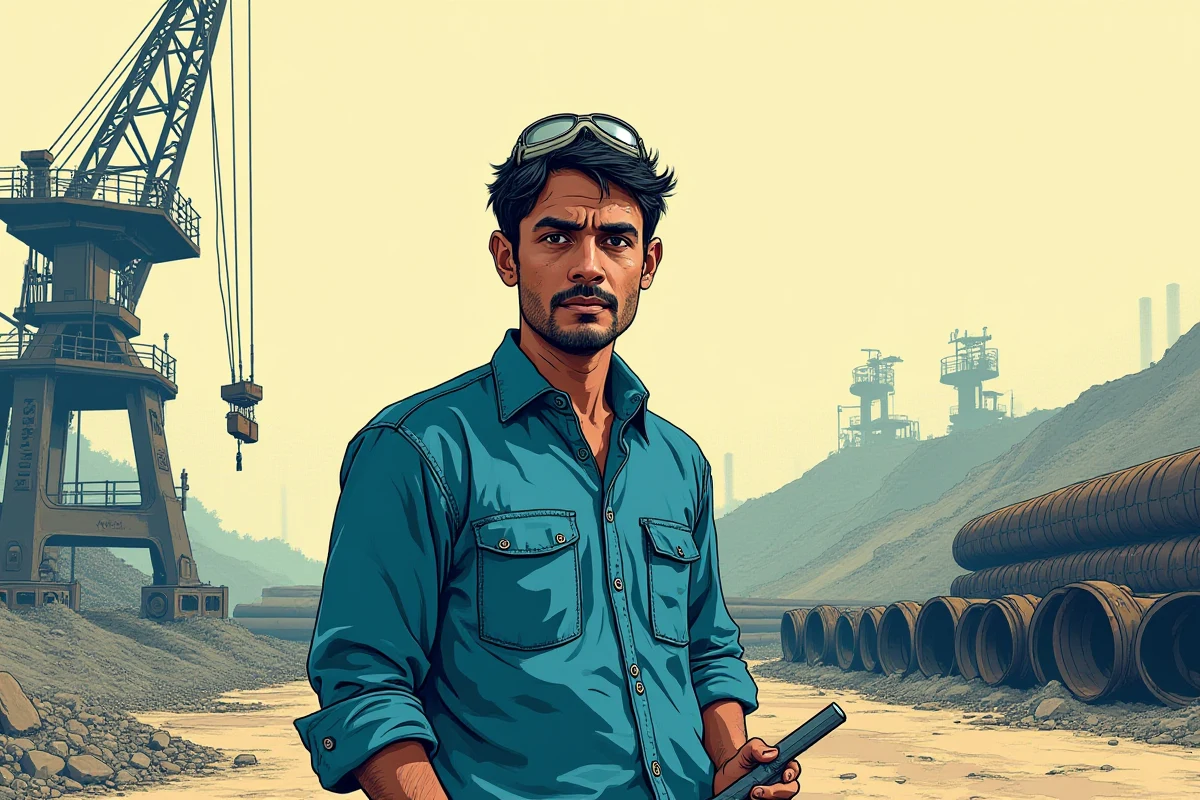
The coal mine equipment yard in Dhanbad smells of hot metal and diesel. By 6 a.m., the workshop is alive—sparks from welding torches painting the dark morning orange, the crack of metal striking metal as machinists align dumper truck frames. Harish has been here four years. He's fast, accurate, and trusted enough to train newer welders. The pay is good: ₹900 a day, sometimes ₹1,000 on 12-hour shifts, which comes to ₹22,000–24,000 a month. In Dhanbad's coal belt, that's enough to rent a two-room flat, send money to his mother in a rural village near Sahibganj, and keep his wife's medical fund topped up.
The Torch and the Blind Spot
But there's a ghost in the factory.
Across the yard work formal employees—electricians and machinists on Tata Steel or coal company payrolls, earning ₹28,000–35,000/month with ESIC (Employees' State Insurance Scheme) cards in their pockets. They wear it like a talisman. One electrician named Ashok once told Harish, "If I get burnt or a cable falls on my leg, the factory pays my hospital bills and gives me compensation. My family doesn't drown." Harish nodded, filed it away. He didn't ask his contractor, Sunil, whether the same covered him.
Sunil is a labour contractor—the middleman between the mine operator and the workers. He subcontracts welding jobs. He pays Harish daily in cash, no paperwork. "Easy for both of us," Sunil had said on day one. "You don't want tax trouble, and I don't want the bureaucracy. Everyone's happy."
Four years passed. Harish never questioned it. He had rent and food. That was the measure of happiness in a coal town.
Then, on a Thursday in March 2025, his friend Kumar came to the yard with bandages on his right arm—second-degree burns from an electric arc flash. Kumar worked three yards over, under a different contractor. Within a week, Harish heard Kumar's name mentioned with relief: his contractor had enrolled him in ESIC. The factory paid 3 days of hospital care. Kumar would get a medical benefit of ₹15,000 and a temporary disability allowance while he healed.
That night, Harish sat in his flat and added up the cost of a hospital visit in Dhanbad. A decent private clinic: ₹3,000–5,000 for a burn assessment and dressing change. Antibiotics and gauze: ₹2,000. If it was bad enough to warrant a week of care—₹15,000 easily. His savings account had ₹8,000 in it.
The math was simple. One accident would erase his family's buffer. One accident, and his mother's blood pressure medicine would stop. His wife's endoscopy—which they'd been saving for—would be postponed indefinitely.
He asked Sunil the next morning: "Do I have ESIC?"
Sunil laughed. "ESIC? Beta, you're a day-wage worker. ESIC is for permanent employees."
"But the factory is registered. It uses ESIC. Everyone here—"
"Everyone here who's on the company payroll," Sunil cut him off. "You're on my contract. I can't afford to enroll you. Costs me ₹500–600 per worker per month in premiums, and I don't have the margin. Find another contractor if you want ESIC."
Harish didn't have the luxury of "finding another contractor." There were dozens of yards in Dhanbad, but they all worked the same way. The coal industry ran on subcontractors and daily wages.
That night, he couldn't sleep.
The Scheme No One Told Him About
Harish's wife, Lakshmi, works as a home health aide. She's more connected to the organized world than he is—she has a mobile phone with internet, a habit of scrolling government websites at lunch. When Harish told her about the ESIC gap, she said: "Let me check something."
Within an hour, she'd found the ESIC website. It had a clear line: If your employer is registered with ESIC, you must be enrolled if you work at least one day in the factory. Below that, a phone number for the ESIC helpline in Dhanbad.
She made a note. The next day was Harish's day off (Sundays were erratic in contract welding, but most weeks had at least one break). He called the number while Lakshmi stood in the kitchen, pretending not to listen.
The voice on the other end was a woman named Priya, an ESIC outreach coordinator based in Dhanbad. She had a patient tone, as if she'd answered this question a hundred times.
"Your contractor is required by law to enroll you if the factory is ESIC-registered and you work regularly there," she said. "It doesn't matter if you're daily-wage or contract. Once you work there, you're covered under the factory's registration."
"So I'm entitled to it?"
"Yes. The factory and contractor both owe you that protection. If you want to pursue it, you can file a complaint with the ESIC office."
Harish felt something shift in his chest—not quite relief, but the beginning of it. He wasn't a ghost. There was a law. He had a name.
Priya gave him the address of the Dhanbad ESIC office and told him what to bring: his Aadhaar, a letter from the factory confirming his employment (or a photograph of the workshop, showing him at work), and a simple written complaint describing his job and his lack of enrollment.
"When you file," she said, "the ESIC office will investigate. They'll contact the factory and the contractor. It usually takes 30–45 days. But you'll be covered retroactively from the first day you worked there."
Retroactively. That word lingered. Four years of invisible coverage, waiting to be claimed.
:::infographic Timeline: The ESIC Maze and When It Matters
| Event | What Happens | Timeline |
|---|---|---|
| Day 1: Worker enters registered factory | Employer is LEGALLY REQUIRED to enroll worker in ESIC within 15 days, regardless of contract type or wage frequency | 15 days to enroll (law) |
| Weeks 1–4: No enrollment happens | Worker is technically covered under the law, but has no card, no proof, and no way to claim if injured | Invisible coverage |
| Week 5–12: Worker becomes aware | Worker suspects ESIC gap (learns from peer, asks contractor, does online research) | Variable—weeks to years |
| Decision to file complaint | Worker or outreach agent files complaint with ESIC office | Same day |
| ESIC investigation (30–45 days) | ESIC office issues notice to employer/contractor; employer must provide enrollment records or face penalty (₹1,000–5,000 per worker per month of non-compliance) | 30–45 days |
| Enrollment completed or penalty issued | If non-compliant, employer must pay back premiums + penalties; worker retroactively enrolled; coverage activated | Immediate (if compliant) or 15 days (if penalty) |
| Worker claims benefit (medical/accident) | ESIC processes claim under retroactive coverage; medical/disability/cash benefits paid | 7–15 days |
The Filing
Harish prepared his complaint on a Sunday. Lakshmi helped him draft it in Hindi—simple, factual. He described his four years of welding work, his daily wages, the factory's ESIC registration number (which he'd copied from a notice board at the entrance), and his contractor's name. He stated that no ESIC enrollment letter had ever been issued to him, and that when he asked, he was told ESIC didn't apply.
He printed it at a nearby cyber café for ₹20. He also brought a photograph of himself at the workshop, holding his welding torch in front of the yard's gantry crane. The ESIC office was a 15-minute walk from his flat.
The officer who received his complaint was a man named Vikram, perhaps 45, with tired eyes and a folder-stacked desk. He scanned the photo, skimmed the complaint, and nodded.
"This happens all the time," Vikram said. "Contractors think they're not liable if the worker is daily-wage. They're wrong. I'll file this officially." He stamped the complaint and handed Harish a receipt with an application number. "Call me in 45 days. We should have a resolution by then."
Harish walked home feeling oddly light, as if he'd set down a weight he'd been carrying and momentarily forgot it existed.
The Hindi Conversation: Sunil Finds Out
Twenty-eight days later, Harish's contractor, Sunil, arrived at the workshop in an agitated state. He'd received a formal notice from the ESIC office—a demand to provide enrollment records or pay back premiums and penalties.
He found Harish between two welding stations and pulled him aside, his voice low and sharp.
"तुमने मेरे ऊपर ESIC की शिकायत की?" (You filed an ESIC complaint against me?)
Harish didn't flinch. His wife had prepared him for this. "हाँ। मैं कानून के अनुसार ESIC के लिए योग्य हूँ। चार साल से काम कर रहा हूँ।" (Yes. I'm legally entitled to ESIC. I've been working for four years.)
"तुम मेरे के लिए काम करते हो। मैं तुम्हें नहीं बर्दाश्त कर सकता।" (You work for me. I can't afford to cover you.)
"फिर आप कानून तोड़ रहे हो। मेरी जिम्मेदारी नहीं है।" (Then you're breaking the law. That's not my responsibility.)
Sunil's face darkened. For a moment, Harish thought he'd be fired on the spot. Instead, Sunil turned and walked away, muttering something about "इन दिनों के बच्चे" (kids these days).
The next day, the workshop manager—a man named Prakash who reported to the coal company, not Sunil—called a meeting. He was furious, but not at Harish. He tore into Sunil in front of the entire team: "You've been breaking the law for years. Now the ESIC office is breathing down the factory's neck. Get enrolled or I'll find a different contractor."
Within two weeks, Harish received an ESIC card in the post. It had his name, his enrollment number, and a date four years in the past—the day he'd first worked at the factory.
:::pullquote
"मेरे पास अब सुरक्षा है। अगर मेरे साथ कुछ होता है, तो मेरी पत्नी अकेली नहीं पड़ेगी।"
"I have protection now. If something happens to me, my wife won't be left alone."
—Harish, 32, Dhanbad welder
The Ripple
Once Harish's enrollment went through, other workers at the yard began asking questions. A mason named Rajesh, who'd been working contract jobs for six years, filed his own complaint. A carpenter named Vikram did the same. Within three months, fourteen informal workers at that single yard had been retroactively enrolled in ESIC.
One of them—a 28-year-old electrician named Dev—had a pneumatic nail gun accident two months after enrollment. The air gun malfunctioned, driving a nail through his left palm. He spent three days in the hospital, had surgery to remove bone fragments, and faced six weeks of recovery. His ESIC card covered the entire bill: ₹28,000 in medical costs and a temporary disability allowance of ₹12,000.
"If Harish hadn't filed that complaint," Dev said weeks later, his hand still bandaged, "I would have borrowed ₹30,000 from the moneylender. I'd be paying 10% interest for the next two years. Instead, my family didn't lose anything."
Word spread through the coal belt. In Bokaro, a steelworker named Pradeep used the same tactic, filing an ESIC complaint against his contractor. In Jamshedpur, three informal welders at a Tata Steel subcontractor yard did the same. The complaints were simple, but they were lawful and relentless.
What Changed: From Ignorance to Clarity
Harish didn't become an activist. He continued welding, earning ₹22,000–24,000 a month. But something shifted in how he understood his place in the economy.
Before filing his complaint, Harish had accepted that informal work meant informal protection—or no protection at all. He saw the ESIC card in Ashok's pocket and assumed it was a privilege reserved for "permanent" employees. He didn't know that the law said otherwise.
After filing the complaint, he learned three things:
The law covers you even when your employer hides it. ESIC enrollment is not a favor or a perk. It's a legal requirement, retroactive from day one. The factory's registration created an obligation, not an option.
Outreach matters. Without Priya's phone call and explanation, Harish might have accepted Sunil's dismissal. But one conversation with someone trained to explain the rules changed his trajectory.
Individual complaints can create collective safety. Harish's ESIC enrollment wasn't his victory alone. It triggered a chain reaction that covered fourteen workers at one yard, and sparked copycat complaints at other facilities.
In the weeks after his enrollment, Harish began visiting the Dhanbad ESIC office to understand what else he'd missed. Priya connected him with another scheme: e-SHRAM, the national database of unorganised workers. When he called her to ask how to register, she was specific:
"आपका ESIC नंबर मिल गया — अब eshram.gov.in पर जाइए। आधार और मोबाइल नंबर चाहिए, बस। रजिस्ट्रेशन दस मिनट में होती है। आपके चार साल का काम का रिकॉर्ड वहाँ सुरक्षित हो जाएगा — किसी भी सरकारी योजना के लिए काम आएगा।"
(Your ESIC number has come through — now go to eshram.gov.in. You need your Aadhaar and mobile number, nothing else. Registration takes ten minutes. Your four years of work history will be recorded there securely — it will be useful for any government scheme.)
Harish registered his name, his work history, and his phone number. In return, he got a digital ID that proved his four years of informal employment to any future employer or scheme administrator.
He also learned about PM Vishwakarma, a scheme that offers skilled trade workers a ₹10,000 grant and access to MUDRA loans at 5% interest. He didn't immediately apply—his salary was enough—but he bookmarked the portal. "If I ever want to go independent," he told Lakshmi, "I know where the money is."
:::infographic Comparison: Informal vs. Covered
| Scenario | Without ESIC | With ESIC |
|---|---|---|
| Workplace burn (medical, not severe) | Pay ₹3,000–5,000 out-of-pocket; miss 5 days of work; lose ₹4,500 in wages; total cost: ₹9,500 | ESIC covers medical (₹3,000); continues wage replacement for 5 days; total cost to worker: ₹0 |
| Serious accident (hospitalization + surgery) | Borrow ₹25,000–30,000 at 10% monthly interest; spend 2 years repaying ₹45,000+ | ESIC covers hospital; disability allowance ₹12,000; medical benefit ₹15,000; loss: ₹0 |
| Occupational disease (silicosis, after 10 years) | No claim possible; permanent lung damage; cannot work; no income; catastrophic | ESIC covers medical screening; occupational disease benefit ₹1 lakh+ (depending on disability %); medical care ongoing |
| Death of worker | Family left with zero; wife loses sole income; children's education halts | ESIC pays survivor pension + ₹2 lakh funeral benefit; wife receives monthly pension; children's education covered until age 25 |
| Transparency & Proof | No record of work; contractor can deny employment; difficult to claim government schemes | ESIC card + enrolment proof; portable across jobs and states; eligible for BOCW loans, scholarships, other social security schemes |
Why We Built This Story
In Jharkhand, the coal and steel industries create an irony: they generate the highest-paid informal work in the state, yet they produce the largest protection gap. Workers like Harish earn ₹22,000–24,000/month—above the informal average—but they're invisible to the very safety net that law requires.
The ESIC gap isn't a small administrative error. It's a systemic cost-shifting. Contractors save ₹500–600 per worker per month by not enrolling. They pocket that margin. Workers and their families bear the real cost: catastrophic medical debt, lost wages during recovery, and generational poverty triggered by a single accident.
We documented Harish's story because it reveals a fact that surprises most informal workers: the law already covers you. You are not asking for a favor. You are not requesting a new scheme. You are claiming a protection that exists, that your factory registered for, and that your contractor is legally bound to extend to you.
The gap between law and practice isn't a policy failure. It's an information failure. Contractors betting that workers won't know. Workers betting that contractors are honest. And a gap so large that a ₹10,000 accident can undo a year of wages.
Harish closed that gap by asking one question and filing one complaint. Three pieces of information—the ESIC website, a phone number, and the knowledge that retroactive enrollment exists—changed everything.
What We Hope Happens Next
For workers like Harish in Dhanbad, Bokaro, and Jamshedpur:
File a complaint if you're not enrolled. Walk into your nearest ESIC office with a photo of yourself at work and a one-page letter stating your job, your factory's ESIC registration number, and the name of your contractor. File the complaint. You will be enrolled retroactively. The factory will face penalties for non-compliance, not you.
Register on e-SHRAM. It takes 10 minutes on your phone. You'll get a digital ID that proves your work history to future employers, lenders, and government schemes. No cost. No paperwork.
Learn the other schemes. BOCW housing loans, PM Vishwakarma working-capital loans, MUDRA for self-employment—they're designed for you, but they operate on the assumption that you know they exist. They don't.
For contractors and factory managers:
- ESIC enrollment is not optional. The law requires it. Non-compliance costs penalties (₹500–5,000 per worker per month), investigation time, and reputational damage. Enrollment is ₹500–600 per worker per month—a cost of doing business, not a discretionary margin.
For government and outreach organizations:
- One conversation changes everything. Priya's phone call took five minutes. It set Harish on a path to legal enrollment and exposed a contractor breaking the law. Outreach agents, ESIC coordinators, and BOCW field staff should be incentivized to conduct workplace visits and worker interviews—not to investigate violations, but to clarify rights. One phone call can cover fourteen workers.
On GabFORGE.in, we exist to close gaps like this one. We build tools and stories that connect informal workers to the protection the law already promises them. Harish had the right to ESIC on day one. He just didn't know how to claim it.
Now he does. And so can you.
Resources
- ESIC Helpline (Dhanbad office): Look up your state's ESIC office at esic.gov.in. Download the complaint form or file in person.
- e-SHRAM Registration: eshram.gov.in — takes 10 minutes, requires Aadhaar and phone number.
- Jharkhand BOCW Board: bocwjharkhand.nic.in — complementary to ESIC; register for accident insurance, housing loans, and education scholarships.
- PM Vishwakarma: pmvishwakarma.gov.in — skilled trade workers eligible for ₹10,000 grant + MUDRA loan at 5% interest (max ₹1 lakh).
- MUDRA Loans: mudra.org.in — collateral-free small business loans up to ₹10 lakh.
About GabFORGE: We're building tools to help informal workers in India navigate government schemes, file complaints, and claim the protections the law already promises. This article is part of our effort to document real stories of workers navigating the gap between law and practice.