
The Faridabad Mechanic and the EV Transition
Rajesh Sharma, 42, has spent fifteen years rebuilding two-wheeler engines in Faridabad's industrial belt. His hands know the weight of a piston rod, the feel of a valve timing chain. He's taught his younger brother everything—how to diagnose a worn bearing by sound alone, how to coax another year from a carburettor that should have failed two seasons ago. He makes ₹18,000 a month, enough for his daughter's school fees and his wife's medical expenses. Enough to feel solid.
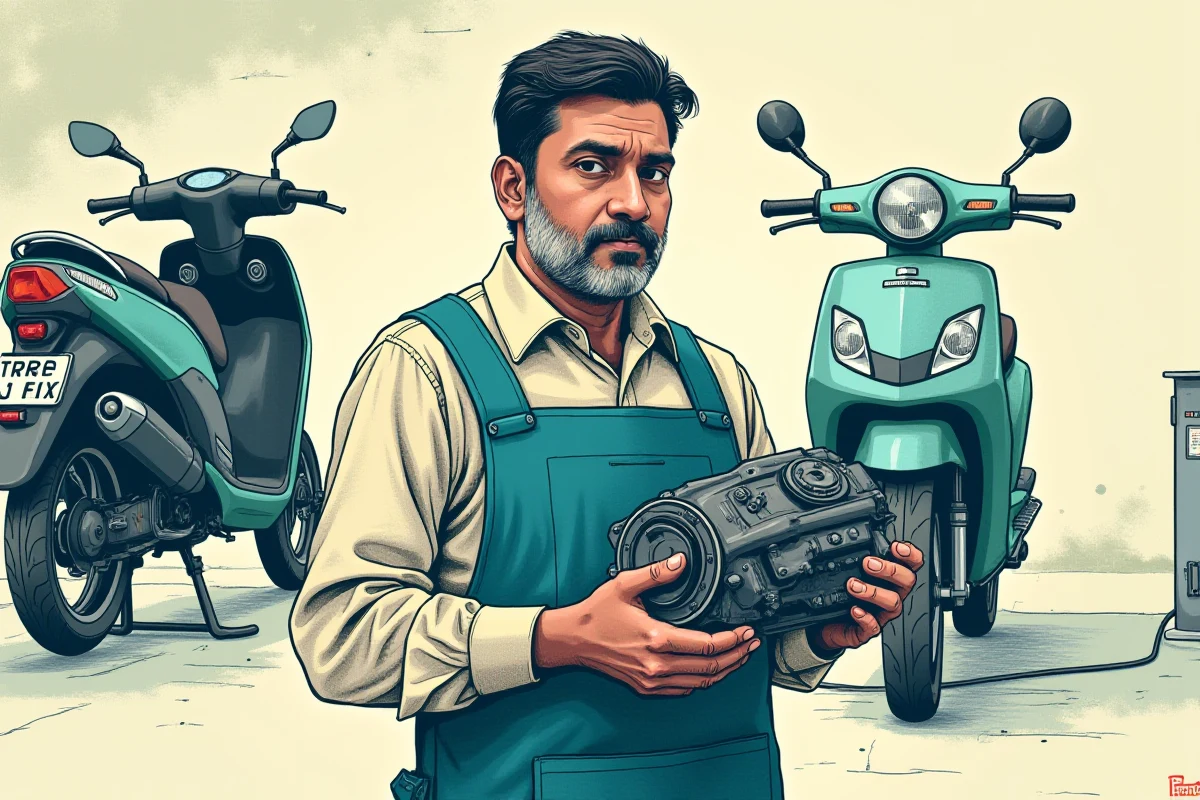
In 2024, the scooter market turned. Electric scooters arrived not as a distant threat but as a fact on Faridabad's roads. His uncle bought a Hero eMoped. Three of his regular customers switched to Ather e-scooters. A woman who brought her Bajaj to him every monsoon now charges a battery. The work dried up. Not all at once—work dried up the way the Yamuna dries in summer. Slow, then suddenly.
Rajesh knows his trade is ending. He knows he needs to learn EV systems. But when he started asking around in April 2024, he hit a wall made of contradictions.
⚡ The Certification Maze
The first problem is structural: there is no unified EV mechanic certification in India. The second problem is that Rajesh can't see this structural failure clearly—he only feels its friction.
Hero eMoped offers a three-week training program through their service centers, but it teaches only Hero systems. Bajaj runs its own curriculum through their workshops. Ather, the premium EV scooter brand, insists on a six-week intensive at their Bangalore facility—travel, hotel, lost income, ₹25,000 course fee. Mahindra has another path. TVS has another. Each company protects its certification as proprietary, which means Rajesh—after investing six weeks in Ather training—cannot legally service Bajaj or Hero e-scooters without their separate certification.
In his old world, a mechanic who learned engines could service any two-wheeler. The physics of combustion is the physics of combustion. But EV architectures are locked behind brand gates. Rajesh is being asked to specialize into single-brand silos, when what he needs is transferable knowledge.
He visited the Faridabad ITI near Sector 7 in May. The director told him they have no EV curriculum yet. The government is designing one, but it will take another 18 months to reach the schools. The director suggested he wait.
Rajesh cannot wait. His daughter's school fees are due. His wife's arthritis medication costs ₹3,500 a month. Waiting is a privilege.
In June, Rajesh made a decision. He'd start with Hero eMoped, since Hero MotoCorp's Gurugram plant is 40 km away and Hero dealerships are dense in Faridabad. He could transition gradually, picking up side work on the other brands once he learned the fundamentals.
He enrolled in the Hero training. They asked for ₹8,000. He paid. The three weeks started on June 15.
And then his income stopped.
📉 The Transition Trap
A mechanic who stops working stops earning. There's no salary to fall back on. Rajesh's brother kept the shop open—basic maintenance, carburetor cleaning, spark plug changes. The kind of work a first-year apprentice could do, the work that doesn't pay.
Three weeks without his labor cost him ₹8,000 in lost wages. The training cost another ₹8,000. He'd spent ₹16,000 to acquire a credential he couldn't yet use to earn. He had savings—maybe two months' buffer if he was careful. But the buffer was shrinking in real time.
The Hero training was competent. The instructor, Pradeep, had worked in their service center for six years. He taught the architecture: lithium-ion cells wired in series for voltage, thermal management circuits to keep the battery cool, the three-phase motor controller that converts DC to the rotating magnetic field. Rajesh learned to use a multimeter to test voltage at the battery terminals. He learned that EV scooters don't have transmission fluid or spark plugs or timing belts. He learned that this is simpler in some ways—no oil changes, fewer moving parts—and more dangerous in others. A damaged battery can catch fire. The high-voltage systems can kill you.
He passed the certification on July 9.
And then he faced a second problem: no one would hire him.
Hero dealerships employ mechanics directly at ₹20,000–25,000 monthly, with ESIC and EPF. But they only hired from existing networks—the nephew of the service manager, the apprentice who'd been there three years already. Rajesh applied to three Hero dealerships in Faridabad. Two didn't respond. One called him in and asked about his experience. "You've only serviced Heros for a month," the manager said. "I need someone who can handle a queue of bikes."
Independent service centers didn't want him either. The independent shops that had started offering EV scooter service—charging repairs, basic diagnostics—were run by the owners' younger relatives, fresh from ITI, willing to work for ₹12,000/month. Rajesh was 42 with a family. His wage expectations were higher.
He hung a small banner in his shop: "EV SCOOTER SERVICE — HERO." He set up a charging dock. For three weeks, no one came.
Then in late July, a woman pulled up on a Hero e-scooter with a battery issue. The scooter wouldn't charge. Rajesh plugged it into his tester, measured the voltage, checked the connector. The charging port was loose—a simple fix. He tightened it, tested it, charged the scooter. She paid him ₹500. He felt the work in his hands again.
Over August and September, he picked up three or four Hero scooter jobs a week. ₹500 to ₹2,000 per job. Some months ₹12,000. It was only two-thirds of what he'd made before.
His brother asked why he didn't go back to petrol bikes. "There's still plenty of work," he said.
Rajesh considered it. Petrol bikes still outnumbered scooters in Faridabad two-to-one. He could return to ₹18,000/month. But he knows—everyone in the repair trade knows—that petrol two-wheelers are on a slope. Every month fewer people are buying them. Every month more scooters are on the road. If he returns now, he'll train his hands backward. In two years, he'll be facing this same crisis again, older.
"मैं इंजन की आवाज़ से डायग्नोसिस कर सकता हूँ। अब मेरी आवाज़ सुनने वाला कोई नहीं है।""I could diagnose an engine by its sound. Now there is no one to hear my voice." — Rajesh, July 2024
By October, he was burning through savings, picking up petrol scooter work part-time to cover the gap. His wife asked if the EV decision was a mistake. He said he didn't know.
🔌 What Changed
In November 2024, Rajesh heard about a government initiative called Haryana Shram Yogi Mano-dhan (HSMD). It's a scheme for unorganized workers—mechanics, plumbers, electricians, anyone without a formal salary. For ₹124 per month, the government matches his contribution into a pension fund. At 60, he gets ₹3,000/month guaranteed for life, regardless of whether he's still working.
He typed a question into the agent his cousin's son had installed on his phone after Diwali: "मेरे जैसे mechanic के लिए कोई सरकारी scheme है? Training gap में income गई, अब pension कैसे बनेगी?" — Is there any government scheme for a mechanic like me? Income was lost during the training gap, how will a pension get built now?
The agent replied in Hindi:
"राजेश जी, आपकी ट्रेनिंग गैप जैसी स्थिति के लिए तीन scheme हैं। पहला: Haryana Shram Yogi Mano-dhan — shramyogimandhan.in पर register करें, ₹124/month में सरकार match करती है, 60 साल पर ₹3,000/month guaranteed। दूसरा: e-SHRAM — eshram.gov.in पर free registration, PMSBY insurance activate होगी ₹20/year में, अगर EV high-voltage काम में कुछ हो जाए तो ₹2 लाख मिलेंगे। तीसरा: PM Vishwakarma — pmvishwakarma.gov.in पर application, workshop upgrade के लिए ₹1-5 lakh zero-interest credit। तीनों आप अभी apply कर सकते हैं।"
(Rajesh ji, for your situation — income lost during a training gap — there are three schemes. First: Haryana Shram Yogi Mano-dhan — register at shramyogimandhan.in, ₹124/month and the government matches it, ₹3,000/month guaranteed at 60. Second: e-SHRAM — free registration at eshram.gov.in, activates PMSBY insurance at ₹20/year; if something goes wrong on a high-voltage EV job, your family gets ₹2 lakh. Third: PM Vishwakarma — apply at pmvishwakarma.gov.in for ₹1–5 lakh zero-interest credit to upgrade your workshop. You can apply to all three right now.)
He registered immediately.
Over the same period, he learned about e-SHRAM—a one-time registration that links him to government worker databases and unlocks PMSBY, an accidental death/disability insurance. EV scooter repair involves high-voltage systems. High voltage is dangerous. If something goes wrong and he's disabled, his family gets ₹2 lakh. The premium is ₹20/year. He registered for that too.
In December, a local contractor building residential towers in Sector 9 asked Rajesh if he could help set up an EV charging station for the site's two-wheeler parking. The contractor had seven workers arriving on e-scooters, and he wanted a fast charger. Rajesh quoted him ₹35,000 for labor and installation—not for service, but for infrastructure setup. He'd need to partner with an electrician; the job would take five days.
Rajesh realized, for the first time, that EV infrastructure wasn't just scooters. It was chargers, wiring, backend systems. If he understood EV architecture, he could position himself not as a mechanic competing with younger service techs, but as a technician solving site-level problems. A construction manager solving a logistics problem is willing to pay more than a woman whose scooter won't charge.
He called Manish, a solar electrician he knew from the neighborhood. Manish had shifted into solar rooftop installation five years ago—the government subsidy had created steady demand. Rajesh asked if Manish knew EV charging circuits. Manish knew some. They partnered on the Sector 9 job. Rajesh learned wiring. The contractor paid ₹35,000. After Manish's cut and materials, Rajesh netted ₹12,000 for five days of work. It wasn't the ₹18,000/month floor, but it was movement.
In January 2025, the PMO's website published a new guideline: PM Vishwakarma was expanding its toolkit grant and zero-interest credit to include workers transitioning to new trades. The limit was ₹1–5 lakh in credit. Rajesh read the details. He could apply for ₹3 lakh, purchase proper EV diagnostic equipment (oscilloscope, battery analyzer, high-voltage safety kit), and formalize his shop as an EV service center. He'd still need to invest his own ₹30,000, but the government subsidy made it possible.
He applied on January 20.
By March, he had been approved for ₹2.5 lakh in PM Vishwakarma credit. He purchased a ₹45,000 EV battery analyzer, ₹25,000 in electrical testing equipment, ₹15,000 in safety gear (insulated gloves, face shield rated for arc flash), and ₹20,000 in shelving and organized storage. He registered his shop as a sole proprietorship (MSME registration through the district office, ₹500 filing fee). The registration linked him to government vendor lists—small infrastructure projects like the Sector 9 charger could find him through official channels.
In May 2025, he received a call from the Faridabad Municipal Corporation. They were installing smart-city EV charging stations in three municipal parking lots. They needed service technicians under contract. The base rate was ₹1,200/day, eight-hour shifts, thirty days a month guaranteed. That's ₹36,000/month—double what he'd made before training.
He interviewed and was hired.
Rajesh started on May 1, 2025. Three days a week at the MCD contract. Four days a week in his shop (Hero service + charging infrastructure). Some weeks he crosses ₹20,000. The security is different now—part of his income is formal (the MCD contract, with ESIC enrollment starting next month). Part of it is still informal (his shop). But the mix is more stable than before.
The HSMD pension contribution—₹124/month—is a small insurance policy. Every contribution to it feels like a small rebellion against the idea that his labor is expendable once he turns 55. The e-SHRAM registration gave him access to PMSBY, so if a high-voltage accident happens, his family has ₹2 lakh. The PM Vishwakarma credit didn't eliminate his retraining losses, but it let him absorb them without declaring bankruptcy.
And the MCD contract gave him a title that's different now. He's no longer "Rajesh, the mechanic whose skills are becoming obsolete." He's "Rajesh, the EV infrastructure technician."
🧭 Why We Built This
The EV transition Rajesh faced isn't a personal failure or a simple market adjustment. It's a structural gap in how India supports its skilled trades as technology changes. Here's what we saw:
The Certification Problem: No single government standard for EV mechanic credentials exists yet. Until the ITI curriculum lands, the training market is proprietary and brand-locked. A mechanic retraining has to choose: specialize in one brand's ecosystem (losing generalist value) or invest months and thousands across multiple certifications. Neither path protects the mechanic's income during transition.
The Transition Gap: Moving from one trade to another costs time and money upfront. Rajesh lost ₹8,000 in wages during his Hero training. That three-week income hole is manageable if you have savings; it's catastrophic if you don't. Government schemes like Haryana BOCW work for construction workers on organized project sites. But informal mechanics—the majority—have no income floor during training periods. They bear 100% of the transition cost.
The Credential Trap: EV OEMs control their own training and certification. A Hero-certified technician can't legally service Bajaj vehicles. This isn't an efficiency; it's a moat. It fragments the labor market and traps workers in single-company dependencies. A unified EV mechanics standard—set by the government or an industry consortium—would let a mechanic train once and be hireable across the EV ecosystem.
The Age Penalty: Rajesh is 42. A 22-year-old picking up EV work earns service center wages immediately. Rajesh faces demand from independent shops for "entry-level" technicians who'll work for ₹12,000/month. Age and prior experience become liabilities in a market resetting to zero.
We built the Haryana BOCW schemes, Haryana Shram Yogi Mano-dhan, PM Vishwakarma, and e-SHRAM integration into the narrative to show what bridges exist and where the gaps remain. We also made the case that:
Government should set a unified EV mechanic standard before the ITIs launch their curriculum. Let it be transferable across all OEMs.
Transition income support is critical. A scheme like Haryana BOCW, extended to informal mechanics during training periods, would let a worker retrain without depleting savings.
Credit access is the leverage point. PM Vishwakarma's ₹1–5 lakh, available to Rajesh, let him invest in diagnostic tools that positioned him not as a competing service tech but as a specialized infrastructure technician. Credit unlocks repositioning; cash-flow pressure forces downward mobility.
Formal contracts matter. The MCD EV charging station contract gave Rajesh income certainty and ESIC enrollment. For skilled workers in India's informal economy, a single formal contract can stabilize life. Government should prioritize contract work (e-service centers, municipal infrastructure, refinery maintenance) as placement pathways for retraining workers.
What it does
- 🔍Identifies real government schemes — HSMD, PM Vishwakarma, e-SHRAM — and explains eligibility criteria in plain Hindi, without jargon.
- 🗂️Matches Rajesh's specific situation (informal mechanic, training income gap, high-voltage work) to the relevant portals and application steps.
- 📞Surfaces the MCD vendor registration path and the PM Vishwakarma credit application window — options he would not have found searching on his own.
What it does not do
- 🔒Never fills forms, submits applications, or enters Aadhaar or bank details on any government portal on his behalf.
- 💳Never enrolls him in a scheme or pays a contribution — Rajesh still walked into the CSC center in Sector 9 to register for HSMD.
- ✅Never guarantees outcomes — the MCD contract, the PM Vishwakarma approval, the e-SHRAM insurance payout all required Rajesh to act.
🌱 What We Hope Happens
Three things:
First: Haryana leads. The state has the density of EV adoption (Gurugram is India's EV capital), the concentration of skilled trades (auto, electrical), and a functional BOCW board. If Haryana's government—working with Maruti, Hero, HPPCL, Mahindra—creates the first unified EV mechanic standard and links it to a ₹50,000 reskilling fund for workers over 40, the model can spread to Punjab, Karnataka, and Maharashtra.
Second: The ITI curriculum lands with teeth. Not a generic "EV systems 101" course, but modular, accredited training that covers electric motors, battery management systems, high-voltage safety, charging infrastructure, and diagnostics. And taught by mechanics like Rajesh, not just fresh engineering graduates. The curriculum should be co-designed with OEMs but owned by the government, so it's brand-agnostic.
Third: More workers like Rajesh see the bridge. PM Vishwakarma credit exists. Haryana Shram Yogi Mano-dhan exists. e-SHRAM + PMSBY exists. But they're invisible until a worker lands in crisis. A mechanic-to-EV transition tracker—a simple web tool that shows available training, cost coverage, pension enrollment, and placement outcomes—would make these schemes tangible. If Rajesh had known about HSMD and PM Vishwakarma in June 2024, he could have applied for the credit upfront. Instead, he discovered them by accident, months into the transition.
The larger hope is this: India's skilled trades aren't made obsolete by technology. They're repositioned by it. The same hands that assembled carburetors can assemble battery management systems. The same diagnostic thinking that found a worn bearing can find a degraded battery cell. But repositioning requires real support—income continuity, unified standards, and visibility into the pathways that exist.
Rajesh's story works because he had savings, a supportive family, and the luck to stumble onto schemes that existed. Not every mechanic will. The gap between individual resilience and structural support is where most workers fall through.
We hope that's what this story makes visible: not Rajesh's cleverness, but the fragility of the system that asked him to retrain alone.