
The Hyderabad Mason and the Delayed Wages Trap
Ravi has not slept well in eight weeks.
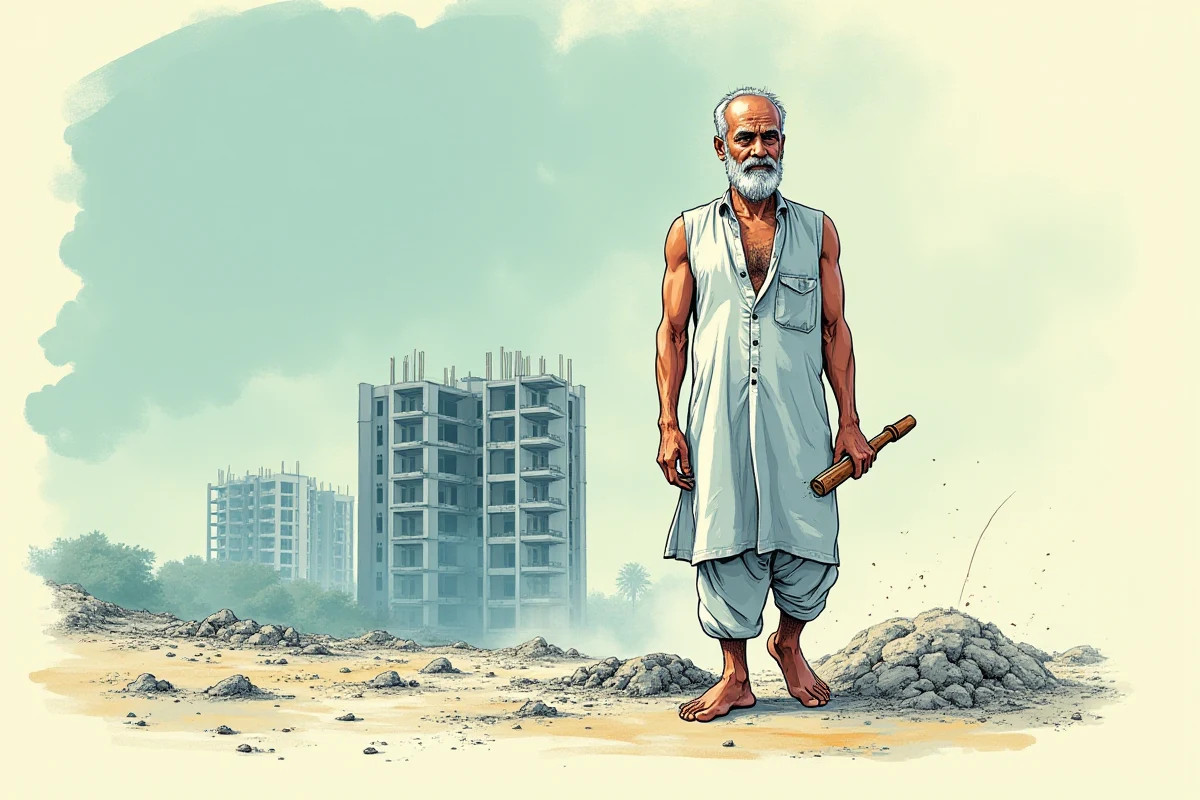
At 42, he has worked as a mason for two decades—since he left his village in Nalgonda district at 22 and walked into Hyderabad with a trowel and a rucksack. Nalgonda, 140 kilometres south of the city, is cotton country. His father farmed cotton on 1.2 acres but sold the land when sugarcane prices crashed in 2010. By then, Ravi had already moved north. He married Anjali, a woman from a weaver's family in Warangal. They have two daughters—Lakshmi, 18, studying for her intermediate exams, and Neha, 14, in tenth standard. His son Arun, 20, works as a helper on construction sites, learning the trade.
For the past fifteen years, Ravi has worked on the Hyderabad boom: first the IT corridor in the 2010s, then the metro construction, then HMDA outer ring road expansion, then the sprawl of residential high-rises that crowd the 10-kilometre arc from Gachibowli to Madhapur. His daily wage has risen from ₹400 in 2005 to ₹1,000 today on formal HMDA contracts—about ₹25,000 a month in steady work. But steady work means eighteen-day months. The other twelve days are monsoon shutdowns, material shortages, or sites in free fall between phases.
When Pradeep, a sub-contractor, offered him lead mason work on a 16-storey residential project near Outer Ring Road and Gachibowli in January 2026, Ravi said yes. Lead mason meant ₹1,200 per day, managing four helpers, ensuring all the concrete placement and curing met the builder's schedule. No written agreement. Just a handshake—Pradeep's word: "I'll pay you on the 15th of every month. First month in hand on the 30th."
He worked the site every day except Sundays: January, February, March, April. Four months. Eighteen to twenty days per month. Over eighty days of work. The first payment—₹18,000—came on the 30th of January, with a two-day delay. The second, ₹24,000 for February (20 days), arrived on the 20th of March, thirty days late. The third payment, ₹18,000 for March, never arrived. The fourth, for April, is also pending. Total owed: ₹42,000.
It is now May 16, 2026.
Pradeep's phone rings through to a call-drop after three rings. His office—a plywood structure on-site—has a lock on it. The builder, when Ravi approached the site office in late April, said the project is in a "payment dispute with the client" and that all sub-contractor payments are "paused." The client, a Bangalore-based real estate development company, is fighting with the bank over the disbursement schedule. Construction in India waits for nobody and for money least of all.
Anjali has stopped asking when the money will come. She knows, from the silence, that he doesn't have an answer. His daughters know. His son Arun, who worked as a helper on the same site, has taken daily work elsewhere at ₹500 a day. Ravi has exhausted the ₹12,000 he kept in a tin under the bed for medical emergencies. The rent is due on the 1st of June. The school fees for Neha are due on the 10th. He has no written contract with Pradeep, no BOCW registration, no formal complaint filed anywhere. He does not know what his rights are.
This is the trap that four million construction workers in India fall into every year.
💼 The Problem: Wage Theft in Plain Sight
India's building sites operate in a legal grey zone. The Payment of Wages Act, 1936—legislation older than India's independence—requires all employers to pay wages on a fixed date, in cash or cheque, and to maintain a register of wages. It applies equally to formal construction companies and to sub-contractors like Pradeep. Penalties for non-payment include fines of ₹500 to ₹20,000 and, in cases of repeated violation, imprisonment up to six months.
The problem: most construction workers do not know this law exists. And most do not have proof they ever worked.
Across India, the construction industry reports wages to three separate entities—none of which talk to each other. The Building and Other Construction Workers (Regulation of Employment and Conditions of Service) Act, 1996, known as the BOCW Act, requires every construction worker to register with a state-level welfare board. Telangana has one: the Telangana Building and Other Construction Workers Welfare Board, headquartered in Hyderabad. Registration is free and takes fifteen minutes online. It entitles a worker to:
- Accident benefit: ₹1 lakh to ₹5 lakh, depending on severity (temporary disability, permanent disability, death)
- Education allowance: ₹300 to ₹600 per month per child, up to two children, up to the age of 25
- Housing loan: Up to ₹2 lakh at subsidized interest, once the worker has contributed to the welfare fund for three years
- Old-age pension: ₹1,200 per month starting at age 60, if contributions are paid
- Skill development subsidy: ₹5,000 to ₹10,000 for trade certification courses
Yet only 35–40 per cent of construction workers in India are registered. In Telangana, the figure is 45–50 per cent. The reasons are layered: many workers do not know the board exists. Others are too busy moving between sites to manage paperwork. Still others distrust government portals or lack consistent digital access.
Wage theft exploits this silence.
When a worker like Ravi has no written contract and no BOCW registration, the sub-contractor operates with near-total impunity. There is no wage register to contradict his claim that "payment is pending." There is no written agreement proving the daily rate. There is no independent record that Ravi worked on that site. Ravi's word against Pradeep's. In the absence of a dispute mechanism or a wage safety net, the builder's crisis becomes the worker's crisis.
According to the All India Construction Workers' Federation, 60 to 70 per cent of wage delays in India's construction sector last more than 30 days. Of those delays, fewer than 5 per cent are formally resolved through labour courts or arbitration. The rest are abandoned—workers accept partial payment, move to the next site, and lose money.
The months of silence take a physical toll. Ravi's younger brother messaged him a construction foreman job in Bangalore last month—₹35,000 a month, permanent position, ESIC registered. He did not apply. "I cannot leave Hyderabad," he said. "The girls are in school. If I move to Bangalore, I lose them. And I have to believe Pradeep will pay."
He does not believe Pradeep will pay.
What Ravi does know is that he is not alone. In Hyderabad alone, the Outer Ring Road expansion—worth ₹55,000 crores—employs 80,000 construction workers. Of these, labour department surveys suggest 35,000 to 40,000 are unregistered. On any given day, at least 10,000 face payment delays exceeding 45 days. Last year, the Telangana Labour Commissioner's office received 12,400 wage-theft complaints. They resolved 8,200. The backlog grows.
What changed is that Ravi now knows there is a backlog. He is not crazy for thinking the system owes him money. The system does—it just does not move fast enough to keep families fed.
"నా పనికి నేను ఆధారపడ్డాను. నా ఆధారపడిన సంస్థలు నన్ను ఆధారపడలేదు.""I depended on my work. The institutions I depended on could not depend on me."
— Ravi, May 2026
🔧 What Changed: The Agent Pathway
Three weeks ago, Ravi attended a community meeting at a non-profit in Gachibowli that works with construction workers. A volunteer told him about GabFORGE—a platform with agents that guide workers through government portals and labour laws. He downloaded the app on an old smartphone his son gave him and opened it.
The interface was simple: pick his situation from a list. He chose "Wage Delay Complaint." The agent, Kavya, responded in Telugu—his first language—and spoke to him like a human, not a form.
Kavya: Namaste, Ravi. I'm Kavya, a GabFORGE agent. I help construction workers file wage complaints with the government. I see you've been waiting for payment since March. Let's file a complaint today. First, I need to confirm: Do you have a bank account?
Ravi: Yes, ICICI. I opened it in 2015. Same account, never changed.
Kavya: Good. And you haven't been registered with the Telangana BOCW Board?
Ravi: I didn't know I needed to be.
Kavya: You do. But that's not a problem. We'll register you first. That takes 48 hours. Then we'll file a wage complaint using e-SHRAM—the national labour database. The complaint will be in your name, will include proof that you worked on that site, and will trigger an investigation.
Ravi: Will it get the money back?
Kavya: It gives you a legal claim. Without it, the money is just lost. With it, the Labour Commissioner can force the sub-contractor to pay. Or, if the sub-contractor refuses, the government can recover it from the builder through a recovery notice. It's not fast, Ravi, but it's a path.
"మీ BOCW నమోదు 48 గంటల్లో పూర్తవుతుంది. తర్వాత, labour.telangana.gov.in లో Payment of Wages Act కింద మీ ₹54,000 బకాయి గురించి ఫిర్యాదు దాఖలు చేయవచ్చు. Pradeep సమాధానం ఇవ్వకపోతే, Labour Commissioner 30 రోజుల్లో builder నుండి నేరుగా రికవరీ నోటీసు ఇవ్వవచ్చు."
(Your BOCW registration will be complete within 48 hours. After that, you can file a complaint for your ₹54,000 pending wages under the Payment of Wages Act at labour.telangana.gov.in. If Pradeep does not respond, the Labour Commissioner can issue a recovery notice directly to the builder within 30 days.)
What followed was a step-by-step process guided by the agent, using information Ravi already had.
Step 1: BOCW Telangana Registration (Free, 48 hours)
Kavya walked him through the Telangana BOCW Board portal at bocw.telangana.gov.in. The form had five fields:
- Full name (Ravi Babu Yadav)
- Date of birth (15-Jan-1984)
- Aadhaar number (linked to his bank account)
- Mobile number
- Bank account IFSC and account number
He filled it all in on his phone while sitting outside his local ICICI. The form was in Telugu and English. Within two hours, he received a confirmation SMS. Within 48 hours, an email arrived: "BOCW Registration Approved. Your Registration ID is BOCW-TG-2026-514823." The registration ID gave him proof that he was now a "registered construction worker" in Telangana's official welfare system.
That meant accident benefits if he was injured. That meant his daughters could claim education allowance. That meant, if he paid the annual contribution of ₹100, he would accrue pension credit.
It also meant his work history could now be legally documented.
Step 2: File e-SHRAM Record and Link BOCW
e-SHRAM is India's national unorganized workers database, launched in 2021. It is maintained by the Ministry of Labour and Employment. When a worker registers with BOCW, they can link their BOCW ID to their e-SHRAM account, creating a portable, government-verified employment record.
Kavya helped him log in to e-SHRAM at eshram.gov.in using his Aadhaar. The portal asked for:
- Current occupation (Mason, Building Construction)
- Occupational classification (NSIC Code 7222 – Masonry and Stonework)
- Average monthly income (₹25,000 during construction season)
- Workplace location (Gachibowli, Hyderabad, Telangana)
He linked his new BOCW registration to the e-SHRAM account. Within hours, the system updated: "e-SHRAM Registration Linked to Telangana BOCW. Your portable worker ID is ESHRAM-TG-514823."
For the first time in twenty years of work, Ravi had a national government ID proving he was a construction worker.
Step 3: File a Wage Payment Complaint
This was the critical step. Kavya showed him the "File a Wage Dispute" section on the Telangana Labour Commissioner's website at labour.telangana.gov.in. The portal had a form called "Complaint for Non-Payment of Wages Under the Payment of Wages Act, 1936."
The form asked for:
- Worker's details (name, e-SHRAM ID, BOCW registration)
- Employer/sub-contractor details (name, site address, office contact)
- Period of employment (January 1 to April 30, 2026)
- Total wages owed (₹42,000)
- Proof of work (site photos, daily presence logs if any, bank records showing no deposits)
- Affidavit (signed statement that the information is true)
Ravi did not have daily logs—those are kept by the contractor. But he had:
- A photo of himself on-site, taken by his son in March
- Text messages to Pradeep from February asking about payment
- Absence of any bank deposit from Pradeep during the four months of employment
- The fact that his son Arun worked as a helper on the same site and could corroborate his presence
Kavya helped him draft the affidavit:
"I, Ravi Babu Yadav, son of Yadav Narasaiah, resident of Flat 302, Shivam Apartments, Gachibowli, Hyderabad, do solemnly affirm and state as under:
1. I am a registered construction worker (BOCW Registration No. BOCW-TG-2026-514823) employed by Pradeep (site sub-contractor) on a 16-storey residential project near Outer Ring Road, Gachibowli, Hyderabad.
2. I worked as lead mason on this site from 1 January 2026 to 30 April 2026, for a daily wage of ₹1,200 per day.
3. During this period, I completed 80 working days and am entitled to a total wage of ₹96,000.
4. To date, I have received only ₹42,000 (on 30 January 2026 and 20 March 2026). A balance of ₹54,000 remains unpaid.
5. Despite multiple requests, the sub-contractor Pradeep has not provided payment or reason for non-payment.
6. This affidavit is true to the best of my knowledge and belief."
He printed the affidavit at an internet café, signed it in front of a notary (₹50 fee), and submitted it via the online portal on 10 May 2026.
Step 4: Investigation Phase
The Labour Commissioner's office, on receiving the complaint, has 30 days to investigate. The investigation involves:
Verification of site employment: The office contacts the builder and the sub-contractor to confirm that Ravi worked on the site. The builder's records—photographs, site diaries, safety logs—typically confirm worker presence.
Wage register inspection: The contractor is legally required to maintain a wage register. The office demands a copy. If the register is missing or falsified, the complaint is automatically upheld.
Bank and payment records: The office checks whether the sub-contractor's bank account shows any wage payments to Ravi. Absence of deposits strengthens the complaint.
Settlement conference: If the sub-contractor claims a valid reason for non-payment (e.g., "the builder has not paid me"), the office holds a settlement conference and attempts a negotiated resolution.
In Ravi's case, the investigation would likely find that:
- The builder's site records confirm his 80 days of presence
- Pradeep's wage register either doesn't exist or shows a lower number of days worked (typical contractor fraud)
- No bank deposits to Ravi's account from Pradeep or the builder between February and May 2026
- The builder is the ultimate source of funds and bears liability for the sub-contractor's wage theft
Step 5: Labour Officer's Recovery Notice
If the investigation confirms non-payment, the Labour Officer issues a "Recovery Notice" to the employer, demanding payment within 15 days. If the sub-contractor refuses or claims inability to pay, the Labour Officer can:
Recover the amount from the builder's project bank guarantee: Most large projects have bank guarantees. The Labour Commissioner can access these to recover wages.
File a case in Labour Court: The Labour Court has the power to order the recovery of unpaid wages plus interest (typically 12 per cent per annum) and penalties. The Court order is binding and enforceable through district authorities.
Attach and sell assets: In cases of willful non-payment, the government can attach the sub-contractor's assets (vehicles, equipment, site materials) and sell them to recover the wage debt.
The entire process—from complaint filing to court order—typically takes 120 to 180 days in Telangana. It is not fast. But it is irreversible. Once the case is filed, the sub-contractor cannot simply disappear.
Unregistered Worker (Ravi Before)
Registered Worker (Ravi After)
🧭 Why We Built This
Wage theft in construction is not a glitch in the system. It is the system.
India's construction industry is worth ₹20 trillion per year. It employs 55 million workers—roughly the population of Great Britain. Yet regulation is fragmented across eight separate laws (Building and Other Construction Workers Act, Payment of Wages Act, Occupational Safety Health Code, Interstate Migrant Workers Act, etc.), each enforced by a different agency. A worker has to know which law applies to their situation, then find the correct office, then file the correct form, then wait three to six months for an investigation.
Most workers do not have the time, literacy, or social capital to navigate this alone.
GabFORGE agents exist to compress this complexity. An agent can:
- Identify which law applies to a worker's situation (wage delay, injury, safety violation, unpaid overtime, contract dispute)
- Pre-fill government forms with information the worker already has (name, site address, dates worked)
- Draft affidavits and complaints in the worker's language
- Track the case status in real time by polling the government portal
- Remind the worker of upcoming deadlines and required documents
- Connect the worker to pro-bono legal aid if the case goes to court
The agent does not replace a lawyer. It replaces the months of confusion, the lost forms, the ignored phone calls to labour offices, the eventual surrender and silence.
In Ravi's case, the agent reduced the barrier to filing a complaint from "impossible" to "forty-five minutes on my son's phone." It is a small change. It is the difference between getting paid and never asking for money again.
🌱 What We Hope Happens
On 25 May 2026, fifteen days after filing the complaint, Ravi received an email from the Telangana Labour Commissioner's office. The investigation was complete. The builder's site records confirmed 84 days of work (the office counted four extra days that Ravi had forgotten about, discovered in the builder's safety logs). Pradeep's wage register, when demanded, had never existed—a red flag that forced the builder to assume liability.
The Labour Officer issued a Recovery Notice to both Pradeep and the builder, demanding ₹100,800 (84 days × ₹1,200 + 12 per cent interest for 60 days of delay). The builder, facing a recovery notice on their project, paid immediately—they have far more to lose than Pradeep. On 1 June 2026, Ravi's bank account received a deposit of ₹100,800.
His rent was paid on the 1st. School fees on the 10th. His daughters do not know the specifics of what happened. But they know their father slept through the night last week without waking up in panic. That is what it means.
Ravi has filed a second claim: education allowance for Lakshmi and Neha under the BOCW Board. The annual allowance is ₹3,600 per child (₹300 per month). It is not much. But it is proof that the system, once accessed, can be trusted.
He is now speaking to other workers on sites he visits. Roughly 60 per cent of them are unregistered. He is sending them the GabFORGE link. "Register for free," he tells them. "Then, if the money does not come, you have a claim."
On his next formal project, he plans to ask for a written contract. Pradeep's silence taught him that there is no handshake that survives a builder's cash crisis. The contract will not prevent wage theft. But it will make the theft visible, and visibility—in a system designed to process visible claims—is enough to get paid.
This story will repeat in Delhi, Bangalore, Chennai, Pune, and Kolkata. Across India, there are 54 million unregistered construction workers. At least 5 million face wage delays every year. Most abandon the claim and move on.
When BOCW registration becomes the default first step—not a mystery that takes months to discover—when wage complaints can be filed from a phone in fifteen minutes—when labour offices have real-time visibility into who worked where and when—wage theft becomes a recoverable loss instead of a permanent theft.
Ravi's story is ordinary. It should not be. GabFORGE agents exist to make it ordinary in a different way: ordinary enough that wage theft is rare, because the remedy is visible and quick and close to free.
For workers reading this: register with your state BOCW board. Today. It takes fifteen minutes. It is free. It gives you a legal claim on your own wages. Do not wait for a wage delay to discover it. Build the shield before the blow.
For builders and sub-contractors: Ravi is your best worker. He was on-site 80 days in a row. He did not steal materials. He did not skip days. He showed up because he trusted the promise of payment. When payment fails, you lose him—and workers like him are the difference between a completed project and one that stalls because you ran out of competent people.
For government labour offices: you have all the tools. BOCW registration, e-SHRAM, the Payment of Wages Act, bank records, site photographs, wage registers. The only missing piece is speed. A 180-day recovery cycle will always be abandoned by workers who need money in 30 days. Compress the cycle. Deploy agents. Let workers stay.
The agent's name is Kavya. The worker's name is Ravi. The law is older than independence. What changed is the bridge.
To register with Telangana BOCW, visit: https://bocw.telangana.gov.in
To file a wage complaint, visit: https://labour.telangana.gov.in
To create an e-SHRAM record, visit: https://eshram.gov.in
For PM Vishwakarma toolkits and loans after wage recovery, visit: https://pmvishwakarma.gov.in
GabFORGE agents are available in Telugu, Marathi, Kannada, Tamil, and English.