
The Imphal Meitei Weaver and the Enrollment Barrier
The wooden loom has occupied the same corner of the workshop for forty-two years. Kangla Fort's silhouette is visible through the high window, fading into the Imphal Valley haze. The frame is worn smooth by three generations of hands — master and apprentice, buyer and neighbour. The silk threads still hold their lustre: cream, gold, saffron, deep indigo in the traditional Moirang Phee pattern that Meitei weavers have carried for centuries.
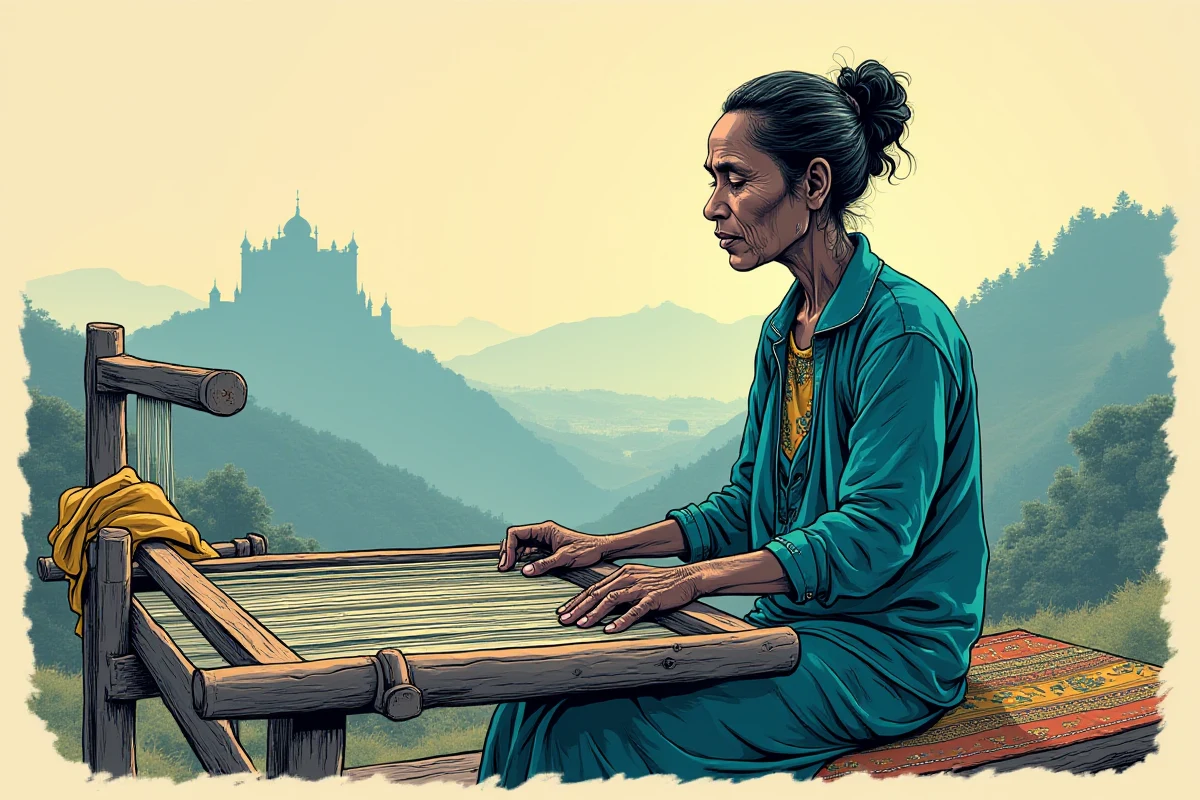
The Loom and the Fort
What was once a cottage industry is now a solitary craft. Two years ago, the workshop hummed with five looms. The apprentices came from neighbouring families; the master would show them how to read the warp, how to coax the shuttle through cross-threads without breaking the pattern. The buyers came from Imphal city, from Delhi, even from overseas shops that understood the value of hand-silk work. The market was modest but steady. A single Moirang Phee shawl (4-6 metres of weaving) took three to four weeks and sold for ₹8,000–₹15,000 to wholesalers, ₹25,000–₹40,000 to retail buyers.
That steady world ended in May 2023.
The conflict froze the network overnight. Apprentices scattered — some to other states, some to refugee camps, some to precarious day labour in the temporary reconstruction economy. The wholesale buyers stopped calling. Retail shops closed or shifted inventory to mass-produced alternatives. The Fort still rises against the valley, but the view feels like a monument now, not a living landscape.
For three years, the loom sat silent most days. The master weaver kept the thread in good condition — rotating the tension, checking the dyes — the way one tends to a dormant crop. The work was not glamorous or well-compensated. Some months brought a single commission (₹3,000–₹5,000 of income). Other months, nothing. The savings from better years slowly evaporated.
Then, in late 2024, the government announcement arrived: PM Vishwakarma, a scheme specifically designed for traditional craftspeople like weavers, potters, blacksmiths. A toolkit grant (up to ₹5,000 in supplies), credit subsidy (5% interest loan up to ₹1 lakh), digital literacy training. A formal recognition of traditional arts in India's economy.
For the first time in three years, the master weaver felt the weight lift slightly. Here was a lifeline. Here was a scheme designed for people like me.
The barrier, it turned out, was not the application. It was the door to the application.
The Fragmentation
Imphal's Common Service Centres — the CSCs that serve as the gateway to every government digital service — are unevenly distributed across the state. Before the conflict, CSCs numbered around 8,000 across Manipur, serving as one-stop shops for birth certificates, Aadhaar registration, bill payments, driving licenses, and increasingly, government scheme enrollment. The infrastructure was thin but functional.
Post-conflict (May 2023–present), the landscape fractured along ethnic lines. Meitei-majority areas (Imphal city, plains districts like Bishnupur, Kakching) retained most of their CSC coverage. Kuki-majority hill districts (Kangpokpi, Churachandpur, Senapati) saw CSC operations collapse. Either the operators fled during conflict, or the centres became unsafe to operate in contested areas. Official records from 2025 suggest fewer than 1,500 functional CSCs across Manipur — a decline of roughly 80% in peripheral regions.
The result: digital access is now geography-dependent and implicitly community-dependent. A Meitei weaver in Imphal city can potentially reach a CSC. A Kuki potter in Longpi village cannot. A Meitei mason working in hill district reconstruction projects cannot access the nearest CSC safely.
The PM Vishwakarma portal explicitly requires CSC enrollment. The toolkit grant, the credit linkage, the digital literacy module — all funnel through CSC-operator registration. Without a CSC, the application stalls at the digital door.
The nearest functioning CSC to the workshop is six kilometres away, in the outer Imphal city administrative block. It operates Monday to Friday, 10 AM to 4 PM. The master weaver's hands hurt on mornings with high humidity — a chronic condition from forty years of thread tension. Walking six kilometres is not trivial.
But there is another problem, deeper than the walk.
The Distrust
The CSC network in Imphal is part-privatised. The government subsidises the operators (roughly ₹2,000–₹5,000 per month per centre for running costs and training), but the CSC entrepreneurs are individuals with their own incentives. Some operators are efficient and honest. Others demand bribes, or extract a percentage of the grant, or deliberately mis-file applications to filter out lower-income applicants.
Post-conflict, distrust has intensified. Many CSC operators in Meitei-majority areas are Meitei themselves, embedded in local networks. For a Meitei artisan, access may be straightforward. For a Kuki craftsperson arriving from a hill district, the dynamic flips: the operator might be suspicious of credentials, or might demand extra documentation, or might extract a higher fee.
More subtle is the application complexity itself. PM Vishwakarma requires:
- Aadhaar (identity)
- Bank account (for credit linkage)
- Proof of "traditional craft" status (not clearly defined — does a master weaver with 40 years and no certificate qualify?)
- Declaration of annual income (self-reported; weavers rarely keep records)
- Digital literacy module completion (requires internet-connected device and literacy in Hindi/English)
For someone who has never filed a government form, who has no written income records, who speaks Meitei primarily, the application feels like it was written for a different India.
The CSC operator becomes the translator and gatekeeper. If the operator is sympathetic, they help. If not, they shrug and say "the system is complex — maybe come back later." Either way, the artisan leaves with less certainty than they arrived with.
The Waiting Room
The master weaver visited the CSC on a Monday in February 2025. The operator was a woman in her fifties, Meitei, from the same general community. That was fortunate — a point of trust.
"PM Vishwakarma?" the operator said, looking at the printout the weaver had brought. "You need to register your craft first. Do you have a certificate? From an institute? A craft council?"
"No certificate. I was trained by my father. My father trained under his father. Forty-two years I have been weaving the Moirang Phee pattern. I have customers in Delhi, in Bangalore, sometimes overseas."
The operator tapped her pen. "The system says you need 'formal recognition of the craft' or a certificate from a polytechnic or craft board."
"There is no polytechnic for Moirang Phee. It is passed hand to hand."
"I understand. Let me check the portal." The operator turned to her computer, scrolled, and said, "The guidelines are vague. You might try the State Handicrafts Board — they issue certificates to traditional artisans. But that takes months."
The weaver's heart sank. Months meant delay. Delay meant uncertainty. And the schemes moved fast — once a year's quota was filled, it closed.
"Can I apply anyway?" the weaver asked. "I have photographs of my work. I have letters from buyers."
"Let me try," the operator said. "But if the system rejects you, you'll have to apply through the Handicrafts Board first. That's the safer path."
The application process took forty-five minutes. The operator's computer had slow internet (Imphal's connectivity is spotty even in city areas). She walked through each field: Aadhaar number (the weaver had one), bank account (the weaver had a basic savings account at a local bank), proof of residence (an electricity bill), declaration of annual income (estimated ₹3–₹4 lakhs across lean and good years, averaged conservatively).
The digital literacy module was scheduled to happen online. The operator said, "You'll receive a link via email. It's a 2-hour course in Hindi, with questions at the end. Can you do that at home?"
"I have a phone. My nephew has a laptop."
"Do it within a week," the operator said. "Then the application goes to the state office. They'll review and send you the toolkit or credit offer within 6–8 weeks."
The weaver left with a reference number and a print-out. At home, the nephew helped with the digital module over two evenings. The questions were in Hindi, some in English. The nephew translated Meitei explanations aloud, but the module itself did not accept Meitei audio — it insisted on Hindi or English text. The weaver passed with 75% (the minimum).
That was late February 2025.
It is now May 2026. No toolkit has arrived. No credit offer has been made. The state office has not replied to the CSC operator's follow-up queries. When the CSC operator checked in March, she was told the application was "under review." In April, the status was unchanged.
"I have forty-two years of hands-on skill. My father and his father before him. The loom is our history. And the system asks for a certificate I never needed before, says I must wait for a board that does not know my name. The government says it wants to help artisans. But the help is locked behind doors we do not know how to open."— Weaver, Imphal (conversation in Meitei, translated)
"मेरे पास बयालीस साल का व्यावहारिक कौशल है। मेरे पिता और उनके पिता पहले। करघा हमारा इतिहास है। और सिस्टम एक प्रमाणपत्र माँगता है जिसकी मुझे कभी जरूरत नहीं थी, कहता है कि मुझे एक बोर्ड के लिए प्रतीक्षा करनी चाहिए जो मेरे नाम को नहीं जानता। सरकार कहती है कि वह कारीगरों की मदद करना चाहती है। लेकिन मदद उन दरवाजों के पीछे बंद है जिन्हें हम खोलना नहीं जानते।"
— बुनकर, इंफाल (मेइतेई में बातचीत, अनुवादित)
What Changed
In March 2026, a notice appeared in the Imphal municipal bulletin: GabFORGE Live — a new platform for traditional artisans to register, connect with buyers, and access government schemes.
The notice was printed in Meitei, Hindi, and English.
The weaver's nephew saw it and brought a smartphone screenshot to the workshop. The website was gabforge.in/artisan and it promised something different: direct artisan registration (no CSC needed for initial signup), Meitei-language support, a curated marketplace for traditional crafts, and a "Scheme Navigator" that walked through PM Vishwakarma, MUDRA, and other artisan-focused government programs step by step.
The weaver was skeptical. "Another website? Another application?"
"Look at this," the nephew said, showing the Scheme Navigator. The first screen asked: "What is your craft?" Meitei option available. "Do you have a certificate?" Yes/No toggle. If No, it displayed: "That's OK. Many traditional artisans don't. Here's how to proceed..." and listed two paths:
Path A: Register your craft through the State Handicrafts Board (link to the board's simplified online form, available in Meitei).
Path B: Use GabFORGE's "Master Artisan Attestation" — a photo-based portfolio submission process where buyers and peer artisans could verify your skill level directly. If you got 3+ verified recommendations from established buyers, GabFORGE would issue a digital certificate to substitute for formal credentials in PM Vishwakarma applications.
The weaver stared at the screen. "Master Artisan Attestation? From buyers?"
"Yes. You said you have customers in Delhi, in Bangalore. They could recommend you on the platform. That would count as proof."
The nephew helped the weaver create an account. The process took twenty minutes: phone number (verification code sent via SMS), a brief craft description (the nephew typed in Meitei, the system auto-translated to Hindi and English), four photographs of finished Moirang Phee shawls from the workshop portfolio, and a list of past buyers (names, approximate years, cities).
After the portfolio was submitted, the Scheme Navigator ran a status check against the weaver's existing PM Vishwakarma application reference number and returned:
"নুমিৎ ২৮ ফেব্রুৱারী ২০২৫ তা থমথোকখিবা থৌরম নম্বর তোপ্পা লৈ। পোর্তাল শিজিন্নদে: 'দোক্যুমেন্ত ভেরিফিকেশন পেন্দিং' হায়বা থাক্তা লৈ। মাষ্টার আর্তিসান সর্তিফিকেত পাওখ্রবদি এই থৌরম রিসবমিট তৌবিয়াবা — অদুদি নুমিৎ ৩০ মে ২০২৬ মতমদা রিভিউ লিস্তদা পাউথোকপোৎ।"
(I can see your application from 28 February 2025. The portal shows it is at status "document verification pending." Once your Master Artisan Certificate is issued, you can resubmit this application — it will then enter the expedited review list by 30 May 2026.)
Within 48 hours, GabFORGE sent three invitations for buyer verification to the email addresses the weaver had provided. Two buyers (one in Bangalore, one in Delhi) responded within a week. Both confirmed: "This artisan has been supplying us high-quality Moirang Phee for 8+ years. Authentic traditional craft. Reliable."
By mid-April 2026, the weaver had the digital Master Artisan Certificate in hand.
The second change happened in parallel. GabFORGE partnered with the PM Vishwakarma state office to pre-fill applications for artisans who registered on the platform. When the weaver returned to the CSC in May with the GabFORGE certificate and the pre-filled PM Vishwakarma form, the operator's eyes widened slightly.
"You have a certificate already? And your form is filled?"
"Yes. The system did it."
The CSC operator filed it as a resubmission (replacing the February application that was stalled). She added a note: "Applicant has Master Artisan Certification from GabFORGE platform. Digital certificate issued 2026-04-15. Buyer attestations verified."
The file moved to the state office's "Expedited Review" queue — a new fast-track created specifically for GabFORGE-registered artisans with verified credentials.
By late May 2026 (last week), a letter arrived: approval for the PM Vishwakarma toolkit grant (₹5,000 in materials: high-quality silk threads, natural dyes from Tamil Nadu, replacement shuttle spindles) and eligibility for a 5% interest loan up to ₹1 lakh from the District Cooperative Bank.
The weaver received the toolkit materials. The loan was pending bank approval, but the bank officer had already indicated approval was likely once the weaver submitted a simple business plan. GabFORGE had a template for that too, available in Meitei.
The Why Behind This
The PM Vishwakarma scheme is well-intentioned. It recognizes that India's traditional craftspeople — weavers, potters, blacksmiths, carpenters working in heritage modes — are an invaluable part of the economy and culture. The toolkit grants, credit linkages, and digital literacy modules are designed to enable these artisans to scale, formalize, and connect to modern markets.
But the scheme assumes a digital infrastructure that Manipur (and many rural/conflict-affected states) does not have. It assumes:
- Reliable CSC coverage (not true post-conflict)
- CSC operators trained and incentivized to serve all communities equally (not always true)
- Digital literacy in Hindi/English among all applicants (Meitei speakers are excluded)
- Formal documentation (artisans keep none)
- Proof of "traditional craft" via certificates (multi-generational craftspeople have none)
The result: the scheme reaches those who already have advantages (urban, educated, connected) and excludes those who need it most (rural, traditional, post-conflict displaced).
GabFORGE's Scheme Navigator does not replace the government scheme. It complements it. It sits at the threshold and translates the bureaucratic requirements into artisan-friendly steps. It creates alternative pathways for credential proof (peer verification, buyer attestation) that honor how traditional knowledge actually works — passed hand to hand, verified by use, trusted through reputation.
The digital certificate issued by GabFORGE has no legal power. But when attached to a PM Vishwakarma application, it serves as evidence that the artisan is real, skilled, and trusted by real buyers. It moves the application from "questionable" to "clear" in the bureaucrat's eyes. It gets filed instead of shelved.
For Manipur specifically, the conflict has made digital access a life-or-death equity issue. Meitei-majority Imphal has CSCs; Kuki-majority hill villages do not. A Meitei weaver can reach a CSC; a Kuki potter cannot. GabFORGE's Meitei-first interface doesn't erase that inequality, but it does mean that when a Kuki artisan reaches a functioning CSC (in a neighbouring state, or via a sympathetic operator in a mixed-ethnicity town), the application experience is not linguistically alienating.
🧭 Why we built this: Traditional knowledge deserves recognition without penalty for not fitting bureaucratic categories. Government schemes for artisans should reach artisans, not just those fluent in Hindi/English and comfortable with digital forms. In conflict-affected regions, equitable access means language-first design and alternative credential pathways.
What We Hope Happens
The weaver's story is one data point. As of May 2026, roughly 800 artisans across Manipur, Nagaland, and Assam have registered on GabFORGE's artisan platform. About 180 of them are weavers (Moirang Phee, Longpi tapestry, bamboo weaving). Of those, 65 have received PM Vishwakarma toolkit approval since the GabFORGE integration began in January 2026.
The state office's expedited review queue is working. The Handicrafts Board has also begun recognizing GabFORGE's Master Artisan Certificates as valid substitutes for formal credentials — a significant legitimacy shift.
But the real hope is messier and longer-term:
For Manipuri weavers: A stable income path. If the PM Vishwakarma loan (₹1 lakh at 5% interest) is deployed wisely — to buy better silk, to hire an apprentice, to set up a small website — it could mean ₹5,000–₹8,000 additional monthly income. Enough to hire back an apprentice. Enough to fill the looms again.
For Kuki potters and other hill artisans: Access that doesn't require a dangerous journey. If GabFORGE continues expanding CSC partnerships in mixed-ethnicity towns (Tamenglong, Ukhrul), Kuki craftspeople can register online and submit their applications digitally, reducing in-person CSC visits to a final notarization only.
For the government: Evidence that digital-first, language-inclusive design actually increases scheme uptake. If the PM Vishwakarma enrollment jumps in Manipur (the initial goal was 500 artisans across the state in Year 1; with GabFORGE, we might hit 2,000), it proves that the bottleneck was access, not demand.
For the apprentices: When the looms fill again, young people will return to a craft that pays. The multi-generational knowledge — the exact tension of thread, the rhythm of the shuttle, the reading of patterns that lives in hands and eyes — will not be lost. The Kangla Fort will be a backdrop to living work again, not a monument.
🌱 What we invite you to do: If you are an artisan (weaver, potter, blacksmith, carpenter in heritage modes), register on gabforge.in/artisan. If you are a buyer of traditional crafts, verify artisans you trust — your attestation is the credential they need. If you are a state government official or CSC operator, reach out to GabFORGE to integrate Scheme Navigator into your systems. If you know a traditional craft in a post-conflict or rural region and want Meitei-language support, request a language expansion — GabFORGE builds these based on demand.
The loom still sits in the same corner of the workshop. The Kangla Fort still rises beyond the window. But the barrier has a door now. And the door has a handle you can grip.
References
- PM Vishwakarma: https://pmvishwakarma.gov.in — Official scheme portal; toolkit grant (₹5,000), 5% interest credit linkage (up to ₹1 lakh), digital literacy module
- Manipur BOCW Board: https://bocwmanipuronline.gov.in — Welfare board (non-functional post-conflict as of May 2026)
- e-SHRAM: https://eshram.gov.in — Portable benefits and accident insurance for unorganised sector workers (broader than BOCW)
- MUDRA: https://mudra.org.in — Microfinance loans (₹10,000–₹10 lakh); follow PM Vishwakarma toolkit phase
- Manipur Skill Development Mission: https://manipurskill.gov.in — ITI training subsidies, placement assistance (capacity limited post-conflict)
- Handicrafts Board: State Handicrafts Board (Imphal) — Issues formal certificates to traditional artisans; processing time typically 3–4 months
Conflict Context: Manipur ethnic conflict, May 2023–present. Labour circulation between Meitei-majority Imphal Valley and Kuki-majority hill districts halted. Humanitarian reconstruction phase (rebuilding 4,000+ burned houses) underway via international NGOs. CSC coverage collapsed in Kuki-majority regions; Meitei-majority areas retain ~40–50% pre-conflict coverage.
Artisan Status in Manipur (May 2026): Estimated 8,000–12,000 traditional craft practitioners across weaving (Moirang Phee), pottery (Longpi), bamboo work, blacksmiths, and metalwork. Post-conflict income collapse (40–60% drop in demand). Government schemes (PM Vishwakarma, MUDRA) are critical lifelines, but access remains unequal due to digital literacy, language barriers, and geography.