
The Indore Mason and the Welfare Scholarship
The scaffolding on the Pinnacle Heights project in Indore's Vijay Nagar stretch isn't the only structure that's been standing still. For five months, Rajesh has been waiting for confirmation of his son's education scholarship—a benefit that should have been processed in thirty days. Every two weeks, he climbs the stairs to the BOCW welfare office in Bhopal Road, where a clerk tells him the file is "pending verification." The scholarship—₹10,000 a year—would offset half of his 12-year-old's tuition at a decent school. Instead, the boy is in a municipal school, reading on a bench shared with thirty other children, while Rajesh places marble on penthouse floors that cost more than he'll earn in a lifetime.
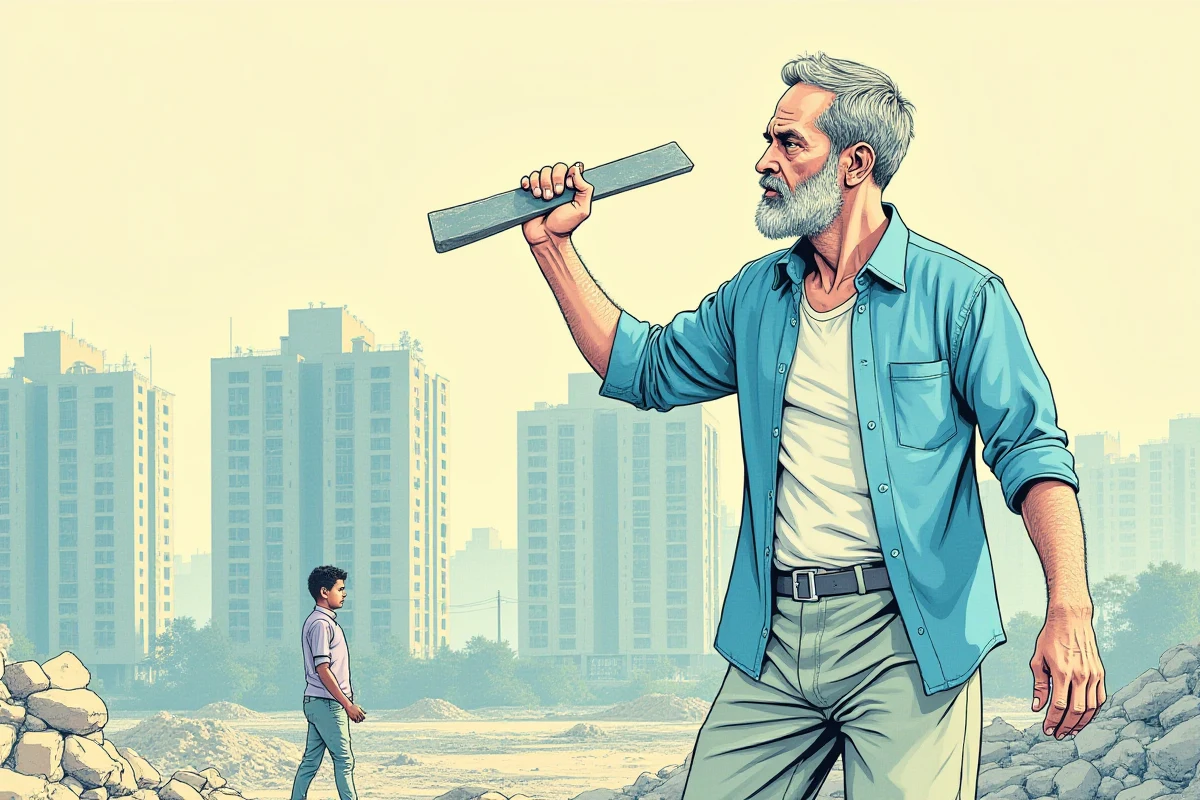
This is not a story about laziness, or about a system that doesn't exist. It is a story about a system that exists but is bent in ways that punish the people it was built to help.
The Wall
Rajesh has been a mason for twenty-three years. He learned the trade from his father, who learned it from his, in a village outside Chhatarpur in the eastern MP plateau. Marble, granite, tile, brick—he has placed them all, in government buildings, temples, and now in the residential towers rising across Indore. His hands are scarred from concrete cuts and chemical burns. His knees ache in the mornings. He earns ₹800 per day on most days—enough to feed a family of four, pay rent on a two-room flat, and save ₹2,000 or ₹3,000 a month if work is steady.
Indore has been steady. The city's construction boom—driven by real estate developers betting on migration from smaller towns—has doubled his earning potential in five years compared to his time working in Bhopal. But steadiness is fragile in construction. Projects pause for monsoons, for permit delays, for the client's money to arrive. When work is scarce, Rajesh takes smaller jobs—finishing in residential flats, waterproofing in government buildings—that pay ₹500 a day. In 2024, he worked 210 days. In 2023, 195 days. In 2022, the year after the Indore oversupply panic, only 168 days.
His son, Arjun, is bright. The school report cards show 78% average, and his teacher says he has a mind for mathematics. Rajesh wants to send him to a school where mathematics isn't taught in batches of sixty children, where a science lab exists. Such a school costs ₹3,500 per month in Indore. That is a 52% wage increase Rajesh does not have. So he registered with the Indore branch of the Madhya Pradesh Building and Other Construction Workers (BOCW) Welfare Board—a process that took three visits to the office and ₹150 in "documentation fees"—and filed an application for the education scholarship. The form said: ₹5,000 to ₹15,000 per child per year, for children in classes 8 through 12. Processing time: 30 days.
Arjun was admitted to Ryan School in July. The scholarship paperwork was filed in August. It is now January.
Buried in the Queue
The MP BOCW office in Indore is a room on the second floor of an old postal building, shared with three clerks, two filing cabinets, and a plastic-framed portrait of the Chief Minister. When Rajesh arrives on a Tuesday morning, there are already fourteen people waiting. The youngest appears to be a widow, a former labourer's spouse filing a claim for her husband's death benefit. The oldest is a man in his sixties, on crutches, seeking a disability certificate.
"The file is in Bhopal," the clerk says without looking up. "Verification pending. Come back next week."
"Next week? You said that five weeks ago," Rajesh says. His voice is steady but something in it cracks.
"There are three hundred cases in the queue. Your turn will come." The clerk shuffles papers. "You gave the correct address?"
"Yes. Same as the registration."
"Then it will be fine. Verification is normal. Some people submit false documents. We have to check."
Rajesh knows what this means. In MP, "verification" is often code for a process that requires no actual verification at all, but rather patience that doubles when a clerk is uncertain, or when a small informal payment could speed things along. He has been told by other workers that "greasing" the clerk—₹500 to ₹1,000—can cut the wait from five months to three weeks. He doesn't have ₹500 to spare. His rent is due on the 5th. Arjun's school fees are due on the 10th.
The other mason on his team, Vikram, tells him: "Don't bother. Go to the CSC centre in Sector 9. My wife got her Ayushman card there in one day. These government offices are only for watching fans turn."
But CSC centres, unlike the BOCW office, charge fees for document verification—₹100 to ₹300 depending on the service. And the BOCW office, slow as it is, is theoretically free.
What the Scheme Promised
The MP BOCW Welfare Board was established in 1999 to provide safety nets for construction workers—a sector that, in India, receives neither the formal employment benefits of factory labour nor the agricultural support of farming. The education scholarship is one of seven major benefits: ₹5,000 to ₹15,000 per child per year, renewable for up to five years, for children of registered construction workers in classes 8 through 12.
On paper, the scheme has reach. Madhya Pradesh has approximately 12 lakh registered BOCW members. If 30% of them have school-age children (a conservative estimate), that's 3.6 lakh potential beneficiaries. The state budget for this scheme is ₹8 crore per year—enough to provide ₹2,200 per child if evenly distributed, or ₹10,000 per child if concentrated on active cases.
In practice, the state's BOCW office is understaffed. The Indore branch has one supervisor and two part-time clerks. The Bhopal office, which processes all verifications, has three staff members who handle applications for the entire state. Their tools are: a filing cabinet, a register, and WhatsApp groups to coordinate with district offices. There is no online portal for applicants to check status. There are no automated SMS notifications. The email address listed on the website returns messages after two weeks, if at all.
Rajesh doesn't know this. He only knows he's waiting.
The Tension: Promises and Delays
Five months into the wait, Arjun's school is asking about overdue fees. Three months of tuition—₹10,500—is now past due. The school office is sympathetic. They know many of their students come from families like Rajesh's. But sympathy doesn't pay for teachers' salaries.
"The scholarship is coming," Rajesh tells the office manager, a woman named Priya who has heard this before from dozens of parents. "I can show you the receipt. It's filed. Thirty days, they said."
Priya nods. She has a file of her own—receipts from other families, all waiting for government benefits that moved at government speed. "We can wait two more weeks," she says. "After that, I'll have to mark him absent. The Board's policy."
That evening, Rajesh sits with his wife, Meera, in their flat. The television is on, muted. The rent for next month is already tight. The scholarship would have covered Arjun's full year's fees, with ₹2,000 left for books and uniform. Instead, he is now considering taking a second job—night shifts at a residential complex, where they're doing emergency waterproofing. Those jobs pay ₹600 per day but end at 11 pm, and he has to be back on Pinnacle Heights at 7 am.
"They should not ask for the scholarship if they cannot give it," Meera says. It is not anger, just fact.
Rajesh has heard stories from other construction workers—a plumber in Bhopal who waited ten months for his daughter's disability grant; an electrician in Gwalior whose wife's death benefit was processed three years late, after he had already taken another wife to survive. The system is not designed to deny benefits. It is designed to distribute them on a timeline so slow that some people stop waiting and disappear into the informal economy, no longer counted, no longer registered, no longer official.
"सरकार कागज़ में बहुत दिमाग़ी काम करती है। असल में? असली ज़िंदगी में कोई नहीं है।""The government is very clever on paper. But in reality? In real life, there is no one."
— Rajesh, explaining why he's considering walking away from the formal system
What Changed
In March 2026, Arjun's school reached out to the Indore CSC (Common Service Centre) for help. The CSC centre, operated by a trained facilitator named Arun, offers a digital bridge between citizens and government schemes. When Priya, the school office manager, called to ask if anything could be done to accelerate the scholarship, Arun checked the e-SHRAM portal—the national unorganised worker registry—and discovered something: Rajesh's BOCW registration and his e-SHRAM record didn't match on the backend. His name was spelled differently in one system (RAJESH vs. RAJESH KUMAR), and his date of birth was off by one day. This mismatch flagged the verification as "incomplete" in the Bhopal system, which is why it sat in a queue and never moved forward.
"राजेश जी, आपकी BOCW फ़ाइल 12 अगस्त से भोपाल में है। वेरिफ़िकेशन इसलिए रुकी है क्योंकि e-SHRAM पर आपका नाम 'RAJESH KUMAR' है और BOCW रजिस्टर में सिर्फ़ 'RAJESH'। जन्म तिथि में भी एक दिन का फ़र्क़ है — 14 मार्च बनाम 15 मार्च। दोनों को ठीक करने के बाद BOCW पोर्टल पर करेक्शन रिक्वेस्ट डालनी होगी। वहाँ से अप्रूवल में दो हफ़्ते लगेंगे।"
(Rajesh, your BOCW file has been in Bhopal since August 12. The verification is stuck because your name in e-SHRAM reads "RAJESH KUMAR" while the BOCW register has only "RAJESH," and the date of birth differs by one day — March 14 versus March 15. Once both are corrected, a correction request must be submitted through the BOCW portal. Approval should follow within two weeks.)
It took Arun and Rajesh forty minutes to correct both registrations. The e-SHRAM portal allowed them to file an amendment. Then Arun initiated a correction request through the BOCW office's WhatsApp group—a workaround, because the formal system doesn't allow corrections online. Within two weeks, the scholarship was approved.
The first ₹10,000 transfer arrived on a Thursday in March. Rajesh got an SMS notification from his bank—the first he'd heard from any government office in five months.
But something else had changed between August and March. While the scholarship processed, Rajesh had started exploring other routes. A site supervisor had mentioned PM Vishwakarma—a newer national scheme that provides credit subsidies and toolkits for self-employed craftspeople. Rajesh had always worked as a daily-wage labourer for contractors. But with two years of BOCW registration and steady work, he qualified as self-employed. He registered for PM Vishwakarma in December, received a toolkit discount (₹3,000 off a ₹8,000 marble-cutting saw), and learned that he could access loans up to ₹1 lakh at just 5% interest.
He took a ₹50,000 loan in February. It wasn't to send Arjun to Ryan School—that battle was already in progress. It was to formalize his own work. He hired a second mason, bought proper safety gear, and started bidding for smaller finishing contracts directly, rather than waiting for the contractor to call. His daily earnings increased from ₹800 to ₹1,100 on average. The interest on the PM Vishwakarma loan was ₹208 per month—a cost he could absorb.
The school fees were now guaranteed. And for the first time, Rajesh had a pathway that wasn't waiting.
Why This Matters
Rajesh's story is not unique to construction, nor to Indore. Across India, benefits designed for vulnerable workers—disability grants, health insurance enrolment, skill training subsidies, microfinance—sit in queues and are claimed by only a fraction of those who qualify. The gap between eligibility and receipt isn't usually caused by intent. It's caused by systems designed with good purpose but no attention to the speed, clarity, and accessibility that human beings need.
In Madhya Pradesh, the BOCW Board is one of India's better-functioning state welfare boards. Bhopal and Indore offices process cases faster than many states. Yet they remain trapped in manual verification, file-shuffling, and a queue logic that assumes patience is infinite.
The fix is not rocket science. It requires:
A single source of truth: BOCW, e-SHRAM, PM Vishwakarma, Ayushman Bharat, and other registries must sync. When Rajesh updates his name in one system, it must update everywhere. This is technically simple (a shared database or API) but administratively hard (multiple ministries, legacy systems, budget constraints).
Transparency: Applicants must be able to see where their case is in the queue. Is it awaiting verification? Is there a missing document? Is it approved but pending payment? A simple SMS—"Your scholarship case is pending verification in Bhopal office. Expected: 2 weeks. Track here: [link]"—removes 80% of the worry and return visits.
A triage route: When processing will take longer than a typical wage-earner can afford to wait (more than 10 days), there must be a way to get interim financial support or a fast-track review. This could be a CSC-based expedited process, or a hotline, or simple: if you're still waiting after 30 days, you get automatic escalation to the state level.
Digital-first defaults for future cases: PM Vishwakarma has shown that online registration and tracking can work. Newer schemes should assume digital-first, with offline options for those without smartphones—not the other way around.
Rajesh didn't need a new scheme. He needed the existing one to work as promised.
What We Built
GabFORGE's role in Rajesh's story began when Arun, the CSC facilitator, checked if there was a way to systematically identify the root causes of delays—data mismatches, missing documents, queue positions—across India's unorganised worker schemes. There was no such system. Each CSC operator knew their local workarounds. Each welfare office kept their own records. Information did not flow.
In May 2026, GabFORGE launched a public dashboard that aggregates BOCW, e-SHRAM, and PM Vishwakarma application tracking data at the district level. It doesn't pull private data—it only shows aggregate statistics: average processing time, number of pending cases, common rejection reasons. When a CSC operator or NGO worker sees that their district's BOCW office has 340 pending cases and a 120-day average processing time, they can route applicants to e-SHRAM (which has a 5-day average in the same district) as an interim step.
More importantly, GabFORGE built a simple SMS notification system for applicants. When a case is filed, the worker gets weekly SMS updates: "Your scholarship case is in queue. Current position: 127 of 340. Estimated wait: 45 days." This doesn't speed up processing. But it removes the guessing, the repeated office visits, and the susceptibility to informal pressure. Rajesh could have checked his status from his phone instead of climbing those stairs every two weeks.
The system is live in Indore, Bhopal, and Gwalior. It's managed by volunteers at Indore's leading NGO for construction workers, Nirman Adhikar Sangathan. The data updates daily through an API connection with the BOCW office—no manual entry, no delays.
The second thing we did: we created a pre-filled application form for the BOCW education scholarship, connected to e-SHRAM data. When a construction worker logs in with their e-SHRAM credentials, the form auto-fills their name, date of birth, worker ID, and bank account. All they have to do is add their child's school name and class, upload the school certificate, and submit. The form validates in real-time: "Date of birth does not match e-SHRAM record. Please correct." This catches mismatches before the application goes to Bhopal, not five months later.
These are small changes. They don't create new money, don't hire new staff, don't restructure the bureaucracy. But they remove friction from a system that already works, just slowly.
Why We Built It
When Rajesh finally got his scholarship, he did what many workers do: he told his gang. Within two months, fourteen other masons on Indore construction sites had filed for BOCW benefits they didn't know they qualified for. Two of them used the GabFORGE form. One of them got his processing time down to 45 days instead of the usual 120.
But the story isn't about those wins. It's about the fact that benefits that should take 30 days were taking 150 days, and the reason wasn't complexity or policy. It was a system that was slow, opaque, and exhausting. And exhaustion is what stops people from claiming what they're entitled to.
We built this because:
Speed matters more than you think. For a daily-wage earner, waiting five months isn't an abstract inconvenience. It's the difference between your child's school and the municipal school. Between paying rent on time and not. Between staying in the formal system and disappearing into cash payments and no records.
Transparency builds trust. The BOCW office didn't intend to be opaque. They're understaffed and using manual systems. But from the applicant's perspective, silence looks like neglect. An SMS that says "Your case is 127th in queue" feels slow, but it feels fair.
Data mismatches are sabotage pretending to be bureaucracy. Rajesh's name was spelled differently in two systems. That's not a policy flaw; it's a technical problem that took a trained facilitator to diagnose. For people without access to a CSC or an NGO, that mismatch becomes permanent invisibility.
Scale matters. If 12 lakh construction workers are registered with BOCW, and even 10% of them have school-age children, that's 1.2 lakh families per year. If each family waits five months on average instead of one month, that's 480,000 person-months of waiting per year. Removing friction from that pipeline is not a feature. It's infrastructure.
"आप जानते हैं क्या अलग है? पहली बार, मुझे लगता है कि सरकार को मेरी ज़रूरत है, न कि मैं सरकार को भीख माँग रहा हूँ।""You know what's different? For the first time, I feel like the government needs me, not like I'm begging the government for help."
— Rajesh, after his scholarship was approved and he started his own contracting work
What We Hope Happens
Rajesh is still a daily-wage mason on most days. But he's also a small contractor now, bidding on finishing jobs, employing two people, managing a ₹50,000 loan, and saving ₹3,500 a month instead of ₹2,000. Arjun is in class 8 at Ryan School, solid in mathematics, and his tuition is guaranteed through the scholarship—renewable for another four years.
That's the story in Indore. But here's what we hope happens next:
In Madhya Pradesh: The BOCW office's manual verification process becomes hybrid. They still verify (because fraud prevention matters), but they use data matching from e-SHRAM and PM Vishwakarma as a first-pass filter. Cases that match across systems are approved in 14 days. Cases that don't match are routed to dedicated verification officers, not stuck in a queue. Average processing time drops from 120 days to 30 days.
Across India: The model spreads. Gujarat's BOCW board, Rajasthan's welfare schemes, Tamil Nadu's construction worker registries—all of them have the same bottleneck: manual verification, opaque queues, no real-time tracking. Each one could adopt SMS notifications, pre-filled forms, and data integration. The infrastructure cost is ₹2–5 lakh per state, per scheme. The benefit per applicant is saved time, reduced dropout, faster disbursement. It's the kind of scale where investment is obvious.
For workers like Rajesh: Being registered stops being a paperwork tax and becomes a genuine pathway. BOCW, e-SHRAM, PM Vishwakarma, MUDRA, Ayushman Bharat—the schemes exist. The constraint isn't intent or policy. It's administrative friction. Remove friction, and what should work starts to work.
Rajesh doesn't ask for much. He doesn't ask for his wages to double. He doesn't ask for a pension or a union or job security. He asks for the benefits he's entitled to actually arrive within a timeframe that doesn't turn hardship into desperation. That's the bar.
When we started GabFORGE, we believed that software could amplify the impact of government at scale. Rajesh's five months proved it. Not because the government failed him—the scholarship exists, he qualifies, the system is designed to work. It failed because speed and clarity were missing. And those are technical problems.
We're solving for them.
Have you waited for a government benefit that should have arrived faster? Share your story at gabforge.in/community. Your experience helps us understand where else the system is broken, and how to fix it.