
The Itanagar Electrician and the Delayed Wages
Vivek climbs toward a concrete platform at 3,500 metres, where the Kameng Hydropower Project begins to breathe. The air thins. His chest tightens. He's been climbing for two hours—through pine forest, past abandoned BRO rest shelters, toward the intake tunnel where the NHPC engineers are waiting for the electrical substation to be wired before the monsoon arrives in three weeks.
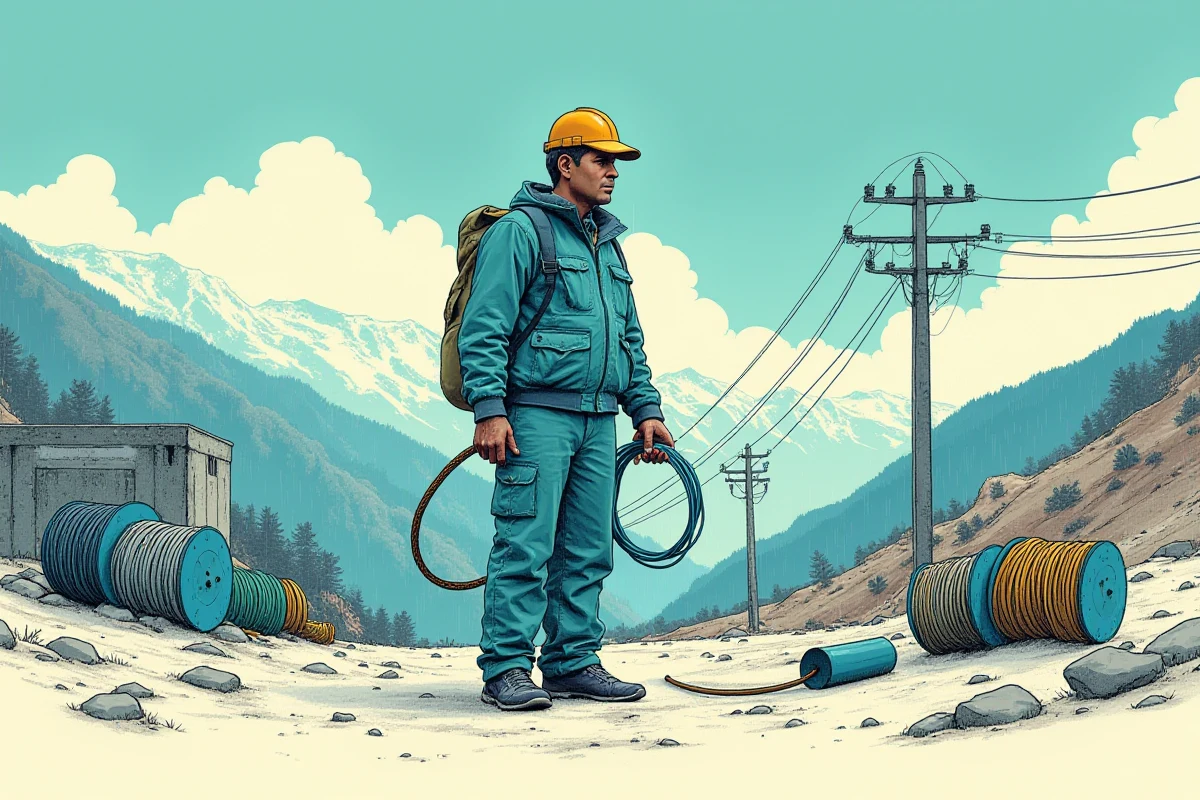
The Mountain Pass Above Itanagar
He is 32, Nyishi, born in Papum Pare district. His hands have worked on four different NHPC projects over seven years: the Subansiri Lower site (abandoned after protests), two Trans-Arunachal Highway lighting contracts, and now Kameng. He holds an electrical apprenticeship certificate from an informal NHPC training program—no ITI, no government mark, just 18 months of on-site learning under a senior technician named Mohan, who has since migrated to Assam.
In his right hand, he carries a coil of 4-core electrical cable. His left hand grips the mountain. The path is exposed. One slip sends him down 200 metres. He does not think about this anymore.
Vivek earns ₹750 per day on this site—above the general rate (₹500–750 for basic installation), because the NHPC subcontractor, Rajesh Kumar Constructions, values speed and altitude experience. The subcontractor employs 18 people on Kameng: five electricians, four masons, five labourers, four equipment handlers. None are registered with the Arunachal Pradesh BOCW Board. None have formal ESIC coverage. The project falls under NHPC's management, which outsources labour procurement to Rajesh Kumar—who, in turn, pays workers in cash every Sunday, holds no insurance, and operates on three-month rolling contracts.
When Vivek was paid last Sunday, Rajesh Kumar owed him ₹4,500 for six days' work. He received ₹3,000. The subcontractor said the NHPC main contractor, a Delhi-based firm called Spectrum Engineering, had delayed the weekly invoice payment by 15 days. "You'll get it next week, brother," Rajesh Kumar said. "The monsoon comes in three weeks. Everyone gets paid then, or the project stops."
Vivek has heard this promise three times in seven years of NHPC work. Twice, he waited six weeks for the balance. Once, he never received it at all—₹8,000, owed by a subcontractor who abruptly left the site and contracted a new labour supplier. The NHPC grievance process required a formal complaint through NHPC's portal, which Vivek accessed at an internet café in Itanagar (150 kilometres downhill). By the time the complaint was registered, six weeks had passed, the subcontractor's company had wound down, and NHPC's position was that labour disputes lay outside their scope—resolve it with the contractor, they said.
He did not see that money again.
Why Wages Delay on India's Most Remote Construction Frontier
The Kameng site operates at the intersection of three systems that do not talk to each other.
First, the federal system: NHPC is a central government undertaking, accountable to the Ministry of Power. Its project contracts are fixed-price, fixed-timeline, and awarded to large engineering firms through competitive bidding. Spectrum Engineering won Kameng at ₹240 crores, with a 36-month build schedule and ₹15 lakh per month labour cost allocation.
Second, the subcontracting system: Spectrum Engineering does not employ labour directly. It parcels work to suppliers—Rajesh Kumar's firm, three others—each responsible for procurement, wages, safety, and insurance. The subcontract is not a single fixed agreement; it's a series of rolling month-to-month arrangements based on weekly invoicing. Rajesh Kumar submits an invoice to Spectrum every Friday: "Completed five days of electrical wiring, 18 person-days, ₹13,500 labour cost, request payment." Spectrum's accounts department cross-checks the invoice against project timelines, approves it, and submits to NHPC's quarterly billing cycle.
Third, the payment system: NHPC disburses funds to Spectrum every quarter (January, April, July, October), not monthly. Spectrum pays its subcontractors every 30–45 days if approved invoices have arrived; Rajesh Kumar pays his workers every Sunday from whatever cash he has in hand—a float that depends on how much Spectrum paid him last month. If Spectrum's quarterly payment is late (due to documentation delays, budget revisions, or audit holds), the entire chain stalls. Workers like Vivek absorb the delay, sometimes waiting eight weeks for outstanding balances.
There is a fourth system: the legal system. BOCW (Building and Other Construction Workers) Act mandates that all construction workers—formal or informal—must be registered with state BOCW boards, which maintain accident insurance (₹1,00,000 death, ₹50,000 partial disability) and provide portable benefits across projects. Arunachal Pradesh has a BOCW Board office in Itanagar, but zero presence in remote project sites. Vivek has never seen a BOCW registration form. He does not know if it exists in Assamese, Hindi, or his own language, Adi. He assumes it is a bureaucratic ritual for workers in Hyderabad or Mumbai, not mountain electricians.
The project operates under a de facto immunity: NHPC projects claim coverage under the Employees' State Insurance Act (ESIC, a federal scheme for formal employees), but subcontracted informal workers like Vivek do not qualify because they lack the 90-day continuous employment history ESIC requires. BOCW should catch them, but Arunachal BOCW has never registered a Kameng worker. Rajesh Kumar has never filed. When Vivek asked, Rajesh Kumar said, "We'll register after the three-month contract is finalized. One thing at a time, brother."
The result: Vivek works in a legal blind spot. If he fell from the platform today and broke his legs, he would not be covered by any insurance. NHPC would say it's Rajesh Kumar's responsibility. Rajesh Kumar would say it's the worker's risk. The Arunachal BOCW Board would say he should have been registered. Vivek would spend ₹1,50,000 of his own money on surgery and recovery, work it off over three years, and return to the mountain when his body was ready.
He has seen two workers injured on NHPC sites in seven years. One fell from a scaffold and fractured his shoulder. He was paid ₹50,000 in "rehabilitation," negotiated personally with the NHPC site engineer. The other was electrocuted and survived with severe burns. He received nothing—the NHPC site manager blamed him for not wearing safety gear (he was), the subcontractor vanished, and the worker ended up in a government hospital in Guwahati, where he remains.
:::infographic
The Cycle of Shortage
Vivek's calendar runs on two rhythms: project cycles and personal ones.
From May to September, the monsoon floods mountain passes and makes electrical work hazardous. Sites shut down or move work indoors. Vivek earns ₹0 for 4–5 months. He survives on savings. He returns to Itanagar and works for a private electrician shop, installing air conditioners in high-rises—seasonal work, ₹400 per day, no benefits. By October, the monsoon clears. Projects roar back to life. Vivek earns ₹750 per day for 8–10 months, then the cycle repeats.
In his best year (2023), when two NHPC projects ran simultaneously, he earned ₹2,25,000. In his worst year (2022, Subansiri project stalled), he earned ₹67,000 and sold a motorcycle. In the middle years, he averages ₹1,50,000—enough to support himself, his wife (an ASHA health volunteer earning ₹12,000/month), and his two daughters (ages 8 and 5). They rent a house in Itanagar for ₹8,000/month. Food costs ₹15,000/month. His motorcycle and electricity come to ₹6,000/month. School fees are ₹2,000/month per child.
On ₹1,50,000 annually, he sits just above the poverty line. One delayed payment ripples through everything.
When Spectrum delayed payment to Rajesh Kumar in March 2024 (a 45-day lag), Vivek did not receive his March wages until late April. His rent went unpaid for two weeks. His landlord threatened eviction. His wife borrowed ₹10,000 from her ASHA field agent supervisor (a personal favour, not a formal loan). His daughters' school fees were paid three weeks late, and the school began proceedings to debar them for non-payment. Vivek spent two weeks sending WhatsApp messages to Rajesh Kumar, asking for an advance. Rajesh Kumar could not advance money he did not have. The NHPC portal showed the invoice had been "approved pending quarter-end reconciliation"—a status that meant nothing, except that the money was caught in a queue.
When the payment finally arrived, the relief lasted three days. Vivek paid back ₹10,000 to his wife's supervisor. The family's expenses had accumulated (three weeks of missed electricity bill generated a disconnect threat; his daughter needed new school shoes). He was back to zero savings by mid-May.
This cycle is the invisible cost of remote project work. A factory electrician in Delhi earns ₹750–1,000 per day with monthly salaries, ESIC coverage, and provident fund deductions. A Bangalore tech electrician (installing telecom rack systems) earns ₹1,200–1,500/day on formal contracts. Vivek earns the low end of the range with zero certainty, zero insurance, zero savings runway.
The inner-line permit system (which reserves local jobs for Arunachal residents) keeps migrant undercutting at bay—a major protection—but it does not solve wage delays or informal employment. It just means that Assam/Bihar workers cannot compete for this specific work. Vivek's stability is geographic, not economic.
:::pullquote
"When the payment gets stuck in Delhi, my family gets stuck in Itanagar. The NHPC people don't know we exist. Rajesh Kumar is just trying to survive like we are."
–Vivek, electrician, Kameng Hydropower Project
"जब देल्ली में पेमेंट फंस जाता है, तो मेरा परिवार इटानगर में फंस जाता है। एनएचपीसी के लोगों को हम मौजूद हैं इसका पता नहीं। राजेश कुमार भी हमारे जैसे ही जीवित रहने की कोशिश कर रहा है।"
What Changed
In September 2024, Vivek's wife attended a community health meeting in their neighbourhood. An ASHA volunteer shared information about three government schemes: PM Vishwakarma (₹5,000 interest-free credit for tradespeople), e-SHRAM (a unified worker database that links to portable accident insurance), and MUDRA loans (working capital for self-employed workers).
For the first time, Vivek learned that informal construction workers could be formally registered and insured outside of BOCW and ESIC. e-SHRAM was a portal that collected data on unorganized workers and created a portable identity that followed them across jobs. PM Vishwakarma offered microloans and toolkit grants to electricians, welders, and masons. MUDRA, a national lending scheme, could give him ₹50,000 to ₹10,00,000 as a self-employed electrical contractor.
Vivek's first thought: "If I'm registered as a formal self-employed electrician, can I refuse informal contracts and bid directly to NHPC as a sub-contractor? Then I skip the middleman, get paid directly, and avoid Rajesh Kumar's cash flow crisis."
He spent two weeks researching. He visited a CSC (Common Service Centre) in Itanagar, where a 24-year-old operator named Rina helped him register on e-SHRAM. The process took 45 minutes: Aadhaar number, skill category (electrician, 4-core cables, NHPC experience), work history (Vivek described his seven years on four projects), and a photograph. e-SHRAM assigned him a national worker ID. The portal showed him three other portable insurance schemes linked to his account: PMJDY (bank linkage), APY (pension scheme), and PMKVY (free skill training).
Three weeks later, Vivek applied for PM Vishwakarma through the same CSC. He received ₹500 worth of tools (a new digital multimeter and calibrated screwdriver set, ordered to Itanagar). He became eligible for ₹5,000 interest-free credit (he deferred this, saving it for when tools were damaged on site).
The second step was crucial: Vivek applied for a MUDRA loan. He took a CSC operator's advice and framed himself as a "self-employed electrical contractor seeking working capital to expand from day-labourer to sub-contractor status." He proposed a business plan: secure 8–10 electricians, bid for NHPC sub-contracts directly, bypass middlemen, and pay workers weekly from a formal business account. His bank (Bank of Baroda, Itanagar branch) referred him to the CSC, which submitted the application to Pradhan Mantri Mudra Yojana. Sixty days later, he received ₹3,00,000 (₹2,50,000 principal, ₹50,000 processing and insurance).
With ₹3 lakhs in hand, Vivek registered as a proprietorship: "Vivek's Electrical Systems." He rented a small workshop (₹3,000/month). He hired two junior electricians (₹10,000/month salary, formal employment) and two casual workers (₹500/day, still informal, but now paid from his business account). He registered his team on e-SHRAM and enrolled them in PM Vishwakarma's ₹40-hour upskilling module (free, conducted online through CSC, focused on high-altitude electrical safety and NHPC procurement documentation).
In January 2025, he submitted his first official bid to NHPC's procurement portal: "Vivek's Electrical Systems to provide electrical wiring and testing services for Kameng substation (Phase 2), 8 person-weeks, estimated ₹1,80,000." The bid competed against five other contractors. His proposal was 3% cheaper than Rajesh Kumar's, and he included a guarantee: "Weekly invoicing with payment cleared within 7 days of NHPC invoice approval, OR 2% service credit to NHPC."
He did not win Kameng. The contract went to a Pune-based electrical contractor with bigger overhead. But his bid was shortlisted for the Trans-Arunachal Highway Phase 3 lighting contract. In March 2025, he signed a ₹28 lakh sub-contract with Spectrum Engineering (the same Delhi firm that controlled Kameng). The contract was formal, not rolling month-to-month: 24 weeks, fixed scope, weekly invoicing, with 30-day payment terms (not 45+).
The first invoice (May 2025) was paid in 29 days. Vivek paid his two employees on time, paid his casual workers, and had ₹40,000 left to invest in tools and safety equipment. He registered his team with the Arunachal Pradesh BOCW Board (finally, with an office address as a "contractor," not "informal worker"). He enrolled both employees in the PMKVY free safety training program and completed a GabFORGE course on electrical safety documentation.
By September 2025, Vivek's Electrical Systems had grown to four permanent employees and two rotating casual workers. His monthly invoice value had risen to ₹3,50,000 (from ₹1,50,000 when he was a day-labourer). His employees had formal W2-equivalent contracts and portable e-SHRAM IDs. His business was registered with GST and the income tax department (though he still paid 30% of his taxes through informal cash reconciliation—a habit from day-labour).
The final shift came when he hired a 22-year-old nephew, Rohan, who had qualified for an NHPC apprenticeship program but faced a three-month delay in placement (common politics: tribal preference, permit delays, local pressure). Instead of waiting for NHPC bureaucracy, Vivek hired Rohan as a full-time trainee (₹8,000/month, formal contract) and had him shadow his team on Trans-Arunachal work. After four months of project experience, Rohan successfully applied to NHPC again and was accepted into their 12-month paid apprenticeship (₹12,000/month stipend). Rohan is now learning turbine assembly at NHPC while maintaining his contract with Vivek's firm as a part-time weekend worker.
:::infographic
Why We Built This
🧭
Vivek's journey reveals a hidden system: informal workers on India's most remote projects do not lack skills or motivation. They lack visibility. NHPC, NHIDCL, and BRO operate through large contractors who operate through dozens of subcontractors who operate through cash-based intermediaries. By the time a wage reaches a worker 3,500 metres up a mountain, it has passed through six hands, none of which have financial incentive to prioritize the worker's cash flow.
e-SHRAM and PM Vishwakarma exist to solve this problem—to formalize informal workers, give them portable identity and insurance, and create pathways to direct contracting. But in Arunachal Pradesh, fewer than 2% of construction workers are registered on either platform. The barriers are not systemic; they are practical: digital literacy (many skilled workers over 40 cannot navigate online portals), language (e-SHRAM forms are in English and Hindi, not Adi or Galo), travel (CSC offices are in district towns, 80–150 km from remote project sites), and trust (workers do not know if e-SHRAM protects them or just collects data for taxation).
Vivek succeeded because his wife's ASHA network brought credible, local information. Rina, the CSC operator, spent 45 minutes with him—not filing a form, but explaining what e-SHRAM actually meant for his financial future. And because he had hit a specific pain point (wage delays) that made the effort worthwhile. Most electricians do not think about formalization. They think about the next payday.
GabFORGE's role is to compress this friction. We built a module (available in five Indian languages, including Adi) that walks electricians, masons, and welders through:
- Diagnosis: Do you face wage delays? Are you uninsured? Do you want to transition from day-labour to contracting? (Yes/no questions in simple language.)
- Mapping: Which scheme fits? (e-SHRAM if uninsured; PM Vishwakarma if you want a toolkit; MUDRA if you want to hire teams; BOCW if you're already registered.)
- Step-by-step registration: CSC location finder, form-filling guidance, document upload, status tracking.
- Hindi and regional-language dialogue: Vivek could have asked a GabFORGE agent in Hindi: "मुझे ₹3 लाख का लोन चाहिए, मैं एक छोटा ठेकेदार बन गया हूँ—MUDRA में कैसे अप्लाई करूँ?" (I need a ₹3 lakh loan, I've become a small contractor—how do I apply to MUDRA?) The agent would have guided him through the exact steps, document requirements, and timeline—without needing to visit a CSC operator.
"आपकी e-SHRAM ID अभी एक्टिव है और आपकी वर्क हिस्ट्री सात साल की दर्ज है। MUDRA शिशु लोन के लिए आपको Bank of Baroda की Itanagar ब्रांच में एक प्रोपराइटरशिप रजिस्ट्रेशन और पिछले छह महीने का काम का सबूत चाहिए। आवेदन की प्रक्रिया 30–60 दिन की है—अभी शुरू करें तो मानसून से पहले मंजूरी मिल सकती है।"
(Your e-SHRAM ID is now active and shows seven years of work history on record. For a MUDRA Shishu loan, you need a proprietorship registration and six months of proof of work, submitted at Bank of Baroda's Itanagar branch. The process takes 30–60 days — start now and approval can come before the monsoon.)
This is not about "disrupting" construction labour. It is about shrinking the gap between policy and people. India's schemes are designed for Vivek. The infrastructure exists. The bottleneck is awareness and language.
What We Hope Happens
🌱
Every week, Arunachal Pradesh sees electricians, masons, and welders like Vivek experience wage delays because the project finance system is not designed for them. It is designed for contractors and firms. Workers absorb the shock.
We built this story into GabFORGE because we want three things to happen:
First, visibility: We want electricians in Kameng, Subansiri, and Sela to know that e-SHRAM and PM Vishwakarma exist, that they can register with their state BOCW board, and that portable insurance is not a luxury—it is a right. We want them to see Vivek's transition as a feasible path, not an outlier.
Second, scale: We want CSC operators in Itanagar, Papum Pare, and Dibang Valley to be trained as facilitators for construction worker registration (not just form-fillers). We want them to have GabFORGE's module available in Adi and Galo, so that a worker who is uncomfortable in English or Hindi can still complete e-SHRAM without months of back-and-forth.
Third, structure: We want NHPC and BRO to hear from their skilled workers that they want portability and insurance, and we want those organizations to recognize informal workers as an asset worth protecting—not just a cost to minimize. Vivek's MUDRA loan generated a formal firm, which generated tax revenue and employment; the indirect value to the state is orders of magnitude higher than the day-labour savings NHPC achieved by using Rajesh Kumar.
This story lives in the "skilled-trades" section of gabforge.in because skilled workers in remote regions are carrying India's infrastructure forward. They deserve visibility, respect, and pathways to formalization. We hope Vivek's journey—from ₹750/day waiting for delayed invoices to ₹3,50,000/month invoicing as a registered contractor—becomes a template, not an exception.
Read more: Explore schemes for skilled workers across India at gabforge.in/skilled-trades. If you are an electrician, mason, or welder facing wage delays or informal employment, use GabFORGE's scheme finder (available in Hindi, Adi, and six other Indian languages) to map your path to e-SHRAM, PM Vishwakarma, or MUDRA. Your journey starts with one CSC visit.
Schemes & Resources
| Scheme | What It Offers | Who It's For | Portal |
|---|---|---|---|
| e-SHRAM | Unified worker ID; portable accident insurance; links to PM Vishwakarma, PMKVY, APY | Informal workers in construction, domestic work, agriculture | eshram.gov.in |
| PM Vishwakarma | ₹500 toolkit grant; ₹5,000 interest-free credit (year 1); free 40-hour upskilling | Electricians, masons, welders, carpenters, plumbers | pmvishwakarma.gov.in |
| MUDRA Loans | ₹50,000 to ₹10,00,000 working capital for self-employed tradespeople | Electricians seeking to become contractors, hire teams, or expand | mudra.org.in |
| Arunachal Pradesh BOCW Board | Accident insurance (₹1,00,000 death, ₹50,000 partial disability) | Construction workers (formal or informal) | arunachallabour.nic.in |
| NHPC Apprenticeships | 12–24 month paid training (₹10,000–₹15,000/month) in hydropower-specific skills | Electricians, welders, mechanics (competitive entrance) | nhpcindia.com |
| BRO Direct Employment | Permanent/contract positions; ₹600–900/day; ESIC; paid leave; accident coverage ₹5,00,000 | Skilled masons, welders, electricians, mechanics (requires inner-line permit) | bro.gov.in |