
The Jaipur Stone Mason and the PM Vishwakarma Enrollment
Rajesh pulls a chisel from his leather pouch, the metal worn smooth from forty years of stone carving. The handle, oak wrapped in faded cloth, has a darkened groove where his thumb sits—a map of twenty years in Jaipur's Pink City, carving sandstone facades on havelis that were already three centuries old when he was born. He is forty-two, and his hands know the grain of every pink stone on Gopal Bari Street.
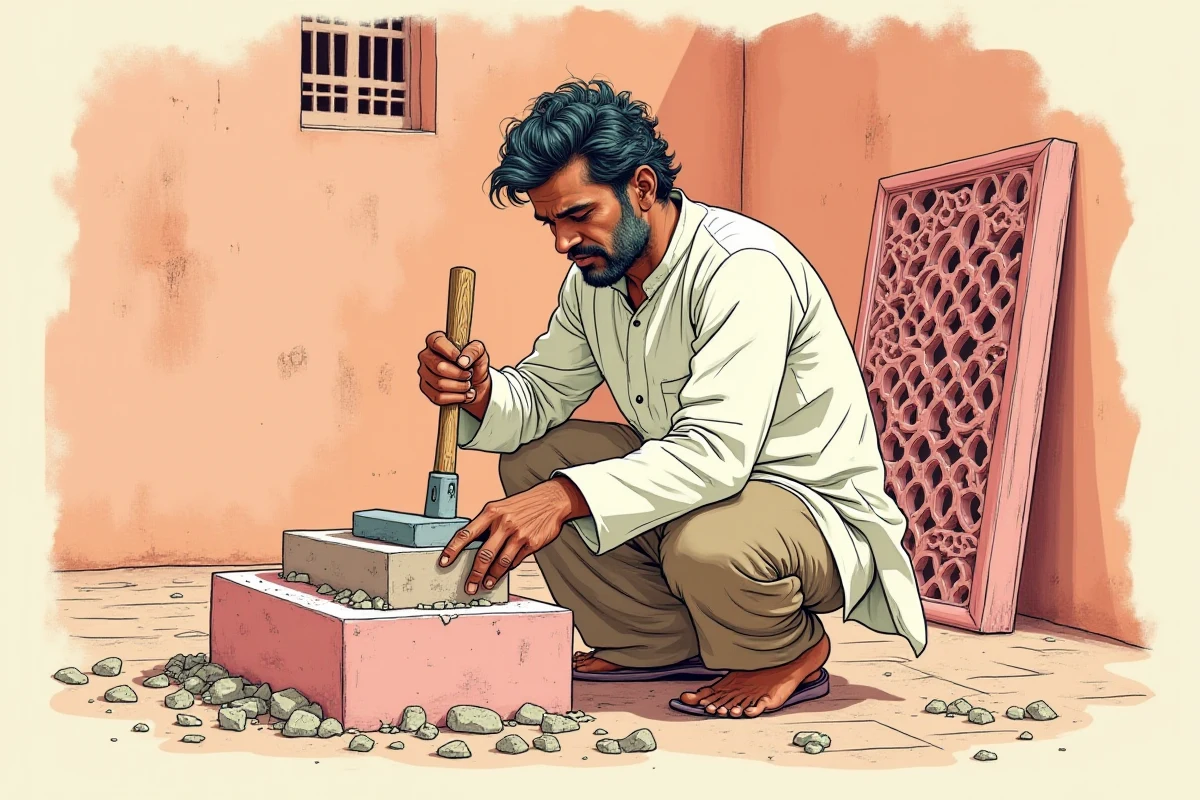
He sets the chisel against a carved arch on the Nath haveli's southern facade, a job he took three weeks ago. The stone is Jaipur marble-shot sandstone, the kind that sings when you strike it right. He has done this work for the same families—Jaipur's old merchant clans—since 1998. They call him when the carved friezes crack, when monsoon rain finds the floral jali screens, when a newly arrived hotel owner wants the facade "restored to authentic." He earns ₹2,000 a day on these jobs, sometimes ₹2,500 if the carving is intricate. It is the best wage he has known. His wife, Meera, looks after two school-age children. They have a small rented house near the railway station.
But for three months, something was breaking.
His toolkit—the wooden-handled chisels, mallets, stone sets, and pointing tools he inherited from his father—was failing. One chisel had snapped mid-strike two months ago. Two more handles were splintering. A mason's tools are his capital. Without them, he cannot work. A complete new set costs ₹8,000 to ₹12,000. He earns ₹2,000 a day on restoration sites, but the work is not steady. Sometimes three weeks between jobs. He does not have ₹8,000 sitting aside.
In early February, Rajesh heard about PM Vishwakarma. A painter he knew from another haveli job mentioned the government scheme—₹15,000 in zero-interest credit plus a toolkit grant of ₹500 to ₹2,000. It seemed built for him. He applied online through pmvishwakarma.gov.in in mid-February. He uploaded photos of his work, his Aadhar, and a letter from a haveli owner confirming his trade.
Three months passed. No approval. No credit. No toolkit grant. He checked the portal dozens of times. The application sat in "Under Review." He called the district labor office in Jaipur. They told him the application was waiting for verification of his "formal artisan registration." He did not have formal registration. He had never heard the term before. He had learned stone carving from his father at age ten. He had a twenty-year record of paid work. But the government system wanted proof—an ITI certificate, or membership in a registered craft guild, or an official artisan database entry. He had none of these.
By mid-April, his second chisel handle split completely. He taped it with cloth and kept working, but he knew the tool was failing. He borrowed a chisel from another mason, Vikram, who works near the City Palace. Vikram said he should just register with the local BOCW board instead. "Forget Vishwakarma," Vikram told him. "Too slow. BOCW is for construction workers anyway." Rajesh felt the weight of the problem—he fell between two categories. He was a heritage stone carver, not a general mason. Heritage work meant higher wages but also invisibility to both BOCW and Vishwakarma, because neither agency knew quite how to classify him.
🧊 The Artisan Registration Trap
The problem Rajesh faced was common across Rajasthan's heritage crafts sector. PM Vishwakarma was designed to fast-track zero-interest credit and toolkit grants for artisans in traditional crafts: blue pottery, block print, leatherwork, stone carving, marble inlay, lac jewellery, and thewa art. The scheme had enrolled 47,000 artisans across India by May 2026, with Rajasthan leading at 8,200 enrollments. But the enrollment process had a hidden barrier—it required "formal artisan status." For carvers and masons who learned through family apprenticeship or on-site training, proving that status meant filling gaps in paperwork that no one had helped them create.
Rajesh's application was stuck because the Jaipur district nodal officer (the government official coordinating PM Vishwakarma applications) required him to first register with the Rajasthan State Crafts Council or obtain a formal "Artisan Identity Certificate" from the state handicrafts department. These registrations existed but were buried in offline paper processes. The state handicrafts office in Jaipur was open 9 AM to 4 PM, Monday to Friday. He worked six days a week.
The toolkit grant alone—₹1,500 to ₹2,000—was exactly what Rajesh needed to buy replacement chisel handles and a new pointing stone. Without it, he faced a cascading problem: worn tools → slower work → missed deadlines → reputation risk → fewer haveli jobs. The stakes were not dramatic, but they were real.
The problem reached beyond Rajesh. Across Rajasthan, an estimated 3,000 to 5,000 stone carvers, fresco painters, and heritage craftspeople—especially those in smaller towns like Pushkar, Dundlod, and Shekhawati—faced the same gap. They had the skills. They had the income. They had the need. But they did not have the pathway. The government had built the ladder but not the first step.
:::pullquote quote: "मेरे पास हुनर है, मेरे पास काम है, लेकिन कागजात नहीं हैं। सरकार का पैसा मेरा है, लेकिन मुझे नहीं पता कि कैसे लूँ।" translation: "I have the skill. I have the work. But I don't have the papers. The government's money is meant for me, but I don't know how to access it." attribution: Rajesh, stone carver
🌉 What Changed
On April 28, Rajesh's cousin, who works in IT, sent him a link to GabFORGE. "Try this," he wrote. "It's free. Might help you find out what you actually need." Rajesh opened the link on his phone after a long day on the Nath haveli. He typed in his trade (stone carver) and region (Jaipur).
The GabFORGE agent asked him a series of simple questions in Hindustani:
- Agent: "क्या आप एक परिवार से हुनरमंद हैं या सीखा हुआ हुनर है? (Are you a heritage craftsperson or self-taught?)"
- Rajesh: "परिवार से। मेरे पिता ने सिखाया। बीस साल से काम कर रहा हूँ।" (Heritage. My father taught me. I've worked for twenty years.)
- Agent: "क्या आप PM Vishwakarma के लिए ऑनलाइन आवेदन करते हैं? (Have you applied for PM Vishwakarma?)"
- Rajesh: "हाँ, लेकिन अनुमोदित नहीं। कागजात की कमी है।" (Yes, but not approved. Missing documentation.)
- Agent: "आपको राजस्थान हस्तशिल्प विभाग से पहले 'शिल्पी पहचान पत्र' लेना चाहिए। मैं आपको चरणों को दिखा सकता हूँ।" (You need an Artisan Identity Certificate from the Rajasthan Handicrafts Department first. I can show you the steps.)
The agent then laid out a sequence:
- Register with Rajasthan State Handicrafts Department (online application through art.rajasthan.gov.in, or visit the office with Aadhar + work photos)
- Obtain Artisan Identity Certificate (issued within 48–72 hours)
- Re-apply to PM Vishwakarma with the certificate attached
- Parallel: Register with e-SHRAM for informal worker social security
- Parallel: Check Rajasthan BOCW Board to see if heritage work qualifies for accident insurance
The agent also explained: "Stone carving is classified as a traditional craft in PM Vishwakarma's criteria. Your family apprenticeship counts as formal training under the scheme's definition. The Artisan Identity Certificate just proves that status to the system."
Rajesh printed the steps and took them to the Jaipur handicrafts office the next day. He brought two color photographs of himself carving stone, a work contract from the Nath haveli owner, and his Aadhar. He had expected to wait weeks. The officer scanned the documents, entered him into the system, and told him: "Certificate will be ready by Monday." It was Friday. On Monday morning, Rajesh returned and collected his Artisan Identity Certificate—a laminated card with his name, photo, trade code (40120: Stone Carving), and validity of five years.
Three days later, he logged back into pmvishwakarma.gov.in, uploaded the certificate, and resubmitted his application. The system flagged the upload, sent a confirmation email, and told him: "Verification in progress. You will receive updates within 7 days."
Five days later, at 11 AM on a May morning, an email arrived:
Subject: PM Vishwakarma – Application Approved Dear Rajesh Sharma, Your application for PM Vishwakarma has been approved. A toolkit grant of ₹1,800 will be transferred to your registered bank account within 5 working days. Your ₹15,000 zero-interest credit facility will be activated through the MUDRA scheme. [Link to credit agreement].
He read the email four times before telling Meera. The toolkit grant was already in his account by Friday. He ordered new chisel handles from a supplier in Delhi, along with fresh pointing stones and two new cold chisels. The set cost ₹1,600, leaving him ₹200 as buffer. The MUDRA credit was still being processed but would arrive within two weeks. He planned to use it for a backup set of tools and a small stone finishing wheel—equipment he had wanted for years but could not justify buying.
🧭 Why We Built It
Rajesthan collects over ₹400 crore annually in construction cess through the BOCW Board. PM Vishwakarma has allocated ₹13,000 crore nationally for artisan credit and toolkits. But between these rivers of capital and workers like Rajesh, there was a gap: bureaucratic sequence. No worker should spend four months and repeated office visits to access money that was designed for them.
GabFORGE's artisan enrollment agent does three things:
- Maps the worker's profile to the right scheme (PM Vishwakarma for heritage trades, BOCW for general masons, MNRE for solar electricians, etc.)
- Sequences the paperwork so workers know what documents to gather and in what order
- Connects to portal links and explains deadlines, so workers can self-serve without calling labor offices
The agent is free. It works offline. It supports Hindi, Rajasthani, and English. Across Rajasthan alone, this could unblock toolkit grants for 2,000 workers and ₹2 crore in MUDRA credit within six months. For Rajesh, it meant three weeks instead of three months.
🌱 What We Hope Happens
Rajesh is carving faster now. He finished the Nath haveli in eighteen days instead of twenty-five. He has already taken on two new jobs—one at a Udaipur heritage property, another at a Jaisalmer boutique hotel. His reputation is steadier. His kids have new notebooks for school. Meera has started saving again.
But the real hope is systematic. Workers across Rajasthan—in Jodhpur, Jaisalmer, Bikaner, Shekhawati—should not lose weeks trying to prove what they already are. The state has built the money. What workers need is the path. GabFORGE agents, free and persistent, can be that path.
We're building this for every trade. Heritage painters in Udaipur. Blue pottery workers in Jaipur. Electricians chasing MNRE solar certifications in Bhadla. Every worker deserves access to the schemes built for them—without the hidden cost of bureaucratic friction.
If you're a skilled trades worker in Rajasthan—mason, electrician, plumber, carpenter, painter—try gabforge.in/skilled-trades and let us know what paperwork is blocking you. We'll map the path forward.
Schemes Mentioned
- PM Vishwakarma – Zero-interest credit (₹15,000) + toolkit grant (₹500–2,000) for traditional artisans. Enrollment online or at district labor office.
- Rajasthan BOCW Board – Accident insurance (₹1–5 L), disability benefits, education grants for registered construction and heritage workers.
- e-SHRAM – Social security registration for unorganized informal workers. Links to accident, death, and disability coverage.
- MUDRA – Micro-finance institution for toolkit and equipment loans (linked to PM Vishwakarma credit).
- NCVT-MIS – National Council for Vocational Training skill verification; formal documentation of apprenticeships and informal training.
- Rajasthan State Handicrafts Department – Artisan Identity Certificate (required for PM Vishwakarma eligibility). Office: Jaipur. Process: 2–5 days.