
The Jowai Mechanic and the Mining Equipment Knowledge Crisis
In a lean-to workshop on the outskirts of Jowai, the capital of Meghalaya's Jaintia Hills, a mechanic known locally as Jayson sits cross-legged on the concrete floor, a diesel pump pulley resting on his lap. The pulley is seized — its bearings frozen by coal dust and monsoon moisture. No textbook has a diagram for this particular problem. No government ITI course teaches repair steps for equipment that was never meant to be standardized in the first place.
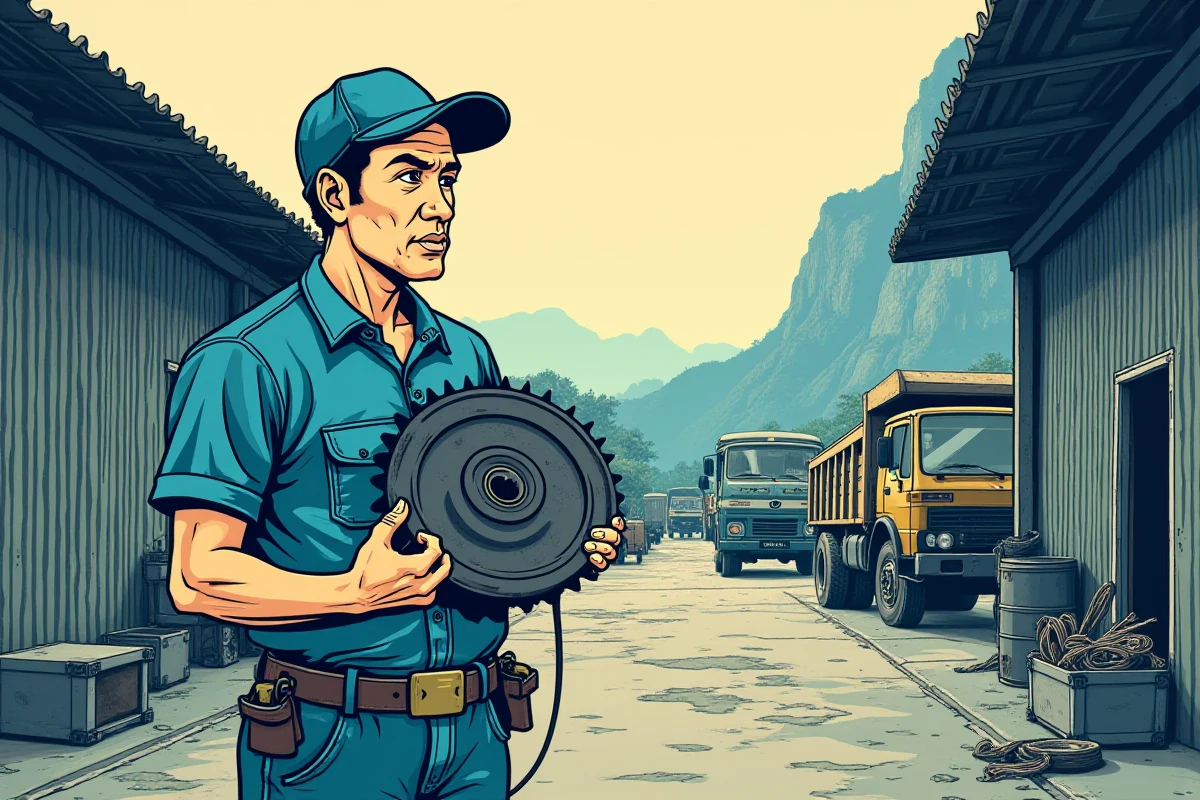
Jayson has been repairing coal-mining machinery for 23 years. He learned by watching his father, who learned from a mechanic two generations back. There is no written manual. The knowledge lives entirely in his hands and in a mental library of pump failures that he has fixed through improvisation, intuition, and careful listening to the sound a broken bearing makes as it spins.
Today, he is one of roughly 80 active mechanics in the Jaintia Hills coal belt. When he retires — if he retires — that knowledge dies with him.
The Equipment Nobody Trains For
The rat-hole coal mining industry of Meghalaya operates in a legal shadow. The practice was officially banned in 2020, but informal operations persist, particularly in East Jaintia Hills. A network of small operators — often individual pit owners — continues to extract coal using low-tech, labor-intensive methods. They use small diesel pumps (usually 5–10 horsepower models from the 1990s), hand-cranked pulleys, rope-and-timber rigging systems, and ancient Tata trucks to haul ore. The entire apparatus is held together by mechanics who have no formal training and no documentation.
"The pump I was working on last week came from a 1998 Kirloskar diesel engine," Jayson explains, tracing a finger along the corroded housing. "Kirloskar stopped making that exact model in 2005. There are maybe 30 of them still running in these hills. If you search for a repair manual online, you get nothing. The pump works because I have repaired it before. The next mechanic who sees this exact failure will have to start from zero unless I sit with him and show him."
This is not a romantic story of artisanal knowledge. It is a crisis in equipment continuity, financial stability, and worker dignity.
The mechanics of Jaintia Hills earn between ₹1,200 and ₹2,000 per day — well above the Shillong electrician average of ₹1,200/day. But the income is volatile and entirely cash-paid. Jayson estimates that in a normal month, he clears ₹40,000 to ₹50,000 if work is steady. During the monsoon (June to August), mines flood and work drops to near zero. In the past two years, since the rat-hole ban tightened, the volatility has worsened. A pit owner might call him for a three-day emergency repair, then go silent for six weeks.
"No bank will give me a loan based on that cash flow," he says. "I cannot go to BOCW board because the cess they collect is less than the informal deductions they take. And PM Vishwakarma asked me to open a bank account and get my Aadhaar seeded — I have been trying to do that for eight months now. The branch in Jowai tells me to wait, and when I ask the manager why, he speaks only Bengali. I speak Khasi and Hindi. My son has to come with me to translate."
The Tension: Tools That Cost More Than Hope
Two years ago, Jayson paid ₹18,000 for a set of specialized wrenches and bearing pullers — equipment he uses almost daily for pump repairs. He bought them cash, over six months, ₹3,000 at a time, from a supplier in Bangalore via WhatsApp referrals. It was the hardest financial commitment of his career.
Today, the bearing pullers show wear. One wrench has a hairline crack. A full replacement set would cost ₹22,000. His workshop roof leaks monsoon water directly onto his toolbox. He has no insurance, no loan access, and no formal registry of his work history.
"If I took a loan from the local moneylender, I would pay 18% interest," he says flatly. "That is ₹396 per month just in interest on ₹22,000 — almost ₹5,000 per year. My PM Vishwakarma loan would be ₹3,500 per month at 5% — ₹1,400 a year. But no bank will give me a PM Vishwakarma loan because my income is cash and unmeasured. They look at my application and say, 'No property, no fixed income, no Aadhaar seeding — come back when you are formalized.' But I cannot formalize. The pit owners do not want me to register with BOCW because then I will demand they contribute the cess. So they will find another mechanic."
This trap — too informal for credit, too marginal for schemes, too debt-averse for moneylenders — keeps Jaintia Hills mechanics frozen in low-tool investment. Which means they cannot upgrade to modern diagnostic equipment. Which means younger mechanics cannot learn best practices. Which means the knowledge remains oral, unstandardized, and vulnerable to loss.
"Sohlup leit ka khun la thoh ar thoh aiji." (ସୋଲୁପ୍ ଲେଇତ୍ କା ଖୁନ୍ ଲା ଥୋହ୍ ଅର୍ ଥୋହ୍ ଅିଜି।)Khasi: Sohlup leit ka khun la thoh ar thoh aiji.
Translation: "Knowledge that dies with one person leaves the next person in darkness."
Jayson's older brother, Clement, was a celebrated mechanic in Jowai. When Clement died in a truck accident in 2003, the pit owners had to bring mechanics from Assam to finish the work on his remaining jobs. The Assam mechanics charged triple rates and understood the Jaintia Hills equipment poorly. Three months of learning were compressed into a decade of expensive mistakes.
"That is when I understood," Jayson says. "The knowledge has to leave the workshop. It has to get documented. It has to have a price. Otherwise, it disappears."
What Could Change: The Catalogue Model
For the past year, a mechanic named Robert (who also works in the Jowai coal belt) has been discussing with Jayson the idea of documenting repairs. Not as a tourist curiosity, not as a heritage project, but as a commercial product: a digital catalogue of pump failures, repair sequences, part numbers, and substitutions that a mechanic could reference on a smartphone.
"I would pay for that," Jayson says immediately. "₹50 per month, maybe ₹600 a year. But only if it was in Khasi. And only if I could talk to someone — maybe a voice call — when I was stuck."
The vision Robert has described is practical:
Video documentation of each pump model (5–10 minutes per video): disassembly, bearing identification, corrosion-removal sequence, reassembly. Shot in his own workshop, featuring the actual pumps that Jowai mechanics work on.
A searchable part-number database (Kirloskar pump codes, Tata generator serial numbers, rope-rigging load calculations) linked to substitutions — if part X is unavailable, what is the safe alternative?
A WhatsApp-based query system: mechanic sends a photo of a seized bearing, a query like "bearing is frozen, pump won't spin, model Kirloskar DG-10," and gets a response with a video link and troubleshooting sequence.
Monthly peer meetings (in Khasi, online or in Jowai) where mechanics share recent failures and solutions. Recorded and added to the catalogue.
"The cost would be maybe ₹5 to ₹10 per mechanic per month if we had 50 mechanics in the network," Robert estimated. "The documentation work costs money upfront — maybe ₹1 to ₹2 lakh to film, transcribe, and build the platform. But where does that money come from? A grant? An NGO? The government? None of them understand this."
This is where formal scheme registration becomes critical. If Jayson and Robert were registered with e-SHRAM, they could apply for PMKVY training grants (₹50K–₹100K per worker for developing new certification modules). If they were BOCW-registered, they could access the tools subsidy (₹5,000–₹10,000 per year). If they could demonstrate a "business model" for equipment knowledge, PM Vishwakarma credit could fund the platform build.
But each of those pathways requires formalization that the pit owners resist and the schemes do not actively support.
Why We Built It: Skill Preservation as Economic Justice
GabFORGE's approach to the Jowai mechanic crisis rests on a simple observation: informal-sector knowledge is a public good that gets privatized by accident.
When Jayson is the only person who knows how to fix a Kirloskar DG-10 bearing seizure, that knowledge is:
- Locked: Only accessible during his working hours, in his workshop.
- Expensive: Pit owners must pay him premium rates because they have no alternative.
- Fragile: When he retires or dies, it vanishes.
- Unmeasured: No official record exists of his skill level, trade history, or economic impact.
Conversely, when that knowledge is documented, formalized, and networked across 50 mechanics, it becomes:
- Accessible: Any mechanic (or apprentice) can reference it anytime.
- Cheaper: Competition increases; pit owners choose between mechanics; wages stabilize.
- Durable: The next generation inherits the repair sequences.
- Measurable: Mechanics' work hours, tools investments, and earnings become visible to lenders and scheme administrators.
The Khasi dialogue model we are building for Jayson is not a translation of English tech jargon. It is a scaffolding of his own language — Khasi — around the idea that his knowledge has a price, and that price is worth financing.
স্ক্রিপ্ট Example — PM Vishwakarma Enrollment Support (Khasi + Hindi)
Agent: "Jayson, e-SHRAM registration would take 10 minutes. You provide Aadhaar number, mobile number. The system sends an SMS. Then you are eligible for PMKVY grants for skill modules."
Jayson (Khasi, via agent interpreter): "Khun law ka jynniewknong ba? Law jynniewknong ka e-SHRAM la, pit owner na la ha kumm?" (Will the pit owner know if I register? Will registering me on e-SHRAM mean the pit owner learns?)
Agent: "e-SHRAM is between you and the government. Pit owner does not get a notification. But BOCW cess is separate — that is the pit owner's 1% contribution, which they hide anyway. You are protecting yourself."
Jayson: "Arum. Khun shibta ka PM Vishwakarma? Loan interest?" (Okay. What about PM Vishwakarma? The interest rate?)
Agent: "PM Vishwakarma is ₹3 lakh at 5% for 5 years. That is ₹3,500 per month. You show your last 12 months of work invoices — even informal ones count — and the bank looks at your cash flow. You say: 'I earn ₹18,000 per month average, I want ₹3 lakh for tools and platform.' We help you build the case."
This dialogue works because it respects Jayson's immediate fear (the pit owner finding out) and his practical concern (Can I afford ₹3,500/month?). It does not assume he trusts banks or understands ₹3 lakh as a number. It treats him as a rational actor in a constrained system, not a gap in need of filling.
The GabFORGE skilled-trades platform, launched in Hindi and Khasi in parallel, offers:
Scheme Enrollment Navigator: Audio-guided, spoken-Khasi walkthroughs of e-SHRAM, PM Vishwakarma, BOCW registration. Questions: "Do you have an Aadhaar?" "Do you have a bank account?" "How much do you earn per month?" Responses auto-populate the application form.
Work History Ledger: Mechanic logs each job (date, site, pit owner, hours, daily rate, tools used). Over 12 months, this builds a visible income history — exactly what PM Vishwakarma loan officers ask for. No tax filing required; just a log.
Peer Documentation Network: Mechanics can upload photos/videos of repair jobs (with pit owner permission). Platform hosts them; royalties accrue (₹50–₹200 per upload, paid quarterly). Younger mechanics learn; older mechanics get compensated for knowledge.
Financial Literacy Modules: 5-minute videos in Khasi explaining:
- How cess deduction works (and why it should be 1%, not 2–3%)
- Why PM Vishwakarma at 5% is cheaper than moneylenders at 18%
- How to read a bank statement
- How to calculate monthly loan EMI vs. average income
Cess Dispute Escalation: Mechanic reports that a pit owner deducted 2.5% instead of 1% BOCW cess. Platform flags it, logs the amount, notifies BOCW Meghalaya. Workers are not individually suing pit owners; the platform aggregates grievances and sends them to the labour board.
"Khun la lumkylliang ka jait, ar jait la thiang." (ଖୁନ୍ ଲା ଲୁମ୍କିଲିଆନ୍ଗ୍ କା ଜାଇତ୍, ଅର୍ ଜାଇତ୍ ଲା ଥିଆନ୍ଗ୍।)Khasi: Khun la lumkylliang ka jait, ar jait la thiang.
Translation: "Knowledge shared is wealth earned; wealth earned is dignity returned."
What We Hope Happens: Scale Beyond Jowai
The Jowai mechanic model is not unique to coal equipment. The same dynamics apply to:
- Plumbers in Cherrapunji (rainwater harvesting systems; no training curriculum for 3,000+ mm annual rainfall)
- Carpenters on steep slopes (Shillong construction on 40–60 degree inclines; standard apprenticeships teach horizontal framings)
- AC technicians in NEIGRIHMS hospital (high-altitude, monsoon-humidity HVAC systems; commercial tech manuals assume sea-level conditions)
- Welders in cement plants (Lafarge, Ambuja; equipment-specific repair sequences; knowledge jealously guarded by individual mechanics)
If the PM Vishwakarma + e-SHRAM + PMKVY pathway opens for coal mechanics, it becomes a replicable template for all Meghalaya skilled trades.
The goal is not to industrialize Jayson. It is to industrialize his knowledge — to move it from his hands into a network where 50 mechanics, then 200, then 1,000, can learn, contribute, and earn. Where a 19-year-old apprentice in Jowai does not have to wait three years to understand bearing seizure. Where Clement's death does not mean losing a decade of repair intelligence.
Phase 1 (Next 3 months): e-SHRAM enrollment for 20 mechanics in Jantia Hills. Platform beta: WhatsApp query bot + manual video links. Khasi audio narration for PM Vishwakarma, BOCW, e-SHRAM enrollment pathways.
Phase 2 (Months 4–8): PMKVY grant application for "Coal Equipment Repair Technician" module (₹50K funding). Filmed documentation of 10 most common pump repairs. Peer documentation network live; mechanics earn ₹50–₹100 per upload.
Phase 3 (Months 9–15): PM Vishwakarma cohort enrollment (10 mechanics, ₹3 lakh each, 5% interest). Platform expands to Shillong carpenters (slope-specific framing), Cherrapunji plumbers (rainwater systems). Khasi support extends to Garo for East Garo Hills mechanics.
Success metric: By mid-2027, 40+ mechanics formally registered (e-SHRAM), with documented work histories averaging ₹18,000/month. 10 PM Vishwakarma loans activated (₹30 lakh total capital deployed). 15 PMKVY certifications completed. Zero mechanics rely solely on pit-owner referrals; all have diversified client bases.
Epilogue: The Catalogue That Outlives Us
On Jayson's last day before he planned to semi-retire (a date that keeps moving), he sat in his workshop and watched a 22-year-old named Sengdor disassemble the same Kirloskar DG-10 pump that had been his reference piece for two decades.
Sengdor has a smartphone with the coal-equipment catalogue open on his WhatsApp.
"The bearing is seized at 0.15mm tolerance," Sengdor says, reading from the video. "So we heat it with this specific wrench, not a blowtorch — because the housing will warp if it gets above 180 degrees Celsius."
Jayson, watching, nods. The sequence is his, but now it is not his alone.
"Where did that 180-degree number come from?" Sengdor asks.
"My father told me," Jayson says. "I wrote it down three years ago, after you asked the same question. It is in the catalogue now."
The knowledge is preserved. The next mechanic will not start from zero. The pit owner will have a choice of technicians, not a monopoly on one man's hands. Clement's ghost, and the ghosts of mechanics before him, can rest.
This is not a story about technology solving poverty. It is a story about systems — e-SHRAM, PM Vishwakarma, PMKVY, BOCW — that were designed to reach everyone, but were not designed for Khasi-speaking coal mechanics in misty hills. It is about taking those systems seriously, translating them into Khasi, funding them with grants, and asking: if a mechanic's knowledge is worth ₹2,000 per day to a pit owner, why is it not worth ₹500/month to a lender?
Jayson does not need charity. He needs formalization, financing, and the dignity of being counted.
The catalogue will outlive him. That is what we built it for.
Resources for Skilled-Trades Workers in Meghalaya
Enroll Now
- e-SHRAM (Unorganized Worker Registry): https://eshram.gov.in — One-time enrollment, linked to PM Vishwakarma and BOCW
- PM Vishwakarma (₹3 lakh credit, 5%): https://pmvishwakarma.gov.in — For self-employed workers with 3+ years trade experience
- BOCW Meghalaya (Death/disability/tools benefits): https://meghalaya.gov.in/labour — Registration ₹1,000, annual cess 1%
- PMKVY (Free skill certification): https://pmkvyofficial.org — Electrician, plumber, mechanic, carpenter modules available
In Khasi / Local Support
- ITEXTC Shillong (ITI courses, electrician): [email protected]
- Khasi Presbyterian Church Job Board (informal but trusted): Contact local churches in Shillong
- WhatsApp Contractor Groups: "Shillong Builders," "East Khasi Mechanics" — entry via mechanic referral
Work History Ledger (Coming Soon)
- GabFORGE Skilled Trades: Log your jobs, build proof of income for PM Vishwakarma, access peer knowledge base
- Khasi audio navigation; voice-guided enrollment for e-SHRAM, PM Vishwakarma