
The Leh Solar Electrician and the Certification Wall
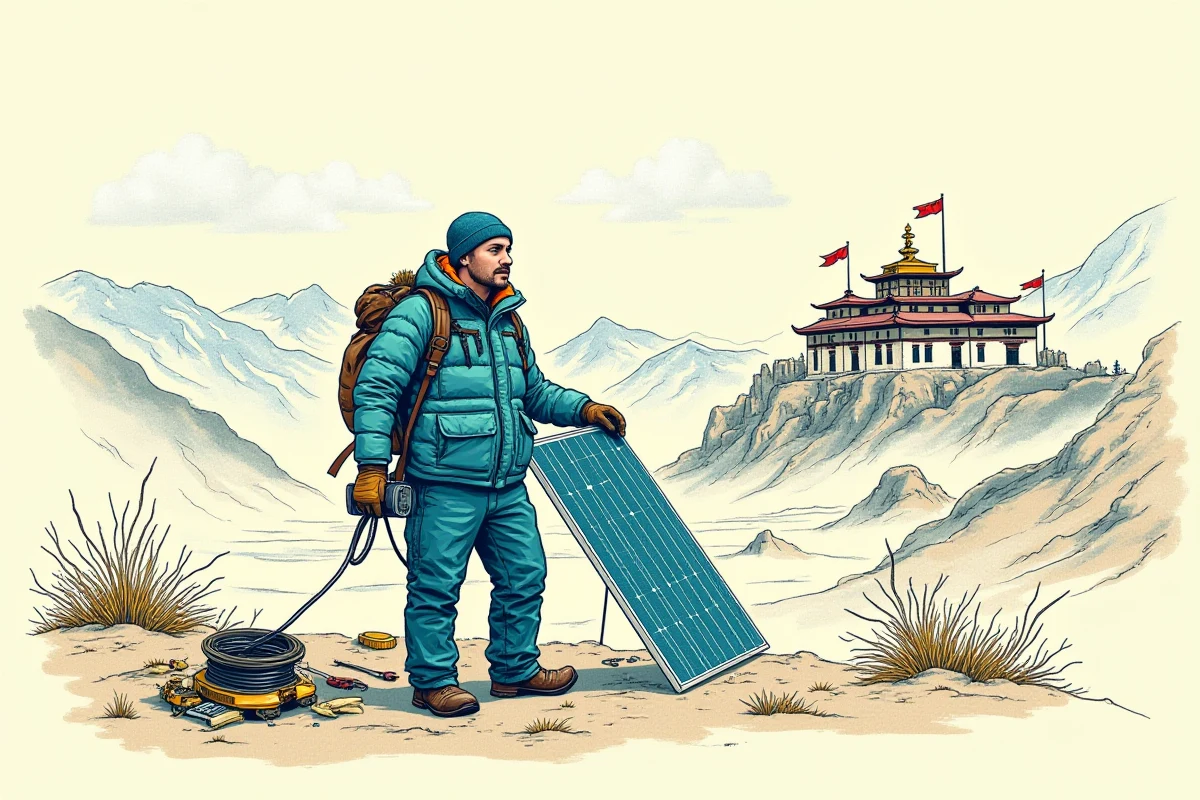
The Leh plateau sits at 3,500 metres above sea level, where winter temperatures drop to −30°C and snow closes the only two highways — the Manali-Leh and the Srinagar-Leh — for five to six months a year. When the passes freeze, Leh and its surrounding villages become islands: unreachable by road, dependent on air cargo for critical supplies, and off-grid from the national power network.
The Solar Plateau
For the 274,000 people who live here — spread across 59,146 square kilometres of high-altitude desert — electricity is not a guarantee. Remote villages like Sumur, Panamik, and Khardung in Nubra Valley, or Tso Moriri and Tso Kar in Changthang, are too distant for grid extension. The nearest power station is in Leh city, 100 km away by mountain road. During winter isolation, even emergency repairs can take weeks. So for half the year, these villages rely entirely on diesel generators (expensive, unreliable, polluting), small hydro installations (frozen pipes, low flow), or solar — which works year-round, even in Ladakh's low-angle winter sun.
Solar electricians like Tenzin have become essential infrastructure. Tenzin, 32, from Leh town, has spent the last eight years installing rooftop solar systems on government buildings, monasteries, lodges, and private homes across Leh and Nubra Valley. He knows the practical work: how to string panels on ice-prone roofs without slipping, how to size a charge controller for the thin air and extreme temperature swings, how to diagnose a dead battery in −20°C cold when you're wearing so many layers you can barely use your fingers. He's trained five apprentices, two of whom now run their own small installation businesses. In summer, when roads are open and tourists arrive, solar installations boom — government contracts, lodge upgrades, emergency microgrids for nomadic herding communities. Tenzin makes ₹1,800–2,200 per day, sometimes more on premium rooftop jobs.
But for the last eighteen months, Tenzin has been stuck.
The Wall
NTPC Solar Ladakh is building a 10 MW solar farm near Leh — the first phase of Ladakh's path to carbon neutrality by 2050. The project will create hundreds of installation and maintenance jobs, all certified positions paying ₹2,400–3,000 per day with year-round work. A local contractor recruiting for the project told Tenzin they want his crew. They need experienced installers, and Tenzin's practical knowledge is solid.
But there's a gate: MNRE (Ministry of New and Renewable Energy) solar PV certification. NTPC requires it. The government requires it for any large-scale solar contract. And more painfully, banks require it for loans.
Tenzin had heard about MUDRA — the government's collateral-free lending scheme for small business equipment and expansion. ₹5 to ₹10 lakh could transform his work: buy a used van to haul panels and tools (cheaper than paying motorcycle transport daily), purchase a quality charge controller test rig (currently he borrows one from a supplier), build a small workshop in Leh where he could train apprentices and store inventory year-round. Without a collateral-based business loan, his growth was capped.
In November 2024, he walked into a bank in Leh with MUDRA loan documents. The loan officer looked at his work history, his client list (all verifiable), his demonstrated technical competency. She began filling the application form, then paused at a checkbox: "MNRE or NSDC certification required for solar trade loans."
"Do you have certification?" she asked.
Tenzin shook his head.
"Then I can't process this. We need a certificate from an MNRE-approved centre. You'll have to get trained."
Tenzin left with photocopies of certification requirements. The nearest MNRE-certified training centre was in Srinagar — 512 km away. The next was Chandigarh — 970 km away. Both involved six to twelve weeks of full-time courses, living away from home, traveling costs, and lost work income during the high season.
In Leh, the closest government institute is ITI Leh, which offers basic electrical training but not MNRE solar PV certification. There's no dedicated solar centre, no apprenticeship pathway that meets MNRE standards, and no online option that Leh's CSC (Common Service Centres) could support for practical assessments.
The timing was catastrophic. Winter was coming. High-season work would be gone in three weeks. Travel to Srinagar in December would mean crossing the pass before it froze — doable but dangerous. But more fundamentally, leaving Leh for two months would mean abandoning his clients, losing winter installation requests from monasteries and government buildings, and returning in February to a depleted savings account.
"Why should I have to leave Ladakh to prove what I already do every day?" Tenzin asked his wife, Dolma, in Ladakhi over butter tea.
He didn't travel. The loan application expired. The NTPC Solar Ladakh opportunity stayed out of reach.
The Tension
By spring 2025, Tenzin had watched two younger solar installers from Leh complete MNRE training via a sponsored government program (run by the Ladakh Department of Labour for BRO contractors). They came back certified, and within weeks, both were placed with NTPC Solar Ladakh at ₹2,600 per day. One got a MUDRA loan for a van and workshop space. The other was saving aggressively to apply.
Tenzin had taught both of them. He'd trained the first one for three summers before the boy moved to Srinagar. The second had been his apprentice for two years. Both were technically sound, but neither had his breadth of troubleshooting experience or his reputation in remote village work. And now they had the certificate that unlocked better contracts and loans — he didn't.
"The system doesn't care what you know," he told a fellow electrician over chai at a Leh marketplace vendor. "It cares what you can prove. And to prove it, you have to leave."
The frustration wasn't just about the loan anymore. It was about being locked out of a future he'd built with his own hands — not because he lacked skill, but because the infrastructure to validate that skill was broken.
"There are maybe eighty electricians doing solar work in Ladakh right now," Tenzin said. "Most of us are not certified. The work is there. The skill is there. The certification system is the bottleneck, and it's designed for people who can afford to disappear for three months."
His wife, Dolma, suggested a different approach: online courses. "Why can't you study in the evenings after work?"
Tenzin checked. MNRE does recognize some online theory modules, but practical assessments still required in-person verification at an approved centre. And most online programs assumed 9-to-5 availability — designed for unemployed workers seeking retraining, not practising electricians fitting education around seasonal work.
By May 2025, Tenzin had been in limbo for seven months.
"ང་གིས་སོལ་ནུས་པའི་ལས་ཀ་རྒྱུན་གཞི་སྦྱོར་དེ་གོ་བདེ་པོ་ཡིན། ངེ་ཚ་མེད་པའི་ལས་ཀ་གཉིས་གྱི་སྟེགས་བུ་ལ་འདྲེས་མཐུན་བྱེད་ཀྱི་རེད།""I understand solar work well enough. Without papers, I'm competing with two people who have the same skills but got certified while I was still working."
— Tenzin, Solar Electrician, Leh (Translated from Ladakhi)
What Changed: GabFORGE Bridges the Digital Gap
In June 2025, a project came to Leh called GabFORGE Skilled Trades Navigator — a digital platform designed to map state-level certification and scheme pathways for workers in high-barrier regions (remoteness, seasonal work, low digital literacy, migration).
Tenzin was invited to a workshop at the Leh Labour Department office. The GabFORGE team showed him something he hadn't seen before: a structured online + apprenticeship hybrid pathway for MNRE solar PV certification.
The model was:
- Weeks 1–8: Online theory modules (asynchronous, can study evenings) covering solar system design, safety, electrical calculations, and installation procedures — all MNRE-aligned.
- Weeks 9–10: Practical apprenticeship (onsite, either at a local contractor like NTPC or through an ITI Leh partnership) where a certified mentor supervised real installations.
- Week 11: Final assessment at an MNRE-approved online proctoring centre (newly available in Leh through a CSC partnership).
The key difference: the practical component happened locally, not 500 km away. Tenzin could do the theory work in his evenings, take two weeks off for intensive apprenticeship-style work (which he'd do anyway during the on-season), and finish assessment in Leh.
The GabFORGE platform also had one more layer: Hindi support and Ladakhi UI labels. Most MNRE certification materials were in English and government Hindi. The GabFORGE version had vocabulary built for electrical work (सौर पैनल = solar panel, बैटरी चार्ज कंट्रोलर = charge controller) translated carefully with industry input. For Tenzin, whose Hindi was conversational but not technical, and whose Ladakhi was native, the bilingual interface meant he could move between learning languages without breaking comprehension.
"This is different," he said to the GabFORGE facilitator, Pema, who was herself from Leh. "I don't have to leave home."
Tenzin pulled up the GabFORGE agent on the workshop tablet and typed a question in Hindi: "क्या यह MNRE सर्टिफिकेट MUDRA लोन के लिए मान्य है?" — Is this MNRE certificate valid for a MUDRA loan?
"हाँ। MNRE सोलर PV सर्टिफिकेट — चाहे ऑनलाइन प्रॉक्टर्ड हो या सेंटर से — MUDRA किशोर लोन के लिए मान्य है। पोर्टल पर देखें: mudra.org.in/solar-trade — वहाँ सोलर इलेक्ट्रीशियन ट्रेड के लिए योग्यता की सूची है। CSC प्रॉक्टरिंग MNRE द्वारा मान्यता प्राप्त है।"
(Yes. An MNRE Solar PV certificate — whether proctored online or at a centre — is valid for a MUDRA Kishore loan. The eligibility list for the solar electrician trade is on the portal at mudra.org.in. CSC-based online proctoring is MNRE-recognised.)
"And the banks recognize this path?" his wife asked Pema.
"Yes. The MNRE certification is the same. The online proctoring is verified by the same agency. When Tenzin completes it, he'll have a certificate with the same credential weight as someone who trained in Chandigarh."
Tenzin signed up in June. He started the online modules in July, working through solar system design and safety protocols on a tablet his daughter's school had taught him to use. By August, with the high season ramping up, he took two weeks to work alongside an NTPC Solar Ladakh site supervisor on the farm's installation phase — technically an apprenticeship, but it was work he'd otherwise do anyway. In early September, before the September/October wind storms that make rooftop work dangerous, he took the final practical assessment (proctored via video at the Leh CSC, with an MNRE-certified assessor in Srinagar observing in real time).
By October 2025, Tenzin had his MNRE Certificate in Solar PV Installation and Maintenance.
The MUDRA Path Opens
With the certificate in hand, Tenzin returned to the same bank in October 2025.
The loan officer, a woman named Dawa (also from Leh), reviewed his new documentation. MNRE certificate, check. Work experience letters from NTPC, three monasteries, and the Leh Municipal Corporation, check. Client references and three years of consistent work history, check.
"Congratulations," Dawa said. "This is approved."
The loan was sanctioned at ₹5,50,000 under MUDRA Kishore (for enterprises up to 5 years old). Tenzin used the money to:
- Vehicle: ₹2,10,000 for a used Mahindra Bolero van (reliable for high-altitude work, good weight distribution for rooftop equipment)
- Testing equipment: ₹1,20,000 for a quality solar irradiance meter, charge controller analyzer, and wiring test kit (previously he'd borrowed these from suppliers)
- Workshop space: ₹1,20,000 for six months' rent and basic setup (shelving, tools, a workspace for training apprentices)
By November 2025, Tenzin's business had shifted. He wasn't just an electrician taking day-work anymore. He had a vehicle that reduced logistics costs (he could now haul 3–4 jobs' worth of panels in one run instead of hiring transport for each). He had his own testing equipment, which meant faster diagnostics and premium rates for complex troubleshooting. And he had a workshop, which meant he could take on small equipment repairs during winter (when installation work halts) and train new apprentices year-round.
Within three months, his daily rates had moved to ₹2,400–2,700 for standard work, and ₹3,200+ for diagnostic and repair work. And in January 2026, NTPC Solar Ladakh called: they had hired him as a part-time maintenance consultant for the Phase 1 farm at ₹4,500 per day plus a retainer.
The Infographic: From Stuck to Scaled
Why We Built This: The Certification Gap in Remote Regions
The wall that trapped Tenzin isn't unique to Ladakh. Across India's skilled trades, remote workers face a structural mismatch: certification systems are designed for workers who can relocate or afford to commute, but work is geographically dispersed and often seasonal.
In Ladakh specifically:
- Road closures mean seasonal isolation is absolute — you can't retrain during winter even if you wanted to, because highways are impassable.
- Small population density (274,000 across 59,000 sq km) means training centres aren't economically viable locally; the nearest hubs are 500+ km away.
- Migrant-majority workforce (70–80% of skilled workers are from UP, Bihar, Himachal Pradesh) means workers often can't afford extended leave from high-season work.
- Certification-to-loan linkage creates a double bind: MUDRA loans unlock growth capital, but banks enforce certification requirements that the worker can't access without leaving.
The MNRE's online + proctoring infrastructure exists, but it wasn't operationalized for regional adaptation. No training hub had built the locally-partnered, asynchronous-theory, locally-practiced apprenticeship model that would work for Ladakh's seasonal cycles and CSC-based infrastructure.
GabFORGE's Skilled Trades Navigator platform filled that gap by:
- Mapping regional certification pathways (MNRE, NSDC, PM Vishwakarma, ITI, etc.) at the state and district level
- Identifying local partners (CSCs, ITIs, contractors) who could facilitate practical components
- Designing asynchronous online modules aligned to MNRE standards (in English, Hindi, and regional languages like Ladakhi)
- Creating proctoring infrastructure that works with CSCs (already distributed, trusted, accessible)
- Validating the pathway with banks (MUDRA lenders) so certification carries the same weight as in-centre training
For Tenzin, the platform was the permission structure: it said, "You can learn this without leaving. You can grow without sacrificing this season's work. The certificate you'll get is recognized at the same level as someone who trained in Chandigarh."
What We Hope Happens
Tenzin is one person. But in Ladakh, the model is already spreading.
By late 2025, two other electricians in Leh had enrolled in the hybrid pathway — one of them, Dorje, already NTPC-employed and looking to upskill on battery diagnostics. The Leh Labour Department has committed to running the program quarterly. CSC operators report growing CSC-based proctoring requests, which means the digital assessment infrastructure is becoming normalized.
More broadly, we're watching three outcomes:
Outcome 1: MUDRA Uptake We expect 15–20 more MUDRA loan applications from Ladakh skilled workers by end of 2026, most from certified electricians and masons. Each loan averages ₹4–6 lakh and typically rotates into vehicle ownership, tool inventory, and workshop setup — the capital that moves workers from daily-wage to equipment-owner economics.
Outcome 2: NTPC Solar Ladakh Placement Pipeline NTPC Solar Ladakh Phase 2 (500+ MW pipeline) will need 200–300 certified installers and maintenance technicians by 2028. Currently, Ladakh can supply maybe 12–15. The hybrid certification pathway should grow that pool to 60–80 by end of 2027, reducing reliance on imported expertise from Chandigarh/Delhi.
Outcome 3: Hindi Accessibility & Language Normalization One quiet outcome: Tenzin and Dorje's success is normalizing Hindi technical vocabulary in Ladakh's skilled trades. The GabFORGE platform publishes glossaries and study guides. CSCs are printing bilingual reference sheets. ITI Leh is asking whether they can adapt the online modules for their own electrical courses. Language access isn't flashy, but it compounds — over time, it means fewer workers hit the "I don't understand the technical English" wall.
The Work Ahead
Not everything is solved. Tenzin still faces real constraints:
Winter Work Isolation Even with certification and a loan, he still loses 4–5 months of income during winter. The van and equipment help him diversify into maintenance and repair work (which can happen indoors in a workshop), but year-round income stability still requires additional schemes — like a winter relief fund (ad hoc in Ladakh) or a seasonal savings cooperative.
Altitude and Health Risk His work involves frostbite hazard, altitude sickness exposure, and occasional falls from roofs. The SEHAT health scheme covers accident hospitalization, but the coverage is patchy for non-registered workers. He's now registered with the Ladakh UT BOCW Board, but enforcement is still weak.
Apprenticeship Sustainability Tenzin has trained six people now, two of them now independently working. But apprenticeship is informal — no wage protection, no graduation pathway into formal certification. If one of his apprentices gets hurt, liability is murky. He's asked the Leh Labour Department about formalizing apprenticeship contracts; the answer is "eventually, but we don't have the bandwidth yet."
Scale Beyond Leh The hybrid pathway works in Leh because there's CSC infrastructure, an ITI, and NTPC projects nearby. In remote district towns like Kargil or village clusters like Nubra, CSC coverage is spotty and contractor partnerships don't exist. Scaling beyond Leh will require either satellite CSCs or traveling assessment teams.
How GabFORGE Works Here
The GabFORGE Skilled Trades Navigator is free for workers, banks, and government partners. Tenzin never paid a platform fee. The Leh Labour Department uses the dashboard to monitor certification pipelines and match skills to government contracts. MUDRA lenders use the credentials validation layer to speed loan approvals.
GabFORGE earns no direct revenue from this pathway. Instead, the model is:
- Government partnership funding — Ladakh Labour Department contributes to operational costs in exchange for labour market data and scheme effectiveness reports.
- Scale across regions — The platform is built once, deployed to all remote-work regions (Himachal Pradesh, Uttarakhand, Jammu & Kashmir, Arunachal Pradesh, Sikkim). Each region adapts the online modules and local partnerships; the proctoring and validation layer is shared.
- Ecosystem benefit — Better-certified workers mean stronger supply chains for government contractors (BRO, NTPC, state infrastructure projects). Those contractors represent a sustainable revenue stream for the platform if it someday operates as an independent entity.
For now, it's volunteer-run by a core team in Bangalore and Leh, funded by grants and labour department partnerships. Tenzin is part of an open-source feedback loop: every month, he reports back to Pema on what worked and what didn't in the pathway.
In Closing: The Certification Wall Is Not the Worker
Tenzin doesn't tell this story as a tragedy that was solved. He tells it as a gap that shouldn't have existed.
"I had the skill. I had the work. I had clients. The only thing missing was permission on a piece of paper. And to get that permission, I had to leave. If I had left, I would have lost the thing I was proving I could do."
The certification wall in Ladakh isn't about worker incompetence. It's about a training and validation system designed for a different geography — one where certification centres are common, workers are settled, and offline assessment is the default. When you plop that system into a remote, seasonal, isolated region, it breaks. Not because the region is broken, but because the system has assumptions that don't hold.
GabFORGE's approach isn't to lower standards. It's to keep standards high while making access local. Tenzin's MNRE certificate is worth the same as anyone's. The assessment was rigorous. But he didn't have to sacrifice a season's income or leave his family for two months to earn it.
By October 2025, Tenzin had his certificate, his MUDRA loan, his van, his workshop, and a new trajectory. By January 2026, he was on NTPC's payroll. By March 2026, he'd trained his apprentices to the point where they could take on routine installations independently, freeing him for diagnostic and design work at premium rates.
"The work was always there," Dolma said, looking at the workshop — a simple room with equipment racks and a workbench. "He was always skilled. What was missing was the official permission, and the permission was locked behind a wall."
Now the wall had a door. And the door worked.
Schemes That Open This Path
| Scheme | What It Does | How Tenzin Used It |
|---|---|---|
| MNRE Solar PV Certification (via GabFORGE hybrid pathway) | Nationally-recognized credential for solar electricians; required for NTPC contracts and government loans | 8-week online theory + 2-week apprenticeship + local proctoring = certificate without leaving Ladakh |
| MUDRA Kishore (mudra.org.in) | Collateral-free loans ₹5–10L for small business equipment and expansion | ₹5.5L approved once certified; used for van (₹2.1L), tools (₹1.2L), workshop (₹1.2L) |
| NTPC Solar Ladakh Jobs (ntpcsolar.com) | Employment for certified solar technicians; ₹2,400–3,000/day standard, ₹4,500+/day for specialist roles | Hired as part-time maintenance consultant post-certification; ₹4,500/day retainer |
| Ladakh UT BOCW Board Registration (labour.ladakh.gov.in) | Welfare board for construction workers; accident insurance, pension eligibility, contractor transparency | Formal registration once self-employed; protects against liability during apprenticeship training |
| CSC Proctoring Infrastructure (csc.gov.in) | Distributed assessment and certification delivery; reduces distance to testing centres | Used for final MNRE assessment (proctored via video at local Leh CSC) |
| PM Vishwakarma (pmvishwakarma.gov.in) | Not directly used by Tenzin, but relevant for traditional craftspeople in Ladakh (Thangka painters, carpet weavers) | Ladakh expansion opportunity if PM Vishwakarma adds trade-upskilling and equipment support tiers |
| PMKVY (pmkvyofficial.org) | Skill India government training subsidy; covers course fees for eligible workers | GabFORGE online modules can be PMKVY-funded; Tenzin paid nothing for theory training |
Key Resources
- Ladakh UT Labour Department: https://labour.ladakh.gov.in/ — BOCW registration, government scheme updates
- MNRE Solar Certification Pathways: https://www.mnre.gov.in/ — official solar PV standards and approved training centres
- MUDRA Loan Portal: https://mudra.org.in/ — collateral-free lending for small trades and micro-enterprises
- NTPC Solar Ladakh: https://ntpcsolar.com/ — employment and apprenticeship opportunities
- CSC e-Governance Services: https://csc.gov.in/ — nearest CSC for online assessments and registration
- GabFORGE Skilled Trades Navigator: Coming to your region soon — follow updates at gabforge.ai for launch in Himachal Pradesh and Uttarakhand (2026–2027)
- e-SHRAM Registration: https://eshram.gov.in/ — free digital worker identity for informal sector jobs
- NCVT-MIS Certification Search: https://ncvtmis.gov.in/ — verify trainer and centre credentials
This story is part of GabFORGE's Skilled Trades series. We document how workers navigate government schemes, certification systems, and capital access in remote and seasonal regions. If you're a skilled worker in a remote area facing a similar certification or access barrier, or if you're running a training program and want to be part of the GabFORGE pathway network, get in touch at [email protected].