
The Mumbai Electrician and the RERA License Wall
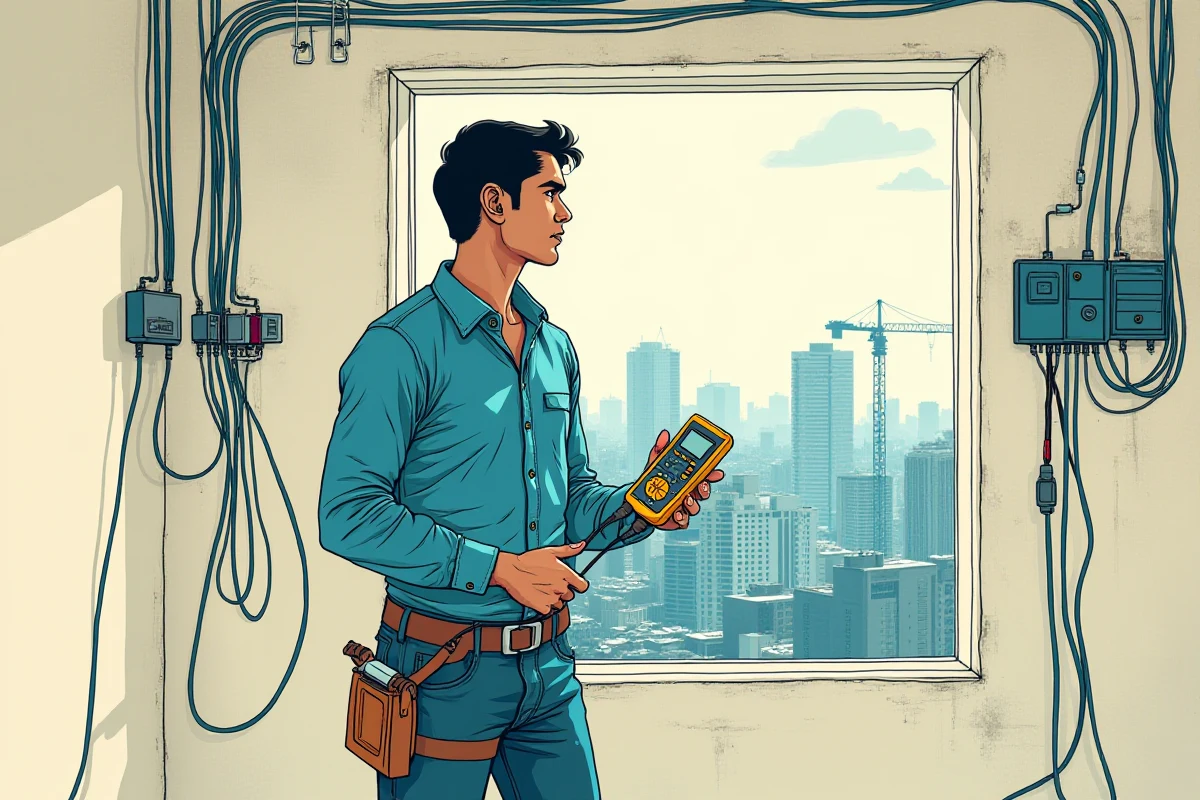
Rajesh wakes at five, drinks chai in the dark, and checks his phone for a message from Suresh—his contractor, the man who calls with work, always site-to-site, always cash. Some days it's Andheri. Some days it's Bandra. Some days there's no call at all. He has been wiring Mumbai high-rises for twelve years. He can thread cable through concrete slabs that were poured two days ago. He can troubleshoot a panel fault by sound alone. He knows the NEC and Indian Standards by heart. He earns ₹1,800 per day on good months and maybe ₹8,000 total in July.
He lives in Dada Nagar, a neighbourhood in Andheri East where rent takes a third of his income. His wife, Priya, works as a housemaid in three flats nearby, earning ₹3,000 a month. Their daughter, Anjali, is six. They have saved ₹2,80,000 in a post office account over the last five years—meant for her school fees.
Last month, Suresh told him about a job. A new RERA-registered tower in Borivali, 47 storeys, ₹120 crore project. The electrical contractor—a formalised company with an office, a website, invoices in triplicate—needed a crew. Three months of work. ₹2,000 a day. Rajesh could have earned ₹1,50,000 over twelve weeks. Could have paid for a year of Anjali's school, saved another ₹80,000. Suresh called him back two days later: the builder's compliance team ran a check. Every electrician on the project had to be registered under RERA. Licensed. Credentialled. Rajesh, who had wired forty high-rises without a single safety incident, without a single callout, could not bid.
🔌 The Credential Wall
RERA—the Real Estate (Regulation and Development) Act, enacted in 2016—transformed Mumbai's construction landscape. It was meant to protect buyers and impose financial discipline on developers. It did both. It also created a wall. Not with intent. With bureaucracy.
All electrical and plumbing work on RERA-registered projects (meaning projects worth ₹20+ crores or on registered land with registered agreements) requires the contractor to hold a RERA electrical contractor license. The license costs ₹5,000 to ₹10,000 in registration fees. The Maharashtra RERA office estimates 4-6 weeks for approval. But there is a threshold: you must prove three years of experience on registered projects. Not informal work. Not twelve years of cash-paid installations. Registered project experience, documented on invoices, with letters from builders, with audited records.
Rajesh has no invoices. His paycheques are sometimes a paper slip, sometimes a mobile payment, sometimes cash handed on site by a foreman. His employers are contractors who work through contractors. There is no paper trail upstream. When he applies for the RERA license, the application asks: Provide proof of three years of electrical work on registered projects. He has nothing to provide.
He is not alone. The Maharashtra BOCW Board (Building and Other Construction Workers Board) estimates that Maharashtra has 45+ lakh registered construction workers across all trades. The RERA-regulated segment—projects large enough to require licensed contractors—accounts for perhaps 5-10% of total construction work by value, but it is growing fast. Every builder with a registered project now must hire licensed electrical contractors. Every licensed contractor can only hire registered workers or can show they have hired through formal agencies. Informal workers are simply not eligible. The formalisation creates two castes of electricians in Mumbai: the licensed and the invisible. Rajesh is invisible.
The financial stakes are real. A licensed electrical contractor can bid on projects worth ₹50 lakhs upward. In Mumbai's construction boom, this is where the steady work is. Three-month continuity, not daily gigs. Insurance. Sometimes travel allowance. A ₹2,000-per-day formal electrician on a continuous project earns ₹4,00,000 over twelve weeks. Rajesh, cycling between projects, between contractors, loses this pipeline. He cycles back to Suresh, back to ₹1,800 a day, back to the uncertainty.
What will it take to formalise him?
- 📋
Gather Experience Proof
Collect letters from past builders, invoices if any exist, bank statements showing deposits from electrical work. RERA requires 3+ years on registered projects. Rajesh has 12 years total, but only 2-3 years of which overlaps with RERA projects (2018 onwards). Building-owner letters are often refused—owners don't keep records, or the contractor is bankrupt.
- 💰
Compile Registration Documents
Form 1A registration (₹5,000 fee), proof of qualifications (ITI diploma or equivalent), liability insurance (₹50,000-100,000 annual), GST registration (₹0 but compliance burden), PAN, Aadhaar, two years of audited financials if claiming annual revenue. Most informal contractors have no audited financials.
- 🏛️
Submit to RERA Maharashtra
Portal: maharashtra.rera.gov.in. Application takes 4-6 weeks. RERA office verifies prior projects by contacting builders—builders often don't respond or have no records. Delays common. Rejections happen silently; appeals unclear.
- ✅
Receive License & Bid
Once approved, listed on RERA contractor registry. Eligible to bid on all registered projects. Annual renewal ₹2,000-5,000. Compliance audits every 2 years. Exposure to project audits, buyer complaints, regulatory penalties if work fails inspection.
The path from informal to formal has three concrete barriers.
First: Proof of prior work. Rajesh needs letters from builders confirming he worked on their projects. But builders are reluctant to generate historical letters—they assume it creates liability, opens audit doors, or exposes them to claims if past work fails inspection years later. When Rajesh contacted three builders whose projects he'd worked on, all three declined or ghosted. One builder's office had moved; the project manager was retired. Another builder's company had been liquidated in a debt restructuring. The third builder replied: "We cannot certify workers on record; get your contractor to apply as the primary electrician."
Second: Financial documentation. RERA applications ask for two years of audited financials if you claim annual turnover above ₹10 lakh. Rajesh earns roughly ₹1,80,000 per year now, but his income is scattered across four contractors, paid sometimes cash, sometimes by cheque. He has no audited statement. To build one, he would need to hire a CA (chartered accountant), which costs ₹8,000-15,000 per year. The application fee is ₹5,000; auditing his non-existent business costs three times that.
Third: Compliance overhead. Once licensed, a contractor must maintain GST records (₹5,000-10,000 annual CA fees), carry project liability insurance (₹50,000-1,00,000 annually), respond to RERA audits, and ensure workers are registered under BOCW. A single-person operation like Rajesh cannot absorb this. A formal electrical contracting company with five employees and steady project flow can. Rajesh—working in a fragmented gig landscape, site-to-site—cannot.
📊 The Scale of Invisibility
How many Rajeshs are there? RERA Maharashtra data shows 12,000+ registered electrical contractors (formal companies). The BOCW Board shows 4.2 lakh electricians in Maharashtra. The gap is absurd. For every registered contractor, there are 35 working electricians. Most are invisible to regulation.
A 2024 survey by the Bombay Chamber of Commerce found that 60% of skilled trades in Mumbai construction operate informally or semi-formally. Electricians are among the highest-skilled—they have ITI training, they have years of field experience—yet they remain locked out of the regulated ecosystem. The reason is not competence. It is documentation.
Project continuity is where this cost becomes visible. A RERA-registered project lasting 18-24 months provides continuous work. An informal electrician like Rajesh works 15-18 days per month, average. A formal electrician on a registered project works 26 days per month, guaranteed. Over a year, that is a difference of ₹2,00,000 in annual income. Over a decade, it compounds: a formal electrician can save ₹5-10 lakhs, build a house, educate two children. An informal electrician like Rajesh accumulates almost nothing. His post-office savings account, ₹2,80,000 at age 34, will likely never grow faster than ₹20,000-30,000 per year. At 65, if he stops working, his family survives on his wife's housemaid income, on Anjali's job, on whatever his daughter builds.
This is the silent cost of the formalisation wall: not that informal work disappears, but that informal workers fall further behind, generationally.
Rajesh speaking to Suresh, after the Borivali project fell through:> "Babuji, mere paas jo hai vo kaafi nahi hai? Barah saal kaam kiya, kabhi koi complaint nahi. Ab mujhe proof chahiye kya? Aur builder ko bhi document chahiye? Ye sab ke liye paise aur samay dono chahiye. Mera naam list mein nahi aayega."
[In English: "Sir, isn't what I have enough? Twelve years of work, never a complaint. Now I need proof? And the builder needs documents too? All of this takes money and time. My name will never get on the list."]
Suresh replied quietly: "You need an agent. Someone with a license. You work under them. That's the only way now."
💡 What Changed
Last week, Rajesh's neighbour, Vikram—who works in IT and knows about government portals—asked Rajesh why he wasn't registered under RERA. Rajesh explained the barrier. Vikram said: "Let me show you GabFORGE. It's an AI assistant for schemes and paperwork. Free." He helped Rajesh sign up. Within 20 minutes, Rajesh was in a conversation with the agent. He spoke in Marathi. The agent understood. He asked questions. The agent listened.
Rajesh: Mala electrician contractor license ghetayche. Pan RERA ne mhantat kya 3 saal experience chahiye. Mala documentation nahi ahe.
[I want to get an electrician contractor license. But RERA says I need 3 years of experience. I don't have documentation.]
Agent: Samajun takla. Pahilya, RERA contractor license ghetayan kya steps ahet, ha samajayachi. Doosra, tumcha experience documented karanyasathi konti schemes ahet, ha samjvun takla.
[I understand. First, let me explain the steps to get RERA contractor license. Second, let me find what schemes can help document your experience.]
The agent then walked him through five possibilities:
1. RERA Direct Application: Listing specific forms and documents needed. The agent clarified that "registered projects" means projects registered in the RERA system after 2016—a definition Rajesh had misunderstood. He thought RERA meant only new large projects; in fact, even redevelopment projects with formal registered contracts qualify. This narrowed his pool, but clarified it. Forms available at maharashtra.rera.gov.in. No shortcuts. But the pathway was now explicit.
2. Affidavit Route: For workers whose builders are defunct or unresponsive, a notarised statutory declaration (affidavit) signed by the worker and verified by two independent witnesses who worked alongside him, can serve as partial proof. Rajesh has three colleagues—electricians from other sites—who could sign as witnesses. Cost: ₹500 for notary. Time: one afternoon.
3. BOCW Registration (₹100 one-time, ₹100 renewal every five years): The Maharashtra BOCW Board, separate from RERA, registers construction workers and provides health insurance, accident cover, and education scholarships for children. Registration itself requires no experience proof—just Aadhaar and proof of work as a construction worker. A letter from Suresh (his current contractor) stating "Rajesh is employed as an electrician" suffices. BOCW registration does not qualify him for RERA, but it is a formal record. Employers often prefer BOCW-registered workers; it reduces their compliance burden. The agent noted: "This will make you eligible for Suresh's projects, and it builds your formal profile."
4. MUDRA Loan: Once BOCW-registered, Rajesh can apply for a MUDRA loan (Micro Units Development and Refinance Agency) up to ₹1 lakh at 8-10% interest. The scheme supports microentrepreneurs. If Rajesh formalises as a sole proprietor electrician (registering a business name, opening a bank account, getting PAN), he could borrow ₹1 lakh, use ₹5,000 for RERA application and ₹50,000 for liability insurance and compliance setup, and retain ₹45,000 as working capital. The loan is repayable over 3 years at ₹3,300/month. On a ₹2,000-a-day income, this is tight but possible—especially if the loan accelerates him into formal projects paying ₹2,200-2,500/day.
5. Incremental Credentialism: The agent noted that Rajesh has been wiring for 12 years but has no formal qualification (ITI, NCVT, or SCERT certificate). If he enrolls in a 3-month ITI electrician bridging course (available at ITI Mumbai, cost ₹12,000-15,000, often subsidised by NSDC for age under 40), he gains a credential respected by RERA. An ITI certificate + BOCW registration + two builder affidavits = sufficient proof for 3 years of experience. The ITI course, combined with his 12 years of informal work, would make him formally credentialed. RERA would likely accept this stack.
The agent then summarised the sequence:
Month 1: BOCW registration (₹100, one week). Get Suresh's letter of employment.
Month 2: Affidavit from two colleague-witnesses (₹500, one day). Enrol in ITI bridging course (₹12,000, starts next intake).
Months 3-5: Complete ITI course while working. Document electrician role and experience via letters and affidavits.
Month 6: Apply for MUDRA loan (₹1 lakh). Simultaneously, submit RERA application with stacked proof: ITI certificate + BOCW registration + affidavits + MUDRA loan statement showing formalisation intent.
Month 7-9: RERA processing (4-6 weeks typical). Use MUDRA loan to pay insurance, GST setup, contingency. Conditional approval or full approval.
Month 10: Once approved, Rajesh is now eligible to bid on RERA projects. His daily rate jumps to ₹2,200-2,500. His job continuity rises (3-month minimum projects vs. daily contracts).
The agent also shared a calculator: Rajesh's income projection.
Current (informal): ₹1,800/day × 15 days/month (assuming 50% downtime) = ₹27,000/month = ₹3,24,000/year.
Post-RERA (formal, first year): ₹2,300/day × 26 days/month (assuming 80% utilisation on continuous projects) = ₹59,800/month, minus ₹3,300 MUDRA repayment = ₹56,500/month = ₹6,78,000/year.
Incremental: ₹3,54,000 per year more. Over three years (MUDRA payback period): ₹10,62,000 gross additional income. After repayment (₹1,18,800), net gain: ₹9,43,200 over three years.
Rajesh saw the numbers and sat quietly for a moment.
Informal (Current)
Formal (RERA Licensed)
Difference (3-year cumulative)
🧭 Why We Built It
Rajesh is not an outlier. Construction in India is 97% informal. Maharashtra alone has 45+ lakh construction workers. RERA applies to roughly 5-10% of construction work by value—the expensive urban residential and commercial projects. As RERA-regulated projects grow (projected 40% of new construction by 2030), the invisible workers face an expanding wall. They are not unskilled. They are not poor workers. They are simply undocumented. The schemes exist—RERA contractor pathways, BOCW registration, MUDRA loans, ITI bridging—but they are scattered across different portals, different eligibility gates, different application cycles. No one tells them how the pieces fit. No one explains the sequence. No one translates the forms from bureaucratic English into Marathi or Hindi. A worker like Rajesh cycles between contractors, hoping, never knowing that a ₹100 BOCW registration + ₹12,000 ITI course + ₹5,000 RERA application could reshape his life.
The GabFORGE agent does not replace RERA. It does not replace Maharashtra government. It simply bridges the gap: it listens, it understands which scheme applies, it explains the sequence, it provides the portal URLs, it speaks in your language. Free. No condescension. No forms. Just clarity.
This is why the free tier exists.
🌱 What We Hope Happens
Two weeks later, Rajesh visited the Maharashtra BOCW district office in Andheri with Vikram. He registered. Cost: ₹100. Time: 45 minutes. The officer was efficient. Rajesh has a BOCW registration number now. He carried it on his phone, a small screenshot. Priya saw it and asked what it meant. He said: "It means I am counted. In the government's eyes, I exist now." She smiled. She had never heard him say something like that before.
He showed the GabFORGE agent summary to Suresh. Suresh, who employs 15 electricians on various sites, was interested. He said: "If you get RERA-licensed, I can move you to the Borivali project. They need a site foreman—₹2,500 a day, and I'll nominate you." Rajesh has enrolled in the ITI bridging course, which starts next month. He will work evenings on smaller projects to cover the ₹12,000 fee. Priya said she will take on a fourth flat (housemaid work in a new building nearby) to help with the course fees. Anjali, six years old, knows her father is studying "to get a better job." She calls him "Beta Electrician" (Little Electrician, affectionately).
Over three years, if this pathway works as projected, the family will save ₹9+ lakhs. Anjali's school fees are secure. Priya might step back from housemaid work. Rajesh might hire an apprentice of his own—a young electrician from Dada Nagar who needs his first break. The invisible worker becomes visible. The informal becomes formal. The undocumented becomes documented, not because government changed, but because someone showed him the door.
This is the hope. Not a guarantee. But a pathway, in a language he understands, in a timeframe he can afford, using schemes that already exist.
If you are a skilled trades worker in India reading this—an electrician, plumber, mason, mechanic, welder, carpenter—and your experience is not on paper, you are not alone. You are one of 45+ million invisible workers. The schemes exist. The pathways are real. But they are hidden behind forms and portals and government language designed for people who have time to search.
GabFORGE is available in Marathi, Hindi, and English. Ask the agent: "I've worked [trade] for [years] but I have no formal papers. What can I do?" The agent will listen. It will tell you which scheme fits, which portal to use, which documents to gather. It costs nothing to ask.
Rajesh's phone number is not here. His life is his own, and his privacy matters. But the next electrician in Andheri, the next plumber in Borivali, the next mason in Kurla—they can do what Rajesh did. They can pick up a phone. Ask for help. And learn that the wall, while real, is not impassable. It just needs translation.