
The Patna Mason and the Benefit Gap
Rajesh Kumar was 26 when he left Patna. It was 2001, the monsoon had been weak, and the local construction market was flat. A contractor from Delhi—a man named Ashok who had worked his way up from laborer to project supervisor—passed through Rajesh's neighborhood looking for young masons. Ashok promised ₹800 a month plus accommodation, a fortune at the time in a state where daily wages for unskilled workers hovered at ₹100.
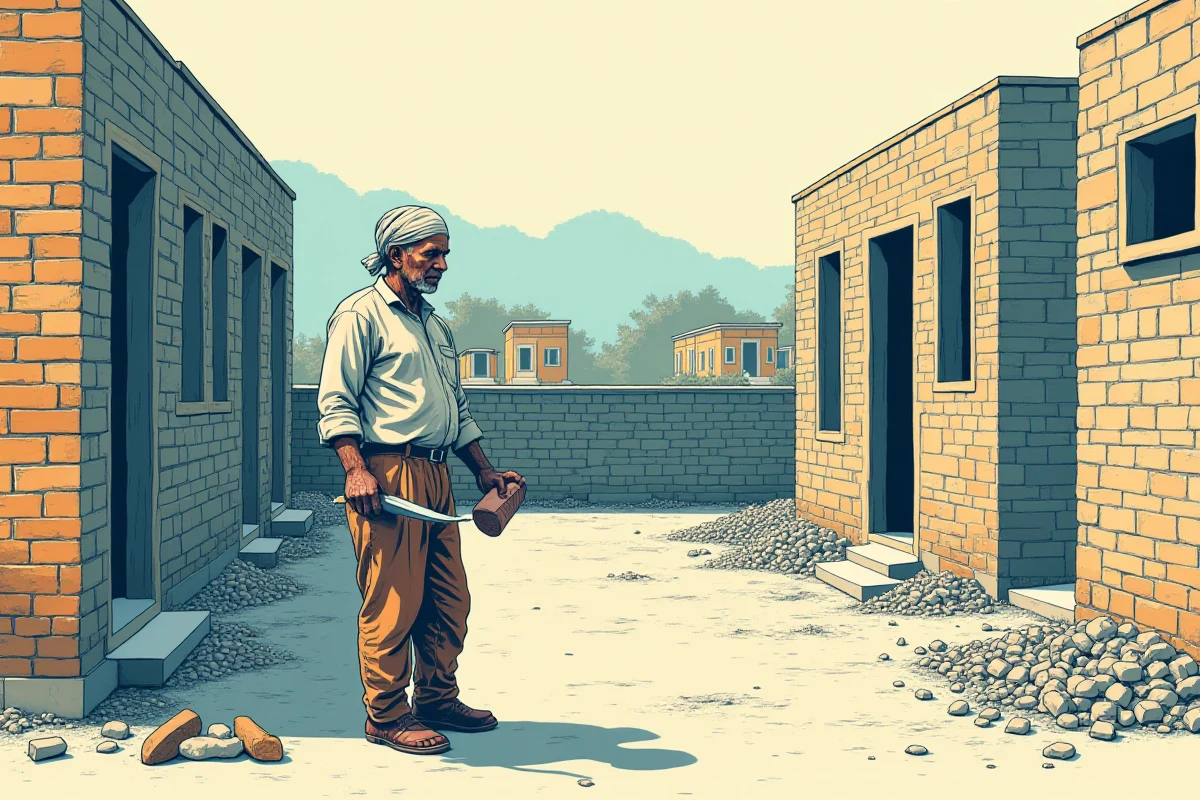
The Return
Twelve years later, Rajesh had worked on six major metro projects in Delhi. He had built residential towers in Dwarka, a shopping complex in Noida, government office renovations in New Delhi. He had trained fifteen younger workers. His skill had evolved from rough brickwork to finishing—the high-precision tiling and plaster work that commanded ₹1,200 a day. He sent money home to his mother. He married a woman from his village, and his wife joined him in Delhi. They had two children born in the city.
Then, in the summer of 2013, his father had a stroke.
The message came by phone. His father was paralyzed on his left side. His mother, then 62, was managing alone with the help of neighbors. Rajesh's only brother was in Kolkata working as a driver. The decision, though difficult, seemed inevitable. He told Ashok he would return for three months. He took a bus back to Patna.
The three months became permanent. His father recovered partially—he could move his left arm, speak clearly—but could never work again. Rajesh's mother, now in her 70s, had only his income to depend on. His wife's parents had no resources. The pull of home was stronger than the security of Delhi wages.
By the time he decided to stay, in September 2013, Rajesh had already missed two months of work. Ashok had replaced him. When Rajesh called asking about re-joining, the answer was a polite no. There were younger workers willing to travel. There was always a queue.
🧱 The Paper Trail Ends
Rajesh spent three years taking whatever work Patna offered. PMAY housing in the rural districts around Patna district. Small residential constructions. A temple renovation in the old city. The wages were ₹500 to ₹800 a day—half of what Delhi had paid. But he was home, and his father was cared for, and the work, though sparse and unpredictable, kept him visible in the local mason network.
By 2016, Patna's real estate boom had begun. Apartment blocks rose in South Patna. New residential colonies. Rajesh's reputation as someone who had worked in Delhi—who understood finishing, who could lead a small team, who could be trusted—started to matter again. By 2020, he was getting enough work to employ two younger masons and a helper. His daily rate had climbed back to ₹900 to ₹1,100. Not Delhi money, but stable.
What he didn't know, sitting in his small rented house in the Patliputra neighborhood, was that he had left twelve years of benefits scattered across a system that had no memory of him.
In Delhi, like most migrant workers, Rajesh had been informally registered with a BOCW (Building and Other Construction Workers) Board. His contractor paid the cess—a small percentage of wages deducted from workers or paid by employers. It was supposed to fund welfare schemes: accident benefits, disability pensions, maternity grants, hospitalization cover. Most workers, including Rajesh, barely understood what it was. It came out of their pay, the contractor said it was the law, and life went on.
But Rajesh had never seen a BOCW card. He had never received a benefits booklet. He had never filed a claim. In 2013, when he returned to Patna, there was no process for "transferring" his account or consolidating his contributions. The Delhi BOCW Board had no way of tracking him. The Bihar BOCW Board had no way of knowing he existed—he had returned to his home state without formal notice to either authority.
Twelve years of cess contributions—perhaps ₹30,000 to ₹40,000 accumulated—were now registered to a worker with no address, no card, no claim mechanism.
In 2023, ten years after his return, Rajesh's youngest child fell seriously ill. High fever, seizures. Three nights in a private hospital cost ₹68,000. It bankrupted the careful emergency fund Rajesh had built. He borrowed ₹40,000 from a moneylender at 18% annual interest. He was 37 years old, still working as a mason, and suddenly aware that he had no safety net.
A fellow mason, Ramchandra, who had worked with Rajesh in Delhi and also returned to Patna, mentioned one evening that he had registered with the Bihar BOCW Board. Ramchandra had been paid ₹15,000 for an accident claim from a fall on-site three years earlier. It had taken a year to process, but it had arrived.
"Why haven't you registered?" Ramchandra asked.
Rajesh didn't know. He had worked in Delhi for twelve years. He had contributed. But there was no paper. No proof. No card. Just memory.
💔 The Tension Millions Face
What Rajesh faced is the quiet tragedy of India's migrant worker system: portability exists in name only.
India has approximately 40 to 50 million seasonal and long-term migrant workers. Most move from rural states like Bihar, Odisha, Chhattisgarh, and Rajasthan to metros and industrial zones. They contribute to accident insurance boards, provident funds, and welfare schemes in multiple states over their lifetimes. But the schemes do not follow them home. When a worker returns to their home state, there is no mechanism to consolidate contributions, transfer claims, or maintain continuity. Each state BOCW Board operates as an island.
Rajesh's twelve-year cess trail in Delhi was worthless in Patna. The money was gone. The record was lost. If he had been injured in Delhi and filed a claim, he would have needed documentation—a BOCW card, a contractor's letter, medical proof—that he never had. Now, a decade later, even if he tried to reconstruct the claim, the statute of limitations had passed.
This happens to millions. A worker spends five years in Gujarat, three years in Maharashtra, four years in Punjab. They contribute ₹5,000 here, ₹3,000 there. They return home to Odisha or Bihar with no consolidated record, no benefits received, and no recourse to retrieve what they paid.
The e-SHRAM (Electronic Shram Management System) portal was designed to address this—a national database that could track workers across states. But uptake among informal workers remains low. Many, like Rajesh in 2013, didn't know it existed. Many couldn't navigate the registration process without help. The portal is technically state-independent, but the underlying welfare schemes—BOCW boards, accident insurance—are still state-controlled and fragmented.
"मैं बारह साल दिल्ली में काम करता रहा, और कोई नहीं पूछा कि मेरी पत्नी, बच्चों को क्या हुआ। अब घर आया, तो कोई रिकॉर्ड नहीं। बस याद है कि हर महीने कुछ पैसा निकल जाता था। कहाँ गया? पता नहीं।"(I worked in Delhi for twelve years, and no one asked about my wife, my children. Now I come home and there's no record. I just remember that some money came out every month. Where did it go? I don't know.)
— Rajesh Kumar, reflecting in 2023
🔍 What Changed
In late 2023, Rajesh made a decision. He was tired of guessing. He visited the Bihar BOCW Board office in Patna, a nondescript government building in the Khajekalan area.
The first clerk he spoke to was dismissive. "You have no card, no documentation from Delhi. How can we verify you worked there? We cannot help without proof."
But a second officer, whose name was Shiv Kumar, was patient. He asked Rajesh detailed questions: Which contractor in Delhi? Which projects? Which areas? Rajesh's answers were precise—he could name the buildings, the project supervisors, the years. Shiv Kumar listened, then said something that changed everything: "We can try a different approach. Let's get you registered in Bihar first. Then we can try to link your Delhi contributions."
What Shiv Kumar was describing was a pathway that existed but wasn't widely advertised: the e-SHRAM portal combined with Bihar BOCW re-registration. Here's how it worked:
e-SHRAM Registration (National Portable Base): Rajesh would register on the e-SHRAM portal using his Aadhaar and basic employment information. This created a national ID that followed him across states and was independent of any single BOCW board.
Bihar BOCW Registration: Simultaneously, Rajesh would register with the Bihar BOCW Board as a returning migrant worker. This required a self-declaration form and a local verification (often just a neighborhood leader or local committee confirming his identity and current occupation).
Delhi BOCW Inquiry (Manual Reconciliation): With his e-SHRAM ID, Rajesh could file a formal inquiry with the Delhi BOCW Board requesting account consolidation or transfer. While the Delhi board couldn't immediately retrieve his old cess, the inquiry created a legal record that could support a future claim if he could provide supporting evidence (project names, dates, contractor names).
PM Vishwakarma Eligibility (Forward Re-Entry): As a registered returning migrant mason, Rajesh became eligible for the PM Vishwakarma scheme, which offered ₹15,000 in free toolkits, collateral-free loans up to ₹3 lakhs, and business registration support for setting up independent masonry practices.
"आपका e-SHRAM पंजीकरण 48 घंटों में हो जाएगा। बिहार BOCW कार्ड के लिए आपके पड़ोस के सरपंच की एक हस्ताक्षरित पहचान काफी है। PM विश्वकर्मा के आवेदन की अंतिम तिथि 31 मार्च 2024 है — अभी छः सप्ताह बाकी हैं। और दिल्ली BOCW को एक लिखित पत्र भेजेंगे जिसमें 2001 से 2013 के ठेकेदार का नाम और परियोजनाओं का विवरण होगा — यह आपका कानूनी रिकॉर्ड बनाएगा।"
(Your e-SHRAM registration will be done in 48 hours. For the Bihar BOCW card, a signed identity letter from your neighborhood sarpanch is enough. The PM Vishwakarma application deadline is 31 March 2024 — six weeks remain. And we will send a written letter to the Delhi BOCW Board noting your contractor's name and project details from 2001 to 2013 — that creates your legal record.)
"I'll help you fill out the forms," Shiv Kumar said. "It won't recover your Delhi money immediately, but it will create a legal record from today forward. And it opens doors."
Over the next four weeks, with Shiv Kumar's guidance and occasional visits to the office, Rajesh completed three registrations:
The e-SHRAM Process: Online with the help of the BOCW office computer. His Aadhaar number was the key. Within 48 hours, he had an e-SHRAM ID: 111456892031. This ID was portable. If he worked in three states over his remaining career, all his contributions would consolidate under this single ID.
Bihar BOCW Re-Registration: A form at the office required his name, address, photo, Aadhaar number, and a self-declaration of his occupation and years of experience. A local sarpanch (village head) verified his identity and signed the form. By January 2024, Rajesh had a Bihar BOCW card—his first formal card in any state.
PM Vishwakarma Application: This was the most significant. As a registered mason with documented years of experience, Rajesh applied through the PM Vishwakarma portal. Within six weeks, his application was approved. He received ₹15,000 as a toolkit grant (he bought three high-quality levels, a laser measure, new trowels, and a safety kit—all registered in an official receipt). More importantly, he was approved for a collateral-free loan of ₹2.5 lakhs through a participating microfinance institution, to be used for business formalization: registering as a proprietor, buying materials in bulk, hiring and training staff formally.
"Now I have a name in the system," Rajesh said later. "Not just in Delhi, not just in Bihar. In India."
🧭 Why We Built This
Bihar sends more workers to other states than any other Indian state—8 to 10 million strong. The majority are men and women in skilled trades: masons, electricians, welders, carpenters, plumbers. They are the invisible spine of India's construction industry.
And for thirty years, the system treated their mobility as a liability, not an asset. A worker was tracked by state, not by identity. When they moved, the tracking ended. Contributions were lost. Benefits were inaccessible. The return—often forced by family emergency, not choice—meant starting over from zero.
PM Vishwakarma changed the economic calculus for returning migrants. For the first time, there was a scheme that actively welcomed them back: recognized their experience, provided startup capital, and formalized their practice. But the scheme's power multiplied when combined with e-SHRAM and state BOCW re-registration. Together, they created what we might call "return-migrant re-entry": a pathway to re-establish oneself locally while maintaining state-independent documentation of contributions and benefits.
Rajesh's story matters because he represents millions of workers for whom the system had no name, no address, no record. He wasn't an outlier. He was the median case—a skilled worker who moved, contributed invisibly, and returned home to find himself erased from every database.
The intersection of these three schemes—PM Vishwakarma, e-SHRAM, and state BOCW re-registration—is where the system finally begins to work for people like him.
🌱 What We Hope Happens
Rajesh is still a mason. He still earns ₹900 to ₹1,200 a day. He still faces the seasonal volatility of construction work in Patna—brisk in October to March, nearly silent in April to June. He still sends money to his mother and his brother's family in Kolkata. But now:
- His contributions are portable. If he works in another state for six months, his e-SHRAM ID will track it.
- He has formal recognition as a skilled tradesperson and business owner—his PM Vishwakarma registration has opened micro-credit doors that were previously closed.
- He has a safety net. The Bihar BOCW Board now has his name, address, and work history. If he's injured, there is a claim pathway.
- His two children, now 12 and 14, understand that their father's work is valued by the state. They see the certificate, the card, the loan sanction letter. It changes the calculus of what their future might be.
We built gabforge.in's skilled-trades section to help workers like Rajesh navigate these pathways before they're forced to by crisis. To show them that re-entry doesn't mean starting from scratch. To put the portability and re-registration schemes in plain Hindi and Bhojpuri, in stories that unmask the bureaucracy.
For Rajesh, the final test will come next monsoon. His father is 87 now. His mother is 81. The work will slow. The loans will need repayment. The system will test whether a return-migrant's re-entry is actually sustainable, or just a bureaucratic success story that doesn't improve daily life.
We're building the tools—GabFORGE—to make sure it's the former.
Where Rajesh Stands
As of March 2024, Rajesh had used ₹1.2 lakhs of his PM Vishwakarma loan to formalize his practice: he registered as a proprietor (GSTIN pending), bought materials in bulk from suppliers who offer contractor rates, and hired his two helpers as semi-formal assistants with a basic written agreement. His effective daily income has risen to ₹1,300 on average because he now bids for larger projects as a registered contractor, not as an individual worker.
He has made no progress on the Delhi BOCW claim. The inquiry he filed was acknowledged by the Delhi board, but they report that the contractor (Ashok) is no longer registered, and the project records from 2005–2013 are archived. It is unlikely, he has been told, that ₹30,000+ in historic cess will ever be recovered.
But Rajesh says this doesn't feel like a loss anymore. "What I have now is worth more than that old money," he told Shiv Kumar during a follow-up visit in February 2024. "I have a name. I have a card. If something happens to me, my family knows where to go. That's new."
Resources for Return-Migrant Masons in Bihar
- Bihar BOCW Board Patna: Khajekalan, Patna | Phone: 0612-2226-6300 | portal: bocw.bihar.gov.in
- e-SHRAM Registration: eshram.gov.in (online, Aadhaar required)
- PM Vishwakarma Portal: pmvishwakarma.gov.in (Apply as Returning Migrant, Mason category)
- MUDRA Loan Alternative (if PM Vishwakarma loan insufficient): mudra.org.in
- Bihar Skill Development Mission: bsdm.bihar.gov.in (Optional: formalize team training)
If you're a returning migrant worker, the pathway starts with e-SHRAM. Everything else follows.