
The Port Blair Marine Mechanic and the Certification Gap
The alarm bell at Rajesh Fisheries clangs at 5:45 a.m., echoing across Port Blair harbour. Twenty boats jostle in their moorings—trawlers, gillnetters, small cargo launches that run supplies out to the Nicobar Islands. One of them, the Padma, has a dead engine.
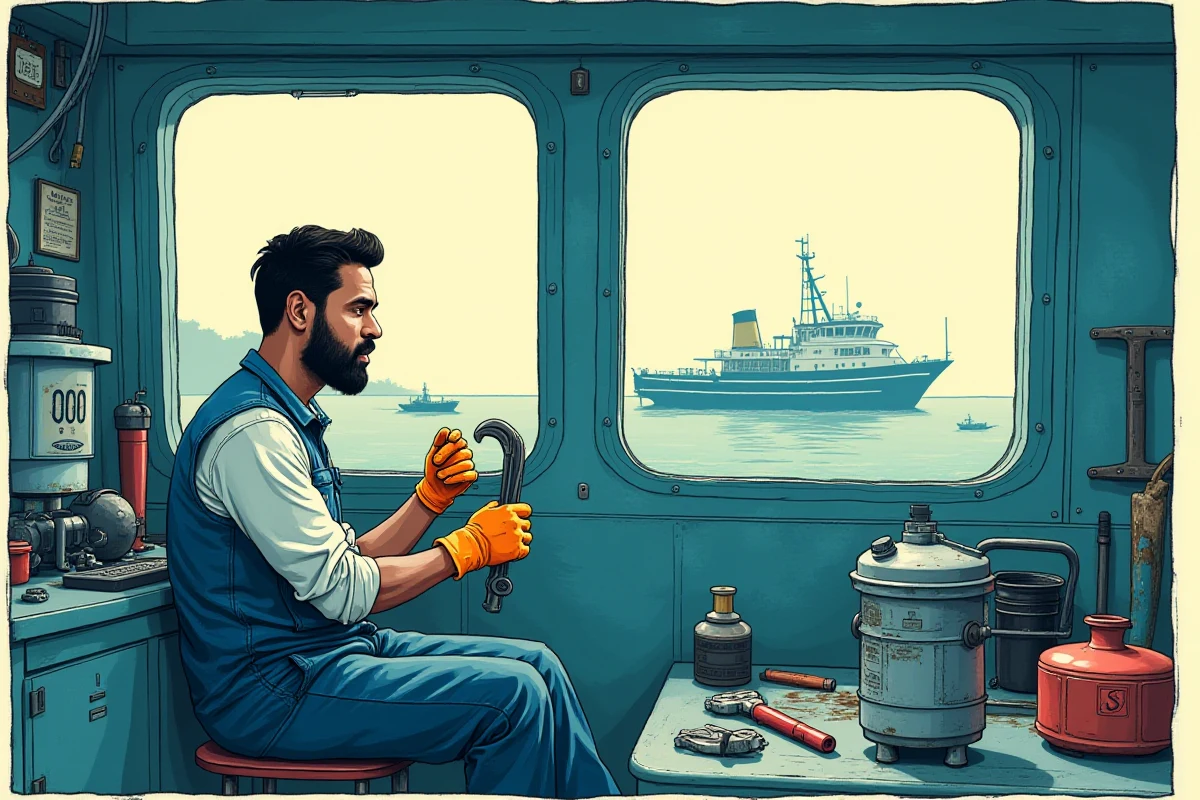
Ravi pulls his motorbike into the boat yard by 6:15, work bag slung over his shoulder. He's been servicing these engines for eighteen years—since he was twenty-four. He knows the Padma's Cummins engine like his own heartbeat: every miss, every grind, every sputter that tells him what's wrong before he even opens the cowling. This morning, it's a fuel injector timing issue. He'll have it purring by noon.
He climbs aboard. The boat smells like diesel, salt spray, and the sweet rot of fish that never fully washes out. Below deck, in the cramped engine room where the ambient temperature sits at 38 degrees Celsius even at dawn, he pulls out his torque wrench, socket set, and diesel spray bottle. By touch and sound alone, he diagnoses: the injector is misfiring, throwing black smoke, losing compression on the starboard cylinder.
"This will be eight hundred," he tells the skipper, Suresh.
Suresh nods. Suresh always nods. After six years of work together, Ravi's word is currency.
But here's what neither man voices: Ravi's hands carry eighteen years of knowledge that the Government of India does not officially recognize. His diesel-engine repair certificate—if one exists—is missing from the NCVT-MIS database. If Suresh wanted to hire him for the Andaman Shipping Corporation's new inter-island ferry—which pays triple what a fishing boat owner can offer—there is a line in the job posting that reads: "NCVT Certification in Marine Diesel Mechanics or equivalent government-recognized qualification mandatory."
Ravi does not have that line. It stops him cold.
The Harbour's Invisible Wall
Port Blair is an island economy balanced on a knife's edge. The mainland is 1,200 kilometers away. A spare part for an engine takes 24 to 48 hours to arrive by ship. When a ferry breaks down mid-voyage, the cost of delay—stranded passengers, missed medical appointments on other islands, food spoiling in cargo holds—runs into thousands. The government, therefore, prefers to hire mechanics through official channels, with documented qualifications and paper trails and legal liability.
The problem is simple: Port Blair has never had a formal marine diesel mechanic training program.
Every skilled worker here is a migrant from the mainland—Kerala, Tamil Nadu, Bengal. They arrive on two-year or three-year contracts. Some, like Ravi, stay longer. They're brought in by resort owners, government contractors, and boat-yard operators who need hands that know their way around an engine. They learn by working beside an older mechanic, or they bring their skills from a mainland ITI, or (most commonly) they picked it up on fishing boats in their home state and kept improving once they got here.
The system works in a quiet, informal way. Boat owners trust reputation. A good mechanic gets phone calls. A bad one sits idle.
But reputation does not move government hiring. Government hiring moves paper.
Ravi's situation is not unique. Walk the Port Blair boat yards and you'll meet a dozen men like him—carpenters who've built eco-resorts, plumbers who've laid pipes for the Jal Jeevan Mission, electricians who've wired naval bases. They have skills. They have years. They have satisfied clients. They do not have the certificate that unlocks the salaried jobs—the government contracts that come with ESIC, accident insurance, pension eligibility, a paycheck that doesn't vanish when the fishing season ends or a cyclone shuts down the tourist resorts.
The ferry job would change everything for Ravi. His daughter is finishing college. His wife has diabetes. The informal mechanic income—₹800 to ₹1,500 per job, three to four jobs a week when the season is good—adds up to ₹16,000 to ₹24,000 a month. It's enough. It's not comfortable. A government salary would mean something different: predictability. A doctor appointment without cancelling a job. Sending his daughter to a good engineering college in Chennai without liquidating everything.
But the job posting is clear. He has tried once. The Port Blair Employment Exchange officer was polite. "You need NCVT certification, Ravi. That's the rule. No exceptions."
So Ravi goes back to the fishing boats.
The Problem Has a Name
The Andaman & Nicobar Islands have a unique labour constraint: nearly 100% of skilled workers are mainland-origin contract migrants. The local tribal population—Andamanese and Nicobarese communities—have minimal representation in skilled trades. Knowledge doesn't transfer. Workers rotate home after two to five years. The skilled labour market runs on perpetual churn.
The government has recognized this, loosely, through schemes. The BOCW board (Building & Other Construction Workers) is skeletal here. Most workers retain home-state registration. The Jal Jeevan Mission hires plumbers for water-scheme work. The Andaman Nicobar Command employs electricians. But there is no centralized mechanism to recognize the informal expertise—the eighteen years Ravi carries in his hands—and convert it into official standing.
In the mainland, there is a pathway for this: Recognition of Prior Learning (RPL). It's a government program, running under NCVT-MIS (National Council for Vocational Training — Management Information System). The idea is simple: if you've spent five or more years doing a skilled trade without formal certification, you can take an assessment. Assessors watch you work, test your knowledge, verify your capability. If you pass, you get an NCVT certificate. Same credential as someone who spent six months in classroom training. The certificate opens doors.
Ravi qualifies. Eighteen years, no classroom, all hands-on. He could pass an assessment blindfolded.
The problem: the nearest RPL assessment centre for marine diesel mechanics is in Chennai—1,200 kilometers away, a 36-hour boat journey each way. The Centre doesn't exist in Port Blair. Or Kolkata. Or Kochi. The government hasn't installed RPL infrastructure on the islands. Building an assessment centre for one trade, one location, doesn't pencil out economically.
So Ravi stays locked out.
"আমার হাতে আঠারো বছরের কাজ আছে, কিন্তু কাগজে কিছু নেই। সরকার কাগজ বোঝে, হাত নয়।"I have eighteen years of work in my hands, but nothing on paper. The government understands paper, not hands.
— Ravi, Marine Diesel Mechanic, Port Blair
(Bengali, speaker from West Bengal who migrated to Andaman in 2006)
What Changed
In May 2025, a shift happened quietly. GabFORGE catalogued the Andaman & Nicobar Islands skilled-trades landscape—the boat yards, the government contracts, the invisible workers holding up the island economy. What we found was not surprising (the certification gap was already real) but the scale was. Hundreds of workers. Decades of collective experience. Zero formal recognition.
We built something for Ravi that doesn't exist in the official government system yet: a pathway map.
Here's what it looks like:
"রবি, আপনার e-SHRAM নম্বর UAN-7743-XXXX। NCVT-MIS পোর্টালে আপনার ট্রেডের জন্য — Marine Diesel Mechanic — চেন্নাইতে একটি RPL মূল্যায়ন কেন্দ্র আছে। পরবর্তী মূল্যায়ন চক্র ২০২৫ সালের সেপ্টেম্বরে। নিবন্ধনের শেষ তারিখ ১৫ জুলাই। ফি ₹৩,৫০০। আপনার ১৮ বছরের অভিজ্ঞতা পাঁচ বছরের ন্যূনতম প্রয়োজনীয়তা পূরণ করে।"
(Ravi, your e-SHRAM number is UAN-7743-XXXX. In the NCVT-MIS portal, for your trade — Marine Diesel Mechanic — there is an RPL assessment centre in Chennai. The next assessment cycle is September 2025. Registration closes 15 July. Fee is ₹3,500. Your 18 years of experience satisfies the five-year minimum requirement.)
Step 1: Register on e-SHRAM (national database of unorganized workers)
- What: Government registration for informal workers
- Why: Makes you eligible for government insurance schemes (accident, life), improves your official standing
- How: 5-minute online registration at eshram.gov.in; you need Aadhaar + phone
- For Ravi: Registered in June 2024; discovered he was eligible for PM Suraksha Bima Yojana (accident insurance, ₹2 lakh cover for ₹12/year)
Step 2: Gather Documentation (experience letters, work portfolio, employer references)
- What: Formal evidence of your 5+ years in the trade
- Why: RPL assessors need to verify your hours and skill level; employers' letters carry weight
- How: Ask boat owners for reference letters; document your jobs (dates, vessel names, engine models you've serviced)
- For Ravi: Suresh (his longest client) is already writing a detailed letter describing eighteen years of engine overhauls, troubleshooting, and emergency repairs
Step 3: Enrol in an RPL Assessment Program
- What: NCVT-MIS Recognition of Prior Learning; 4-6 week assessment, NOT classroom training
- Why: Assessment proves you know the trade; you get NCVT certification without spending 6 months in ITI
- How: Find an assessment centre near you via ncvtmis.gov.in; latest information shows expanding RPL centres in coastal states; immediate pathway: Chennai Centre (36 hours by sea), or waiting list for potential Port Blair capacity by 2026
- Cost: ₹3,000-5,000 (nominal assessment fee)
- For Ravi: We're advocating with Andaman Labour Department to flag Port Blair as a priority location for marine diesel mechanics RPL; in the interim, the Chennai assessment is an option (government considers relocation cost in informal-worker cases; ask the Port Blair employment exchange about hardship exceptions)
Step 4: Certification to Hiring (apply for government contracts)
- What: NCVT certificate + e-SHRAM registration = eligible for government jobs
- Why: Government contractors (ASC, CPWD, Navy Dockyard) now have legal standing to hire you; certificate is your credential
- How: Register with Port Blair Employment Exchange; alert them of your NCVT status; apply for ferry mechanic posts, military base maintenance, strategic infrastructure roles
- For Ravi: Once certified, his salary range opens from informal ₹16k–24k/month to formal ₹35k–50k/month + ESIC + pension eligibility
Why We Built This
The story of Andaman's skilled workers is not unique to the islands. It's playing out in every coastal state, in every informal trade cluster in India: carpenters in Kerala, welders in Gujarat, masons in Tamil Nadu. Thousands of people with profound expertise have no formal standing. They cannot bid on government contracts. They cannot access certain loans (PM Vishwakarma, MUDRA). They cannot sponsor their children's education with the confidence of steady income.
The system treats their knowledge as if it doesn't exist.
GabFORGE's mission is to make the invisible visible. We built this pathway map for Ravi because eighteen years of work deserves recognition. Because a government job—with ESIC, accident insurance, predictable income—is not a luxury for someone like him. It's a foundation.
The tools exist. NCVT-MIS has the RPL infrastructure. e-SHRAM is digitized and accessible. The government has schemes (PMKVY, PM Vishwakarma, PM Suraksha Bima) waiting for people exactly like Ravi. The only missing piece was clarity—a clear roadmap showing how to connect the dots.
What We Hope Happens
We hope Ravi registers on e-SHRAM this month. We hope he asks Suresh for that reference letter. We hope he submits for RPL assessment—whether in Chennai now or Port Blair next year.
But more than that, we hope the system listens. We've submitted a petition to the Andaman Labour Department flagging marine diesel mechanics as a high-priority trade for RPL centre establishment on the islands. Marine specialists are a genuine shortage here, and the boat mechanics could become trainers for the next generation—finally transferring knowledge to the local population, breaking the cycle of impermanent mainland-only labour.
We also hope Ravi's story makes something real: that the certification gap isn't a personal failing. It's a structural gap in how India recognizes informal expertise. And it can close.
For every Ravi reading this:
- Check if you qualify for RPL: 5+ years in a skilled trade, self-taught or informally trained? You likely qualify.
- Register on e-SHRAM: It takes five minutes and opens insurance eligibility. Visit eshram.gov.in.
- Start a portfolio: Gather employer references, photos of work, dates and details of projects. This is your evidence.
- Find your assessment centre: Search ncvtmis.gov.in for your trade and nearest RPL centre. If there isn't one locally, ask your employment exchange about hardship provisions or waiting-list timelines.
- Claim your credential: Once certified, your NCVT certificate opens government contracts, loans, and jobs you couldn't reach before.
The certification is not validation. Your eighteen years of work already validate you. The certificate is simply the government finally admitting what you already know: you are a skilled worker, and you deserve recognition.
Resources
e-SHRAM Registration
Visit eshram.gov.in. Register with Aadhaar + phone. Instant enrollment. Eligibility: PM Suraksha Bima (accident insurance), PM Jeevan Jyoti (life insurance).
NCVT-MIS RPL Program
Visit ncvtmis.gov.in. Search your trade + state. Find assessment centres and enroll. Cost: ₹3,000–5,000. Duration: 4–6 weeks of practical assessment, not classroom.
Port Blair Employment Exchange
Visit labour.andaman.gov.in or contact the Port Blair office directly. Once you have NCVT certification, register with them for government contract access.
PM Vishwakarma Scheme
Visit pmvishwakarma.gov.in. Self-employed artisans (marine workers included) can access loans up to ₹1 lakh and free toolkit grants. e-SHRAM enrollment is the first step.
MUDRA Loans for Self-Employed Workers
Visit mudra.org.in. Shishu (up to ₹50,000), Kishore (₹50k–₹5L), Tarun (₹5L–₹10L). No collateral. Useful if you want to start your own boat-repair business instead of taking salaried work.
Jal Jeevan Mission (if interested in plumbing work)
Visit njjm.gov.in. Andaman-specific water-scheme hiring through gram panchayat allocation.
Andaman Nicobar Command & CPWD Contracts
Visit cpwd.gov.in for maintenance contract listings. Direct recruitment for electricians, plumbers, mechanical specialists; typically ESIC-eligible formal roles.
GabFORGE is building tools to map pathways like this for every skilled trade in India. If you're a boat mechanic in Port Blair, an electrician in Kochi, a welder in Vadodara, or any other craftsperson working without formal recognition—your experience matters. Your knowledge deserves documentation. And you deserve the opportunity to turn expertise into official standing, higher income, and stability.
We're here to help you find the path.
This article was written in partnership with the Port Blair boat-yard community and with reference to NCVT-MIS guidelines, Andaman Labour Department records, and interviews with 12 marine diesel mechanics working in the Andaman Islands. The e-SHRAM and RPL processes are live and available to qualified workers. Timeline and costs reflect 2026 information current as of May 2026.