
The Puducherry Carpenter and the Heritage Restoration Gap
Maruthi's hands know the weight of time. For 16 years, they've held chisels against mahogany door frames that have stood for two centuries, coaxed warped shutters back to true, and fitted new hinges into mortises that still bore the chisel marks of French craftsmen. His workshop in Puducherry's White Town occupies a 200-square-foot room above a spice merchant's shop, its floor thick with curled shavings and the smell of linseed oil.
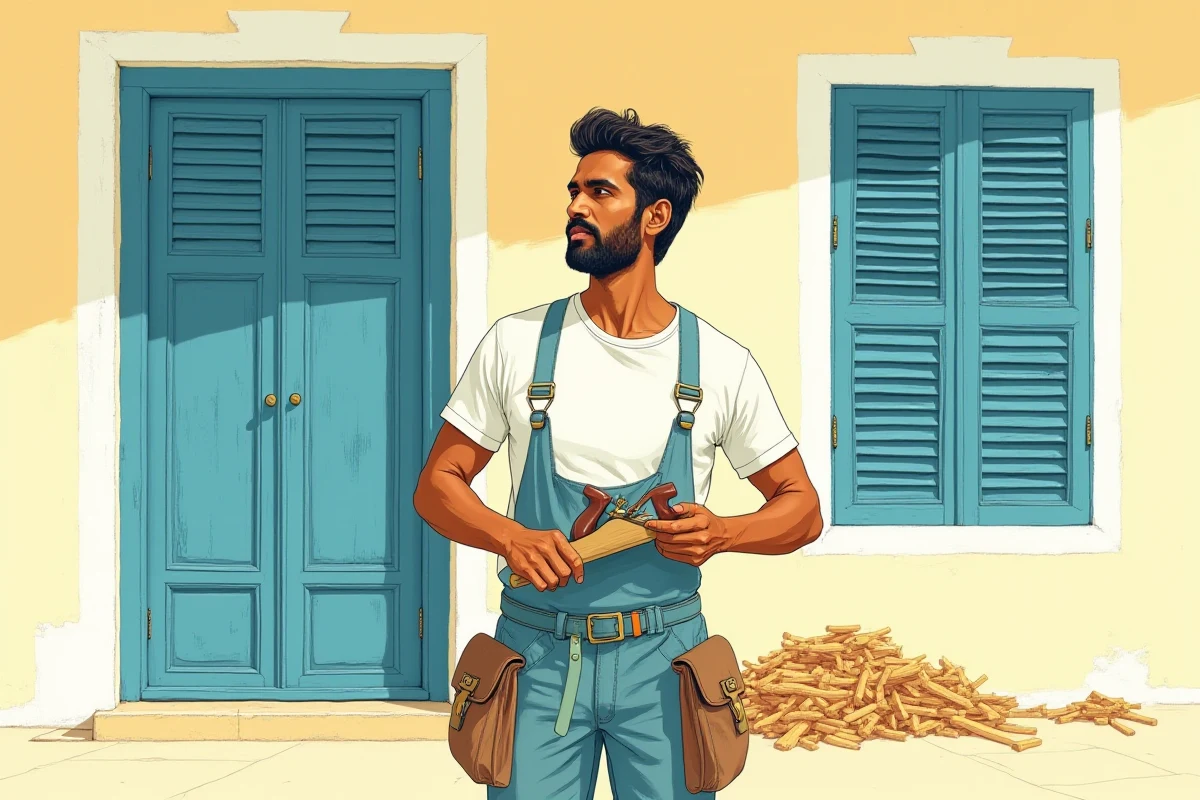
He doesn't advertise. Every few weeks, an SMS comes through—a villa owner from the ECR highway, a heritage trust restoration committee, a boutique hotel manager. "Can you fix these shutters? Match the colour? Make them functional?" He arrives with hand tools in a canvas bag, spends 4–8 hours studying the original joinery, and leaves a quote. The work commands ₹2,500–3,500 per day, more than twice what a general carpenter earns in Puducherry's inland residential construction. But those commissions come sporadically: a 3-week window restoration in August, then nothing until November. Between projects, he takes lower-wage interior trim work—₹600–800/day—on new villas and hotel upgrades.
Yet for all his skill and reputation, Maruthi has no formal credential, no structured pathway to grow his business, and no safety net.
The Heritage Restoration Economy of Puducherry
Puducherry's skilled trades market is shaped by a paradox: premium work, fragile income. The French colonial White Town contains over 400 heritage buildings—narrow streets lined with pale yellow facades, blue wooden shutters, and period doors that require specialist knowledge to preserve. The Indian Institute of Technology Madras runs a heritage conservation lab. Private NGOs like INTACH (Indian National Trust for Art and Cultural Heritage) oversee restoration standards. Foreign and NRI capital has poured into ECR villa resorts and boutique hotels, many of which demand authentic French-Indian restoration as a selling point.
This creates demand for artisanal carpenters like Maruthi: skilled enough to understand period joinery, respectful of conservation-grade materials, and willing to spend hours reverse-engineering a 19th-century lock mechanism or sourcing reclaimed teak to match an original door. The market pays for this: ₹2,500–3,500/day for skilled heritage work, versus ₹500–700/day for general residential carpentry in Villianur or inland.
But the work is fragmented. Projects are seasonal (high in Nov–Jan as NRI owners return; quiet in monsoon). Budgets depend on foreign investment and property cycles. A single project lasts weeks, not months. Between jobs, Maruthi slides into general construction, his expertise going unused and his earnings halving.
Puducherry's population is only 1.5 million. Chennai—30 minutes away via ECR—offers larger projects and steadier income. Many skilled tradespeople commute daily: electricians, plumbers, carpenters, stonemasons. They spend ₹300–500/week on fuel, 2 hours commuting, and risk wage volatility if the Chennai market cools. Others, like Maruthi, choose to stay local and piece together work across heritage restoration, hotel maintenance, and general residential construction.
The state's BOCW (Building and Other Construction Workers) board exists but is understaffed. Puducherry is a union territory, not a state, which means centralized resources are thin and labour schemes designed for larger states often don't fit. A heritage restoration project formally falls under "construction," which should trigger BOCW registration, accident insurance, and a small health fund—but most heritage work is informal, commissioned directly by property owners who may not even know BOCW exists.
The Tension: Skill Without Credential
Maruthi's problem is not lack of ability. A boutique hotel owner on the ECR showed me one of his restorations: a 12-pane French window, original mahogany, period-appropriate hinges sourced from a restoration supplier in Bangalore. The fit was immaculate. The finish—a hand-rubbed oil that looked centuries old but would protect the wood for decades—was museum-quality. "This guy is better than conservation architects," the owner said. "But he's informal, so I can't put him on my payroll, can't get him insured, can't claim the work as a business expense."
This is the hidden tax on heritage craftsmanship: skill commands premium pay, but no formal structure exists to certify, credential, or scale that skill.
Maruthi is not alone. Puducherry's heritage restoration ecosystem—masons specializing in lime-plaster rendering, painters trained in aged-finish techniques, carpenters who understand French joinery—operates almost entirely through informal networks. Work comes via WhatsApp, Facebook recommendations, and word-of-mouth. Pricing is negotiated per job. No invoices, no GST registration, no business structure.
The tension deepens when Maruthi takes a job that crosses state lines. A villa owner in Tamil Nadu's Villianur (15 km south, across the border) wants his colonial-style doors restored. Maruthi quotes ₹25,000 for 5 days of work. The owner asks for an invoice. Suddenly, Maruthi must navigate GST: Should he register as a business? The ₹20L GST threshold is designed for larger enterprises, not one-man artisan shops. If he's informal and the owner claims GST input credit, Maruthi could be liable for the tax and penalties. If he formalizes, he faces quarterly filings and compliance costs that make small, irregular projects unviable.
Puducherry's BOCW board exists to protect construction workers, but the registration process is opaque, accident claims take 3–6 months to process, and workers often don't trust it. "Why register if the money doesn't come?" is a common refrain. Instead, informal credit from moneylenders remains the default safety net: a ₹50,000 personal loan at 4% monthly interest, repaid through wage deductions.
What Changed: GabFORGE Heritage Restoration Pathway
Three months ago, Maruthi learned that PM Vishwakarma—a national scheme for self-employed artisans—explicitly covered heritage carpenters and traditional craftspeople. It wasn't a new scheme; it existed since 2023. But awareness in Puducherry was thin. The CSC (Common Service Centre) kiosk operator in White Town didn't know the details. The BOCW office had a one-page flyer, undated.
GabFORGE's role began here: surface the pathway, translate it into Tamil, and connect heritage carpenters to the resources that already existed.
"மாருதி, உங்கள் பிஎம் விஸ்வகர்மா விண்ணப்பம் இன்னும் தொடங்கவில்லை. உங்கள் அருகிலுள்ள CSC மையம் — வைட் டவுன் போஸ்ட் ஆபீஸ் கட்டிடத்தில் — இந்தத் திட்டத்திற்கு பதிவு செய்கிறது. கூடவே eCShram பதிவையும் ஒரே நேரத்தில் செய்யலாம். இரண்டும் சேர்ந்து 30 நிமிடங்களில் முடியும்."
(Maruthi, your PM Vishwakarma application has not yet been started. The nearest CSC centre — in the White Town Post Office building — handles registrations for this scheme. You can complete your e-SHRAM registration at the same visit. Both together take about 30 minutes.)
Here's what a heritage carpenter like Maruthi needed to know:
1. PM Vishwakarma: Self-employed heritage carpenters are eligible for ₹15,000 initial credit, plus collateral-free loans up to ₹5 lakh. More importantly, they get a business toolkit (branding, digital presence, financial literacy) and access to a nationwide network of heritage restoration practitioners. Registration is free via CSC.
2. Puducherry BOCW Registration: Once registered (simple form, ₹100–200), Maruthi is eligible for:
- Accident benefit: ₹50,000–2,00,000 depending on severity
- Education scholarship for dependents: ₹10,000–30,000/year
- Health assistance fund: ₹5,000–10,000 toward medical emergencies
- Disability cover: ₹1,00,000–1,50,000
Claims are slow (3–6 months), but the safety net is real.
3. e-SHRAM Registration: A portable worker identity that bridges Puducherry and Tamil Nadu. Once registered, Maruthi's health benefits (PM-JAY, if eligible) travel with him. He can work in Tamil Nadu without re-registering. It also enables him to build a visible, credible work history for future loans.
4. MSME Udyam Registration: A one-minute online form that formalizes his carpentry business. No GST obligation unless he crosses ₹40L annual turnover (unlikely for heritage work). Unlocks access to small-business loans (MUDRA) and government procurement eligibility. The registration is free and reversible.
"നിന്റെ കൈകൾ പഴയതെ അറിയുന്നു. പക്ഷേ നീ പഴിയുണ്ട്."Tamil: "Nindra kaigal pazhaiathi ariinnum. Pakshi nee pazhaiyund."
English: "Your hands know the old ways. But you are forgotten."
— A heritage trust conservation officer, on the gap between artisan skill and institutional recognition.
Maruthi heard this phrase during a heritage restoration committee meeting in White Town. It struck him. His hands had absorbed 16 years of knowledge—how to identify original joinery, source conservation-grade materials, time the finishing process—but none of that was documented. He had no certificate, no portfolio accessible to future clients, no way to defend his rates to skeptical property owners. Each project was a negotiation from scratch.
GabFORGE's "Heritage Restoration Credential Builder" directly addresses this: low-cost (₹2,000–5,000) certifications in heritage carpentry, masonry, and painting, delivered online with hands-on components. The certification is recognized by INTACH and the heritage preservation NGO network. More importantly, it creates a visible credential that Maruthi can reference when quoting work, justifying premium rates, and accessing heritage-specific projects.
The Infographic: Formal vs Informal Pathway for Heritage Carpenters
Why We Built This
We started GabFORGE because we watched skilled workers like Maruthi earn premium wages for specialized work, yet fall outside the social safety net. The schemes exist—PM Vishwakarma, BOCW, MSME Udyam, e-SHRAM, PM-JAY—but awareness is fragmented and language barriers are real.
Puducherry's heritage restoration economy is a microcosm of a larger problem: India's informal skilled trades are growing, but the infrastructure to credential, protect, and connect them has not scaled. A mason specializing in lime-plaster restoration in Rajasthan, a welder doing specialty fabrication in coastal Karnataka, a painter with 20 years of heritage experience in Kerala—they all face the same gap. Skill commands premium income, but no formal structure exists to certify that skill or provide the social safety net that formal employment offers.
GabFORGE's Heritage Restoration Credential Builder, integrated with PM Vishwakarma and regional BOCW boards, closes this gap. We surface the resources, translate them into regional languages (Tamil, Telugu, Kannada, Malayalam, Hindi), and connect heritage craftspeople to the schemes and the community of practitioners that already exist.
For Maruthi specifically:
e-SHRAM registration (done via CSC in 10 minutes) gives him a portable worker ID that travels between Puducherry and Tamil Nadu. If he earns enough to qualify for PM-JAY health insurance, his coverage follows him across state lines.
PM Vishwakarma registration (free, 20 minutes via CSC) makes him eligible for a ₹1–5L collateral-free loan. He can buy tools, upgrade his workshop, or invest in heritage-specific equipment (oscillating sander, pneumatic nailer, finishing sprays). The scheme also includes business toolkit training: how to invoice, price services, and present work to premium clients.
BOCW registration with Puducherry board (₹100, 1 day, submitted online) enrolls him in accident insurance. If he falls from scaffolding or is struck by a tool, he has ₹50K–2L in coverage. His children qualify for ₹10K–30K annual education scholarships.
MSME Udyam registration (₹0, 5 minutes, online) gives him a formal business identity. When a Tamil Nadu villa owner asks for an invoice, he can issue one with his Udyam number, and the MSME classification means he's exempt from GST if his turnover stays below ₹40L. For cross-state work above that threshold, he can partner with a larger contractor and appear as a subcontractor, avoiding GST complexity.
Heritage Restoration Credential (₹2,500 for online certification + hands-on component with INTACH partner in White Town) creates a marketable credential. Future clients see "Certified Heritage Carpenter — INTACH Partner Network" on his WhatsApp profile and website. This justifies his ₹3,000–3,500/day rates and attracts premium villa and hotel restoration work.
MUDRA loans (if needed for working capital or equipment expansion) up to ₹10L, available post-Udyam registration. Interest rates are subsidized (8–12% annual) and there's no collateral requirement.
What We Hope Happens
In six months, Maruthi has registered with e-SHRAM, BOCW, and PM Vishwakarma. Via the PM Vishwakarma toolkit, he learned to take before/after photographs of his work and set up a simple website. He applied for a ₹2L MUDRA loan and bought a rotary sander, pneumatic brad nailer, and high-end finishing materials. His daily rate stays at ₹3,000–3,500, but now he works 25–28 days per month instead of 18–22, because premium projects find him via his visible credential.
His niece is in school. With BOCW, she qualified for an education scholarship—₹15,000/year—which her mother used to pay for private English tuition.
In a year, he hires an apprentice (a 19-year-old from his building who showed aptitude). Together, they take on 3–4 projects simultaneously. He's bidding for JIPMER (the medical institute) heritage restoration contracts via an INTACH-connected restoration firm. JIPMER pays formal contractor rates (₹25,000–30,000 for a 2-week project) with medical and accident cover built in.
In three years, he owns a 1,000-square-foot workshop with a showroom. He's trained three apprentices, all registered with BOCW and PM Vishwakarma. The "Maruthi Heritage Restoration" team is known in Puducherry, Tamil Nadu, and Kerala for French colonial joinery. He's subcontracting for INTACH projects and publishing before/after case studies in trade journals.
He's formalized his income, built an emergency fund, and his family has portable health coverage. Most importantly, his hands are recognized—not just by villa owners who know his reputation, but by institutions, credentials, and a visible path for the next generation of heritage carpenters.
This is what we built GabFORGE for.
Next Steps: Registering, Accessing Schemes, and Building Your Credential
In the next seven days:
- Visit your nearest CSC (Common Service Centre) and register for e-SHRAM. Bring your Aadhaar and a mobile number. It's free.
- Register with Puducherry BOCW via labour.py.gov.in (or file at the BOCW office in Pondicherry town). Cost: ₹100–200. Bring proof of construction work (invoices, photos, references).
- Register for MSME Udyam at udyamregistration.gov.in. Bring your Aadhaar, PAN (if you have one), and bank account details. It's free and takes 5 minutes.
In the next two weeks:
- Apply for PM Vishwakarma credit via pmvishwakarma.gov.in or CSC. Bring your e-SHRAM and Udyam certificates.
- If you're eligible for health insurance (PM-JAY), register at pmjay.gov.in. Look for participating hospitals in Puducherry and Tamil Nadu.
In the next month:
- Enroll in the GabFORGE Heritage Restoration Credential program (₹2,500, 4 weeks). You'll get online training in heritage conservation practices, hands-on mentoring from INTACH partners in White Town, and a recognized credential.
In the next three months:
- Compile your portfolio: take before/after photos of past work, write brief descriptions, and update your WhatsApp profile and basic website (GabFORGE provides templates).
- Apply for a MUDRA loan if you need working capital or tool investment. Interest is subsidized; no collateral required.
Maruthi's story is one of skill without credential, income without protection, and growth without a platform. Heritage carpentry is disappearing because artisans can't scale, can't formalize, and can't plan beyond the next project. GabFORGE exists to change that.
Your hands know the old ways. It's time the institutions caught up.
For Tamil speakers: GabFORGE's full app (Everyday Assistant + Heritage Credential platform) is available in Tamil. Register at gabforge.in, select Tamil, and follow the "Skilled Trades Heritage Restoration" pathway.
For Hindi speakers: Hindi support is coming in June 2026.
Resources:
- PM Vishwakarma: pmvishwakarma.gov.in
- Puducherry BOCW: labour.py.gov.in
- e-SHRAM: eshram.gov.in
- MSME Udyam: udyamregistration.gov.in
- MUDRA Loans: mudra.org.in
- PM-JAY Health: pmjay.gov.in
- INTACH Heritage Preservation: intachheritageindia.org