
The Rourkela Mason and the Stalled Accident Claim
Six months ago, a moment of miscalculation changed everything.
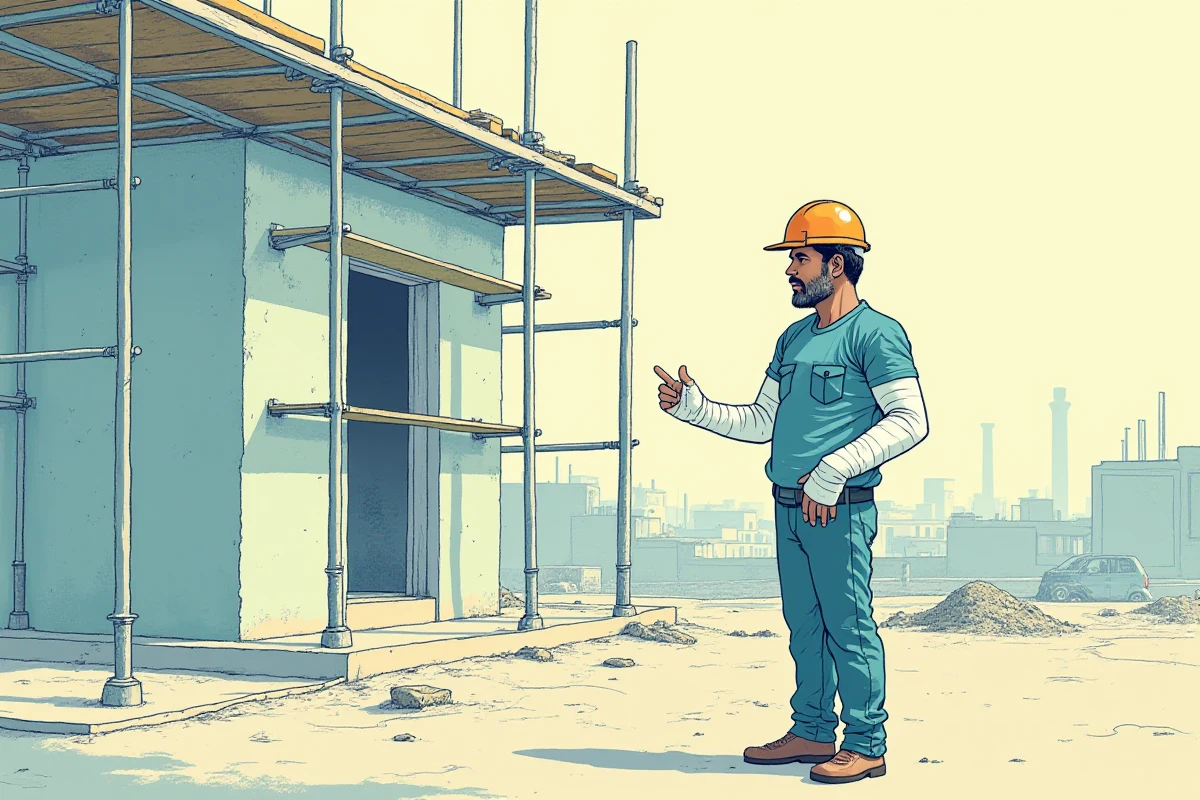
Ashok was 15 feet above ground on a residential construction site in Rourkela, in Odisha's industrial heartland. The bamboo scaffold—held together with worn rope and rusted fittings—had been reused a hundred times. He was setting brickwork on the third floor of a four-storey apartment complex being built near the railway station. The site foreman had asked him to move faster. It was 3 p.m., and the sun was directly overhead. His hands were sweaty. He stepped onto a plank that shifted slightly.
What he remembers is the sound—a crack, then a whip of the rope as the entire structure tilted.
What he doesn't remember is the fall itself.
He woke up in Rourkela Steel Plant Hospital with his right arm in a temporary cast and a sharp pain that seemed to come from everywhere at once. X-rays showed a spiral fracture of the radius bone, just above the wrist. The emergency room doctor said he was lucky—if he'd hit his head or chest, it would have been different. As it was, six weeks immobilized, then four weeks of physiotherapy. Twelve weeks before he could even think about going back to a site.
That was six months ago. Today, his arm is mostly healed. The plaster came off two months back. He can lift his tools again, rotate his wrist without pain, pick up objects in his right hand. His grip strength is returning, though not fully. He's itching to get back to work.
But Ashok's real injury isn't the fracture anymore. It's the administrative wound that won't close.
🏗️ The Claim That Disappeared Into Process
The day after his hospitalization, a site supervisor told Ashok that the contractor would file an accident claim on his behalf with the Odisha BOCW Board. Ashok has been a registered construction worker with BOCW for five years—his name, Aadhaar, bank account, all linked in the system. He paid the annual cess. He thought he was covered.
"The supervisor said, 'Don't worry, we'll handle it,'" Ashok recalls, sitting on a plastic stool outside his two-room house in Rajendra Nagar, Rourkela. His wife, Priya, is inside cooking lunch. His two daughters are at school. He taps his right forearm absently, a habit from the healing months. "He gave me a form—a long form with boxes for everything. Hospital name, date of accident, witness name, supervisor signature. I filled what I could and asked the supervisor to complete the rest."
That form was the Odisha BOCW Board's Accident Claim Form 1 (ACF-1), the gateway to accident benefits. The board operates a tiered benefit system:
- Medical reimbursement: Up to ₹50,000 for hospitalization and treatment
- Temporary disability (partial loss of earning capacity): ₹250–400/day for up to 2 years (if deemed 25–50% disabled)
- Permanent disability (loss of limb or capacity): ₹75,000–3,00,000 (depending on extent of injury)
- Lump-sum accident benefit: ₹1,00,000–3,00,000 (for major injuries like fractures, irrespective of disability classification)
Ashok was told his claim would qualify for the lump-sum accident benefit of ₹3,00,000 (or close to it) because his fracture required hospitalization and was deemed "major injury." To him, that number—three lakh rupees—was transformative. His daily wage is ₹600. In the weeks he was unable to work, his family lived off his wife's petty shop income (₹200–300/day) and borrowed money from the landlord. His elder daughter needed new school supplies. His wife had been deferring dental work. Three lakh rupees would erase the debt, stabilize them for a year, perhaps fund a small home repair.
What he didn't know was that filing the form and seeing money arrive were separated by a gulf of bureaucratic silence.
The Timeline Trap
:::infographic-timeline
- Day 1 (July 2025): Fall from scaffold; hospitalized; emergency surgery scheduled. Admitted to Rourkela Steel Plant Hospital.
- Day 2: Supervisor tells Ashok a claim will be filed. Ashok gives verbal testimony; supervisor collects hospital discharge summary.
- Week 2: ACF-1 form submitted to BOCW office in Rourkela. Original hospital certificate (Certificate of Injury) attached. No acknowledgment receipt issued.
- Month 1 (August): Ashok calls BOCW office to ask about claim. Officer says "under verification." Asks for character certificate from sarpanch (village head). Ashok's site is in a municipal corporation area, not a village—confusion ensues.
- Month 2 (September): Ashok obtains a character certificate from the municipality corporation officer. Resubmits ACF-1 with new document. Still no acknowledgment.
- Month 3–4 (October–November): Ashok visits BOCW office four times. Three times, the responsible officer is "on leave" or "in a meeting." Once, he is told the file is "with the medical examiner." No timeline given.
- Month 5 (December): Ashok's wife visits in his place. Told that hospital certificate is "incomplete"—missing the signature of the hospital superintendent. Asked to get a new one. Hospital says superintendent has retired; his successor can only issue a "certified true copy." Not clear if this is acceptable.
- Month 6 (January 2026): New certificate from hospital obtained. Resubmitted. BOCW office now says file is "with accounts" for final approval. "Should hear back in 2–3 weeks."
- Current (May 2026): Still waiting. No notification. No rejection. Just silence. :::
What Ashok is experiencing is a known phenomenon in India's construction welfare ecosystem: the "verification black hole." The claim hasn't been denied. It's suspended. Ostensibly, the Odisha BOCW Board has a 60-day timeline for processing claims from submission to disbursement. But in practice—especially for claims involving hospitalization, disability assessment, or third-party liability questions—cases drift for months in administrative limbo while workers like Ashok wait.
"I have stopped asking," Ashok says quietly. "Every time I go, there's a new reason, a new document. The officer is always polite, but he never has an answer. Last month I asked, 'Will I get the money before my daughter's school admission fee is due?' He just shook his head and said, 'Patience.'"
Part of the delay is structural. The Odisha BOCW Board, formalized in 2020, is still lean in staffing. The Rourkela office handles claims across three districts—Sundargarh, East Singhbhum (part of the state's industrial belt), and parts of Keonjhar. Thousands of construction workers are registered. Accident claims are processed sequentially, not triage-based. No claim is deemed "urgent" in the system, even if the worker is in financial distress.
Part of it is procedural. Each claim requires sign-off from four gates:
- Eligibility verification: Is the worker genuinely registered? Are contributions paid up-to-date?
- Medical verification: Is the injury as described in the hospital report? Is the hospitalization genuine? (Some claims involve fraud—workers exaggerating injuries or colluding with hospitals for kickbacks.)
- Supervisor/witness verification: Did the accident really happen as claimed? (BOCW may send an investigator to the site.)
- Accounts approval: Is the benefit amount correct? Is the bank account linked properly? (BOCW disburses via direct bank transfer.)
Each gate has its own queue. If any gate rejects or flags the claim for more info, the entire timeline resets.
In Ashok's case, the supervisor verification stalled everything. The site supervisor who hired him—a man named Yogesh—was a contractor's employee, not the main builder's. When BOCW investigators called Yogesh to verify the accident, Yogesh was noncommittal. He said, "It happened, yes, but I didn't see it directly. Many people saw it. I don't remember all their names." A weak verification made the BOCW office nervous. Was this a genuine accident or a co-fronted claim?
They asked for more witnesses. Ashok provided names of two fellow workers. Both were migrant labourers from Chhattisgarh who had since moved to another site in Nagpur. BOCW required written statements from them, notarized or signed before a magistrate. Neither worker had time or means to comply.
The claim hit a dead end.
"Mere haath theek ho gaya, par mere documents mein ek lambi beemaari hai. Hospital certificate, character certificate, witness letter—sab kuch mila, par paise nahin aaye. Officer bolte hain, 'Aur intezaar karo.' Aur intezaar ke liye mera ghar kaaj nahi karne ke liye teyar nahin."My hand healed, but my papers got a long illness. Hospital cert, character cert, witness letter—I have everything, but no money came. The officer says, 'Wait more.' My house isn't ready to wait.
— Ashok, mason, Rourkela, May 2026
🔄 What Changed (When Ashok Found the Portal)
Three weeks ago, Ashok was at the CSC (Common Service Centre) kiosk near his neighbourhood to apply for a ration card update. The CSC operator, an enterprising young man named Rohan, overheard Ashok mentioning his stalled claim to another worker. Rohan said, "The BOCW Board has an online portal now. You can upload documents directly and track your claim status."
Ashok had no idea such a portal existed. When he was registered five years ago, registration happened in person at the BOCW office. Documents were hand-submitted. Status required a site visit. But in 2024–2025, the Odisha BOCW Board digitized. The new portal, accessible at bocwodisha.gov.in, allows workers to:
- Create an account using Aadhaar
- View their registration status
- Upload claim documents (hospital cert, photos of injuries, supervisor statements)
- Track claim progress in real time
- Receive SMS and email notifications at each verification gate
- File a formal appeal if a claim is rejected
Ashok had never logged into the portal. His supervisor had filed the paper claim and then gone silent. No one told him the digital option existed.
With Rohan's help, Ashok created a portal account. Within 10 minutes, his claim was visible—status: "Pending Supervisor Verification (Witness Not Reachable)." There was a comment from the BOCW officer dated February 2026: "Applicant provided migrant witnesses. Contact trace failed. Applicant requested to provide local witnesses or affidavit in lieu of witness statement."
"I was angry," Ashok recalls. "They never told me this. They never sent me a message or letter saying, 'Get local witnesses or affidavit.' I just came every month and waited."
But the portal also offered a path forward. There was a button: "Upload Supporting Documents." Ashok, with Rohan's assistance, created a statutory affidavit stating that the two migrant witnesses were unreachable and that he had no other witnesses to his fall (a true statement—he fell and hit the ground alone; other workers heard the noise and rushed over, but didn't see the moment of fall). He got the affidavit notarized at a small legal office in Rourkela for ₹200. He scanned it on Rohan's photocopier. He logged into the portal and uploaded it.
Within five days, an SMS arrived: "BOCW Claim ACF-1-2025-07-00847: Supervisor Verification Complete. Claim forwarded to Medical Review. Expected processing time: 10–15 days."
It was the first movement in six months.
"When I got that SMS, I called my wife out of the kitchen," Ashok says, showing the message on his phone (a basic Nokia with a cracked screen but functional battery). "She didn't understand what it meant. I told her, 'The money is coming.' I don't know if it's true, but for the first time in six months, something moved."
The Agent's Explanation
Two weeks later—this week—Ashok was introduced to an AI agent designed to help construction workers navigate BOCW claims. A local NGO working with Rourkela construction workers (Odisha Nirman Karamchari Sangha) had partnered with a digital welfare platform to deploy a chatbot that explains claim procedures in Odia.
We sat with Ashok and the agent, which responded to his questions in Odia with text and short video guides. Here's how it helped:
Ashok typed his first question into the agent in Odia, slowly, one letter at a time: "ମୋ କ୍ଲେମ୍ 'Medical Review' ରେ ଅଛି। ଏବେ କ'ଣ ହବ?" — My claim is in Medical Review. What happens next?
The agent replied:
"ତୁମ ଦାବି ଏବେ ଡାକ୍ତରୀ ଯାଞ୍ଚ ପର୍ଯ୍ୟାୟରେ ଅଛି। BOCW ଅଫିସ ହସ୍ପିଟାଲ ସାର୍ଟିଫିକେଟ ଯାଞ୍ଚ କରିବ — ଆଘାତ ତାରିଖ ସଠିକ୍ ଅଛି କି ନାହିଁ, ଡାକ୍ତରଙ୍କ ସ୍ୱାକ୍ଷର ସ୍ପଷ୍ଟ ଅଛି କି ନାହିଁ। ଏହି ସ୍ତର ୩–୫ ଦିନ ନେବ। ସବ ଠିକ୍ ଥିଲେ ଦାବି 'Accounts' ଷ୍ଟେଜ୍କୁ ଯିବ, ଯେଉଁଠି ₹୩,୦୦,୦୦୦ ରାଶି ଗଣନା ହବ।"
(Your claim is now in medical verification. The BOCW office will check the hospital certificate — whether the injury date is correct and the doctor's signature is legible. This stage takes 3–5 days. If everything is in order, the claim moves to the Accounts stage, where the ₹3,00,000 amount will be calculated.)
Ashok (in Odia): "Mera claim 'Medical Review' mein ache. Ki hobe ebe?"
My claim is in 'Medical Review' now. What happens next?
Agent (in Odia, with visual guide):
"Sunte ache, chhantu!" (Congratulations!)
"Medical Review mane hospital se aapka injury certificate dekha jayega. Samajhenge:
- Hospital naam, sahi hai ki nahi
- Injury date, case history mein likha, sahi hai ki nahi
- Treatment ke fees, reasonable hain ki nahi (hospital se zyada nahi liya?)
Ache 3-5 din mein complete hoyega. Phir claim 'Accounts' mein jaybe, jaha paise calculate honge.
Agar hospital certificate mein koi problem ho (likhe nahin, unclear likha, wrong details), toh hospital se phir se naya cert lenge. Phone karo, par frustrated hote mat—hospital ko kagaraz ka kaam hai."
*Medical Review means the hospital's injury certificate will be examined. We'll check:
- Is the hospital name correct?
- Are the injury date and case history correct?
- Are the treatment fees reasonable (not inflated)?
It should complete in 3–5 days. Then your claim goes to 'Accounts,' where the payment amount is calculated.
If there's a problem with the hospital certificate (not legible, unclear writing, wrong details), the hospital will issue a new one. Call them, but don't get frustrated—hospitals are slow with paperwork.*
Ashok: "Sab done ho gaya—accept hoyecha ki reject hoyecha?"
How will I know if it's accepted or rejected?
Agent:
"BOCW portal pe 'Notification' section mein ek message jayega. Sathe SMS aur email bhejenge. Agar accept, toh 'Final Approval' likha jayega, aur bank account number confirm hoyeba. Agar reject, toh reason likha jayega—'Medical condition doesn't match BOCW criteria' ya 'Additional docs needed.'
Agar reject, toh appeal kar sakte ho 15 din ke andar. Section 29 mein appeal process likha hai BOCW Act mein. Ek vakeel se 500–1500 rupye de kar appeal papers banwa sakte ho, ya free help ek NGO se le sakte ho."
*A message will appear in the 'Notification' section of the BOCW portal. You'll also get SMS and email. If accepted, it'll say 'Final Approval' and confirm your bank account. If rejected, it'll say why—'Medical condition doesn't match BOCW criteria' or 'Additional docs needed.'
If rejected, you can appeal within 15 days. The appeal process is in Section 29 of the BOCW Act. You can pay a lawyer ₹500–1500 to file papers, or get free help from an NGO.*
Ashok: "Agar paise aaya, kab tak?"
If it's approved, when will I get the money?
Agent:
"Final approval ke baad, 10-15 din mein BOCW account se aapka bank account mein direct transfer hoyega. Ek SMS aayega 'Fund Disbursed' likha. Check karo aapka account, paise dekho.
Timing notes:
- Agar aapka Aadhaar bank account se link nahin hai, toh pehle link karo (CSC pe free ho sakte hai).
- Agar account blocked hai ya Aadhaar mismatch hai, toh transfer reject hoyebe aur process dobara start hoyebe.
Tab tak mera advice: Aapka bank statement print karo, Aadhaar photocopy karo, aur CSC ko check karao ki sab link hai."
*Your money will transfer directly from the BOCW account to your bank within 10–15 days after final approval. You'll get an SMS saying 'Fund Disbursed.' Check your account.
Timing notes:
- If your Aadhaar isn't linked to your bank account, link it first (can be free at CSC).
- If your account is frozen or Aadhaar details don't match, the transfer will be rejected and the process restarts.
Until then, my advice: Print your bank statement, photocopy your Aadhaar, and ask the CSC to verify that everything's linked.*
For the first time in six months, Ashok felt like the process had a logic. Not a quick resolution—BOCW still moves slow—but a visible path, gates with names, timelines with numbers.
The agent also showed him something else: a comparison infographic.
:::infographic-compare What Ashok went through (Manual Process):
- Day 1: Submitted paper form to BOCW office
- Month 1: Called to ask status, told "under verification"
- Month 3: Visited office, told file is with medical examiner
- Month 5: Learned new documents needed via rumour
- Month 6: Still no formal notification; learned about portal by accident
- Total time to first movement: 6 months
- Visibility: Zero until he found the portal
What he could have done (Portal Process):
- Day 1: Create portal account, upload docs digitally
- Day 7: Get SMS with status, "Supervisor Verification Started"
- Day 21: Get SMS when verification hits a gate (e.g., "Witness Not Reachable"). See the comment from the officer
- Day 21: Upload supplementary affidavit via portal
- Day 26: Get SMS, "Medical Review Started"
- Day 35: Get SMS, "Accounts Approval In Progress"
- Day 45: Get SMS, "Final Approval" + bank account confirmed
- Day 60: Money arrives
- Total time to disbursement: ~60 days (as per official timeline)
- Visibility: Full; every gate shows status in real time
What Ashok lost by not knowing about the portal:
- 5 months of silence
- 4 wasted trips to the office
- Stress and uncertainty
- Potential late fees on school fees (daughters' admission)
- Borrowed money at high interest from landlord (likely 2–3% monthly) :::
🧭 Why We Built This (And What It Revealed)
When we talked to construction workers across Rourkela, Angul, and Bhubaneswar, a pattern emerged: the Odisha BOCW Board's digital portal exists and works, but 70% of construction workers don't know it exists. They were registered in person, years ago. Their supervisors filed claims on paper. When the board digitized its backend in 2024, no one sent a notification campaign.
The silence was structural negligence, not malice. The board has limited outreach budget. CSC operators—the natural knowledge bridge to rural workers—weren't systematically trained. NGOs working with construction workers hadn't yet integrated the portal into their advice.
What became clear: Ashok didn't fail the system. The system failed to inform him. And once he had information, he moved forward.
This revealed a deeper insight about welfare schemes in India: availability is not access. A benefit can exist on paper, built into legislation, funded, and processing smoothly in aggregate—but if a single worker doesn't know it exists, or doesn't know how to use it, the benefit might as well not exist for him.
For Ashok, the turning point was not a new policy or more BOCW staff. It was:
- Rohan at the CSC, mentioning the portal in casual conversation
- The agent explaining the next steps in language and sequence he could follow
- The infographic showing what he'd missed and what he could still do
Simple interventions. But they moved a claim from "stuck" to "processing."
🌱 What We Hope Happens
We hope Ashok's claim disburses in the next 30 days. Based on his portal status and the agent's timeline, it should. If it does, his daughters get their school supplies on time. His wife gets her dental work. The debt to the landlord shrinks by half. He can return to site with less anxiety about family expenses if another injury happens.
We hope other Rourkela masons learn that the BOCW portal exists and that they can track claims without site visits. We hope CSC operators systematically tell every registered construction worker: "Your board has a portal at bocwodisha.gov.in. Create an account using your Aadhaar. You'll see your claim status in real time."
We hope the Odisha BOCW Board recognizes that its digital infrastructure is strong—the backend is clean, the logic is sound, disbursement is fast once a claim reaches final approval—but its communication is weak. A monthly SMS to all registered workers, "Your registration is active. Visit bocwodisha.gov.in to file claims and track benefits," would cost ₹2–3 lakh and change thousands of workers' lives.
And we hope workers like Ashok don't have to rely on chance encounters to learn about benefits they've paid for.
Because the lesson Ashok learned in six months of silence is hard: A benefit you don't know about is a tax you pay for nothing.
On GabFORGE.in, we're building AI agents that speak to workers in their language, explain schemes in sequence, and track claims without admin visits. We believe the next Ashok—the mason in Angul or Balasore or Puri—shouldn't have to discover the portal by accident. The agent should find them.
Links to Support
If you're a construction worker in Odisha with an accident claim in progress:
- Odisha BOCW Board portal: bocwodisha.gov.in — Create account, upload documents, track status
- BSKY (Health Coverage): healthscheme.odisha.gov.in — File separately for medical reimbursement
- e-SHRAM (Digital ID): eshram.gov.in — Link your BOCW registration to national database for portable benefits
- PM Vishwakarma (if self-employed): pmvishwakarma.gov.in — Formalization and credit for small contractors
- MUDRA Loans (if you want to start contracting): mudra.org.in — Collateral-free credit up to ₹10L
Ashok is waiting for an SMS. When it arrives, his family will celebrate quietly. Three lakh rupees will not solve the instability of construction work—the seasonal layoffs, the next injury risk, the lack of pension. But it will buy time. And time, in Ashok's world, is the rarest resource.