
The Silvassa Pipe Fitter and the Invisible Safety Gap
The warning signs were already there. A small high-pressure leak in the condensate line, a metal fatigue fracture visible only under magnification, a maintenance schedule that had drifted six weeks past its deadline. Rajesh, a 38-year-old pipe fitter, had been working at the Silvassa chemical plant for three years—long enough to read these warnings the way a sailor reads weather. He'd seen the operation grow: eight production lines, three shifts, and a constellation of smaller contractors moving through the facility like mercury in a thermometer. But what he hadn't seen was his own name on an ESIC enrolment list.
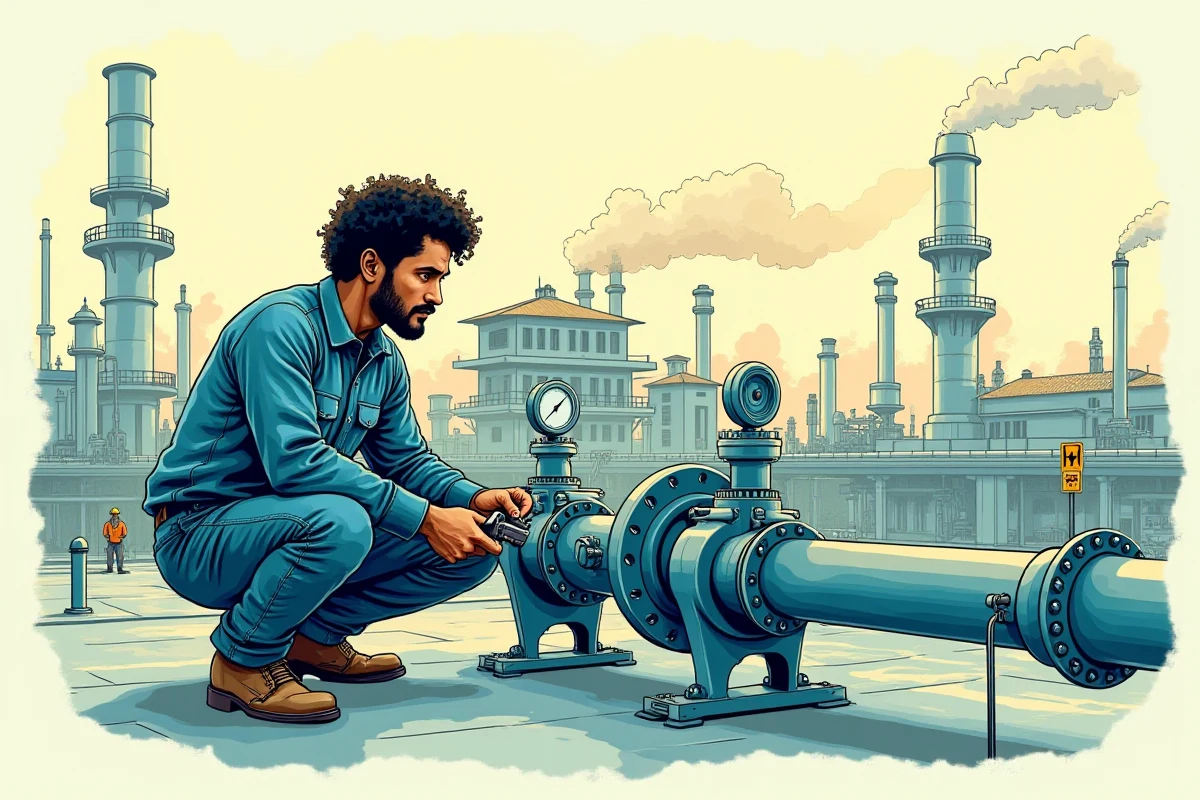
The Invisible Safety Gap
Silvassa, the capital of Dadra and Nagar Haveli, sits at the epicentre of India's densest industrial zone per capita. Four thousand manufacturing units cluster here—pharmaceuticals, bulk chemicals, plastics, textiles, packaging—each one clamouring for skilled maintenance workers. The factories that produce the medicines India ships across the world, the plastics that line supermarket shelves, the chemical building blocks for industries downstream. And yet, the workers maintaining the very machinery that produces these goods often exist in a peculiar twilight zone: formally employed, regularly paid, deeply skilled—but stripped of the legal protections that are supposed to shield them from harm.
This is Rajesh's story. But it is also the story of hundreds of pipe fitters, instrumentation technicians, electricians, and welders working across Silvassa's industrial estate, where a small-to-medium chemical plant owner can still push enrolment deadlines into the future, and where a single workplace accident transforms from a manageable injury into a family catastrophe.
The Habit of Working Unprotected
Rajesh came to Silvassa in 2023 from Vadodara, Gujarat—two hours south by bus. His family has roots in mechanical work: his father had worked as a machine operator in a cotton mill, back when such mills still existed. Rajesh trained through a Gujarat ITI, apprenticing under a senior fitter in a capital equipment workshop for two years. By the time he was 28, he could read a P&ID diagram, troubleshoot a pressure relief system, and diagnose corrosion patterns that would escape an untrained eye. Wages in Vadodara had plateaued at ₹15,000 monthly for shift work. Silvassa's chemical plants paid ₹22,000 base, plus production bonuses. The offer came through a contractor who supplied maintenance crews to the plant. Rajesh said yes.
His employer's name was Arun Desai—a mid-sized chemical manufacturer producing polymer additives and industrial coatings. The operation was lean: twelve permanent staff (including Rajesh), another eight to twelve contractors rotating through on three-week stints. Desai was careful about wages and the appearance of propriety. Rajesh received a wage slip every month. The slip listed his earnings, deductions for provident fund (₹2,200/month), and a deposit to his bank account within three days of month-end. Everything looked lawful.
Except for ESIC.
ESIC—the Employee State Insurance scheme—is India's mandatory social security blanket for industrial workers. Any employer with ten or more workers must enrol employees earning ₹21,000 or less per month. The enrolment grants access to a ladder of protections: outpatient and inpatient medical care through ESIC hospitals and empanelled clinics; accident benefits up to ₹90,000 in cash plus medical costs; temporary and permanent disability pensions; old-age pensions; and family pensions if the worker dies. The contribution is small: the employer pays 3.25% of wages, the worker 0.75%. It is, in plain language, a legal requirement.
Rajesh did not know this. Or rather, he did not know with certainty. His wage slip made no mention of ESIC. He had assumed the provident fund was the state's way of managing his protection. He had seen the same pattern at two previous employers, smaller operations in the Vadodara and Vapi chemical corridors. No one had corrected him. In the mental model of migrant industrial workers—men who move from plant to plant, carrying skills but no institutional memory—the absence of a deduction is often mistaken for the absence of a requirement.
The Cost of One Accident
On a Monday morning in October 2024, Rajesh was inspecting the flanged connections on the No. 3 reactor inlet manifold. The reactor processes polymer resin in a closed loop at 6 bar pressure. The manifold is a cast-iron block studded with ports, each one a potential leak point. Rajesh had written the maintenance schedule himself: every eight weeks, he would run a hydrostatic pressure test, measure the bore wear on all six ports, and replace any seals showing micro-fractures. The schedule was rational. The execution was not always on time.
That morning, the flange on port 4 began to weep. Not a sudden rupture—just a fine aerosol of process fluid (a volatile ester used as a solvent) beginning to cloud the maintenance platform. Rajesh called for a shutdown. While the shift supervisor initiated the cooling sequence, Rajesh climbed down to get a closer look. The space was already humid; the escaping solvent evaporates quickly in warm air. Rajesh was wearing a dust mask, not a respirator. No one had told him a respirator was necessary. The supervisor had not specified one.
By the time the reactor had cooled enough to safely disassemble the manifold, Rajesh had inhaled an unknown quantity of ester vapour. He felt light-headed and nauseated. He sat down, drank water, and told the supervisor he needed to go home. The supervisor—a young man named Vikram who had been at the plant for six months—said okay, noted it in the shift log, and told him to report back the next day.
That night, Rajesh's breathing became shallow. His wife, Priya, noticed his lips had taken on a faint blue tint. By morning, he had a fever and a dry cough. At the local clinic in Silvassa town, the doctor examined him and said it sounded like chemical pneumonitis—inflammation of the lungs from inhaling irritant vapours. Not life-threatening, but not trivial. He prescribed antibiotics, bronchodilators, and a week of rest. Rajesh did not return to work for twelve days.
During that week, the reality of his protection—or lack thereof—became visible.
He had no sick leave provision in his employment contract. The supervisor had not offered one. His wage slip had made no mention of it. When he returned, four days late because the fever persisted, Desai deducted those four days from his monthly pay: ₹2,933. The pneumonitis lingered. For another three weeks, climbing stairs left him gasping. He could not perform his full duties. He moved to lighter inspection tasks, filing reports, calibrating instruments in the air-conditioned office. His monthly bonus—which usually added ₹3,000 to ₹4,000—was halved, because he had not been on the production shift. His monthly income dropped to ₹17,000.
It was during this period that Rajesh asked a colleague named Suresh, an older electrician who had worked at the plant for seven years, whether there was a way to claim medical reimbursement or some kind of welfare benefit. Suresh laughed—not unkindly, but with the exhaustion of someone who had asked the same question years ago.
"There is no benefit, bhai," Suresh said. "You see your wage slip. Provident fund only. If you had ESIC, this would be paid. But Desai hasn't enrolled us."
"Can he do that?" Rajesh asked.
"He's doing it," Suresh said.
The Scope of the Problem
Silvassa's industrial zone is a peculiar ecosystem. The units range from pharmaceutical multinationals—companies like Lupin, Alembic, Ipca—down to single-factory operations producing specialty chemicals for export. The larger companies are scrupulous about compliance. Their HR departments manage ESIC enrolment the way they manage tax filings: as a routine, auditable function. But the long tail of smaller chemical plants, plastic processors, and textile dyers—the units with fifty to three hundred workers—operate in a grey zone of selective compliance.
Some enrol workers in ESIC but attempt to keep wages reported below ₹21,000 to limit contributions. (The ESIC limit has been raised repeatedly; as of 2024, the nominal ceiling is ₹21,000 but many older employers still anchor to older thresholds.) Some enrol core permanent staff but exclude contract workers, treating them as "outside contractors" even though they work full-time on-site. Some, like Desai, simply do not enrol anyone and count on the fact that enforcement is sparse and penalties are often treated as a business cost to be absorbed every few years if an inspector happens to visit.
The UT administration—Dadra and Nagar Haveli's labour department—is chronically understaffed. There is one ESIC Sub-Regional Office in Silvassa serving the entire industrial estate. It is staffed by one superintendent and one assistant, both drowning in complaint backlog. A complaint filed in January might be actioned in June. In that interval, employers know the window to evade or negotiate.
For workers like Rajesh, the situation creates a trap. He is legally an employee of a company with more than ten workers earning below the ESIC ceiling. He is entitled to enrolment. And yet, the enrolment can only be initiated by the employer—Rajesh cannot self-enrol. If he complains to the labour inspector, he risks being seen as a troublemaker. Desai might deny him shift work or find reasons to terminate him. Rajesh has remittances to send. His wife Priya is a schoolteacher in Vadodara, earning ₹18,000 a month, but their son is in his final year of college in Pune. Medical bills for a younger daughter are still being paid off. Rajesh cannot afford to lose ₹22,000 a month.
This is the leverage that keeps the system intact.
The Turning Point
In late November, Rajesh attended a safety briefing at the plant. It was mandatory, held quarterly, and usually consisted of an external consultant reviewing accident statistics and injury prevention slides. This time, the consultant mentioned something Rajesh had not heard before: a government scheme called GabFORGE, designed to help workers understand their legal entitlements and navigate social security enrolment.
The consultant did not know much about it. He mentioned a website—gabforge.in—and said it had information about schemes like ESIC, BOCW, and PM Vishwakarma for workers in different states. Rajesh wrote the name down.
That evening, using his phone's hotspot at home, Rajesh searched for gabforge.in and found the skilled-trades section. The layout was straightforward: articles about real workers in his situation, explanations of schemes in Gujarati and Hindi, and step-by-step guides to filing complaints and accessing welfare. There was even a section specifically about ESIC non-compliance in Silvassa's industrial zone—a practitioner's guide written for workers who suspected their employers had dodged enrolment.
The guide explained the complaint process. A worker could file a complaint directly with the ESIC Sub-Regional Office in Silvassa, providing their name, employer name, approximate joining date, and wage details. The ESIC office would then issue a formal notice to the employer asking for proof of enrolment. If the employer could not produce it within fifteen days, ESIC would initiate mandatory enrolment and back-bill the employer for three years of premiums (employer and employee contributions, plus interest). The worker would then be covered retroactively.
Rajesh typed a question into the GabFORGE assistant, in Hindi: "अगर मैं ESIC शिकायत दर्ज करता हूँ, तो क्या मेरा मालिक मुझे निकाल सकता है?" — If I file an ESIC complaint, can my employer dismiss me?
"नहीं — ESIC Act की Section 72 के तहत, कोई भी employer किसी worker को ESIC शिकायत दर्ज करने की वजह से terminate नहीं कर सकता। यह illegal retaliation है और इसकी सज़ा ₹10,000 fine और 6 महीने की सजा है। आप complaint ESIC portal (esic.gov.in) पर online भी कर सकते हैं — बिना office visit किए। आपका employer name, joining date, और salary slip — ये तीनों documents काफी हैं। Silvassa Sub-Regional Office का case reference number usually 7–10 working days में आता है।"
(No — under Section 72 of the ESIC Act, no employer can terminate a worker for filing an ESIC complaint. This constitutes illegal retaliation and carries a penalty of ₹10,000 fine and six months imprisonment. You can also file the complaint online at esic.gov.in without visiting the office. Your employer name, joining date, and salary slips are sufficient. The Silvassa Sub-Regional Office typically issues a case reference number within 7–10 working days.)
But here was the critical part: the worker did not need to put his name on a complaint form visible to the employer. He could file anonymously. Or he could file through a labour inspector, which added an official layer and made employer retaliation less likely. Or—and this was new to Rajesh—he could file online via the ESIC portal.
The GabFORGE guide also clarified something Rajesh had worried about: filing a complaint does not automatically lead to termination. There are legal protections against employer retaliation for filing safety or welfare complaints. And if retaliation does happen, there are remedies.
That night, Rajesh called his friend Rohit, who works as an electrician at a pharma plant in Daman. Rohit had been ESIC-enrolled for four years and had used the benefits twice—once for an outpatient treatment for a work-related burn, and once to claim the maternity benefit when his wife was pregnant.
"The ESIC is real, bhai," Rohit said. "I have a card. I went to an ESIC hospital in Daman and they did not charge me. Full free treatment."
"And your employer, was he upset?" Rajesh asked.
"Why would he be upset? It's the law. He has to do it. But when I was uninsured, I went to the private clinic and paid three thousand. With ESIC, I paid zero."
The Dialogue
Rajesh spent the next week thinking through his options. He shared the GabFORGE article with Suresh, the older electrician. Suresh read it and immediately recognized the stakes.
"We should tell Desai," Suresh said. "Not threaten him. Just tell him: you are required by law to enrol us. Here is the form. Here is the process. Do it."
Rajesh was hesitant. The power asymmetry felt too stark. But Suresh was senior, and his confidence was steadying.
"Look," Suresh said. "Desai respects workers who know the rules. He's not a bad man—he's a businessman who has been cutting corners. If we show him that we know, and that there is a formal way to regularise, he might just do it. And if he doesn't, we have a backup plan."
The backup plan was to file a complaint with the ESIC office. But Suresh was right: it was worth attempting a direct conversation first.
A few days later, Rajesh arranged a brief meeting with Desai in his office. Rajesh brought the printout from GabFORGE, the relevant government notices, and his wage slips. He explained, calmly and factually, that he had noticed ESIC was not deducted from his pay despite working at a plant that legally qualified for mandatory enrolment. He said he had looked into the rules and understood that the employer was responsible for enrolment. He asked if there had been an oversight, and if Desai could initiate the process.
Desai's response was not angry, but it was evasive. He said he would "look into it," that there might be some complication with the contractor arrangement, that he would get back to Rajesh. Weeks passed. Nothing happened.
In January 2025, Rajesh decided to escalate. He filed a complaint with the ESIC office, using the online portal. He provided the plant name, his name, his wage slip copies, and his approximate joining date. He noted that he had requested enrolment directly from the employer and had been deflected. He did not mention retaliation fears, but he asked that the ESIC office handle the matter formally.
Two weeks later, the ESIC office issued a notice to Desai, requesting proof of enrolment or a formal explanation for non-compliance. Desai received it on a Friday. On Monday, he called Rajesh and Suresh into his office.
"You filed a complaint," he said. It was not a question.
Neither Rajesh nor Suresh denied it.
"I could fire you both," Desai continued. "But I'm not going to. Because I know this is coming anyway. And because, frankly, you're good workers and I'd rather keep you than replace you. But I want you to understand: going around me to the government makes things harder for me. Next time, just tell me directly."
"We did tell you," Rajesh said quietly. "In December. You said you'd look into it."
Desai seemed to remember. His face shifted from defensive to resigned.
"Alright. I'll enrol you. I'll need to enrol everyone. It's going to cost me about ₹45,000 per month in employer contribution. That's not nothing. But I'll do it."
By March 2025, Rajesh's ESIC enrollment was processed. He received a Smart Card in the mail, along with a list of ESIC hospitals and empanelled clinics in the region. His wage slip now showed the ESIC deduction: ₹165 per month. The employer contribution was being made separately. For the first time in three years, he was covered.
- 🏥
October 2024 — Accident and cost
Chemical pneumonitis from solvent exposure. Twelve days off work, four days' wages deducted (₹2,933), bonus halved. Monthly income drops from ₹22,000 to ₹17,000. No ESIC coverage.
- 🔍
November 2024 — Entitlement discovered
GabFORGE skilled-trades guide identifies ESIC non-compliance. Agent confirms complaint can be filed online at esic.gov.in, anonymously or with name, with retaliation protections under Section 72.
- 📋
December 2024 — Employer approach
Rajesh meets Desai directly with wage slips and printout. Desai says he will look into it. No action taken over the following six weeks.
- 📨
January 2025 — Formal complaint filed
Online complaint submitted to ESIC Sub-Regional Office (Silvassa). ESIC issues notice to Desai within ten working days. Desai acknowledges non-compliance in the meeting that follows.
- ✅
March 2025 — Smart Card received
ESIC enrollment processed for all twelve permanent workers. Rajesh's wage slip shows ₹165/month employee contribution. Employer contribution (3.25%) confirmed. First ESIC Smart Card arrives by post.
"Going around me to the government makes things harder for me. But I'll do it." — Arun Desai, Silvassa chemical plant owner, after receiving ESIC non-compliance notice
The Resolution and Beyond
The three-year gap in ESIC coverage could not be retroactively corrected by Rajesh's individual complaint. ESIC can only mandate back-enrollment from the date the complaint is filed. The three years prior remain a gap. But Rajesh is protected now. His pneumonitis residue—a lingering cough and slight shortness of breath after exertion—can be monitored at an ESIC hospital for free. If his condition worsens, he can claim occupational disease benefits.
More importantly, Suresh and the other workers at Desai's plant are now enrolled. When another chemical leak occurred in June 2025—a minor one, handled without hospitalization—Suresh was covered. His outpatient treatment cost nothing. His loss of wages for a day of monitoring was covered under the temporary disability benefit. The gap between having insurance and not having it had become material.
Rajesh's path forward had also shifted. With ESIC enrollment and a clearer understanding of his legal entitlements, he began thinking about longer-term career moves. He researched PM Vishwakarma, a new government scheme offering ₹15,000 toolkit grants and ₹3 lakh interest-free credit for skilled self-employed workers. He realized that with proper capital and a network of clients in Silvassa's industrial estate, he could transition to freelance instrumentation work—taking on maintenance contracts directly, without an intermediary employer. It would be riskier, but it would also give him more control and higher potential earnings.
He is not ready to make that leap yet. But the possibility is no longer a fantasy. It is a path he can see and plan for.
Why We Built This
The Silvassa chemical industrial estate is one of India's crown jewels of manufacturing. The medications that cure diseases, the polymers that package goods, the chemical building blocks that serve downstream industries—all emerge from this cluster of thousands of small and large units. And yet, the workers who maintain these factories, who diagnose failures and prevent accidents, often work in a state of legal invisibility.
We built GabFORGE because we noticed a pattern: skilled workers in unorganized and semi-formal industries know how to do their jobs. They do not always know their rights. And the asymmetry between worker knowledge and employer knowledge creates a system where compliance is optional, not mandatory. An ESIC enrollment is not a favor the employer grants. It is a legal obligation. But when that obligation is systematized through government portals, formal notices, and procedural clarity, the conversation changes.
Rajesh did not need a lawyer or a union organizer to trigger ESIC enrollment. He needed information. He needed to know that a formal complaint could be filed online. He needed to know that his employer could not legally retaliate. He needed to know that ESIC coverage was not optional—it was law.
GabFORGE's skilled-trades guides walk workers through exactly these scenarios. They explain the schemes. They provide templates for conversations with employers. They show real examples from workers who have navigated non-compliance and come out protected.
What We Hope Happens
Our hope is not grandiose. We do not imagine that every ESIC non-compliance in Silvassa will be resolved because one website exists. The leverage of employers is still real. The power asymmetry is still there. But we hope that:
Workers will know. If you are employed in a factory with ten or more people and earning ₹21,000 or less per month, ESIC enrollment is not optional. You are entitled to it.
Filing a complaint will become normal. Right now, filing a complaint feels like an act of aggression. We want it to feel like asserting a right—the way claiming a tax refund feels normal.
Employers will realize compliance is easier than non-compliance. The back-billing, the interest, the legal exposure—it compounds. Compliance upfront is cheaper.
Workers will move into the formal economy with their eyes open. Rajesh is now thinking about his next career move because he has a safety floor. That is what ESIC provides: not luxury, but a floor. A floor makes it possible to jump.
Resources to Explore
ESIC Non-Compliance: A Step-by-Step Guide to Filing a Complaint
- Visit esic.gov.in and navigate to the Grievance / Complaints section
- Or contact the ESIC Sub-Regional Office (Silvassa) directly
- Bring your wage slips, employment contract (if available), and employer details
UT BOCW Welfare Board (Dadra and Nagar Haveli)
- Registration for construction and allied workers
- Portal: dnh.nic.in/labour
- Accident benefits, housing loans, education scholarships
PM Vishwakarma: Self-Employment Toolkit & Credit
- For skilled tradespeople transitioning to self-employment or side work
- Registration via CSC or DDPU office
- Portal: pmvishwakarma.gov.in
- ₹15,000 toolkit grant + ₹3 lakh interest-free credit
National Career Service (NCS)
- Job matching and apprenticeship opportunities for skilled trades
- ncs.gov.in
A Final Word
Safety is not invisible. The moment you understand that you are entitled to protection, the moment you know that the law requires your employer to provide it, the moment you can articulate your rights in a conversation—safety becomes visible. It becomes negotiable. It becomes real.
Rajesh is one person. His story is one story. But it is a story that repeats across thousands of workers in Silvassa, in Vapi, in the industrial corridors of Gujarat and Maharashtra, wherever skilled tradespeople maintain the machinery that powers India's industries.
We built GabFORGE to make that story one of informed choice, not silent vulnerability. Your safety is not a favor. It is a right. And knowing the difference is where everything begins.