
The Varanasi Loom Mechanic and the Enrollment Wall
Mohammad Ansari's hands are the colour of dark leather, etched with the creases of fifty-two years spent threading, twisting, and hammering. He sits in the half-light of his workshop in Madiyahun gali, one of Varanasi's narrowest weavers' lanes, where the air tastes of brass and crushed cardamom, and the sound of looms carries through the stone walls like a heartbeat. He is a loom mechanic—taliye-rana—which means he repairs the wooden silk looms that have threaded gold through Varanasi cloth for four centuries.
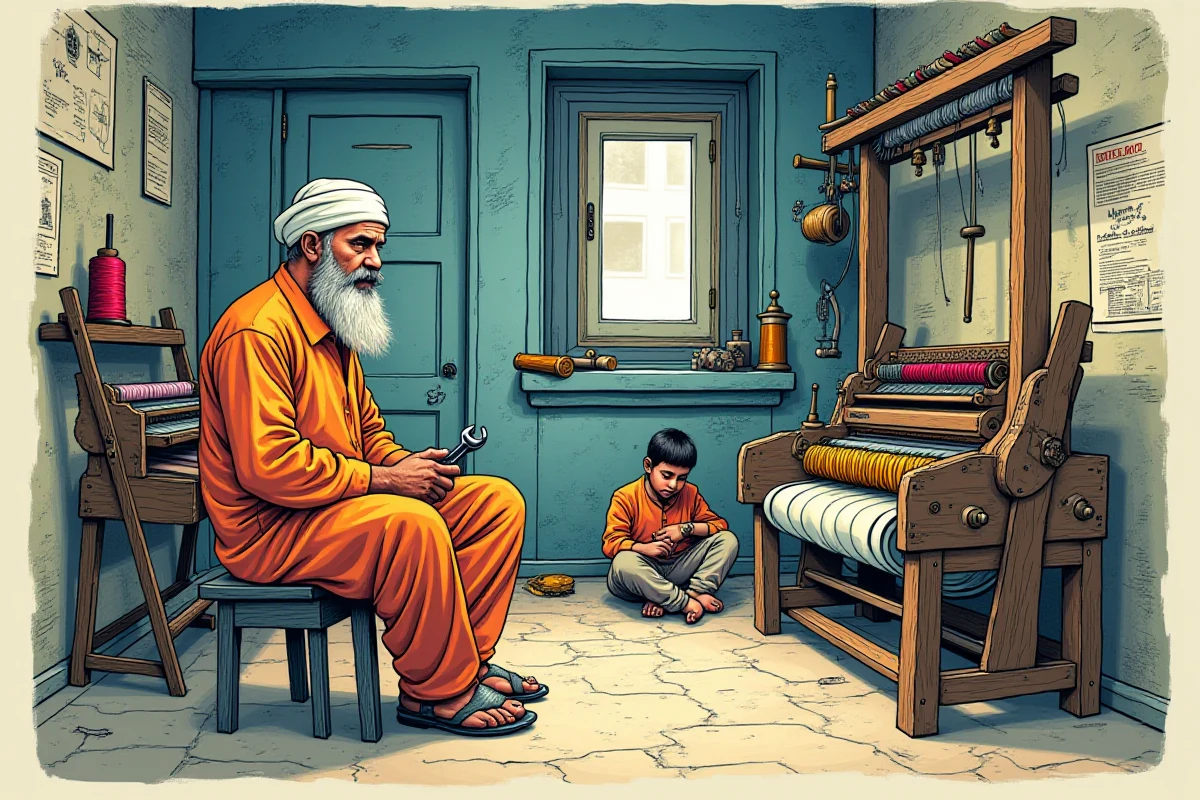
His workshop is not large. Two looms occupy the floor, both awaiting repair. Spools of thread—crimson, gold, deep purple, cream—crowd the walls in wire cubbies. A metal toolbox lies open: chisels, wrenches, a block plane worn smooth by his palms, calipers marked in his own hand. An apprentice boy, Vikram, sits cross-legged on the stone floor, grinding a cast-iron heddle on a sandstone block. The machine will soon be ready to return to the Ansari family weaving house next door. The repair will earn Mohammad ₹1,200. It will take three days.
His wife, Amina, brings him tea. She works at a small tailoring shop two lanes away. His two daughters completed secondary school; one is married and lives in Lucknow with her husband, a software engineer. The other, Zahera, is studying commerce at Varanasi Hindu University. Mohammad is proud, but also tense. Zahera's fees are ₹80,000 per semester. His income fluctuates between ₹35,000 and ₹50,000 per month—steady enough, but not sufficient to save.
Last year, a WhatsApp message arrived in the group chat of Banarasi loom mechanics. The PM Vishwakarma Yojana had opened enrollment. The scheme promised ₹15,000 for a toolkit, collateral-free credit of ₹3 lakh at 5% interest, free skill training, and a small insurance payout. For Mohammad, the math was immediate: ₹15,000 would buy new precision calipers, gauges, and a small hydraulic press—tools that would let him take on the specialized repairs that commanded ₹2,500–₹3,500 per job instead of ₹1,200. The credit at 5% was a gift compared to the informal moneylender in his neighbourhood who charged 24% per annum.
He went to the CSC centre near the Ghat Road. The operator, a young man named Rajesh, pulled up the PM Vishwakarma portal and asked for his Aadhaar card. Mohammad produced it. Then Rajesh typed something and frowned. "Your Aadhaar is not linked to your bank account," he said. "The system won't let me proceed."
Mohammad did not yet have a bank account. Most of his work was paid in cash—the loom owners kept registers, the repairs were documented in notebooks, but the money came in notes and coins. He had, at Rajesh's insistence, opened a state bank account two years prior for a small government scheme, but he had never activated it. The Aadhaar linking had not happened.
Rajesh said: "Go to the bank. Link your Aadhaar. Come back."
🔒 The Enrollment Trap
PM Vishwakarma looks simple on paper. The government website lists three steps:
- Visit a CSC centre with Aadhaar and bank details
- Fill out the online form
- Biometric verification at the CSC
- Toolkit claim or credit transfer within 30 days
In practice, the system demands precision that many traditional artisans do not possess.
Mohammad's first barrier was the Aadhaar-bank linkage. He travelled to the bank branch (a 20-minute walk from his workshop), stood in line for two hours, and presented his Aadhaar and bank passbook. The bank manager informed him that his account details did not match the Aadhaar database. His Aadhaar was registered under "Mohammad Ansari," but the bank account was registered under "Mohammed Ansari"—a single letter difference that the UIDAI system flagged as a mismatch.
To correct it, Mohammad was told to file an Aadhaar correction request with UIDAI. This required an offline document (a passport, a driving licence, or a property deed). Mohammad had none of these. His identity, for four decades, had rested on his reputation in the lane, his face, his work. Official identity was abstract to him.
He could have hired an Aadhaar correction service—the CSC operator had offered to help for ₹500—but ₹500 felt like a week's margin in his budget. He delayed.
Three months passed.
In March, a second message arrived on WhatsApp. The enrollment deadline was being extended. Mohammad, prompted by hope, returned to the bank and asked again about the correction. A different manager said he could simply re-register under the correct spelling, but his old account would be closed and the bank would issue a new account number. This meant new bank statements, new passbooks. The process would take 15 days.
Mohammad went home and told Amina: "This is too much trouble for ₹15,000."
But his neighbour, Hassan, had enrolled successfully in the PM Vishwakarma scheme. Hassan was a younger loom mechanic, perhaps 38, who worked in a more formal setting—his loom repair shop was actually registered as a small cooperative. He had already received the ₹15,000 toolkit subsidy and was in the process of accessing the ₹3 lakh credit to buy a second-hand computerized loom-threading station that would make repairs faster.
Hassan's success stung. Mohammad realized he had fallen through a crack not because of intent, but because of bureaucratic precision.
By June, at Hassan's urging, Mohammad returned to the CSC. Rajesh's face lit up in recognition. "Your Aadhaar-bank is now linked," he said. The form submission took 20 minutes.
Then came the biometric verification. Rajesh explained: "The system will scan your fingerprints and compare them to your Aadhaar database. If they match, you're approved."
Mohammad placed his finger on the scanner. It blinked red. "Not recognized," Rajesh said. "Try again."
This happened twice more. Mohammad's hands, calloused and creased from decades of work, did not register cleanly on the optical scanner. Rajesh suggested trying the other hand. Still nothing. He made an appointment for the following week.
The second visit, the scanner worked. Mohammad never learned what changed—perhaps a firmware update, perhaps just luck.
Then came the waiting. The form had been submitted to the state PM Vishwakarma backend. The status page showed "pending." Days became weeks. Three weeks in, Rajesh told Mohammad to file a query on the state portal. Mohammad asked Rajesh to do it for him; Rajesh complied, charging ₹100.
On day 28, the status changed to "approved."
💔 The Year Lost
While the bureaucratic machinery ground slowly, Varanasi's loom repair market continued without him.
Mohammad did not lose income—the immediate repair work continued. But he lost the opportunity to upgrade his tools and access the credit that would have let him invest in new repair stations. Hassan, meanwhile, had claimed his toolkit and purchased a computerized heddle-threading system for ₹80,000 (using ₹15,000 of his own savings and the PM Vishwakarma ₹15,000 toolkit). Within two months, Hassan's repair turnaround time had dropped from three days to one, and his rates climbed to ₹2,500–₹3,000 per job.
Mohammad did the math: over a year, Hassan's toolkit investment had already returned itself in higher job fees. Mohammad had watched this from the outside.
The broader picture was worse. Across Uttar Pradesh, PM Vishwakarma enrollment had exceeded 2 lakh artisans, but uptake of the actual benefits—toolkit and credit—hovered at 25–30% of eligible workers. The scheme had been designed with urban, digitally-literate artisans in mind. For traditional craftspeople like Mohammad, the enrollment process had become a wall.
National surveys showed that in UP—the state with the highest PM Vishwakarma enrollment—fewer than 3 in 10 registered artisans had successfully accessed the full benefit bundle. The reasons: Aadhaar mismatches, biometric failures, CSC operator indifference or incompetence, state backend processing delays, and bank account complications.
In August, Mohammad attended a gathering of loom mechanics at a local cooperative office. The conversation turned to PM Vishwakarma. Of the 23 mechanics present, only 4 had received the toolkit. The others recited variations of his experience: biometric problems, form rejections, waiting periods stretching from weeks to months.
One mechanic, Rafiq, said flatly: "The government designed it for someone in Delhi with a Aadhar and a smartphone. Not for us."
Hindi/Bhojpuri (Varanasi dialect)"Sarkaari kaam to sirf kaagaz-pattar ka khel hai. Hamare haath se jo kaam niklta hai—silk, gold thread, the looms that weave stories—us par to koi dhyan hi nahin hai."
English Translation
"Government work is just a game of papers and documents. No one pays attention to the work our hands produce—the silk, the gold thread, the looms that weave stories."
— Mohammad Ansari, loom mechanic, reflecting on the PM Vishwakarma enrollment delays.
🔓 What Changed: GabFORGE Steps In
In September, a WhatsApp message arrived in the Banarasi loom mechanics group. It was from a platform called GabFORGE. The message, in Hindi and Bhojpuri, explained that an AI agent could guide PM Vishwakarma applicants through the entire enrollment process—from Aadhaar linking to toolkit claim.
Mohammad was sceptical. Digital platforms had, in his experience, been built for people in cities, by people in cities. But Hassan texted him privately: "Try it. Worst case, you ignore it."
Mohammad downloaded the GabFORGE app and selected "PM Vishwakarma Enrollment Guide."
The agent's first response came in Bhojpuri, his regional language. It asked for his name, age, and current status with PM Vishwakarma. Mohammad typed that he was approved but had not yet claimed the toolkit or accessed credit.
"Aapka application 28 October ko approve hua hai. PM Vishwakarma state portal par aapka toolkit voucher taiyaar hai — ₹15,000 ka. Authorized vendor se seedha delivery manga sakte hain ya CSC ke through claim file kar sakte hain. Aapka naya bank account IFSC verified hai. Agli step mein hum vendor list check karenge — Varanasi aur Patna dono mein authorized vendors hain."
(Your application was approved on 28 October. Your toolkit voucher of ₹15,000 is ready on the PM Vishwakarma state portal. You can request direct delivery from an authorized vendor or file a claim through the CSC. Your new bank account IFSC is verified. In the next step we will check the vendor list — there are authorized vendors in both Varanasi and Patna.)
The agent said: "You are at stage 7—Toolkit Claim. Let me walk you through the remaining steps. First, we need to check if your state backend has issued your toolkit voucher."
Over the next 30 minutes, the agent guided Mohammad through:
Toolkit Voucher Status: The agent connected to the PM Vishwakarma state portal and checked Mohammad's status. It was "approved and toolkit authorized." The agent explained that he could now purchase tools from any authorized vendor and claim reimbursement, or request direct delivery from a PM Vishwakarma vendor.
Vendor Selection: The agent asked what tools Mohammad needed. Mohammad listed: precision calipers, a digital gauge, a small hydraulic press, a set of chisels, and a rewinding spool. The agent cross-referenced his need against the PM Vishwakarma approved vendor list. It turned out there was a tool vendor in Patna, just two hours by train, who stocked all five items and was authorized to deliver and file reimbursement claims directly.
Credit Application Setup: The agent then asked about his credit access. It explained that the next step—accessing the ₹3 lakh credit at 5%—required a separate application and income verification. The agent offered to prepare the application with Mohammad's workshop income data and submit it on his behalf to the state backend.
Bank Account Verification: The agent asked for Mohammad's new bank account number and IFSC code, then verified it against his Aadhaar. All matched.
Three days later, Mohammad received an email from the Patna tool vendor confirming his order. The toolkit would arrive in a week. The vendor would file the PM Vishwakarma reimbursement claim on Mohammad's behalf; the ₹15,000 would be credited to his bank account within 30 days.
Mohammad also received a second email from the state PM Vishwakarma backend confirming that his credit application had been received and was "under review." The agent predicted approval within 10 days.
He stared at his phone in disbelief. Ten minutes of conversation with an AI had unstuck a year of bureaucratic inertia.
🧭 Why We Built It
India's Ministry of Micro, Small & Medium Enterprises counts 3 crore+ traditional artisans across 18 designated trades: silk loom mechanics, carpet weavers, brassware makers, glass artisans, cobblers, woodcarvers, blacksmiths, toolmakers, cutlery makers, basket weavers, stone masons, ironsmith, dye-makers, lac workers, and others.
Most of these trades cluster in specific geographies: Banarasi silk in Varanasi, Mirzapur carpets in Mirzapur, Moradabad brassware in Moradabad, Firozabad glass in Firozabad, Agra shoes in Agra, Saharanpur wood carving in Saharanpur. These are places where craft traditions run deep, where skills pass from parent to child, where an artisan's identity is inseparable from their trade.
The PM Vishwakarma Yojana was designed to serve exactly these communities. ₹15,000 in toolkit subsidy is not meant to transform lives—it is meant to refresh tired tools, to unlock precision work, to let craftspeople invest in themselves. The ₹3 lakh credit at 5% is meant to buy a second loom, a better workspace, a junior apprentice's wage. The free training is meant to bridge between tradition and modern certification. The insurance is meant to protect against the catastrophic accident that could end a career.
But enrollment requires digital fluency, bureaucratic patience, and access to consistent, knowledgeable help. For an artisan in Varanasi, in a lane where internet is spotty and the nearest bank is a 20-minute walk, the enrollment process becomes a gauntlet rather than a gateway.
GabFORGE's PM Vishwakarma agent is designed to collapse that gauntlet. It guides applicants through each step, in their regional language. It handles the state portal interactions, the bank verifications, the vendor coordination. It predicts what will fail and fixes it before it becomes a barrier. It restores time to the artisan—time that would otherwise be spent queuing at banks and CSCs, time that could instead be spent on looms.
The agent works across all 18 PM Vishwakarma trades. It is available in Hindi, Tamil, Gujarati, Marathi, Telegu, Kannada, and Bhojpuri. It is free for all artisans. It costs nothing to the government. It simply automates what a patient human caseworker would do—if one existed.
🌱 What We Hope Happens
Eleven months after he first walked into Rajesh's CSC centre, Mohammad's toolkit arrived. The hydraulic press alone changed his workflow. Repairs that had taken an hour to position now took 20 minutes. His first week with the new tools, he completed eight repairs—double his usual weekly volume. His income that week was ₹21,000. He called Hassan to tell him.
Three weeks later, his credit application was approved. ₹3 lakh, at 5%, payable over 60 months. The monthly instalment would be ₹6,500. His new income trajectory would easily cover it.
The next step, the GabFORGE agent suggested, was to enroll in the free UPSDM loom mechanic certification course. Mohammad was 52; he had no formal credentials. But the certificate would let him apply for government procurement contracts and teach apprentices formally. The course was online, conducted in Hindi and Bhojpuri, with video modules and a practicum. Mohammad's daughter Zahera, home for semester break, helped him register.
Six months later, when Zahera asked about his plans, Mohammad said: "I'm thinking of expanding. Hassan and I talked about opening a joint workshop, bigger space, two stations. With the credit and the new toolkit, it's possible now. And if I can get the UPSDM certificate, we could train more apprentices—proper training, not just picking it up as you go."
Zahera smiled. She had never heard him talk about expansion before.
GabFORGE's mission is simple: the work of your hands deserves support that matches the precision of your craft.
We have built agents for 40+ personas across life and work—students seeking scholarships, caregivers navigating elderly health, jobseekers building portfolios, and, now, skilled-trades workers accessing government schemes that were designed for them but made inaccessible by bureaucratic friction.
The Varanasi loom mechanic, the Mirzapur carpet weaver, the Moradabad brassware maker—they do not need lectures on entrepreneurship or digital upskilling. They need their hands to be recognized, their traditions to be supported, and the schemes that promise to do so to actually work.
This is what gabforge.in exists to ensure.
Start here: gabforge.in. Our agents guide you through PM Vishwakarma enrollment, UP BOCW welfare claims, MUDRA loans, e-SHRAM registration, and dozens of other schemes. All conversations are in Hindi, Bhojpuri, Tamil, Gujarati, Marathi, Telugu, and Kannada. All support is free. All work is yours.
Additional Resources
- PM Vishwakarma Portal: pmvishwakarma.gov.in — official enrollment and scheme details
- UP BOCW Board: upbocw.org — construction worker welfare, accident benefit, housing loan
- UPSDM (UP Skill Development Mission): upskillmission.gov.in — free training and certification for skilled trades
- e-SHRAM Portal: eshram.gov.in — unorganised sector benefits, accident coverage
- MUDRA Loan Scheme: mudra.org.in — collateral-free loans for micro-enterprises
- Varanasi Silk Board: Regional trade association for Banarasi loom mechanics; contact through Varanasi Chamber of Commerce
- GabFORGE Skilled Trades Agents: gabforge.in/skilled-trades — PM Vishwakarma, BOCW, and sector-specific guidance