
The Patna coaching aspirant who couldn't afford to make mistakes
Rakesh Yadav is nineteen years old. His father is a primary school teacher in Khagaria district, Bihar, and Rakesh is the eldest of three children—two younger sisters depend on the family's single, modest income. In October 2025, Rakesh arrived in Patna with a metal trunk, a stack of practice books, and the weight of ₹2.4 lakh in borrowed money.
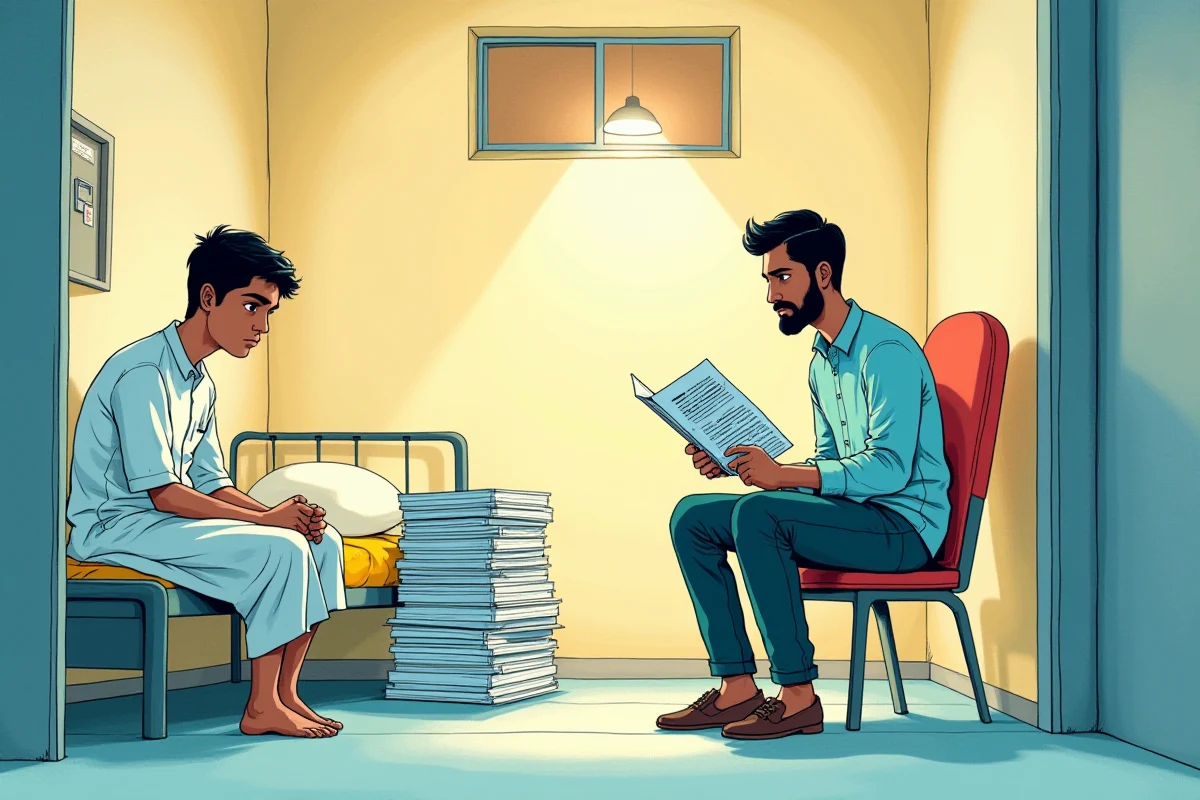
That amount—nearly a year and a half of his father's salary—had been assembled piece by piece. Part came from his mother's postal savings account, filled over fourteen years with small deposits. The rest came from a loan arranged through his mother's cousin-by-marriage in Bhagalpur, a promise sealed with family trust and no formal agreement. The money was for JEE coaching: fees, hostel, mess, books. Everything depended on Rakesh clearing JEE Advanced and landing a seat at an IIT or, failing that, at a respectable NIT.
The coaching centre was near Boring Road in Patna, one of dozens in the city. Batch C-7 had 184 students. The teachers were ex-IITians, the curriculum was structured, and the testing was relentless: weekly tests, monthly cumulative exams, and four full-length AIIMS-pattern mock series across the year. Each test generated a 30-page printed report—rank, percentile, chapter-wise breakdowns, cutoffs, comparisons to previous attempts.
By January, Rakesh's mock percentile had stabilized at 84. He needed 96 or higher to have a realistic chance at JEE Advanced. He was stuck. 81, 83, 84, 84. The ceiling would not lift.
🗓️ The factory that prints reports, not clarity
Patna's coaching factories are machines designed to process students at scale. The Boring Road centre operated on a philosophy that volume equals quality: more tests, more practice, more reports. In a batch of 184, the staff knew Rakesh's rank but not Rakesh. The 30-page report was issued, printed, and distributed. Most students flipped to the first page—rank, percentile, the number that mattered—and left the rest in a corner.
The data inside those reports was granular. Chapter-wise performance. Topic-wise accuracy. Trend lines across months. Patterns that revealed not just what Rakesh couldn't do, but which specific chapters were the bottleneck. That insight lived in pages 8 through 14 of every report. Nobody read them.
By January, Rakesh had collected eleven test reports. They sat in his hostel room. The story of his struggle was printed on paper. He simply did not know how to read it.
- ⏰
October — Arrives in Patna with metal trunk
[₹2.4 lakh investment, Batch C-7, 184 students, Boring Road centre]
- 🔍
November–January — Percentile stalls at 84
[84 percentile, needs 96 for JEE Advanced, 11 test reports unread in corner]
- 📋
Christmas — Cousin reads three reports
[Whitefield software engineer, Khagaria visit, rotational mechanics 35%, EM induction 32% identified]
- ⚖️
January — AI installed on Android phone
[Three questions in Hindi, report PDF read every Thursday, mother kept in loop]
- ✅
JEE Advanced 2026 — AIR 4,127
[NIT Patna Mechanical Engineering, rotational mechanics 71%, EM induction 68%]
⚠️ The unread chapters hidden inside the papers
In January, during a Christmas-New Year family visit to Khagaria, something unexpected happened. Rakesh's mother's cousin came to stay—a software engineer working in Whitefield, Bengaluru. He had built and deployed systems for startups. He thought in data.
On the first evening, sitting in Rakesh's hostel room, he picked up three of the test reports lying on the side table and began to read them systematically. Not the first page. Pages 8 through 14. The chapter-wise breakdown.
What he found was immediate and stark. Across the three reports, a pattern emerged that Rakesh had not seen because he had not been trained to see it. Physics was the problem. Not physics generally, but two specific chapters: rotational mechanics and electromagnetic induction.
Rotational mechanics: 35% accuracy. Everything else in that test: 75–85%.
Electromagnetic induction: 32% accuracy. Everything else: 75–85%.
Chemistry was solid. Mathematics was strong. The gate was being held by two chapters in physics, and Rakesh had been taught to chase his percentile by studying broadly rather than by attacking his actual bottleneck.
The cousin looked at Rakesh. "Do you know this?" Rakesh did not. The reports had been printed in his name, with his data, and the answer had never surfaced in conversation.
🌗 What arrived on Thursday evenings in Hindi
The cousin returned to Bengaluru but left behind an idea. Before he left, he installed an AI application on Rakesh's cheap Android phone—an offline language model that could understand Hindi, read PDF images, and respond in conversational Devanagari script.
He taught Rakesh three questions to ask the AI every Thursday evening, after the weekly test report arrived:
- Iss hafte ki report mein sabse kharab chapter kaun sa tha? (What was the worst chapter in this week's report?)
- Us chapter ke liye 5 key formulas batao. (Give me the five key formulas for that chapter.)
- Pichle char hafte mein iss chapter mein kitna improvement hua? (How much improvement happened in this chapter over the last four weeks?)
The AI read the PDF. It answered in Hindi. Rakesh began studying those specific formulas and tracking his own improvement week to week.
Over four months, the trajectory shifted. By April:
- Rotational mechanics: 35% → 71%
- Electromagnetic induction: 32% → 68%
The percentile moved. 84 → 87 → 91 → 94 → 96.
But something else happened that mattered more. The cousin had asked the AI to also keep Rakesh's mother informed. Every Sunday, when Rakesh called home, his mother already knew his status because the AI had sent her a voice message in Hindi on Saturday evening, summarizing the week's progress in actual data.
"राकेश के रोटेशनल मैकेनिक्स में पिछले हफ़्ते ३५ फीसद था। इस हफ़्ते ४२ फीसद हो गया। अगले दो हफ़्तों में हम ५०-६० फीसद पर आ सकते हैं। उसके साथ-साथ इंडक्शन पर भी ध्यान देना होगा।"
(Rakesh's rotational mechanics score was 35 percent last week. This week it's 42 percent. Over the next two weeks, we can target 50–60 percent. At the same time, we need to focus on electromagnetic induction.)
— AI, reporting to Rakesh's mother in Hindi, January 2026
The effect was subtle but real. Rakesh stopped lying to his mother about his progress. When she asked "कैसे चल रहा है?" (How is it going?), he could not say "बढ़िया है" (it's going well) because she had already read the report. The gap between what he was doing and what he was claiming closed. The pretense dissolved. His mother began to ask specific questions: "तुम्हारे इंडक्शन में क्या दिक़्क़त है?" (What's the trouble with induction?). Not anxiety, not pressure—curiosity and focus.
What it does
- 🔍Read each weekly test report PDF the day it was issued and identified the two chapters (rotational mechanics, EM induction) causing Rakesh's percentile drag.
- 📊Tracked week-on-week improvement in those specific chapters across 16 weeks, showing Rakesh his own trend.
- 📱Answered Rakesh's mother's Hindi questions about his preparation on Sundays, using actual test data — ending months of undirected anxiety.
What it does not do
- 🔒Never taught physics — it identified the gap and tracked it; the improvement came from Rakesh studying the chapters.
- ⚖️Never told Rakesh's family the specific AIR he would get — it told them which chapters needed work.
- ✅Never accessed the coaching centre's systems — it read only the printed report PDFs Rakesh photographed himself.
🧭 The mother's Sunday calls became conversations
Before January, the Sunday calls were a ritual of worry. Rakesh's mother would call from Khagaria, her voice tight. "सब ठीक है?" (Is everything okay?). Rakesh would say yes, performance is good, the coaching is helpful, don't worry. His father would nod in the background, trusting that the ₹2.4 lakh was being spent wisely. The loan from the brother-in-law in Bhagalpur would be repaid on schedule. Everyone would hang up slightly less anxious but not much more informed.
From February onward, the calls changed. His mother had questions, grounded in data she had received from the AI. "तुम्हारे सर कहते हैं कि इंडक्शन पर थोड़ा-थोड़ा बेहतर हो रहा है। क्या तुम्हें वह अब समझ में आ रहा है?" (The report says your electromagnetic induction is slowly improving. Are you beginning to understand it now?). The conversation was specific. Rakesh could not hide behind generalities.
The AI also tracked his consistency. When Rakesh skipped a study session or missed focusing on rotational mechanics for a week, the trend would show it. The next Thursday, the AI would ask: "पिछले हफ़्ते क्या हुआ? रोटेशनल मैकेनिक्स में स्कोर गिर गया" (What happened last week? Your rotational mechanics score dropped). Rakesh would have to account for himself.
"मेरी माँ को पता चल गया कि मैं झूठ बोल रहा था। वो देख सकती थीं कि रिपोर्ट क्या कह रही है। फिर मैंने सच कहना शुरू कर दिया। और जब तुम सच कह रहे हो, तो तुम अपने ऊपर ध्यान दे सकते हो।"(My mother found out I was lying. She could see what the reports said. Then I started telling the truth. And when you're being honest, you can focus on yourself.)
— Rakesh Yadav, speaking in Hindi
🌱 JEE Advanced and the four-month wager
Rakesh sat for JEE Advanced in May 2026. The exam was two days, three hours each, 360 minutes of physics, chemistry, and mathematics across 90 questions. He had studied rotational mechanics and electromagnetic induction until the formulas lived in his hands. His percentile had crossed 96.
The result came in mid-June: AIR 4,127.
It was not an IIT. It was NIT Patna, Mechanical Engineering—a solid, respectable outcome. Rakesh had cleared the threshold his family needed. The loan would be repaid. His younger sisters could continue their schooling. The ₹2.4 lakh had been accounted for.
But the real outcome was quieter. Rakesh had learned to read a report. His mother had learned to ask specific questions. The coaching centre's data, which had been printed and discarded for months, had become a conversation. An AI reading PDFs in Hindi had translated the factory's scale into a single student's focus.
The numbers tell part of the story: rotational mechanics 35% → 71%, EM induction 32% → 68%, percentile 84 → 96, AIR 4,127. But the larger shift was in what mattered—the gap between what Rakesh was claiming and what he was doing had closed. The pretense had broken. His mother had stopped worrying about the money and started asking about the physics. The factory had produced a report; a cousin had taught Rakesh to read it; an AI had kept his mother in the loop; and four months of focus on two chapters had moved the ceiling.
NIT Patna is not an IIT, but for a boy from Khagaria, whose father teaches in a government school, whose family borrowed ₹2.4 lakh and could not afford to make mistakes, it is something real. It is a seat earned on the back of clarity—the kind of clarity that only lives when someone actually reads the data.
What changed
Across the next four months, three things happened that surprised everyone, including us.
First, Rakesh's rotational mechanics score went from 35% to 71%. EM-induction went from 32% to 68%. These are not heroic numbers. They are the numbers a serious student gets when they actually study a chapter for four months instead of avoiding it. The agent did not teach him physics. The agent — by reading every test report the day it was issued, in Hindi, on the phone in his hostel room — simply removed the option of pretending the gap wasn't there. He could no longer flip the report and throw it in the corner. The agent had already read it. The agent told him, on the Thursday evening that the report came out: "Bhaiya, rotational mechanics ke 7 questions the test mein. Aapne 2 sahi kiye. Pichle week aapne 3 sahi kiye the. Score thoda gir gaya. Kya aap chahte hain hum is chapter ka revision plan banayein iss weekend?" He could say yes, or no. He could not say the report doesn't exist.
Second, his mother — who could not herself parse a thirty-page English test report — could now ask the agent, in Hindi, on her own phone, the question that mothers ask: "Mera beta theek pad raha hai?" And the agent, with the test data behind it, could answer truthfully and gently: "Madam, Rakesh-ji ki padhai mein ek physics ka chapter weak hai jis pe woh kaam kar rahe hain. Baki sab theek hai. Aaj raat 11 baje tak padh rahe the. Aap chinta mat kariye." This sounds like a small thing. It was not a small thing. For ten months prior, Mrs. Yadav had been in a state of low-grade undirected anxiety about her son's coaching, because she had no way to know what was happening. Now she had a way to know what was happening.
Third — and this is the thing the coaching factories will never tell you, because it is the thing the coaching factories do not solve — Rakesh stopped lying. Not because he had decided to stop lying. Because lying had become structurally harder. The agent was in the loop. The agent had the data. He could not maintain a coherent fiction with his mother on a Sunday video call while the agent on her phone had read his Tuesday test report. So he started saying "Maa, is week physics mein dikkat thi" and his mother started saying "haan beta, mujhe pata hai, sab theek hai, mehnat karte raho" and that was, in the small everyday way these things are, the moment the family started to function as a unit again.
JEE Advanced 2026 results came out two weeks ago. Rakesh got AIR 4,127. He is going to NIT Patna for mechanical engineering. He did not crack the IITs. By the strict logic of the coaching factory, he is a "failure"; by the actual logic of his family's life, he is a son with a respectable engineering admission, the first in his family, and a postal savings account that can now be modestly replenished over the next four years from his eventual salary. His sisters will be educated. His father will retire on time. The 2.4 lakh was, in retrospect, a sensible investment that produced a sensible outcome.