
The Raipur OBC student and the scholarship portal that needed four more words
Sunita Sahu opened the scholarship portal rejection email at her hostel desk in Bhilai, her laptop screen reflecting the fluorescent overhead light. She was nineteen, admitted to Rungta College of Engineering for Information Technology, and the first in her family to attend an engineering college. Her father, Rajesh Sahu, runs a small provisions shop in Raipur's Old City — the kind of business that keeps a family fed but doesn't generate paper trails. When Sunita had cleared her entrance exam, the family's quiet pride came with a practical worry: the tuition was steep, and the scholarship was supposed to bridge that gap.
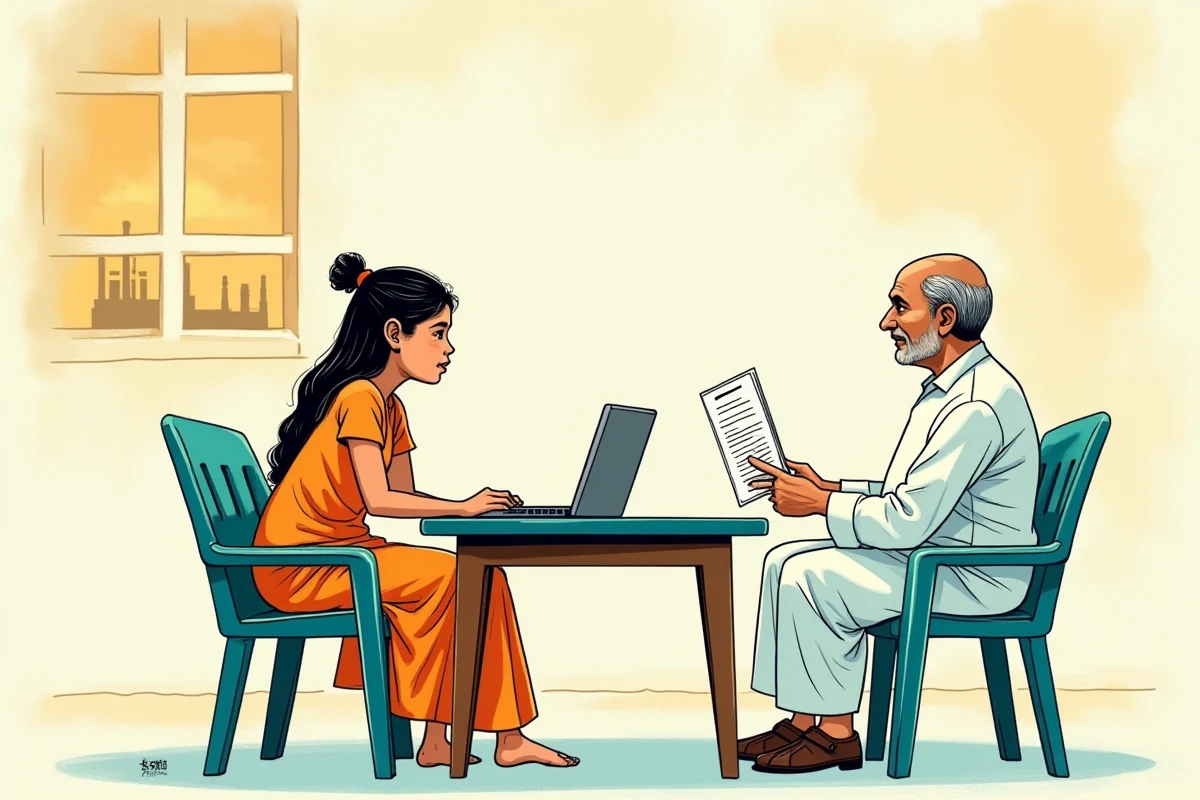
The email said: Certificate rejected. Invalid issuing authority and missing mandatory compliance language.
She read it three times. The certificate in question — her OBC (Other Backward Class) certificate — had been issued by the patwari of her village in Raipur district six months earlier. It said "OBC" clearly. The family had paid ₹100 for it. But the portal wanted "OBC (Non-Creamy Layer)" written explicitly, and it wanted the Tehsildar's signature instead of the patwari's. Four extra words. One extra bureaucratic step. Two weeks later, after her father went to the Raipur Tehsildar's office, she had the corrected certificate. The scholarship was approved — ₹10,000 per year, plus an unexpected ₹5,000 from the CM Yuva Udyami scheme for first-generation engineering students. But the delay, the second rejection, the confusion about who could sign what and why — that exposed the gap between a scholarship portal's requirements and what most families know they need to get.
This is Sunita's story, but it's also the story of how administrative category — not poverty, not merit, but the precise wording and source of a single certificate — can lock a student out of the money meant for her.
🗓️ The Chhattisgarh state scholarship system for OBC engineering students
Chhattisgarh's Department of Social Welfare runs the scholarship portal at scholarships.cg.gov.in. The OBC scholarship for engineering students is ₹10,000 per financial year, payable directly to college fees. The portal accepts applications year-round but processes them in batches. The rule is simple in theory: if you are OBC, studying engineering in a government or recognized private college in Chhattisgarh, and your family income is below the cutoff (₹6 lakhs per annum for OBC), you qualify.
What isn't simple is the certificate itself.
- ⏰
June 2025: Application submitted with patwari certificate
Sunita uploads her OBC certificate (issued by village patwari, Raipur district). Portal accepts the upload without immediate error. Application moves to verification queue.
- ❌
July 2025: First rejection — invalid issuing authority
Portal automated verification flags the certificate. Reason: 'Issuing authority does not match DVIP eligibility matrix. Patwari-issued certificates not recognized. Requires Tehsildar signature.' Sunita is confused. The certificate looks official.
- 🔍
July 2025: AI consultation + research into CG scholarship guidelines
Sunita learns the distinction: patwari is village-level, Tehsildar is block/tahsil-level. For students outside their home village, CG scholarship requires Tehsildar authority. She also learns that 'OBC' alone is not enough — the certificate must explicitly state 'OBC (Non-Creamy Layer)'.
- 🛣️
August 2025: Father travels to Raipur Tehsildar office for corrected certificate
Rajesh Sahu visits the Raipur district Tehsildar's office (Old City branch) with the patwari certificate, Sunita's admission letter, and identity documents. Tehsildar re-issues certificate with both 'OBC' and 'Non-Creamy Layer' language. Takes 10 days due to verification with revenue records.
- ✅
September 2025: Corrected certificate uploaded; scholarship approved within 5 days
Sunita uploads the Tehsildar certificate. Portal verifies instantly. Scholarship of ₹10,000 approved. Bonus discovery: she also qualifies for CM Yuva Udyami ₹5,000 per year (first-generation OBC engineering). Total aid: ₹15,000 per year.
⚠️ The patwari versus Tehsildar distinction, and why "OBC" is not the same as "OBC (Non-Creamy Layer)"
Revenue administration in India runs in layers. At the bottom is the patwari (or patwar), a village-level scribe who maintains land records and issues basic certificates — caste, income, domicile. A patwari's certificate is legally valid within their village and for very local purposes: school enrollment, marriage registration, minor administrative proofs. The signature of a patwari is authentic, but it carries limited jurisdiction.
Above the patwari is the Tehsildar (also spelled Tahsildar), the block-level revenue officer who oversees multiple villages within a tahsil (administrative subdivision). The Tehsildar is a gazetted officer — meaning their signature carries government authority across block boundaries and for higher-order purposes: passport references, state-level admissions, scholarship portals, higher education institutions.
When Sunita moved from Raipur to Bhilai for college, she crossed not just a district boundary but an administrative jurisdiction. The patwari's certificate, valid in her home village, was no longer sufficient. The Chhattisgarh scholarship portal treats cross-district applicants as requiring Tehsildar verification — a deliberate policy to reduce fraud in certificates issued at the village level.
But there's a second layer to the rejection: OBC versus OBC (Non-Creamy Layer).
In India's reservation system, OBC is a broad category. But since 1992, the government has excluded the "creamy layer" — the economically well-off within OBC communities — from certain benefits. A family is considered "creamy layer" if the parents' income exceeds ₹8 lakhs per annum (as of recent guidelines, though this changes). The scholarship portal needs to verify not just that someone is OBC, but that they are OBC and not creamy layer.
A patwari certificate often says only "OBC." It doesn't specify NCL. The portal required Sunita's certificate to explicitly state "OBC (Non-Creamy Layer)" or "OBC (NCL)" to prove the creamy layer exemption. Without those words, the portal's verification logic treats it as incomplete.
This is a documentation gap. Most village-level revenue offices don't routinely include NCL language in OBC certificates because most local-level authorities don't need it. It's not fraud; it's a cascade of administrative siloes. The portal was designed with Tehsildar-issued certificates in mind, which routinely carry NCL language. A patwari certificate caught in that filter doesn't stand a chance.
🌗 What the AI found in CG scholarship guidelines
When Sunita consulted an AI to understand the rejection, the AI dug into the Chhattisgarh Department of Social Welfare's published eligibility criteria. The guidelines, buried in a PDF on the department's website, spelled out:
Issuing Authority: "OBC certificate must be issued by a Tehsildar of the district in which the applicant's domicile lies, or in which the college is located if the applicant is domiciled outside the state. For inter-district applicants, only Tehsildar authority is recognized."
Certificate Language: "Applicant must submit a copy of the OBC certificate that explicitly mentions 'Non-Creamy Layer' status. A generic OBC certificate without NCL specification will be returned to the applicant for reissuance."
Proof of NCL Status: "For students from OBC families with family income above ₹6 lakhs, the scholarship is forfeited even if NCL is mentioned. Creamy layer exemption is verified through income certificate issued by the same Tehsildar."
None of this information appeared on the portal's rejection screen. The portal said only "Invalid issuing authority" and "Missing mandatory compliance language." The actual rules were hidden three layers deep in a PDF that Sunita would have had to know to search for.
What it does
- 🔍Tehsildar certificate with 'OBC (Non-Creamy Layer)' explicitly written
- 🔍Tehsildar certificate issued from the student's home district even if college is in another district
- 🔍Tehsildar certificate countersigned by Collector's office (for appeals or corrections)
- 🔍Income certificate from the same Tehsildar, dated within two years, for NCL proof
What it does not do
- 🔒Patwari certificate, even if it says 'OBC' and is legally valid in the home village
- 🔒Tehsildar certificate that says only 'OBC' without explicitly stating 'Non-Creamy Layer' or 'NCL'
- 🔒Certificate issued from a different state (even if the student's caste is recognized as OBC in both states)
- 🔒Income certificate more than two years old (creamy layer status is re-evaluated annually)
The AI explained it to Sunita in Hindi, the language she and her father spoke at home:
"आपका सर्टिफिकेट पटवारी ने दिया था। पटवारी गाँव का अधिकारी है, ब्लॉक का नहीं। स्कॉलरशिप पोर्टल को अलग जिले से आने वाली छात्राओं के लिए तहसीलदार की मुहर चाहिए क्योंकि उससे सत्यापन मजबूत होता है। और दूसरी समस्या यह है कि आपके सर्टिफिकेट में सिर्फ 'ओबीसी' लिखा है। पोर्टल को 'ओबीसी (नॉन-क्रीमी लेयर)' ये चारों शब्द चाहिए। बिना इसके, पोर्टल यह नहीं मान सकता कि आप क्रीमी लेयर से बाहर हो। आपको रायपुर में तहसीलदार से नया सर्टिफिकेट बनवाना पड़ेगा।"
(Translation: "Your certificate was issued by a patwari. A patwari is a village officer, not a block officer. The scholarship portal requires a Tehsildar's stamp for students coming from a different district because it makes verification stronger. And the second problem is that your certificate says only 'OBC.' The portal needs 'OBC (Non-Creamy Layer)' — those four words. Without them, the portal cannot assume you are outside the creamy layer. You will have to get a new certificate from the Tehsildar in Raipur.")
The four words made all the difference. It wasn't a mistake on Sunita's part or her family's part. It was a mismatch between what village-level bureaucracy produced and what state-level portals demanded.
🧭 Father's trip to Raipur Tehsildar and getting the corrected certificate
Rajesh Sahu took leave from the shop on a Thursday. The Raipur district Tehsildar's office is in the Old City, a 45-minute autorickshaw ride from his shop in Arera Colony. He brought:
- The original patwari certificate
- Sunita's college admission letter from Rungta College
- Their voter IDs as proof of domicile
- A photocopy of Sunita's Aadhar card
The Tehsildar's office was crowded — it always is. There were farmers seeking income certificates for loans, families applying for property transfers, students like Sunita needing education-related certificates. The clerk at the counter, seeing the patwari certificate and the college letter, knew what Rajesh wanted. "You need a fresh OBC-NCL certificate for your daughter's scholarship?" he asked in Chhattisgarhi Hindi. Rajesh nodded.
The clerk explained the process: the Tehsildar's office would verify the caste with their revenue records (maintained by the patwari, but cross-checked at the tahsil level), confirm the family domicile, and issue a new certificate with explicit "OBC (Non-Creamy Layer)" language. The fee was ₹150. The wait would be 7 to 10 days.
On the 10th day, Rajesh returned. The new certificate was ready. It was printed on official Chhattisgarh government letterhead, signed by the Tehsildar (S. R. Sinha), and stated:
"This is to certify that Shri Rajesh Sahu, S/O [Father's name], resident of [village], Raipur district, belongs to Teli community, which is recognized as OBC (Non-Creamy Layer) in the state of Chhattisgarh. This certificate is valid for all official purposes including scholarships, admissions, and reservations."
That single sentence — "which is recognized as OBC (Non-Creamy Layer)" — was the difference between rejection and approval.
"तहसीलदार साहब ने बहुत मना लिया। मुझे लगा कि अगर पहले ही सही सर्टिफिकेट बनवा दिया होता, तो सुनीता का स्कॉलरशिप तुरंत निकल गया होता। पर सब ठीक हो गया। अब हर महीने ₹833 स्कॉलरशिप का पैसा सीधे कॉलेज को जाता है।"— Rajesh Sahu, Sunita's father, speaking in Hindi
(Translation: "The Tehsildar was very helpful. I thought that if we had gotten the right certificate from the start, Sunita's scholarship would have come through immediately. But everything worked out. Now every month ₹833 of the scholarship goes directly to the college.")
What struck Rajesh was the speed of the second approval. The moment Sunita uploaded the Tehsildar certificate, the portal's verification system flagged it as valid — not for manual review, but instant automated approval. A single certificate that said the right things in the right format could be verified in seconds. The portal wasn't being difficult. It was just waiting for documentation that matched its rule set.
🌱 Scholarship approved, plus the CM Yuva Udyami bonus
On September 15, 2025, Sunita received the first scholarship deposit: ₹833 (one-twelfth of ₹10,000) to her college's fee account. The OBC scholarship for engineering students in Chhattisgarh is ₹10,000 per financial year, paid in monthly installments from July to June.
But there was a second approval hiding in the same portal.
While verifying Sunita's OBC status, the scholarship portal's system cross-referenced her application against the CM Yuva Udyami Scholarship — a Chhattisgarh state scheme for first-generation learners from economically weaker sections and reserved communities. The criteria were:
- First in family to pursue higher education (engineering, medicine, law, or postgraduate)
- From OBC, SC, ST, or minority community
- Family income below ₹6 lakhs per annum
- No family member employed in government salaried positions
Sunita met all four. Her father's provisions shop, while stable, didn't trigger the salaried-government-job clause. Neither parent had worked in government service. She was the first to attend college, let alone engineering college. The result: an additional ₹5,000 per financial year.
The AI had surfaced this scheme when researching Sunita's rejection. It was buried in a different part of the scholarships.cg.gov.in website — not linked from the main OBC scholarship form. Most students and parents don't know it exists. Sunita's family might have applied for it separately if they'd known. The portal's system caught it automatically during verification, flagging Sunita as eligible and auto-enrolling her.
Total scholarship aid: ₹15,000 per year (₹1,250 per month). For a family where the father's monthly shop income is around ₹25,000–₹30,000, the scholarship covers a third of Sunita's annual college fee and living costs.
What this means for other students
Sunita's story is a reminder that state scholarship systems work at the intersection of policy and platform. The policy is (usually) fair. The platform is (usually) accurate. But the gap — the mismatch between what a student has and what the portal expects — is where rejections happen.
If you are OBC and applying for engineering scholarships in Chhattisgarh:
Get a Tehsildar certificate, not a patwari certificate. If your home Tehsildar (from your domicile district) is different from your college's Tehsildar, you can use either, but Tehsildar-level is mandatory for portal applications.
Ensure your certificate explicitly says "Non-Creamy Layer" or "NCL". Don't assume a patwari or even a Tehsildar will include this language automatically. Ask for it specifically. Bring proof of income (last year's income tax return or an income certificate from the same Tehsildar) to speed up the process.
Check the CM Yuva Udyami scheme separately. It's not always auto-triggered. If you're first-generation and your family income qualifies, ask the scholarship office to manually verify your eligibility for this ₹5,000 add-on.
Screenshot every portal page and every email rejection. If the portal rejects your application, the email will give a reason, but it will be brief. Dig into the actual guidelines on the department website. What the portal says is not always what the guidelines say.
Don't assume a government office is wrong just because it rejected you. They are usually right, but they are also usually opaque about why. Get a family member or trusted advisor to read the guidelines and identify the specific gap. Then fix the gap, not the person.
Sunita is now in her second year at Rungta College, with ₹15,000 per year in aid secured. Her father still runs the shop. Her mother is taking a tailoring course. The family's hope was that engineering would create a path out of hand-to-mouth commerce into stable work. The scholarship made that path real.
Four words — "Non-Creamy Layer" — and one officer's signature — the Tehsildar's — were all it took. Everything else was already there: the merit, the family, the need, the eligibility. The system just needed the documentation to match the format.