
The Aizawl café and the dry-state beverage inspection
Zothanmawii Hnamte is twenty-nine years old. She opened Lungpui — the Mizo word for a spring that emerges quietly from the hillside — in a narrow first-floor space on Dawrpui main road, Aizawl, in February 2024, sixteen months before the inspection that would briefly threaten to end it. The café seats sixteen: eight on pine plank chairs at four tables along the window wall, where the hill drops sharply and the morning light comes in at a low angle over the corrugated roofs of the houses below, and another eight on a bench covered in a strip of Puanchei textile that her grandmother wove for a different purpose entirely but which Zothanmawii had repurposed without apology. The menu is hand-painted on a piece of board she cut from a packing crate: filter coffee, Aizawl-style with chicory, in small and large; bai served with steamed rice on a small tray; koat pitha, the rice-cake snack that Zothanmawii makes herself each morning from a batter her mother taught her; and, on a separate panel titled Special Espresso Drinks, a list of five flavoured lattes and espresso drinks whose names she had borrowed from a café she had liked during a visit to Guwahati.
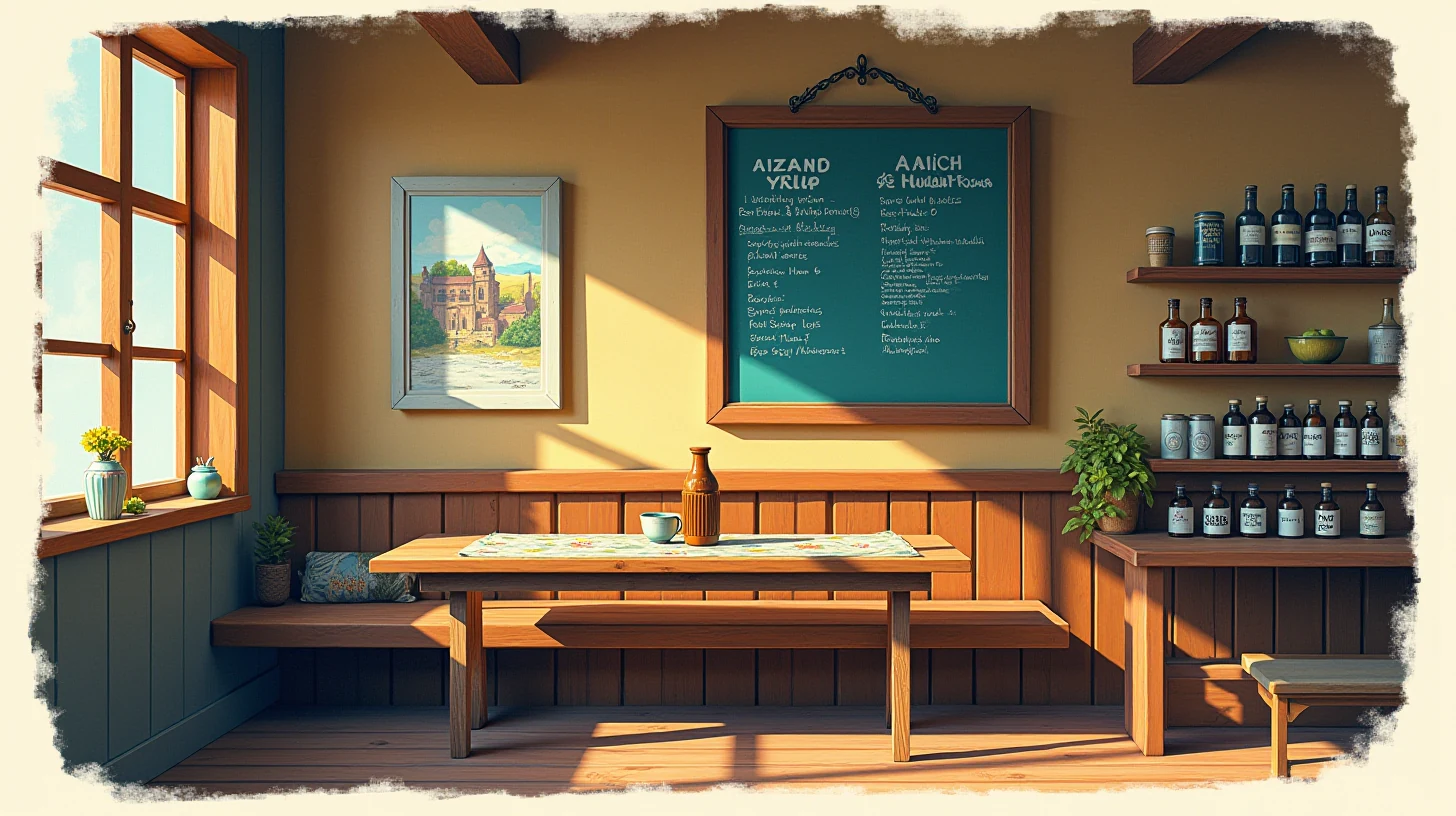
Those names were the problem.
She employs one person full-time: Lalthansangi, twenty-two, who handles the counter and espresso machine from 8 AM to 3 PM while Zothanmawii does the morning prep and manages the afternoon herself. The espresso machine is rented — ₹4,800 a month to a Silchar supplier who services it quarterly — and the flavoured syrups she uses in the Special Espresso Drinks panel come in 750 ml glass bottles from a distributor in Guwahati: hazelnut, caramel, vanilla, and two others labelled, on their imported labels, as Rum Flavour Syrup and Whisky Flavour Syrup. The syrups are non-alcoholic — food-grade flavour concentrates, alcohol-free, produced by a manufacturer in the Netherlands and distributed into Northeast India through a licensed food importer. On her menu board, Zothanmawii had written the drinks honestly: Rum-Flavoured Espresso and Whisky-Flavoured Latte. The names were accurate. They were also, in a total-prohibition state operating under the Mizoram Liquor (Prohibition) Act 2019, the exact two words an Excise inspector reading a menu board on a busy Thursday morning was going to stop on.
🗓️ The state that chose to go dry
Mizoram has had liquor prohibition in various forms since the 1990s, and the 2019 Act is the most comprehensive iteration: it bans the manufacture, sale, transport, possession, and consumption of liquor across the state, with narrow exceptions for medicinal use documented by a government hospital. The Act defines "liquor" by reference to alcohol content — any beverage or preparation with more than 0.5% alcohol by volume qualifies. Enforcement is through the Excise and Narcotics Department, which operates out of a main office on Tuikual South road in Aizawl and conducts inspections of premises — hotels, restaurants, cafés, grocery stores — both on complaint and on a roster basis.
For a food business like Lungpui, the prohibition framework intersects in two practical ways. The first is straightforward: you cannot serve alcohol, you cannot stock alcohol, you cannot sell alcohol. Zothanmawii had never intended to do any of these things. The second is less obvious and almost never discussed in any business registration guidance: if your food or beverage products carry names or labels that invoke alcoholic beverages — rum, whisky, beer, wine — the Excise Department is empowered to inspect the premises and demand proof that the named substance is not, in fact, alcoholic. The standard of proof required is not informal. A verbal assurance is not sufficient. A printed menu disclaimer is not sufficient. The inspector, in the encounter on that Thursday in October 2024, was not unreasonable. He was doing exactly what the Act required him to do.
He arrived at 10:40 AM on a Thursday, when Lungpui had six customers at the tables. He identified himself, asked to see the FSSAI licence and the Mizoram Shops Act registration, and then pointed at the menu board. He asked, in Mizo: "Rum leh whisky hi tih lam?" — What do you mean by rum and whisky? Zothanmawii explained: the syrups, non-alcoholic, from a licensed food importer. The inspector nodded, but did not leave. He needed, he said, to see the product labels. He needed the importer's FSSAI registration number. He needed, ideally, the FSSAI product approval or the manufacturer's declaration of alcohol content. He had thirty minutes before his next inspection. He could return the following week, but in the meantime he was issuing a notice under Section 42 of the 2019 Act requiring her to produce the documentation or to remove the named items from the menu. The notice was politely worded. It had a ten-day response deadline.
- ⚖️
Day 1 (Thursday, 10:40 AM) — Section 42 notice issued
Excise inspector reads 'Rum-Flavoured Espresso' and 'Whisky-Flavoured Latte' on the hand-painted menu board. Verbal explanation of non-alcoholic syrups is noted but not accepted as documentation. A Section 42 notice is issued with a ten-day deadline to produce FSSAI labelling records, the importer's registration, and the manufacturer's alcohol-content declaration.
- 📨
Day 2 (Friday) — Guwahati distributor contacted
Zothanmawii calls her Guwahati syrup distributor. He confirms the products are FSSAI-registered and that the importer's FBO registration is on the FSSAI FoSCoS portal. He emails her a scanned copy of the original Dutch manufacturer's alcohol-content certificate showing 0.0% ABV. The email arrives at 6 PM.
- 🛑
Day 3 (Saturday) — Shops Act renewal gap discovered
While assembling the compliance folder, Zothanmawii discovers that her Mizoram Shops and Establishments Act registration — Form IV under the Mizoram Shops and Commercial Establishments Act 1966 — had not been renewed since 2023. A lapsed Shops Act registration, encountered during an active Excise notice, is a compounding liability. Two separate inspections can now happen on the same premises.
- ✅
Day 8 (Thursday) — Notice cleared, Shops Act renewal filed
Zothanmawii submits the compliance folder to the Excise office on Tuikual South road: manufacturer ABV certificate, importer FSSAI registration printout from FoSCoS, and a copy of the FSSAI labelling regulation citation under Regulation 2.4.5. The inspector accepts the documentation. The Section 42 notice is formally closed. The Shops Act renewal is filed at the Labour Commissioner's office the same afternoon, with a ₹1,400 late fee.
⚠️ What very nearly happened
The ten-day window was tight by design — not punitive design, but systemic design. Section 42 notices under the 2019 Act are administrative instruments: they compel documentation, not closure. If documentation is not produced within the deadline, the inspector's next step is referral to a senior officer, who can issue a show-cause notice, which in turn can lead to a fine of up to ₹50,000 for first-time non-compliance and, for a repeat or unresolved case, premises sealing. The sealing is temporary and reversible. It is also, for a sixteen-seat café with a rented espresso machine and four regulars who come every morning before their government office shifts, the kind of temporary that closes a business.
Zothanmawii did not know any of this when the inspector left on Thursday morning. What she knew was that she had ten days, that the Guwahati distributor was her only contact for the syrup documentation, and that the FSSAI portal — where the importer's registration number was supposed to be publicly searchable — had, when she tried it on Thursday evening on her phone, returned a search result that was not the company name she knew but a registered business name that she was not sure matched. The uncertainty was not technical. The portal worked. What it required was knowledge of which regulation governed flavour syrup labelling and what a valid declaration of alcohol content was supposed to look like. Without that, she was not sure whether the documents she was assembling were sufficient or whether she was producing the right type of evidence for the wrong type of claim.
The Shops Act lapse made it worse. A lapsed registration, she learned from a neighbour who had once had a similar notice, meant that even after clearing the Excise notice she was technically operating without current establishment registration — which, if the Excise inspector happened to note it in his file and route it to the Labour Department, could generate a second proceeding. Both problems were solvable. Neither was urgent in isolation. Together, with a ten-day clock running and a café to open at 7 AM every morning, they were the kind of compound stress that is hard to describe to anyone who has not tried to run a small business alone in a hill city with one employee and no compliance counsel.
🌗 What changed
Zothanmawii's cousin Vanlalruata — he works at an NGO in Zemabawk that supports women-owned micro-enterprises in rural Mizoram — had been telling her for three months to try the AI assistant that his organisation used for compliance questions. She had resisted: she is not, by temperament, a person who trusts tools she cannot explain, and she had a low prior on digital platforms that claimed to help small businesses. On the Friday evening after the inspection, with the manufacturer's certificate in her email and the FoSCoS portal still not giving her a confident answer, she called Vanlalruata and asked him to come over.
He arrived at Lungpui at 7 PM, after closing. He set up the agent on her phone in eleven minutes. Then they worked through the problem together.
Zothanmawii typed her question in Mizo, slowly, one sentence at a time: "Khawngaihin, Food Safety Act-ah rum flavour syrup-a non-alcoholic a ni tih hre chhuah theih nang?" — Can you help me find out how to prove a rum flavour syrup is non-alcoholic under the Food Safety Act?
The agent replied:
"Aw, FSSAI Food Safety and Standards (Labelling and Display) Regulations, 2020-a Regulation 2.4.5 chuan 'non-alcoholic' tih hian manufacturer-in ABV certificate pek a ngai, chutah chuan importer FSSAI FBO registration number a ngai bawk. FoSCoS portal-ah hian importer register number 'search by product' option a awm — company name tih loh chuan FSSAI FBO ID number-in thlen tur. Certificate-in 0.0% a tarlang a nih chuan, a hlaw tawh."
(Under Regulation 2.4.5 of the FSSAI Labelling and Display Regulations 2020, proving a product is non-alcoholic requires the manufacturer's alcohol-by-volume certificate and the importer's FSSAI Food Business Operator registration number. On FoSCoS, search by FSSAI FBO ID rather than company name — the ID will return the correct match. If the certificate shows 0.0% ABV, that is sufficient documentation.)
This was the sentence she needed. The manufacturer's certificate showed 0.0% ABV. She had been uncertain whether that was the right document type — the certificate said "alcohol-free declaration" in English and Dutch, but she was not sure whether "alcohol-free declaration" was the same as what Regulation 2.4.5 required. The agent confirmed it was. She searched FoSCoS by the FSSAI FBO ID printed on the syrup bottle's back label — not the company name — and the importer's registration appeared immediately.
Manufacturer ABV certificate
0.0% alcohol — Netherlands originThe Dutch manufacturer's alcohol-by-volume declaration, showing 0.0% ABV for both Rum Flavour and Whisky Flavour syrups. This document satisfied the substance question: the products contain no alcohol. Obtained from the Guwahati distributor within 36 hours of the inspection.
Importer FSSAI FBO registration
FoSCoS portal — FBO ID searchThe licensed importer's FSSAI Food Business Operator registration, printable from foscos.fssai.gov.in by searching the FBO ID printed on the bottle's back label. This document confirmed the products entered India through a registered food importer operating under FSSAI oversight. Found via FBO ID, not company name.
Regulation 2.4.5 citation
FSSAI Labelling Regulations 2020A one-page printout citing FSSAI Food Safety and Standards (Labelling and Display) Regulations 2020, Regulation 2.4, Sub-regulation 2.4.5: declaration of ingredients and alcohol content for flavouring substances. The citation told the inspector exactly which regulation the documentation satisfied — removing interpretive ambiguity from the review.
She printed all three documents at the cyber café two lanes over from Lungpui on Saturday morning. On Thursday — Day 8, two days before the deadline — she walked to the Excise and Narcotics Department office on Tuikual South road, carrying a clear plastic folder with the three documents in the order the agent had suggested, and the printed Regulation 2.4.5 citation on top. The inspector looked at them for four minutes. He stamped the notice closed.
On the way back, she filed the Shops Act renewal at the Labour Commissioner's compound. The form was Form IV under the Mizoram Shops and Commercial Establishments Act 1966. The late fee was ₹1,400. She paid it without complaint.
"Chutia kan tumhlir loh chuan, ka lawrkhawm hi a la awm tawh lovang."— If we had not looked carefully at that, the café would not exist anymore.
🧭 Why we built it
Mizoram has over 4,000 registered food businesses — restaurants, cafés, canteens, bakeries. The Excise inspection regime under the 2019 Act is active: the Department conducts several hundred premises checks a year in Aizawl district alone, and the notices that result from flavour-name ambiguities are not rare. The problem is specific to the Northeast prohibition states — Mizoram, Nagaland, and Gujarat nationally — but the underlying structure is common across India: a legal obligation whose compliance depends on knowing which sub-regulation applies, and no affordable channel for a sixteen-seat café to get that knowledge in time.
The FSSAI labelling regulations are public documents. They are downloadable in English from the FSSAI website. Regulation 2.4.5 is not hidden. But it is embedded in a 200-page consolidated regulation document, behind 2.4 (declaration of ingredients), under a subheading that a small café operator in Aizawl has no particular reason to have read. The knowledge gap is not about effort. It is about there being no path from "the inspector mentioned a labelling regulation" to "the relevant sub-regulation is 2.4.5 and here is what it requires" in an accessible, Mizo-language channel.
The Shops Act renewal lapse is a version of the same gap. Form IV renewal under the Mizoram Shops and Commercial Establishments Act 1966 is an annual obligation. The penalty for lapse is a late fee that scales with duration. The notice is not routinely sent. It is assumed known. For a sole operator like Zothanmawii, the obligation to track renewal across FSSAI, Shops Act, and GST — three separate regulators, three separate calendars, three separate portals — is not onerous in the abstract. It is impossible in practice alongside a daily 7 AM opening.
What it does
- 🔍Identifies the specific FSSAI sub-regulation (e.g., Regulation 2.4.5) that governs a labelling or ingredient question
- 🗂️Explains which documents are required as evidence — ABV certificate, importer FBO registration, ingredient declaration — and what each must show
- 📞Locates FoSCoS portal search method (FBO ID vs. company name) and confirms whether a found registration is current and valid
- ⏰Tracks renewal deadlines for FSSAI, Shops Act, and GST and sends advance reminders in Mizo before windows close
What it does not do
- 🔒Never submits documents, forms, or portal applications on the owner's behalf — every action requires the owner to confirm and execute
- 💳Never handles fee payments or challan generation — it identifies the amount and route, the owner pays
- ✅Never represents the business to a regulator or inspector — the owner produces the documents and attends the office in person
🌱 What we hope happens
The Lungpui café is open. The Excise notice is stamped closed and filed in a plastic sleeve behind the counter, next to the FSSAI licence and the renewed Shops Act registration. Zothanmawii changed the menu board the week after the inspection — Rum-Flavoured Espresso is now Spiced Rum-Style Espresso (Non-Alcoholic Syrup), and the Whisky Latte has become Smoky Malt Latte. The hand-painted lettering is smaller to fit the longer names. She is considering, she says, making a small card that sits beside the syrup bottles on the shelf explaining what the syrups are and where they come from, the way a wine bar might put a tasting note beside each bottle. This strikes her as honest, and in Mizoram, she thinks, honesty about what you are selling is not merely a regulatory strategy but a social expectation.
The agent now tracks three renewal dates for her: FSSAI licence (February, annually), Mizoram Shops Act Form IV (March, annually), and GST GSTR-9 annual return window (December–January, annually). Each reminder arrives in Mizo, eight weeks before the deadline: "FSSAI licence renewal tum tawh — February deadline a ni. FoSCoS portal-ah login rawh." She has set aside ₹3,200 in a labelled envelope in the counter drawer — the estimated cost of the next FSSAI renewal fee — since November.
She has also applied for a MUDRA Kishore loan of ₹3.8 lakh through her bank, using her Udyam certificate as the primary business registration document. The loan, if approved, will pay off the rented espresso machine in a buyout the Silchar supplier has agreed to and leave ₹1.1 lakh for a second-hand display refrigerator for packaged takeaway items. The application is pending.
Vanlalruata was at the café last Sunday, the first time he had come as a customer rather than as a technical assistant. He ordered the Smoky Malt Latte and a plate of koat pitha. He said the latte tasted fine. Zothanmawii said it tasted exactly as it had before the inspection — the syrup had not changed — but that she was now somewhat better at explaining what was in it.
That is, in a small way, exactly the kind of thing this product is meant to help with. Not eliminating the inspection — the inspector was doing his job, and the job is legitimate. But making it possible for the person behind the counter, when the inspector points at the menu board and asks "Rum leh whisky hi tih lam?", to have a confident, documented answer ready before the ten-day clock starts.
If you run a café or small restaurant in Mizoram, Nagaland, or anywhere in India where the intersection of food safety labelling and state excise law can produce a notice you were not expecting, the product is free at gabforge.in. It works in Mizo. It will not tell you the answer to a legal question that requires a lawyer. But it will find the sub-regulation, identify the documents, and remind you, eight weeks early, that the Form IV deadline is coming.