
The Daman restaurant and the tourist liquor licence
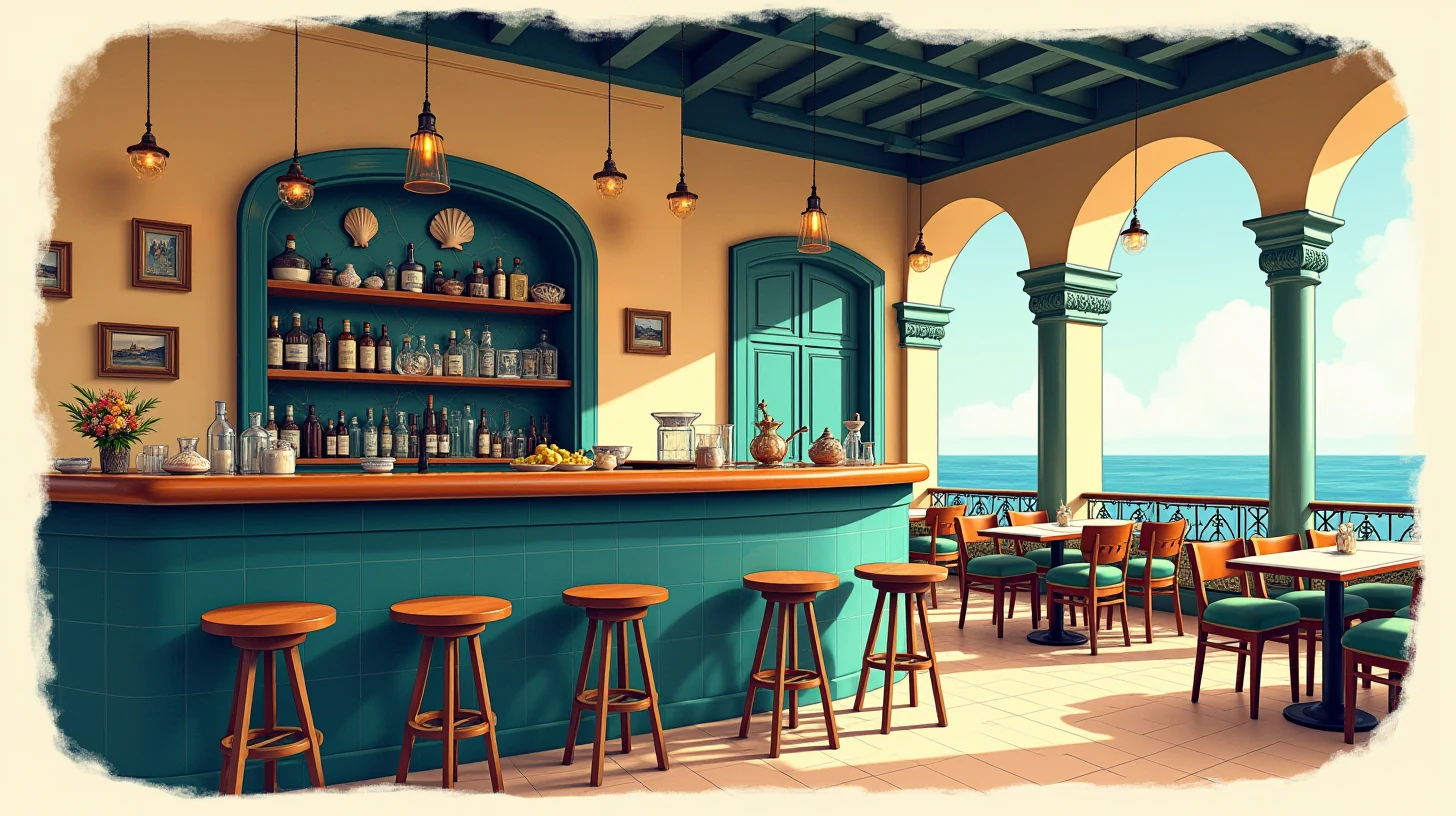
Jignesh Correia is forty-four years old and has been running Devka Talao — "the Devka pool," named for the tide-fed natural hollow behind the beach where his grandfather once kept crab traps — for eleven years from a ground-floor space on Devka Beach Road, about two kilometres north of the Daman town centre in Nani Daman. The restaurant seats forty. There is a covered terrace of twelve seats where the sea wind arrives after eight in the evening and makes the candle-lanterns on the tables useless, and an interior of twenty-eight seats where Portuguese blue-and-white azulejo tiles line the wall behind the bar and a shallow alcove of raw-wood shelving holds Jignesh's collection of conch shells, none of which are for sale and all of which his father brought back from various beach-combing trips before he died in 2011. The bar runs along the south wall, eight stools, dark mahogany with a brass footrail that Jignesh polishes every Sunday morning before the restaurant opens.
The cuisine at Devka Talao is what Jignesh calls, when visitors ask him to describe it, "what happens when you are a Gujarati Daman-Catholic and your mother argues about everything." His mother — now seventy-two, who still comes in most Thursday evenings — is Goan, from Panaji, and her fish curries carry the red Goan masala and the coconut notes of the Mandovi estuary. His father was from a Gujarati Lohana family who had been in Daman since the Portuguese era, and his influence is in the vegetable preparations, the dabeli-inspired chutney bread that comes with every table's amuse-bouche, and the insistence on jaggery in sauces where most Goan cooks would use sugar. The menu's anchor dishes are the Bombay-duck rechado, the prawn balchão on Gujarati-style bhakri, and a sea-bass preparation that has been unchanged since 2015 and which Jignesh refers to as "the one thing we are not allowed to adjust." The bar serves wine, beer, spirits, and a short cocktail list — the house cocktail is a gin-and-kokum sour that was added in 2022 and now accounts for approximately eighteen percent of bar revenue on Friday and Saturday evenings.
Monthly turnover runs between ₹7.5 lakh and ₹11 lakh depending on the season. October through February — when dry-Gujarat residents cross the border at Vapi in significant numbers specifically because Daman is where you can drink legally — accounts for sixty percent of the bar's annual revenue. The tourist-liquor-destination character of Daman is not incidental to the restaurant's viability. It is structural.
The trouble, when it came, arrived not as a single problem but as three compliance threads that had been unravelling independently for eighteen months and which, by October 2025, had wound themselves into a knot tight enough to threaten the bar's operating status in the highest-revenue quarter of the year.
🗓️ The annual ritual
Daman's liquor licensing framework is governed by the D&NH+DD UT Excise Department, which, since the 2020 merger of Dadra & Nagar Haveli with Daman & Diu into a single Union Territory, operates as a consolidated authority under the Daman Excise Act and the Diu Excise Act — two separate colonial-era statutes that were never merged post-2020 and which the UT administration continues to administer in parallel, one for each geographic district. For a restaurant in Daman with a bar, the operative licence is the FL-2 Tourist Liquor Licence — FL standing for Foreign Liquor, the post-colonial designation for all alcohol that is not toddy or country liquor — which authorises the holder to serve and sell imported and Indian-made foreign liquor (IMFL) for on-premises consumption by customers, and, in a separately annotated sub-condition, to sell sealed packaged liquor for off-premises take-away.
The FL-2 licence runs on a calendar year from April 1 to March 31 — the UT's financial year. It must be renewed by March 15 each year. The renewal fee, for a 40-seat or above establishment with a bar, is ₹1,25,000 payable to the UT Excise Department by demand draft. The security deposit — a refundable bond held by the department against compliance — is ₹2,00,000 for restaurants of Jignesh's category, last revised in 2023. On top of the renewal fee and the deposit, the licence holder must produce a clean NOC from the D&NH+DD UT Municipal Council (for Nani Daman establishments), a valid FSSAI licence, and a certificate from the Fire Safety Office.
For eleven years, Jignesh had renewed the FL-2 every February. His accountant, a man named Dharmesh who worked from a two-room office near the Daman court and handled GST and ITR for thirty-two small businesses in the area, took care of the paperwork. Dharmesh had a system: he filed the renewal application in the second week of February, deposited the demand draft at the UT treasury by the third week, and handed Jignesh the new licence by March 10. It had worked every year. In 2024 it had worked. In 2025, it almost did not.
- 📋
December–January — Renewal documents assembled
NOC from UT Municipal Council, FSSAI licence copy, Fire Safety certificate, current-year GST returns summary. Each document has its own renewal dependency — a lapsed municipal trade licence, for instance, blocks the Municipal Council NOC.
- 💳
Second week of February — Demand draft deposited
FL-2 renewal fee of ₹1,25,000 by demand draft to UT Excise. Security deposit of ₹2,00,000 (held) to be topped up if the department has revised the category threshold since last renewal.
- ⚠️
Third week of February — Deadline crunch
Any document gap discovered here gives eight business days to resolve before the March 15 hard deadline. After March 15, the licence lapses and the bar must close until a fresh grant is issued — typically taking four to eight weeks.
- ✅
By March 10 — Licence in hand
When the process runs clean, the new FL-2 is dated April 1 and collected from the Excise office on Moti Daman Road. The tourist-season rush begins April-May. The bar's high season (October–February) is fully covered.
⚠️ What very nearly happened
In January 2025, Dharmesh had begun assembling the FL-2 renewal documents as usual. The FSSAI licence was current — Jignesh had renewed it in November without incident. The Fire Safety certificate had been issued in August after a routine inspection. But when Dharmesh requested the NOC from the D&NH+DD UT Municipal Council's Nani Daman ward office, the clerk told him there was a hold on the issuing of the NOC because Devka Talao's municipal trade licence had not been renewed since 2022.
The municipal trade licence — issued by the UT Municipal Council under the D&NH+DD UT Municipal Councils Regulation — is a separate compliance item from the excise licence. Jignesh had been paying his municipal property tax every year without fail. But the trade licence, which costs ₹4,500 annually for a commercial food service establishment with a bar, had a separate renewal track that Dharmesh had been tracking only loosely, because for several years the ward office had not demanded it as a precondition for other clearances. In 2024, the Municipal Council had circulated a directive requiring all trade licences to be current before any departmental NOC would be issued. Nobody had told Dharmesh. The directive was published on the UT administration's notice board at the Collectorate. It was not emailed to businesses. The ward clerk knew about it. Dharmesh had not visited the ward office since 2022.
The trade licence arrears, with the applicable late fee, came to ₹13,180 for the period April 2022 to March 2025 — three years unlicensed. Jignesh paid the arrears in the first week of February and got the trade licence reinstated. The Municipal Council then took twelve days to issue the NOC. By the time Dharmesh had the NOC in hand, it was February 27. The demand draft for the FL-2 renewal fee had been prepared. The Excise office received the full packet on March 3.
And then, on March 4, the Excise officer handling Jignesh's file called Dharmesh with a different problem.
The D&NH+DD UT Excise Department had, as part of a post-merger compliance review, issued a notice in December 2024 to all FL-2 licence holders who had the take-away sealed-bottle sub-condition attached to their licences. The notice said that from April 1, 2025, all packaged liquor sold under the take-away sub-condition would attract the revised security deposit category — effective deposit ₹2,75,000 instead of ₹2,00,000. The difference, ₹75,000, needed to be deposited by March 15 alongside the renewal fee. The notice had been issued in December. Dharmesh had not seen it.
The reason Dharmesh had not seen it was the same reason Kavitha in Kochi had not seen her FSSAI renewal notice: it had been sent by registered post to the address on the FL-2 licence — the restaurant's kitchen-side address, which was also the address for the gas supplier's delivery notices and the fire department's inspection letters — and had arrived during the October-November busy season when nobody was processing the incoming correspondence shelf behind the kitchen. It had sat there since December, unopened, under a cooking-gas invoice and a calendar from a FSSAI-accredited food testing lab.
Jignesh found it on March 5, when he went looking for it after the Excise officer's call.
The security deposit top-up of ₹75,000 was available — barely. But pulling ₹75,000 from the restaurant's operating reserve in the first week of March, when supplies for the summer season had just been ordered and the staff advance for Holi had been paid, left the operating account at a number Jignesh did not want to think about during the busiest quarterly advance-payment window of the year. He called Dharmesh. Dharmesh said he would handle it. What neither of them had factored in was the third problem.
"ફ્રેન્ચ-ખિડકીવાળી ઑફિસ ઠીક છે — ત્યાં ફક્ત એ ખ્યાલ ન હોય કે અમારો November December Daman માં ગળ્ડ઼ ઊડ઼ ઊડ઼ જ ચાલે. ₹75,000ની નોટિસ December ની — ને અહીં March 5 ઉઘાડ઼ ઊ."— The office with the French windows is fine — they just don't realise that our November-December in Daman goes by in a blur. A December notice for ₹75,000 — opened here on March 5.
The third problem was GST. Specifically, the dual-jurisdiction GST classification on the packaged liquor sold under the take-away sub-condition of the FL-2.
Daman, post-2020 merger, is part of a Union Territory that also includes Dadra & Nagar Haveli — a landlocked enclave entirely surrounded by Gujarat. Most of the packaged liquor that Devka Talao's bar sold under the take-away sub-condition was bought by visitors from Gujarat — Vapi, Surat, Navsari, Bharuch — who drove into Daman specifically to purchase sealed bottles that they could not buy at home. From a GST perspective, this sale was treated by Dharmesh as a UT-to-consumer transaction, attracting UT-GST and Central GST (CGST), because the sale took place within the UT and the buyer was physically present at the counter. Dharmesh filed GSTR-1 accordingly, treating all take-away bottle sales as intra-UT supply.
In September 2024, the GSTN issued a clarification — Circular No. 210/4/2024-GST — on the classification of packaged liquor sales at border UTs where the majority of buyers are resident in neighbouring states. The circular clarified that where a UT establishment can demonstrate through purchase records that more than 50% of packaged goods purchasers provide a non-UT GST address or non-UT state ID at the point of sale, the supply may be classified as IGST inter-state supply, which changes the input-tax-credit (ITC) eligibility for the restaurant's own liquor procurement. The distinction was not about the total tax amount — UT-GST plus CGST and IGST were equivalent in rate — but about the ITC flow: under IGST classification, Jignesh could claim ITC on the inter-UT procurement of bottled liquor from his Gujarat-licensed distributor, which he had not been doing.
Dharmesh had not seen the circular. Jignesh had not known to ask.
The unclaimed ITC on packaged liquor procurement over the twelve months of the 2024–25 financial year came to approximately ₹2,20,000. It had been filed incorrectly in GSTR-1, and the annual return for 2023–24 had also been filed under the intra-UT classification. The correction was possible — a rectification through GSTR-1 amendment and a revised GSTR-9 annual return — but it required a detailed re-examination of every take-away bottle sale record for twenty-four months, matching them against the buyer-address data that the bar's POS terminal had been collecting but that nobody had extracted and examined in aggregate.
By the second week of March 2025, three things were simultaneously unresolved: the FL-2 renewal was pending the security deposit top-up; the GST classification on take-away bottle sales was incorrect and the ITC had not been claimed; and the operating reserve was depleted to a level that made the ₹75,000 deposit top-up uncomfortable. The high season was ten days away.
🌗 What changed
Jignesh's cousin Nisha — his father's sister's daughter, now thirty-one, who had studied accounting at Veer Narmad South Gujarat University in Surat and worked for a mid-size hospitality consulting firm in Surat before returning to Daman in 2023 to look after her parents — came for dinner on a Saturday evening in the second week of March 2025. She noticed the look on Jignesh's face as he was standing at the bar after service, going through a stack of papers on the polished mahogany surface, and asked what had happened.
He told her: the licence situation, the security deposit, the GST confusion, the depleted reserve. Nisha listened. She asked to see the GST returns, the FL-2 renewal packet, and the December Excise notice. She sat at the bar for two hours with her phone and Jignesh's laptop. Halfway through, she installed the agent on his phone, set the language to Gujarati, and typed the situation in.
Jignesh watched over her shoulder as the agent replied.
"FL-2 renewal ₹75,000 deposit shortfall — MUDRA Kishore route available. Udyam registration active? Dharmesh-ji ને MUDRA application form 2B ready karava kaho — bar equipment upgrade ane security deposit top-up kombine kari sako cho. Processing 7–10 business days, same-bank limit. GST circular 210/4/2024 check karo: take-away bottle majority non-UT buyer hoy to IGST reclassification possible, ITC credit ₹2L+ possible recover. GSTR-1 amendment window open for FY 2023–24 until September 2025. FL-2 March 15 deadline mate two parallel tracks chale — March 12 sudhi deposit jama karva mate. Koi ek track confirm karo?"
(FL-2 renewal ₹75,000 deposit shortfall — MUDRA Kishore route is available. Is your Udyam registration active? Ask Dharmesh to prepare MUDRA application form 2B — you can combine bar equipment upgrade and security deposit top-up. Processing is 7–10 business days, same-bank limit. Check GST Circular 210/4/2024: if the take-away bottle majority buyer is non-UT, IGST reclassification is possible and ITC credit of ₹2 lakh+ can be recovered. GSTR-1 amendment window is open for FY 2023–24 until September 2025. For FL-2 March 15 deadline, two parallel tracks are running — to deposit by March 12. Which track do you want to confirm first?)
Jignesh had not known MUDRA applied to security deposits. Dharmesh had prepared a MUDRA Kishore application the previous year for an oven upgrade but had withdrawn it when the bank's processing timeline looked too slow. The agent surfaced both the MUDRA route and the GSTR-1 amendment window as parallel solutions.
Nisha called Dharmesh that evening. Dharmesh submitted a MUDRA Kishore application the following Monday morning at the Bank of Baroda branch on Seaface Road — combining ₹75,000 for the security deposit top-up with ₹1,50,000 for the bar's chiller and POS terminal upgrade that had been deferred for fourteen months. The combined application of ₹2,25,000 was sanctioned by March 11 — four business days. The ₹75,000 portion was drawn immediately. The demand draft for the security deposit top-up reached the Excise office on March 12. The full FL-2 renewal packet — fee, top-up deposit, NOC, FSSAI, Fire certificate — was accepted on March 13. The new licence was issued, dated April 1, 2025, and collected by Dharmesh on March 18.
The GST reclassification took longer. Nisha extracted eighteen months of POS data from the bar's terminal — the terminal had been recording buyer addresses since it was installed in mid-2023, as a standard field that neither Jignesh nor Dharmesh had used. Of 4,312 take-away bottle transactions across eighteen months, 3,891 showed a buyer address in Gujarat — Vapi, Surat, Navsari, Bharuch, Baroda. That was 90.2% non-UT buyers, well above the 50% threshold in the circular. Nisha filed the GSTR-1 amendment in June 2025, reclassifying the take-away bottle sales as inter-UT supply under IGST. The resulting ITC credit on packaged liquor procurement came to ₹2,17,400 for FY 2023–24 and the first half of 2024–25. Dharmesh applied the credit in the GSTR-3B for the following two months, reducing Jignesh's GST cash outflow by ₹2,17,400 across June and July 2025.
FL-2 Licence Renewal
₹75,000 deposit top-upSecurity deposit category revised in December 2024 notice — missed during October peak season. MUDRA Kishore (combined ₹2.25L application) sanctioned in four days, enabling the deposit to be paid by March 12. New licence issued March 18.
Municipal Trade Licence
₹13,180 arrears clearedThree years unlicensed after the ward office stopped proactively following up. A 2024 directive made the trade licence a hard NOC dependency. Arrears paid February 2025, NOC issued twelve days later, unblocking the excise renewal packet.
GST ITC Reclassification
₹2,17,400 recoveredTake-away bottle sales were filed as intra-UT supply (UT-GST+CGST) when 90% of buyers were Gujarat-resident. GST Circular 210/4/2024 permitted IGST reclassification. GSTR-1 amendment filed June 2025, ITC applied across two quarters.
🧭 Why we built it
Daman is the only tourist-liquor destination in the D&NH+DD UT — a Union Territory that, since 2020, also includes a dry-Gujarat-adjacent landlocked enclave where liquor is legal but where the excise, municipal, and GST frameworks have been evolving unevenly since the merger of two administrations into one. The FL-2 tourist licence framework that governs restaurants like Devka Talao is not new — it predates independence — but its interaction with post-merger GST classification rules is new, and the specific wrinkle of inter-UT supply classification for packaged goods sold at the UT's border is a 2024 clarification that most small restaurant operators in Daman have not yet processed. Dharmesh was not negligent. He was current as of 2023 and had not seen the 2024 circular.
There are, in Daman alone, somewhere between 150 and 200 FL-2 licensed restaurants and bars. Of these, the majority carry the take-away sub-condition. Of the take-away sub-condition holders, the GSTN's own reclassification guidance of 2024 applies to all of them — every restaurant where more than half the packaged-goods buyers are from Gujarat. The proportion of non-UT buyers at Daman's bars is not difficult to estimate: it is why the bars exist in the numbers they do. The unclaimed ITC, at ₹2,17,400 for a 40-seat restaurant with a modest bar, extrapolated across 150 establishments, suggests a UT-wide ITC shortfall in the region of ₹30–35 crore per year, sitting unclaimed in incorrectly filed returns that nobody has flagged.
The FL-2 renewal calendar itself is a known fragility. The March 15 deadline falls in a preparation window for summer and Easter tourism — for Catholic-heritage Daman restaurants, the Easter and Holy Week trade in March is the highest weekend-revenue period of the year. The administrative concentration of excise renewal, municipal NOC, and GST filing review in the January-March window, at exactly the point when a restaurant owner is managing seasonal supply orders and staff advances, is structural bad luck. The December Excise notice for security deposit revisions landing during October peak and going unread until March is not negligence — it is the mismatch between an administration's notice calendar and a hospitality business's attention bandwidth.
The agent's role in Jignesh's story was to hold three threads simultaneously: the FL-2 deposit shortfall, the MUDRA Kishore eligibility, and the GST circular — and to surface all three as related problems with a combined solution path. Dharmesh knew each thread independently. He had not seen them as a connected system with a shared March 15 deadline and a shared MUDRA Kishore solution. The agent did not discover anything that was not already in the publicly available excise notices, GST circulars, and MUDRA guidelines. It read them together, in Gujarati, on a Saturday evening at the bar, and presented the connection clearly.
What it does
- 🔍Reads the FL-2 renewal calendar, security deposit notices, and municipal trade licence renewal dependencies and surfaces them as linked preconditions with hard deadlines.
- 📊Identifies the GST circular (210/4/2024) applicable to inter-UT packaged liquor sales and flags the ITC reclassification opportunity based on the POS buyer-address data.
- 💳Identifies MUDRA Kishore eligibility and the combined application route (equipment upgrade + security deposit) to resolve a cash-flow constraint within the renewal window.
What it does not do
- 🔒Never accesses the excise department portal, GST portal, or MUDRA application on the owner's behalf or without explicit instruction on each field.
- ⚖️Never advises on the legal standing of FL-2 sub-conditions or the interpretation of UT Excise Act provisions — the agent surfaces the rules, the excise officer interprets them.
- ✅Never submits the GSTR-1 amendment or the MUDRA application — that requires the owner's sign-off and the accountant's professional certification.
🌱 What we hope happens
By October 2025, the bar's chiller was running at full capacity with the new unit funded by the MUDRA loan. The POS terminal — the one that had been recording buyer addresses since 2023 without anyone extracting the data — now generated a monthly summary that Nisha had taught Jignesh's manager to read: take-away bottle volume, buyer-state distribution, running ITC tracker. The FL-2 renewal for the 2025–26 year was already in motion by November 2025, two months earlier than Dharmesh's usual February start. The December notice from the Excise office — another communication, this time about a revised display-requirements condition for take-away sections — was opened and read on December 14.
Devka Talao's October and November revenues came in at ₹10.8 lakh and ₹11.3 lakh respectively — the two strongest months in the restaurant's eleven-year history, not because anything material had changed in the kitchen or the cocktail list, but because the bar had been operating through the high season without the ambient dread of an unresolved excise file.
Jignesh's mother came in on a Thursday evening in November and sat at the bar as she usually did, working through a small glass of feni and looking at the azulejo tiles the way she had been looking at them since Jignesh first put them up, which was shortly after his father died and he decided the restaurant needed something on the wall that felt like the family had made a permanent decision about where they belonged. She did not ask about the licence. She asked if he had eaten. He said yes. She said the sea-bass was slightly over-salted. He said he would tell the kitchen.
What we hoped for was not the recovery of ₹2.17 lakh in ITC, though that mattered. It was not the sanctioned MUDRA loan or the on-time licence renewal. It was the possibility that a restaurant owner should not arrive at March 7 with three unresolved compliance threads and a ten-day deadline, because the threads had been visible — in the excise notice, in the GST circular, in the ward-office directive — months earlier, and the only missing piece was someone to read them together, in Gujarati, and say: here is what is coming, here is the order in which it must be handled, here is the route that connects them.
If you run a restaurant or bar in Daman, Diu, Silvassa, or anywhere else in the D&NH+DD UT — or any excise-licensed establishment in India where the bar's compliance calendar and the kitchen's compliance calendar run on different clocks — the agent is available free at gabforge.in. It reads excise notices, GST circulars, and municipal trade licence renewal schedules together, in Gujarati, Hindi, or English, and it does not wait for February to tell you what arrived in December.