
The Guwahati restaurant and the GST dispute over AC and non-AC seating
Nandita Borah is forty-one years old. She runs a restaurant called Xopun Bhoj — loosely, the Dream Feast — in the Ulubari neighbourhood of Guwahati, a ten-minute walk from Fancy Bazar and close enough to Dispur that a portion of her lunch trade consists of state government employees who want a proper Assamese thali and cannot face the canteen again. The restaurant has sixty seats: thirty in an air-conditioned inner hall that Nandita partitioned from the original dining room in 2021, adding a glass-panel wall and a two-tonne ceiling cassette unit, and thirty more in an open-air courtyard shaded by a corrugated fibre roof and two mature banana trees. The courtyard is the older part of the building. It is also, in the Guwahati monsoon, the part that is pleasant from October through February and difficult from June through August, when the rain comes sideways off the Brahmaputra plain.
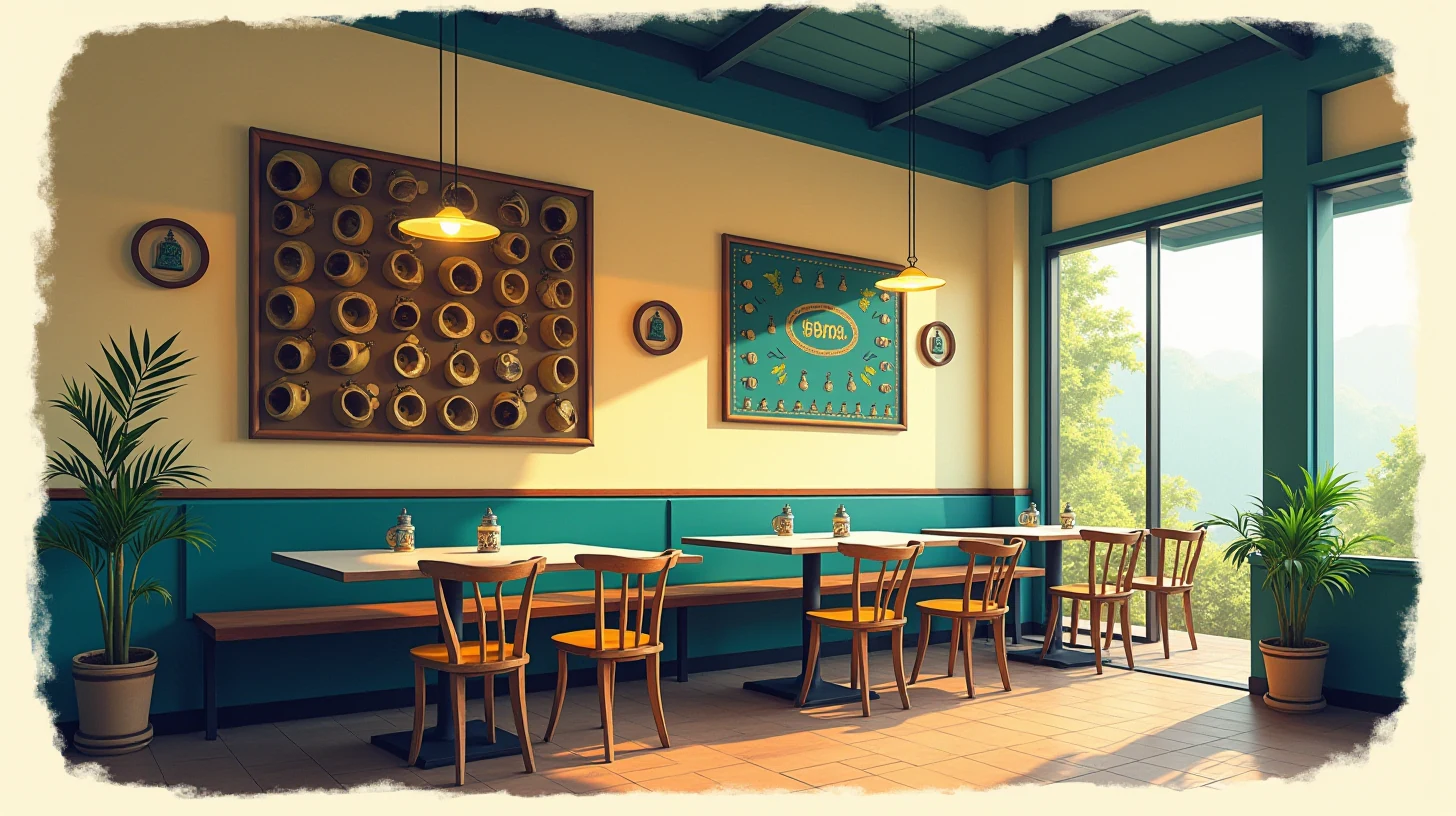
The restaurant serves Assamese food: fish curries from the Bharalumukh market, ou tenga dal, khar, a seasonal pitika rotation served in small clay bowls. The menu has not changed in eight years. The regulars would protest if it did. Fourteen people work here. Monthly revenue runs between ₹6.8 lakh and ₹9.2 lakh, higher in the November-through-March tourist months when Kaziranga and Majuli visitors pass through Guwahati.
The trouble arrived in an envelope.
🗓️ The year the rates changed — and the audit that forgot
When GST launched in July 2017, restaurants were split into two tiers: non-air-conditioned at 5% without input tax credit, air-conditioned at 18% with ITC. The distinction created an immediate problem for restaurants with both AC and non-AC seating under one roof — a single GSTIN, a single billing system, two zones. In November 2017, the GST Council rationalised the structure: a flat 5% composite rate with no ITC was applied to all restaurants, regardless of air conditioning. The 18% AC rate was abolished. From that point, Nandita — who had registered under the composite rate from the day Xopun Bhoj opened — had charged 5% GST on every bill, in both zones, and filed her GSTR-1, GSTR-3B, and GSTR-9 returns accordingly. This was correct. This was the law. This is not what the auditor understood.
The GST audit visit happened in the second week of September 2025. A field officer from the Guwahati North range of the Assam GST Commissionerate arrived at the restaurant at 11:20 AM on a Tuesday, during the pre-lunch setup, and asked to see two years of records: GSTR-1 and GSTR-3B filings for FY 2023-24 and FY 2024-25, the restaurant's FSSAI State Licence, the Udyam registration certificate, the last twelve months of electricity bills, and the AC installation invoice. Nandita produced all of these from a folder her accountant maintained. The officer spent forty minutes in the restaurant, photographed the AC unit, photographed the glass partition, and noted the seating count in each zone. He left without indicating a finding.
The DRC-01A notice — a pre-show-cause demand notice under the GST framework — arrived five weeks later, in mid-October 2025. The demand was ₹4,17,300 in additional tax, plus interest of ₹83,460 at 18% per annum calculated from the filing dates, plus a proposed penalty of ₹41,730. The auditor's stated basis: the AC dining hall constituted an air-conditioned restaurant in the meaning of the original GST schedule, and the composite seating arrangement did not exempt the AC zone from the 18% rate. The revenue attributable to the AC zone — estimated by the officer at 48% of total restaurant revenue, based on seat count — should have been taxed at 18% throughout FY 2023-24 and FY 2024-25, not 5%. The notice gave Nandita thirty days to respond.
⚠️ What ₹5,42,490 actually looks like
Nandita is not a person given to panic. She had run Xopun Bhoj through the lockdown years, replaced the kitchen exhaust in 2022 at ₹2,40,000 on a UCO Bank loan she was still repaying at ₹18,000 per month. She was not fragile. But ₹5,42,490 — the combined demand, interest, and penalty — was roughly two months of gross revenue for a restaurant whose net margin ran between 8% and 12%. Two months of gross revenue as a tax demand, on a basis she believed was legally wrong, was the kind of number that required sitting down.
What frightened her more than the number was the mechanism. The GST framework does not suspend a demand while it is disputed. If confirmed — escalated to a full show-cause notice, then to a demand order — it would become a recovery proceeding. That meant the potential attachment of her bank accounts. The UCO Bank EMI continued regardless. The Bharalumukh fish vendor expected payment every Thursday. Fourteen staff expected salaries on the first.
She was not certain, reading the notice at midnight after last service, that the November 2017 abolition was unambiguous for a layout like hers — a glass partition, a separately metered cassette unit, a seat count split exactly down the middle. The auditor's notice was written with the confidence of someone who believed the composite seating was a loophole, not a recognised category. She could not immediately prove otherwise.
Original GST (July–Nov 2017)
18% with ITC for AC restaurantsAC restaurants taxed at 18% with input tax credit; non-AC restaurants at 5% without ITC. The composite layout problem was immediately apparent but unresolved for four months.
Revised GST (Nov 2017 onward)
5% flat, no ITC, all restaurantsGST Council notification abolished the 18% AC category. All restaurants — AC, non-AC, and composite — moved to a flat 5% rate with no input tax credit. Xopun Bhoj has charged 5% correctly throughout.
Auditor's demand (Oct 2025)
18% on 48% of revenue — disputedField officer treated the AC glass-partition hall as a continuing AC restaurant under the original schedule. The DRC-01A applied 18% retrospectively for FY 2023-24 and FY 2024-25, ignoring the November 2017 rationalisation entirely.
Her accountant, Deepak Sharma, had an office in Paltan Bazar and had been handling Xopun Bhoj's GST returns since 2019. He was reliable and unhurried, two qualities Nandita valued, and when she called him the morning after receiving the notice he told her, in the even tone of a man who has seen this before: "This is wrong. The 18% rate was abolished in 2017. There is a CBIC circular. We will respond." This was reassuring. It did not entirely dissolve the ₹5,42,490.
🌗 What changed
Nandita's younger brother Ratul worked at an e-commerce logistics company in Guwahati's Beltola area and had the habit, common among people in their early thirties who work in tech-adjacent jobs, of being insistently helpful about software tools. He had been using an AI assistant for his own paperwork — PF queries, income tax forms, a vehicle insurance dispute — and had concluded it was particularly useful for documents that contained legal and regulatory language addressed to people who were not lawyers. The DRC-01A was exactly this kind of document. He arrived at the restaurant on a Saturday afternoon in late October, sat down at the corner table in the courtyard under the banana trees, and spent an hour reading the notice with the agent.
He typed the key passage from the notice — the auditor's claim that the composite seating arrangement was subject to the 18% AC restaurant rate — into the agent in Assamese.
"এইটো DRC-01A নোটিচত কোৱা হৈছে যে AC আসন এলেকা 18% GST-ৰ অন্তৰ্ভুক্ত। কিন্তু আমি শুনিছোঁ যে 2017 চনতে এই হাৰ বাতিল কৰা হৈছিল। এইটো সঁচা নে? কোনখিনি চাৰ্কুলাৰ বা নিৰ্দেশনাই এইটো স্পষ্ট কৰে?"
(This DRC-01A notice says the AC seating area falls under the 18% GST rate. But we have heard that this rate was cancelled in 2017. Is that correct? Which circular or notification makes this clear?)
The agent's response came in Assamese and set out, in plain language, the sequence of events: the original July 2017 GST launch with the AC/non-AC split, the GST Council meeting of 10 November 2017 that issued Notification No. 46/2017-Central Tax (Rate) abolishing the higher rate for restaurants, and the CBIC's subsequent clarificatory circular confirming that all restaurants — irrespective of whether they had air conditioning — would be taxed at 5% without input tax credit from that date forward. It named two Advance Authority for Advance Ruling decisions — one from Maharashtra, one from Karnataka — where composite seating layouts had been considered and the 5% flat rate confirmed. It was specific. It was not legal advice. It was the kind of specific that Deepak Sharma had described, but with document references that Nandita could now carry to the meeting.
"মোৰ ৰেস্তোঁৰাৰ ভিতৰত কাঁচৰ দেৱাল আছে বুলি চৰকাৰে 2017 চনৰ আগৰ হাৰ বিচাৰিব নোৱাৰে। সেই হাৰ বাতিল হৈছিল আৰু সেয়া সঁচা।"— The government cannot demand a rate from before 2017 just because my restaurant has a glass wall inside it. That rate was abolished and that is real.
Ratul and Nandita spent two more hours that Saturday tracing through the GSTR-9 annual return filings for FY 2023-24 on the GST portal, the agent helping them identify which line items the auditor had used to estimate the 48% AC-zone revenue attribution. The auditor had used seat count as a proxy — thirty AC seats divided by sixty total seats equals 50%, rounded down to 48% with a margin note. The agent flagged what this method did not account for: that the AC hall at Xopun Bhoj operated at lower average cover per table than the courtyard, because the courtyard handled larger family groups and festival season bookings. Nandita's actual billing records from the POS system showed that the AC hall accounted for approximately 39% of revenue by billing value, not 48% by seat count. Even accepting the auditor's mistaken legal premise — which Deepak would dispute entirely — the revenue base for the contested demand was overstated by roughly ₹86,000.
She brought this to the Paltan Bazar meeting ten days later with a printed summary the agent had helped her structure. Deepak, who had planned a two-page rebuttal, extended it to four pages.
🧭 Why we built it
There are more than 7.5 million registered food service establishments in India. GST compliance for restaurants has, since 2017, been a field of compounding complexity: the AC/non-AC split, the November 2017 rationalisation, the withdrawal of input tax credit, and a series of circulars and AAR rulings that clarify — and occasionally contradict — how composite layouts should be classified. A field auditor who trained before the rationalisation, or who has seen restaurants genuinely exploit the dual-rate structure, is not unreasonable to flag a composite layout for scrutiny. The system's ambiguity invites it.
The problem is that the restaurant owner receiving a DRC-01A in Guwahati — running forty hours of kitchen operations plus twenty hours of administration in what is structurally a one-person management job — does not have ready access to the November 2017 notification number, the CBIC circular, or the AAR precedents from Maharashtra and Karnataka. Deepak Sharma has them. He also has twenty-three other clients in Guwahati and Jorhat and is not, in the arithmetic of his working hours, a real-time research resource between meetings.
What the agent did on that Saturday afternoon was not legal representation. What it did was move the conversation from "I think the 18% rate was abolished" to "here is the November 2017 notification and here is what it says." That shift — from vague belief to specific document — is the difference between a rebuttal and a protest. The agent can make that shift at 11 PM on a Saturday, which is when Nandita and Ratul needed it. The POS billing analysis — the ₹86,000 overstatement in the revenue base — is arithmetic, applied to data Nandita already owned but had not assembled in the format the dispute required.
What it does
- 🔍Located the November 2017 GST Council notification that abolished the 18% AC restaurant rate, with the notification number.
- 🗂️Identified two AAR precedents (Maharashtra, Karnataka) where composite seating layouts were considered and the flat 5% rate confirmed.
- 📋Helped Nandita extract POS billing data and compare it against the auditor's seat-count revenue estimate, identifying the ₹86,000 overstatement.
- ⏰Tracked the thirty-day DRC-01A response deadline and reminded Nandita and Ratul of it during the Saturday session.
What it does not do
- 🔒Did not log into the GST portal, access Nandita's account, or file any part of the response without explicit confirmation.
- ✅Did not advise Nandita on whether to accept, partially accept, or fully contest the demand — that decision belongs to Deepak Sharma.
- ⚖️Did not represent or substitute for a chartered accountant or legal advisor; Deepak Sharma drafted and filed the rebuttal.
🌱 What we hope happens
Nandita's DRC-01A response was filed on 12 November 2025, within the thirty-day window. Deepak Sharma submitted four pages of written rebuttal, citing the November 2017 GST Council notification, the CBIC circular, the two AAR rulings, and the POS-based revenue analysis as an annexure. The Guwahati North range has not, as of the date this account was written, issued a reply. These proceedings move slowly. The case may be closed on the basis of the rebuttal alone, or it may proceed to a formal show-cause notice and a personal hearing before the adjudicating officer. Deepak believes the latter is unlikely, given the clarity of the November 2017 rationalisation. Nandita is living with the uncertainty.
What has changed, in the meantime, is the way she reads her GST filings. She had not, before the audit, looked at her GSTR-9 in detail — she had trusted Deepak's preparation and signed. She now reviews the annual return herself before it is filed, using the agent to explain the line items she does not recognise. The first time she did this, for the FY 2024-25 return filed in March 2026, she found a line item for exempt supply that she did not understand. The agent explained it in Assamese, in plain language, and confirmed it matched the restaurant's supply profile. It was correct. She found nothing wrong. But she understood what she was signing.
The khorai bowls on the shelf near the entrance of Xopun Bhoj are not decorative. Nandita uses them to serve the ou tenga dal on festival days, when the restaurant books out three weeks in advance and the courtyard is full past the banana trees. The glass partition that divides the AC hall from the courtyard has a small crack in the lower-left corner, which appeared during the 2023 earthquake and which Nandita has covered with a strip of opaque film. She has been meaning to replace the panel since 2024. She has not, because the cost estimate — ₹34,000 for laminated safety glass — competes, in the queue of things the restaurant needs, with the exhaust hood filter replacement and two new ceiling fans for the courtyard.
The DRC-01A dispute has not yet resolved. The glass panel still has its crack. The thirty seats in the courtyard fill first, every evening, because the regulars prefer the open air, the banana trees, and the smell of khar from the kitchen. The AC hall fills later, with office parties and people celebrating things quietly. The billing system makes no distinction between them. It charges 5% GST on every table, as the law has required since November 2017.
If you run a restaurant or café and have received a GST audit notice you are not certain about, the product is free at gabforge.in. We read government documents in Assamese and eleven other Indian languages. We will not interpret for you — that is your accountant's work — but we will find the specific notification or circular your accountant needs, and we will find it before the response deadline.