
The Hyderabad rooftop restaurant and the FL-3 excise licence
Sridhar Venkataraman is forty-four years old. He runs a restaurant called Araku Sky Table on the fifth floor of a commercial complex on Road No. 12 in Banjara Hills, Hyderabad — a ninety-seat rooftop fine-dining establishment with a bar counter in polished black granite and a menu that moves between Hyderabadi dum cooking and Continental plates, the two idioms sharing a menu card in a way that Sridhar describes as "the honest biography of how I was trained." He trained at the Taj Falaknuma, worked a stint in Muscat, and returned in 2014 with enough savings and enough conviction to open the kind of restaurant he had wanted to work in since he was twenty.
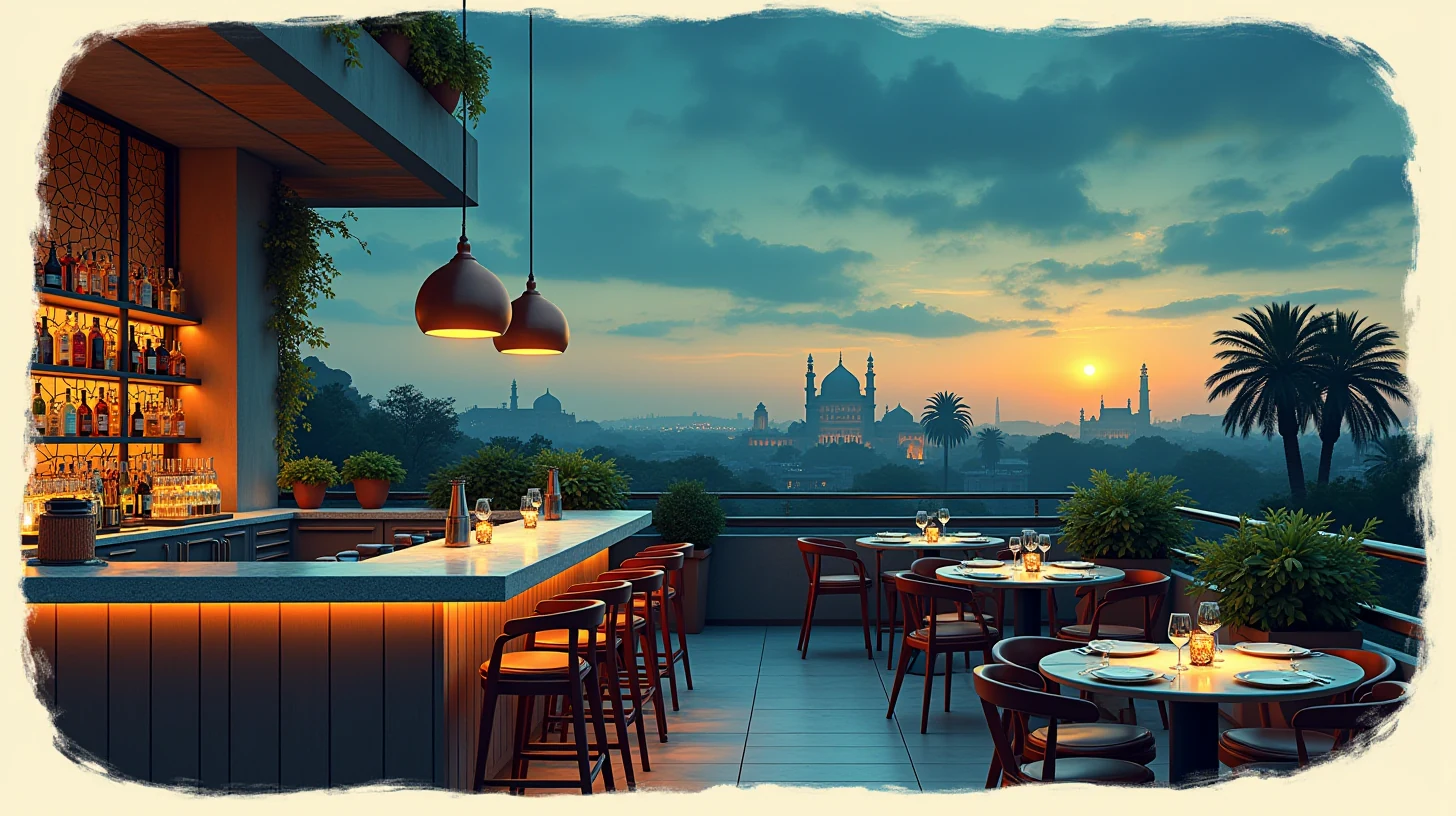
The restaurant has been operating for nine years. It seats ninety on the terrace when the misting units are running, which in Hyderabad means roughly six months of the year. The other six months — from October to March — are when the rooftop earns its name. The view from the fifth floor on a clear November evening reaches west toward the Hussain Sagar and, on nights when the haze is thin, a faint smudge that Sridhar points to as Charminar. The bar turns over between ₹1.8 lakh and ₹2.5 lakh a month; total revenue runs between ₹14 lakh and ₹18 lakh in peak months, and between ₹9 lakh and ₹11 lakh in May and June.
Sridhar employs twenty-three people. His general manager, a meticulous woman named Lalitha who has been with him since year two, manages the floor and the supplier relationships. His head bartender, Kiran, manages the bar inventory and the cocktail menu. The kitchen runs on a brigade of six. The compliance work — licences, GST, FSSAI, provident fund — is handled by Sridhar's accountant, a CA named Ramesh Babu from Somajiguda who has been filing the restaurant's returns since 2017.
The trouble arrived in March 2026, in three separate envelopes, on three different days, from three different government offices.
🗓️ The annual ritual
The FL-3 licence is the licence that allows a hotel or restaurant in Telangana to serve Indian Made Foreign Liquor, beer, wine, and cocktails to its customers. Without it, the bar shuts. It is issued by the Telangana Prohibition and Excise Department, and it must be renewed annually, in the first quarter of every calendar year. The licence fee for a 90-seat restaurant with a bar in Hyderabad's Banjara Hills area runs to approximately ₹2.2 lakh per year — a number Sridhar has paid every year since 2016, when he first obtained the licence, without particular drama.
The renewal process, until 2024, had been an offline one: Ramesh Babu would prepare the renewal application, Sridhar would sign it, the documents would be submitted to the Excise office at Basheer Bagh, a field officer would visit the premises for verification, and the renewed licence would arrive in the post within four to six weeks. Sridhar had never missed a renewal. He had, in nine years, never once operated the bar on an expired licence.
What he had not tracked closely was that the Telangana Prohibition and Excise Department had moved the FL-3 renewal process to an online portal in mid-2024, under the Integrated Excise Management System. The offline submission route was officially discontinued from January 2025. Applications submitted offline after that date were to be returned unprocessed.
Ramesh Babu had not registered on the new portal. He had been preparing Sridhar's renewal documents the old way — physical forms, attested photocopies, a demand draft — and had walked them to the Basheer Bagh office in the second week of February 2026, as he had done every year. The receiving clerk had accepted the bundle and given a token receipt. Six weeks passed. The renewed licence did not arrive.
The first envelope was a notice from the Telangana Excise Department: the physical application had been returned, unprocessed, and the FL-3 licence would lapse on April 1st if a valid online application was not submitted by March 25th. The notice arrived on March 5th. That gave them twenty days.
⚠️ What very nearly happened
The second envelope arrived three days later, from the GHMC — the Greater Hyderabad Municipal Corporation. It was a show-cause notice under the Telangana Municipal Corporation Act, citing non-compliance with the new rooftop seating safety regulations issued in September 2025.
Sridhar had not heard of the September 2025 rooftop safety circular. The circular, issued by GHMC's Building Permissions and Town Planning department following two rooftop restaurant fires in Secunderabad, required all rooftop food establishments — defined as restaurants operating on the terrace or roof of a building — to obtain a renewed Fire NOC with a specific rooftop-seating endorsement by March 31, 2026. The previous Fire NOC, covering the ground-floor and common areas of the building, did not automatically extend to rooftop dining. A rooftop-specific inspection, a rooftop emergency evacuation plan, and a fresh NOC application to the Telangana Fire and Emergency Services were required.
The notice gave Araku Sky Table until March 31st to comply or face suspension of the rooftop seating permission. If the rooftop seating was suspended, the restaurant's capacity would drop from ninety to zero, because the entire establishment is on the terrace. There is no ground-floor seating. The restaurant would, effectively, close.
The third envelope — which arrived the same week, forwarded by Ramesh Babu with a note that said simply "Need to discuss" — was a query from the GST department regarding a discrepancy in Araku Sky Table's GSTR-3B filings for the financial years 2022-23, 2023-24, and 2024-25. The discrepancy related to the classification of revenue from liquor sales.
Here is the GST trap that catches composite-bill restaurants: food and non-alcoholic beverages attract GST at 5% (HSN 996331, no input tax credit). Alcoholic liquor is entirely outside the GST framework — it falls under state excise. When a restaurant presents a single bill that includes both, the bill must be split: food at 5%, liquor at zero GST. The two figures must be separately reported in the GSTR-3B — taxable supply and non-GST supply.
Ramesh Babu had, for three years, been filing the liquor revenue under "exempt supply" rather than "non-GST supply" — technically incorrect, producing the same net GST outflow but creating a mismatch that the GST department's automated scrutiny had flagged. The query asked for a written explanation and rectification through GSTR-9C.
The potential exposure, if the scrutiny escalated to an audit and the auditor treated the misclassification as evasion rather than clerical error, was a GST penalty of 10% of the disputed tax amount and interest at 18% per annum on the entire three-year period. Ramesh Babu's note estimated the worst-case figure at approximately ₹4.8 lakh in penalties and interest, not counting the professional fees for the rectification filing.
Food & non-alcoholic beverages
GST: 5% (HSN 996331)All food items and non-alcoholic drinks — water, juice, soft drinks, mocktails — are taxable at 5%. No input tax credit available. Reported under 'taxable supply' in GSTR-3B.
Alcoholic liquor
GST: Nil (outside GST framework)Beer, wine, spirits, and cocktails containing alcohol are outside GST entirely. State excise duty is embedded in the cost. Revenue must be reported under 'non-GST supply' — NOT 'exempt supply' — in GSTR-3B. The difference between these two boxes is the audit trigger.
The correct bill split
Reported in GSTR-3B: both columnsA table that orders ₹4,000 in food and ₹3,200 in whisky pays GST on ₹4,000 only (₹200 tax). The ₹3,200 must appear in the 'non-GST supply' column, not 'exempt supply'. Three years of swapped columns is the compliance trap.
Three envelopes. Twenty days to the FL-3 lapse. Twenty-three days to the rooftop seating suspension. A GST query with a ₹4.8 lakh downside. All arriving simultaneously, in the same week in March.
🌗 What changed
Lalitha, the general manager, had a brother who ran a catering business in Madhapur. Her brother had been using an AI assistant for his GST reconciliation and supplier payment tracking for about eight months. On the evening after the third envelope arrived, she called him.
He drove to the restaurant the following morning — a Saturday — and sat with Sridhar and Ramesh Babu at the bar counter, his tablet open, the three envelopes arranged on the granite beside a pot of tea. He registered the restaurant on the agent, then fed it the FL-3 licence number, the GHMC trade licence number, the Fire NOC reference, the GST registration number, and the financial year summaries from Ramesh Babu's filed returns.
Sridhar typed his first question to the agent in Telugu, slowly, reading the words from his phone's keyboard:
"FL-3 renewal online portal ఎలా పని చేస్తుంది? Offline దాఖలు reject అయింది."
— How does the FL-3 renewal online portal work? The offline submission was rejected.
"FL-3 renewal ఇప్పుడు Telangana Integrated Excise Management System ద్వారా మాత్రమే జరుగుతుంది — excise.telangana.gov.in. మీ FL-3 licence number తో login చేయండి, 'Renewal Application' tab లో prior year licence copy, premises photo, FSSAI licence copy, మరియు ₹2,20,000 renewal fee demand draft upload చేయాలి. March 25 deadline — మీకు ఇంకా 17 రోజులు ఉన్నాయి. Ramesh Babu గారు portal registration మొదలెడదామా?"
(FL-3 renewal now happens only through the Telangana Integrated Excise Management System — excise.telangana.gov.in. Log in with your FL-3 licence number, and under the 'Renewal Application' tab upload the prior year licence copy, premises photo, FSSAI licence copy, and a demand draft for ₹2,20,000. The deadline is March 25 — you have 17 days remaining. Shall we have Ramesh Babu begin portal registration?)
That morning, the agent mapped all three problems in sequence and proposed an order of attack. The FL-3 deadline was hardest — March 25th, seventeen days away, and the portal registration itself would take two to three days to activate. The rooftop Fire NOC application was next in urgency, with a March 31st deadline for submission to the Telangana Fire and Emergency Services through the Hyderabad Fire Services office at Nampally. The GST query response, while the highest in financial exposure, had a sixty-day response window from the date of the notice — which meant it was the least urgent in the immediate sprint, though not in importance.
- ⚖️
March 8 — Three envelopes, one week
FL-3 offline application returned unprocessed. GHMC show-cause for missing rooftop Fire NOC endorsement. GST query on three years of exempt-vs-non-GST supply misclassification. All deadlines within 23 days.
- 📱
March 9 — Agent intake, sequencing begins
Lalitha's brother registers the restaurant. Agent maps all three issues, identifies FL-3 as hardest deadline (March 25), Fire NOC as second (March 31), GST query as highest value but longest window (60 days).
- 📋
March 10–13 — Excise portal registration and FL-3 documents
Ramesh Babu registers on the Integrated Excise Management System. Agent prepares a document checklist: prior-year licence, premises photographs, FSSAI licence, DD for ₹2,20,000. Portal activation completes March 13.
- 🛑
March 14–18 — Rooftop Fire NOC inspection and application
Agent surfaces the September 2025 GHMC rooftop safety circular. Sridhar commissions a structural safety audit (₹18,000, Hyderabad Fire Systems Pvt Ltd). Application submitted to Nampally fire office with evacuation plan on March 18.
- ✅
March 21–25 — FL-3 online application filed, field visit completed
FL-3 renewal application filed online March 21. Excise field officer visits March 24. Renewed licence issued March 25, before the deadline. Rooftop Fire NOC inspection scheduled for April 4.
The rooftop Fire NOC was the part Sridhar had not anticipated. The September 2025 circular required not just an inspection form but a site-specific emergency evacuation plan — floor layout, exit stairwell dimensions, maximum occupancy per evacuation zone, assembly point designation on the terrace and at the building's ground-floor entrance. Sridhar did not have this document. The agent found, on the Telangana Fire and Emergency Services website, a template evacuation plan for rooftop dining establishments and a list of empanelled fire safety consultants authorised to certify rooftop venue plans in Hyderabad. Sridhar hired one — a firm called Hyderabad Fire Systems from Kukatpally — for ₹18,000, and the plan was prepared and submitted with the application to the Nampally fire office on the 18th of March.
"ఒక రాత్రి మొత్తం restaurant పని చేస్తుంది — వంట, service, bar — కానీ పగలు ఈ papers చూసే సమయం లేదు. ఇది మా తప్పు కాదు. ఇది మా పరిస్థితి."— The whole restaurant works at night — cooking, service, bar — but during the day there is no time to look at these papers. This is not our fault. This is our condition.
The GST issue took another three weeks after the immediate crisis resolved. Ramesh Babu filed a written response to the department query on April 15th, acknowledging the clerical misclassification and attaching rectified GSTR-9C computations for all three financial years. The agent had helped him build a year-by-year table of the liquor revenue figures, cross-referenced against the bar inventory purchase records and the excise duty challans, to demonstrate that the underlying tax had been correctly paid — the error was purely in the classification box, not in the amount. The rectification reduced the exposure significantly. Ramesh Babu's final estimate was a compounding interest liability of approximately ₹31,000, which the department accepted in April. The ₹4.8 lakh worst-case did not materialise.
🧭 Why we built it
The compliance trap that Sridhar walked into is structural, and it affects every restaurant in India that serves both food and alcohol on a single bill.
The GST framework's treatment of liquor is, in principle, simple: liquor is outside GST, food is inside GST. In practice, the simplicity collapses at the point of billing. Most restaurants do not issue separate bills for food and alcohol — they issue one bill. That one bill must, in the GSTR-3B, be disaggregated into taxable supply and non-GST supply. The field labels matter: "exempt supply" covers items like unprocessed grains, which are GST-exempt. Liquor is not GST-exempt — it was never in the GST framework to begin with. These are legally distinct categories with different return-scrutiny triggers. The GST portal does not surface a warning when a food business with an FL-3 excise licence files liquor revenue under the wrong column. The system accepts it. The scrutiny happens eighteen months later, in a query letter that arrives like the third envelope in Sridhar's March.
The rooftop Fire NOC gap is structural in a different direction. When GHMC issued the September 2025 circular adding a rooftop-specific endorsement requirement, no notification reached existing rooftop restaurant operators. The circular was published in the GHMC gazette. Nobody checks the gazette. The gap between what government publishes and what restaurant operators receive is, in most cases, wide enough to park a building in.
What it does
- 🔍Monitors FL-3, FSSAI, Fire NOC, and GHMC trade licence expiry dates and alerts operators 60 days, 30 days, and 7 days before each deadline.
- 📋Surfaces regulatory circulars and new requirements — such as the September 2025 rooftop safety rule — by checking GHMC and Telangana Fire Services notices.
- 🗂️Builds document checklists for each renewal application, cross-referenced against current portal requirements for TGIEM (excise), FSSAI FoSCoS, and GHMC.
- ⚖️Identifies composite-bill GST classification errors by comparing GSTR-3B supply columns against excise licence records and flagging the non-GST supply vs exempt-supply distinction.
What it does not do
- 🔒Never logs into the Telangana Excise portal, GST portal, or GHMC systems on the operator's behalf — credentials remain with the operator and their CA.
- ✅Never submits a renewal application or GST return without the operator's and accountant's explicit review and confirmation.
- 💳Never handles licence fees, demand drafts, or challan payments — the operator retains full financial control of every government payment.
🌱 What we hope happens
Araku Sky Table's rooftop opened again in October 2026, on the first genuinely cool evening of the season. The misting units were off. The Charminar silhouette was visible at dusk. Sridhar stood at the bar counter and watched the ninety seats fill, the way they had filled every October for nine years, and felt the specific relief of a man who had come close to losing something he had spent nine years building and had not lost it.
The FL-3 licence is valid. The rooftop Fire NOC, with its evacuation plan and its emergency assembly-point sign at the terrace entrance, is pinned to the back wall of the service station. The GST returns for 2025-26 correctly separate food revenue from liquor revenue in their respective GSTR-3B columns — Ramesh Babu put a handwritten note in his files: non-GST supply, not exempt. The agent will surface the FL-3 renewal window in January, forty-five days before the March deadline, and will check the GHMC gazette monthly for any new circulars bearing the words "rooftop," "terrace," or "outdoor seating."
Sridhar is not a compliance expert. He is a chef who learned Continental cooking in a Muscat hotel kitchen and came home to cook Hyderabadi food at altitude. The regulatory framework he operates inside — FL-3, GHMC, FSSAI, GSTR-3B, rooftop safety circulars — is not something he was trained for. What happened in March 2026 was not negligence. It was the structural gap between a regulatory system that communicates through portals and gazettes and a restaurant operator who communicates through the smell of cardamom in a dum pot and the sound of a bar counter filling at seven in the evening. The agent does not close that gap entirely. It narrows it — enough, on the evidence of one March in Banjara Hills, to matter.
The terrace fills fastest in November, when the city cools and the Charminar lights come on at dusk. That is, in Sridhar's estimation, reason enough.