
The Jaipur haveli restaurant and the heritage NOC
Mahesh Singhvi is forty-four years old. He runs a restaurant called Haveli Rasoi inside a 200-year-old haveli on Tripolia Bazaar, a short walk from the Hawa Mahal in Jaipur's Walled City. The building belongs to a joint family trust, but the restaurant is Mahesh's: he built it from a disused storage courtyard in 2016, took a ₹34 lakh loan from Punjab National Bank's Badi Chaupar branch, and opened on Diwali eve with ninety seats, a dal-baati-churma menu refined over four years of catering work, and a wood-fired tandoor set into the original stone alcove beside the first courtyard.
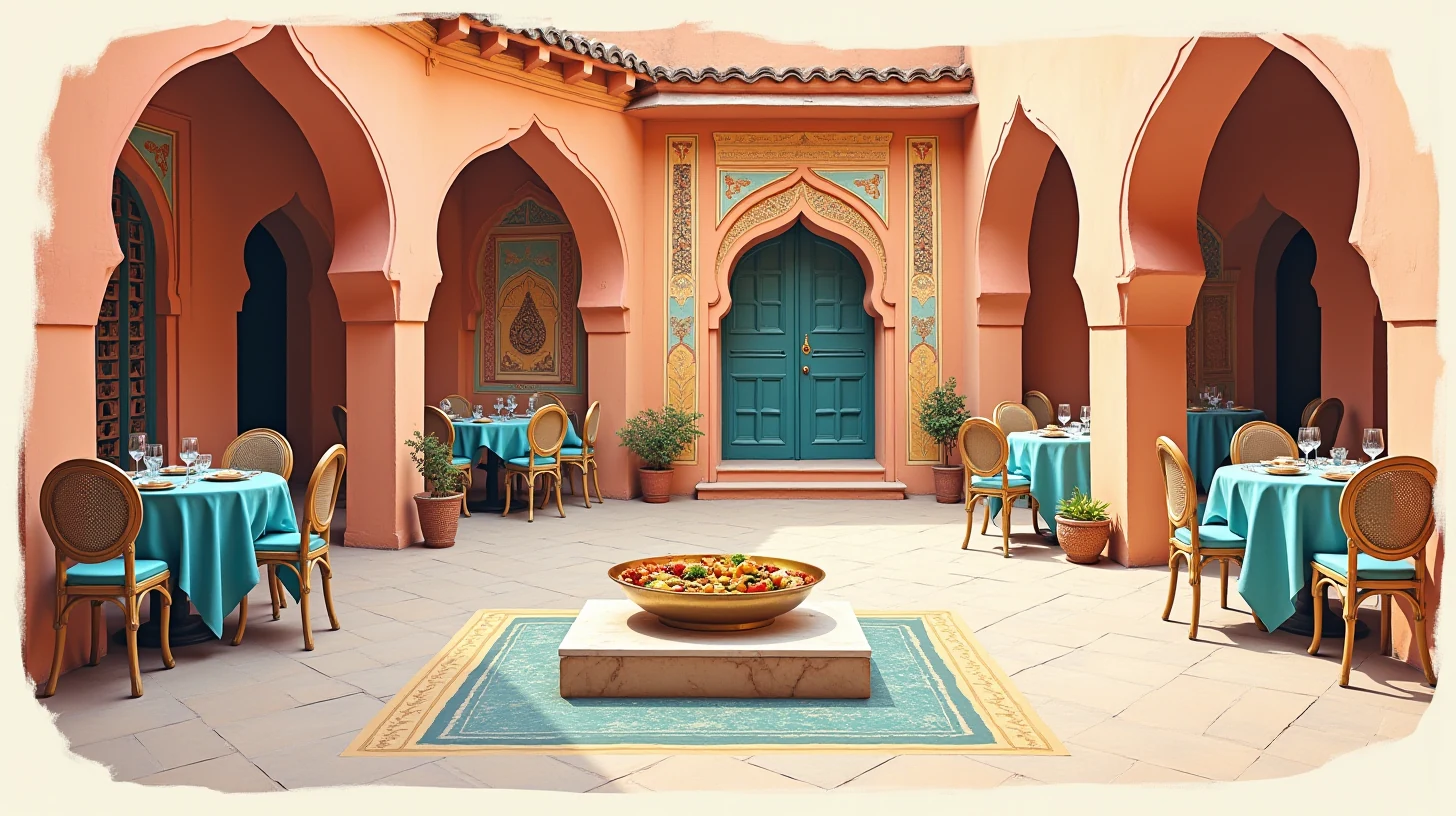
The haveli is genuinely beautiful. Its frescoed walls — Shekhawati-style ochre and indigo arabesques framing Krishna-leela panels — have survived two centuries of monsoons and one aggressive interior-design consultant Mahesh fired after two days. The dining courtyard is open to the sky. The jharokha screens on the upper gallery throw lattice shadows across the marble floor in the afternoon. He employs fourteen people: head cook Ratan, who has made the same dal-baati for eleven years, a manager named Deepak who handles bookings and also, on festival days, performs a welcome ceremony in a silk achkan, and the serving staff. Monthly revenue runs between ₹8.5 lakh and ₹14 lakh, depending on the tourist calendar.
The trouble came not in a single letter but in four regulatory threads, each unravelling at its own pace, none fully visible until they arrived in the same week in February 2026.
🗓️ The annual ritual
The Rajasthan Tourism heritage classification — Heritage (Grade II) — is what allowed Mahesh to use the word heritage in his marketing and to appear on the Tourism Department's curated restaurant list. It is the justification for his ₹850-per-head dal-baati lunch. The classification NOC must be renewed every three years, and on renewal, the Tourism Department inspects the property against the conditions in the original grant.
One of those conditions specifies that the external facade — including the jharokha screens visible from the lane — must be maintained in the colours listed in the heritage gazette entry: a particular gulabi sandstone plaster shade and RAL 8016 mahogany-brown for the wooden lattice panels. During the 2024 monsoon, one second-floor screen was water-damaged and replaced. The carpenter used a walnut-brown stain he had on hand — darker, cooler, definitively not RAL 8016. Mahesh noted the slight difference and decided it was close enough. The NOC renewal inspection was scheduled for March 2026.
The RSPCB consent-to-operate for the wood-fired tandoor (Category Green, Air Act 1981) had been renewed by a consultant named Sharma-ji in 2022. Sharma-ji had since moved to Pune, the task had transferred to no one, and the consent had lapsed silently in September 2025. The renewal notice arrived at the address registered on the loan documentation — not the restaurant address — and Mahesh never received it.
The JMC trade licence had been current through December 2023. The December 2024 renewal was missed: Mahesh was hosting a wedding on the due date, and the renewal notice, filed in Deepak's desk drawer, was never actioned.
- ⚖️
June 2024 — jharokha restained in wrong shade
Monsoon damage prompts lattice replacement. The carpenter uses walnut-brown instead of gazetted RAL 8016. Mahesh notes the difference and decides it is close enough.
- 📨
September 2025 — RSPCB consent lapses
Sharma-ji's 2022 renewal was the last. The 2025 renewal notice is mailed to the wrong address. No one files. The wood-fired tandoor is now operating without current environmental consent.
- 🛑
December 2025 — JMC trade licence overdue
The annual renewal is missed during a courtyard wedding. The notice sits in Deepak's drawer. The licence has been lapsed for ten weeks by the time anyone notices.
- ⏰
February 2026 — inspection notice arrives
Tourism Department issues advance notice of the March inspection. Mahesh reads the facade compliance clause for the first time since 2023. All four threads surface at once.
⚠️ What very nearly happened
Mahesh keeps a physical compliance calendar — a laminated sheet near the manager's desk, updated each April. It had three structural gaps. The RSPCB consent was not on it: the original consultant had handled it, the 2022 renewal had happened without anyone at the restaurant being responsible for it, and the 2025 renewal had, accordingly, not happened at all. The JMC gap was simpler — a missed date buried under a wedding booking. The facade colour issue was subtler: there was no calendar entry for "verify jharokha colour against heritage gazette," because no one had imagined it would need to be verified.
What very nearly happened: the Tourism Department inspector arrives in March, notes the wrong lattice shade, checks the JMC trade licence (inspectors in the Smart City heritage zone routinely do), finds it lapsed, checks the RSPCB consent display (required by law to be displayed on-premises), finds nothing current, and issues three simultaneous deficiency notices. The heritage classification renewal is suspended pending rectification. During those sixty days, Mahesh cannot use the heritage designation in any public-facing material — including the booking portal listing for the March wedding, which a forty-two-person party from Delhi had confirmed on the basis of the heritage certification and paid ₹2.4 lakh in advance.
The RSPCB risk was separately significant: a show-cause notice for operating wood-fired equipment without consent, triggered by any third-party complaint in a dense heritage neighbourhood, can issue a stop-work order. Ratan would have had no function. The dal-baati menu would have been unreachable.
🌗 What changed
Mahesh's younger cousin Priya worked at a Jaipur architecture firm specialising in heritage restoration and knew the Walled City compliance framework well. She came to the haveli on a Sunday in February to look at the jharokha, identified the colour discrepancy immediately, and then, somewhat incidentally, asked to see the compliance folder Deepak kept. She read the four documents — RSPCB consent (lapsed September 2025), JMC licence (lapsed December 2024), heritage NOC (renewal inspection in six weeks), FSSAI Central licence (valid to April 2026) — and installed the agent on Mahesh's phone.
The agent read the text from each document and returned a compliance summary: two lapses (RSPCB, JMC), one active inspection with a facade deficiency (heritage NOC), one upcoming renewal (FSSAI). It ranked them by urgency and flagged the connection the compliance calendar had missed — that the JMC licence would be checked at the heritage inspection, and that a lapsed licence at inspection would flag the entire NOC renewal.
Mahesh read the summary sitting at one of his own low wooden platforms in the empty afternoon courtyard, with Priya across from him and a brass cup of afternoon chai going cold beside a brass thali. He said nothing for a moment. Then he said, quietly, to no one in particular:
"एक काम सही से नहीं हुआ तो सारी चेन टूट जावे।"— One thing left undone, and the whole chain breaks. (Mahesh, in the empty courtyard, February 2026)
The agent's output was a sequence, not a panic: JMC renewal first (fastest, most likely to be inspected), RSPCB consent application second (show-cause risk), jharokha colour rectification third (fixed inspection deadline), FSSAI fourth (six weeks remaining, no emergency).
Deepak renewed the JMC trade licence at the Corporation office in Pink Square on Tuesday: ₹4,800 fee plus ₹2,200 late penalty. Priya found a heritage-paint supplier near Bapu Nagar stocking RAL 8016. The carpenter restained the lattice screen over three days for ₹6,500. Mahesh personally compared it against the gazette photograph. It matched.
For the RSPCB consent, Priya connected Mahesh with a fresh environmental consultant — Kavya Sharma from Vaishali Nagar, who had quietly taken over Sharma-ji's client list. She filed the renewal application with the Board's Jaipur regional office, submitted the chimney stack inspection report, and paid the consent fee of ₹3,600. The application was under review on the inspection date — a pending renewal in good standing is treated differently from an unfiled one, and the inspector accepted the letter.
"Mahesh ji, Rajasthan Tourism Department ke inspection mein heritage zone facade compliance check hoti hai. Aapke jharokha ki colour ab RAL 8016 ke according sahi ho gayi hai — isko repair photograph ke saath inspection note mein daalna zaroori hai. RSPCB consent renewal bhi 'application submitted' stage pe hai — yeh letter apne paas rakhna, inspector ko dikhana."
(Mahesh, the Tourism Department inspection includes a heritage zone facade compliance check. Your jharokha colour is now correctly restored to RAL 8016 — document this with a before-and-after photograph in your inspection notes. The RSPCB consent renewal is at 'application submitted' stage — keep that letter with you and show it to the inspector.)
The inspection happened on the third of March. Inspector Bhanwarlal from the Jaipur Heritage Circuit office spent forty minutes at Haveli Rasoi. He noted the corrected lattice, verified the current JMC licence, checked the RSPCB renewal letter, and signed off — with one deficiency note: ESIC contribution filings had fallen three months behind. Mahesh had not known this. The Smart City heritage zone framework requires employment compliance as a condition of the Grade II designation; Bhanwarlal noted it as a condition of renewal, not a ground for rejection.
Deepak filed the ESIC arrears — ₹63,400 across fourteen employees — the following week, with ₹2,200 in interest. The Heritage (Grade II) NOC renewed in April. Reference number: RJ/HER/JPR/2026-29/0441.
What it does
- 🔍Read the four compliance documents and identified two lapses, one active deficiency, and one upcoming deadline
- 🗂️Cross-referenced the JMC licence lapse against the heritage NOC inspection criteria to flag the dependency
- 📞Sequenced the four tasks by urgency and consequence, giving Mahesh and Deepak a clear order of action
What it does not do
- 🔒Never accessed the JMC portal, RSPCB portal, or FSSAI FoSCoS on Mahesh's behalf — all filings were done by Deepak and the consultant
- 💳Never submitted a payment or an application — every transaction was confirmed and executed by a human
- ✅Never told Mahesh the inspection would pass — it surfaced the risks and the sequence; Mahesh and Priya resolved them
🧭 Why we built it
Jaipur's Walled City has, by Jaipur Smart City Limited's own count, more than 3,000 commercial establishments within the heritage zone buffer. A significant fraction hold some form of heritage classification, tourism licence, or facade-preservation obligation. The regulatory framework governing them is not a single document. It is the Tourism Department's classification rules, the JMC trade licence cycle, the Smart City heritage zone guidelines (a separate administrative instrument), and the RSPCB's environmental consents — each on a different renewal calendar, each administered by a different department, each communicating through a different channel.
Mahesh Singhvi is not a person who ignores regulation. He built his entire price point on the legitimacy of the heritage classification. He hired Deepak specifically for the administrative load. What the system did not give him was a single view of where each thread stood — and which thread, if it frayed, would pull the others. The Jaipur Smart City heritage zone guidelines are 47 pages of municipal legalese in English. The agent's compliance summary was eleven lines in Hindi. Mahesh read the eleven lines. He had not read the 47 pages.
This is not unusual. In every heritage city in India — Jodhpur, Mysore, Pondicherry, Ahmedabad's Pols, Varanasi's ghats — the small business owners carrying layered compliance obligations are operating at the edge of their bandwidth. The government's compliance communications are calibrated for someone with a compliance officer. Most heritage haveli restaurateurs do not have a compliance officer. Some have Deepak.
🌱 What we hope happens
The March wedding happened as planned. Forty-two guests. Three courses of Rajasthani cuisine, beginning with panchkuta and ending with malpua and rabri, with the dal-baati-churma served in the firelit alcove beside the tandoor. The new heritage certificate — RJ/HER/JPR/2026-29/0441 — is framed near the entrance, where guests photograph it on the way in.
Mahesh asked Priya what the whole exercise had cost. The tally: ₹6,500 (carpenter), ₹7,000 (JMC renewal with penalty), ₹3,600 (RSPCB fee), ₹5,800 (consultant), ₹63,400 in ESIC arrears, ₹2,200 in interest. Total: ₹88,500. That is not a small number. It is also less than the cost of a suspended heritage designation in the first week of March, with a ₹2.4 lakh wedding advance already in the account.
Mahesh said he was going to put the RSPCB renewal on a calendar reminder. He said the agent would read each renewed certificate when Deepak scanned it in, and flag anything expiring within six months. He said this in the forward-facing way of a man who has paid ₹88,500 to learn a lesson and has taken it.
Agle saal se sikhna nahi chahiye — pahle se sikhna chahiye. The lesson is not supposed to arrive with the penalty. It is supposed to arrive before. That is what the agent tries to do: read the documents you already have, find the deadline buried in clause 4(b), and send you eleven lines in Hindi before the inspector does.
The product is free at gabforge.in. If you run a heritage restaurant, a licensed dhaba, or any food business carrying a stack of government certificates reviewed once a year and forgotten — the agent will read them with you. It will not renew them for you. It will tell you, in Hindi or Marwari or any of eleven Indian languages, that the RSPCB consent lapsed five months ago, and that the heritage inspection is in six weeks, and that these two facts are related.
The tandoor is still lit. The lattice throws its shadows across the marble floor in the afternoon, in the right shade of teak-brown.