
The Leh rooftop restaurant and the tourist-season staff permit
Stanzin Dolkar is forty-one years old. Her restaurant sits on the top floor of a stone-and-timber building on Main Bazaar, Leh. There is no sign from the street — you climb a narrow staircase past two floors of a pashmina shop owned by her brother-in-law and arrive onto a rooftop with thirty seats, a stone parapet, and a view of Stok Kangri to the south. Butter-lamps burn in a carved niche beside the kitchen door. The menu is two things at once: skyu and chhutagi and butter tea on one side; shakshuka, hummus, falafel wraps on the other — the Israeli-Continental layer that backpackers quietly installed on Leh menus in the 2010s and that Stanzin has maintained because it works. The restaurant is called Namsol, which in Ladakhi means the clear, open sky.
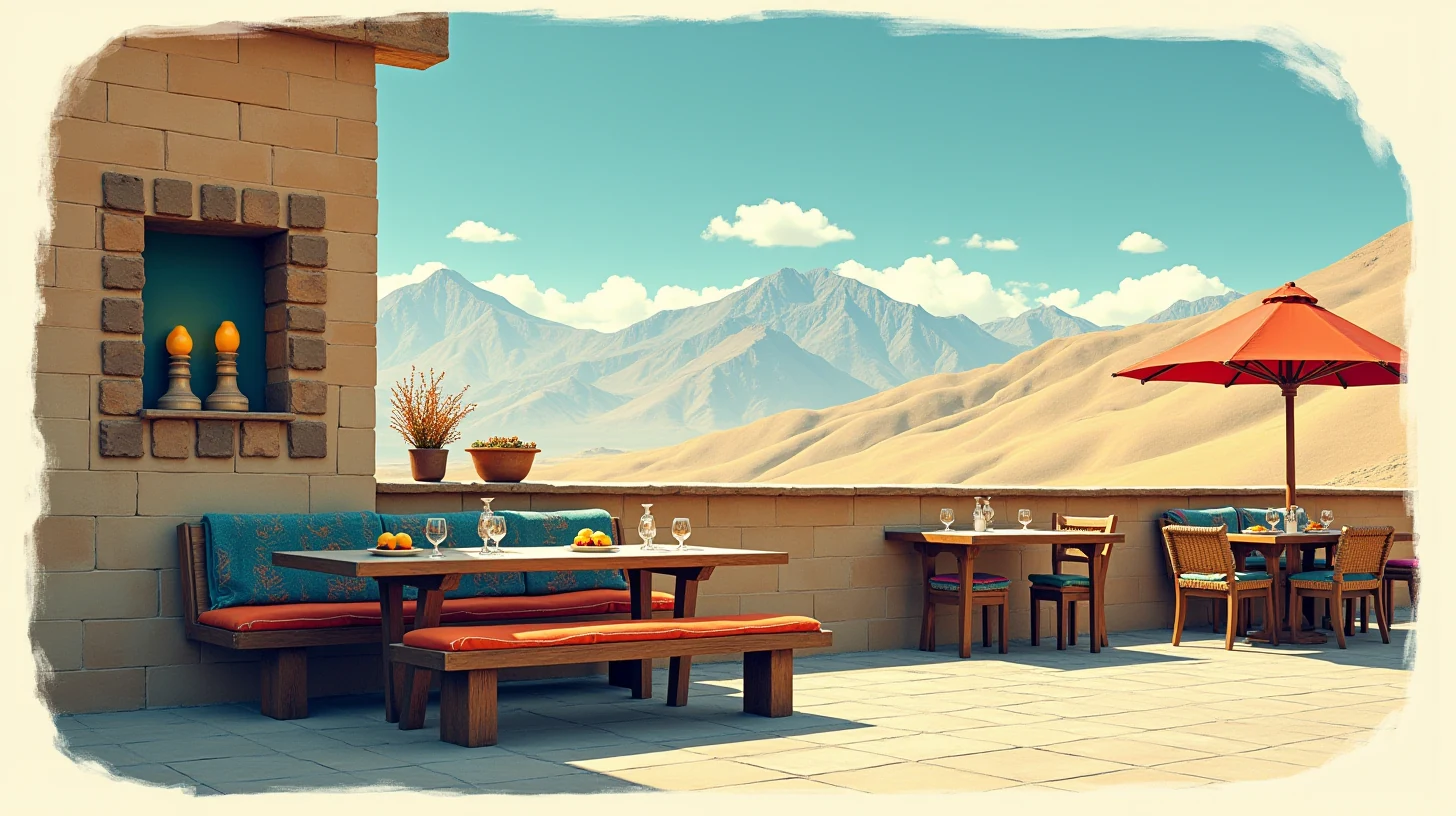
She opened it in 2014. Her husband Sonam runs a trekking operation and is on the mountain for most of the tourist season, so Stanzin runs the front-of-house herself from May through October. The kitchen is not hers alone. At its centre is Raju Thapa — forty-four, from Pokhara in Nepal, a cook who learned Tibetan cuisine in Dharamshala and Israeli-Continental in a McLeod Ganj hostel-café, and who has cooked at Namsol every season since 2018. He is joined each May by two helpers from Bihar: Santosh Kumar, twenty-nine, from Sitamarhi, who handles prep and the morning market run; and Pintu Rajak, who came for the first time in 2024. Stanzin pays Raju ₹28,000 per month, Santosh ₹14,500, Pintu ₹11,000.
In early April 2025, an envelope arrived from the Office of the Labour Commissioner, Ladakh UT. It was the first such letter, in Stanzin's eleven years of operation, that she had ever received.
🗓️ The annual ritual
When J&K was reorganised into two Union Territories in October 2019, Ladakh came directly under central administration. Enforcement of most regulations was paused during COVID. By 2023 the Ladakh administration was issuing its own framework: the Ladakh Shops and Commercial Establishments Act, 2023 replaced the older J&K Act under which most Leh businesses had originally registered. Every commercial establishment was required to re-register under Form SE-1 within eighteen months — by early 2025. Penalty for continued operation under the superseded registration: up to ₹5,000 per day. Stanzin had renewed the old J&K certificate every year as routine and had not known the framework changed. No one had written to say so.
The second requirement came from a different statute. Under the Inter-State Migrant Workmen Act, 1979 — applicable to Ladakh UT — any employer bringing workers from another state must register with the local labour department and issue each worker a Form XIII passbook. This provision had been applied loosely in Leh's tourist economy for decades. In January 2025, a UT circular changed that: establishments with three or more seasonal inter-state workers were required to file documentation and arrange eShram registration for each worker before the season began. Raju Thapa's case added a layer: as a Nepali national, he fell under the Foreigners Act, requiring annual notification to the Leh police Foreigner Registration Office. Stanzin had filed this in 2018 and 2019. Since 2020 she had not.
The third issue was the Ladakh Renewable Energy Development Agency's commercial-kitchen directive, issued March 2024: all registered food businesses must install or demonstrate a BIS IS 12933-compliant solar water heater as the primary hot-water source, or pay a ₹3,000 annual surcharge and risk exclusion from tourism-department referrals. Namsol had a gas geyser. Stanzin had never trusted solar as her only source in the cloud-prone shoulder months. She had never heard of LREDA.
The April letter referenced all three — Shops re-registration, worker documentation, LREDA kitchen directive — cross-referencing the establishment registry for follow-up. Stanzin sat with it for two days before she showed it to anyone.
⚠️ What very nearly happened
Namsol's economics are simple and unforgiving: six months of revenue — monthly peaks of ₹4.5 to ₹6 lakh in July and August — must cover the full-year cost of the space, equipment, and Stanzin's family. Outside the season, the rooftop is cold and closed.
The Labour Commissioner's letter set a compliance deadline of May 15, 2025. Raju was arriving from Pokhara on May 8. Santosh and Pintu would take the May 10 bus from Manali. Without inter-state worker documentation filed by May 15, a Labour Department inspection could prevent formal engagement of the workers — the kitchen would not open. The Shops and Establishments re-registration deadline was end of April; she was already two weeks past it. The LREDA solar-heater certificate had to be lodged by May 31 as a condition of Shops re-registration completion. Shyok Solar, the LREDA-certified Leh installer, quoted ₹38,000 for a 200-litre BIS IS 12933-compliant flat-plate system. Stanzin did not have ₹38,000 liquid in April. The season had not begun.
What very nearly happened was a Labour Department inspection in June finding three things wrong simultaneously: unregistered workers, a superseded Shops and Establishments certificate, and a kitchen without solar compliance. Combined fine range: ₹5,000 to ₹50,000. Possible closure notice. Season interrupted at its most profitable point.
- 📨
Early April 2025 — Labour Commissioner's letter arrives
Stanzin receives the UT Labour Commissioner's notice referencing three requirements: Shops & Establishments re-registration under the Ladakh 2023 Act, inter-state worker documentation for Raju, Santosh, and Pintu, and LREDA solar-heater compliance. Deadline: staggered between late April and May 31.
- ⚠️
April 25 — Shops & Establishments deadline passes
Namsol is still registered under the superseded J&K Act. The re-registration application under the Ladakh Shops and Establishments Act, 2023 (Form SE-1, ₹500 fee) has not been filed. Stanzin does not yet know the correct form or submission office.
- 🛑
May 8–10 — Seasonal staff arrive
Raju Thapa arrives from Pokhara. Santosh and Pintu arrive by bus from Manali. Without inter-state migrant worker documentation and eShram registration, their formal engagement cannot be certified. Police registration for Raju (a Nepali national) is also outstanding.
- ⚖️
May 31 — LREDA solar-heater deadline
Commercial kitchens in Leh must demonstrate BIS IS 12933-compliant solar water heating or pay the ₹3,000 annual surcharge and risk Shops & Establishments certificate suspension. Stanzin has a gas geyser. The LREDA installer quote is ₹38,000.
🌗 What changed
Stanzin's niece Yangchen — twenty-six, studying hotel management in Chandigarh, home for spring break — read the letter at the corner table and said it was, in her assessment, not a single problem but a checklist, and that some items were simpler than they looked. She had an agent on her laptop for sourcing coursework. She opened it and typed: "मेरी बुआ की Leh में एक छोटी restaurant है। उन्हें labour department का letter मिला है — Shops & Establishments re-registration, inter-state workers ke documents, और LREDA solar heater certificate। Season May में शुरू हो रहा है। क्या यह सब एक साथ हो सकता है?"
The agent replied:
"हाँ — तीनों काम अलग-अलग हैं, लेकिन एक क्रम से करने पर दो हफ़्ते में पूरे हो सकते हैं। पहले Shops & Establishments re-registration करें — Ladakh UT Labour Department का Form SE-1 भरें, ₹500 fee, Leh के Labour Office में जमा करें। यह मिलने के बाद inter-state migrant documentation file करें: हर worker के लिए Form XIII (ISMW Act के तहत), और eShram पर registration। Raju Thapa चूँकि Nepali national हैं, उनके लिए Leh police का Foreigner Registration Office notification अलग से देना होगा — यह एक दिन में होता है। LREDA solar heater के लिए: MSME Udyam registration होने पर 30% subsidy मिलती है — ₹38,000 का installation ₹26,600 में पड़ेगा।"
(Yes — the three tasks are separate, but done in sequence they can be completed in two weeks. First, file the Shops and Establishments re-registration: Form SE-1 under the Ladakh UT Labour Department, ₹500 fee, submitted at the Leh Labour Office. Once that is received, file the inter-state migrant documentation: Form XIII under the ISMW Act for each worker, and eShram registration. Since Raju Thapa is a Nepali national, a separate notification to the Leh police Foreigner Registration Office is required — this takes one day. For the LREDA solar heater: if MSME Udyam registration is in place, a 30% subsidy applies — ₹38,000 installation becomes ₹26,600.)
Stanzin read the reply twice. Then she asked Yangchen to ask about the MSME part — she had heard of Udyam but had never registered.
The agent confirmed that Namsol's annual turnover (approximately ₹28 lakh in a good season) placed it in the Micro Enterprise category; Udyam registration was free, took under thirty minutes at udyamregistration.gov.in, and required only Aadhaar and the business's GSTIN. The 30% LREDA subsidy was available to micro-enterprises under the UT's solar deployment push. The net installation cost would be approximately ₹26,600, which Shyok Solar confirmed when Stanzin called them the following day and mentioned she was a registered micro-enterprise.
Shops & Establishments
Form SE-1 + ₹500Stanzin filed Form SE-1 under the Ladakh Shops and Establishments Act, 2023 at the Leh Labour Office on April 30. The re-registration certificate arrived on May 7 — one day before Raju landed. The superseded J&K registration was formally surrendered. Fine waived on first-time re-registration.
Inter-State Worker Permits
Form XIII + eShram × 2Form XIII (ISMW Act) was filed for Santosh and Pintu. Each received an eShram registration with a Unique Registration Number, giving them portability of social security benefits across states. Raju Thapa's police FRO notification was filed on May 9 — a single-page form, processed in three hours.
LREDA Solar Heater
₹26,600 net (30% subsidy)Udyam registration was completed in April. Shyok Solar installed a 200-litre BIS IS 12933-compliant flat-plate collector on May 19. LREDA inspection certificate (Ref: LREDA/LEH/COM/2025/0417) issued May 22. Certificate lodged with Shops & Establishments file by May 27.
The kitchen opened on May 18 — two weeks after Stanzin had sat with the letter thinking it was a threat she did not know how to answer. Raju made skyu on opening day, as he always did, because skyu is what you make when something needs to feel steady again.
🧭 Why we built it
Leh's Main Bazaar has approximately 140 registered food establishments, the majority opened before the 2019 UT conversion. Most carry the ghost of the J&K administrative framework — old Shops Act registrations, old labour numbers — and no one officially told them the framework changed. The re-registration requirement is real, current, and being enforced. The communication was a letter to a registered address. Operators who were out of Leh in April missed it.
The ISMW Act, 1979 is forty-six years old. Form XIII passbooks for seasonal migrant workers were always a legal requirement. What 2024 added was enforcement — a UT circular making documentation in the tourist economy a stated priority, driven by concern for seasonal workers from Bihar and Himachal Pradesh doing twelve-hour kitchen shifts at high altitude with no portable social security and no employer of record if something goes wrong.
The LREDA solar requirement is specific to Ladakh's geography. The UT sits on some of the highest solar irradiance in India. Commercial kitchens running imported LPG when a south-facing rooftop collector can supply hot water at near-zero operating cost is a policy contradiction the administration has decided to resolve. The barrier is ₹38,000 installed at the start of a season before revenue has begun. The Udyam-LREDA subsidy chain cuts that to ₹26,600. But the chain requires knowing three things: Udyam is free, the subsidy is available to micro-enterprises, and it is applied at the point of installer billing. None of this appears in the compliance letter.
"ངའི་ཟས་ཁང་གི་ལས་མི་རྣམས་ལ་ངས་ལས་བྱ་གཏང་རྒྱུ་མིན་ གལ་ཆེ་ཞིང་། ཁོང་རྣམས་ཀྱིས་ཕྱི་རྒྱལ་ནས་འབྱོར་ཏེ་ང་ལ་རོགས་རམ་བྱེད་ཡོད། ད་ལྟ་ཡིག་ཆ་ཡོད་ན། ང་ཚོ་ཚང་མ་འཐད་ལྡན་ཡིན།"— My restaurant staff are not mine to dismiss. They come from far away to help me. Now that the paperwork exists, all of us are legitimate.
🌱 What we hope happens
The LREDA solar-water-heater system on Namsol's kitchen roof was, as it turned out, more than a compliance item. Raju noticed in late July that the morning water temperature was consistently 48 to 52 degrees Celsius without the gas geyser running — which meant the washing and prep cycle happened faster, which meant breakfast service ran cleaner. On the cloudy days of early September, the supplemental gas geyser came on automatically. The system did what it was supposed to do. It cost Stanzin ₹26,600 and she expects to recover that in LPG savings within two seasons.
Santosh's eShram registration number now travels with him. He had worked in Leh, in Shimla, and in a hotel in Rishikesh over the past four years, and had never had portable documentation. The eShram number means that when he returns to Bihar in October and needs medical care at a public hospital, his registration is visible. This is not a large thing. It is the thing that distinguishes formal from informal, and formal is what he is now.
The agent stays on Yangchen's laptop, which she has loaned to Stanzin until October. Before leaving, Yangchen will ask it to map the following year's calendar: Shops renewal, worker documentation window, LREDA annual check-in. Three dates, each with a form number and submission office.
"अगले साल की dates बताओ — Shops and Establishments renewal, workers के documents, LREDA certificate। मैं चाहती हूँ कि सब पहले से तैयार हो।"
(Tell me the dates for next year — Shops and Establishments renewal, worker documents, LREDA certificate check-in. I want everything prepared in advance.)
Stanzin wrote the dates in Ladakhi in the margin of her accounts notebook, under the column she uses for the FSSAI licence and the gas cylinder contract. Now it has three more lines.
What we hope happens is this: the next operator on Main Bazaar who receives a letter from the Labour Commissioner does not sit with it for two days. That someone — a niece home for spring break, a neighbour with a tablet — can say: this is four forms, two office visits, and one phone call to Shyok Solar, and here is the order. And that the agent reads the letter in Ladakhi and says: you have enough time, if you start today.
Namsol opened its 2025 season fully compliant for the first time in eleven years. The skyu is the same. Stok Kangri is where it has always been. The butter-lamps are in the niche. The paperwork, for once, matches the kitchen.