
The Lucknow Awadhi restaurant and the eating-house licence that almost expired
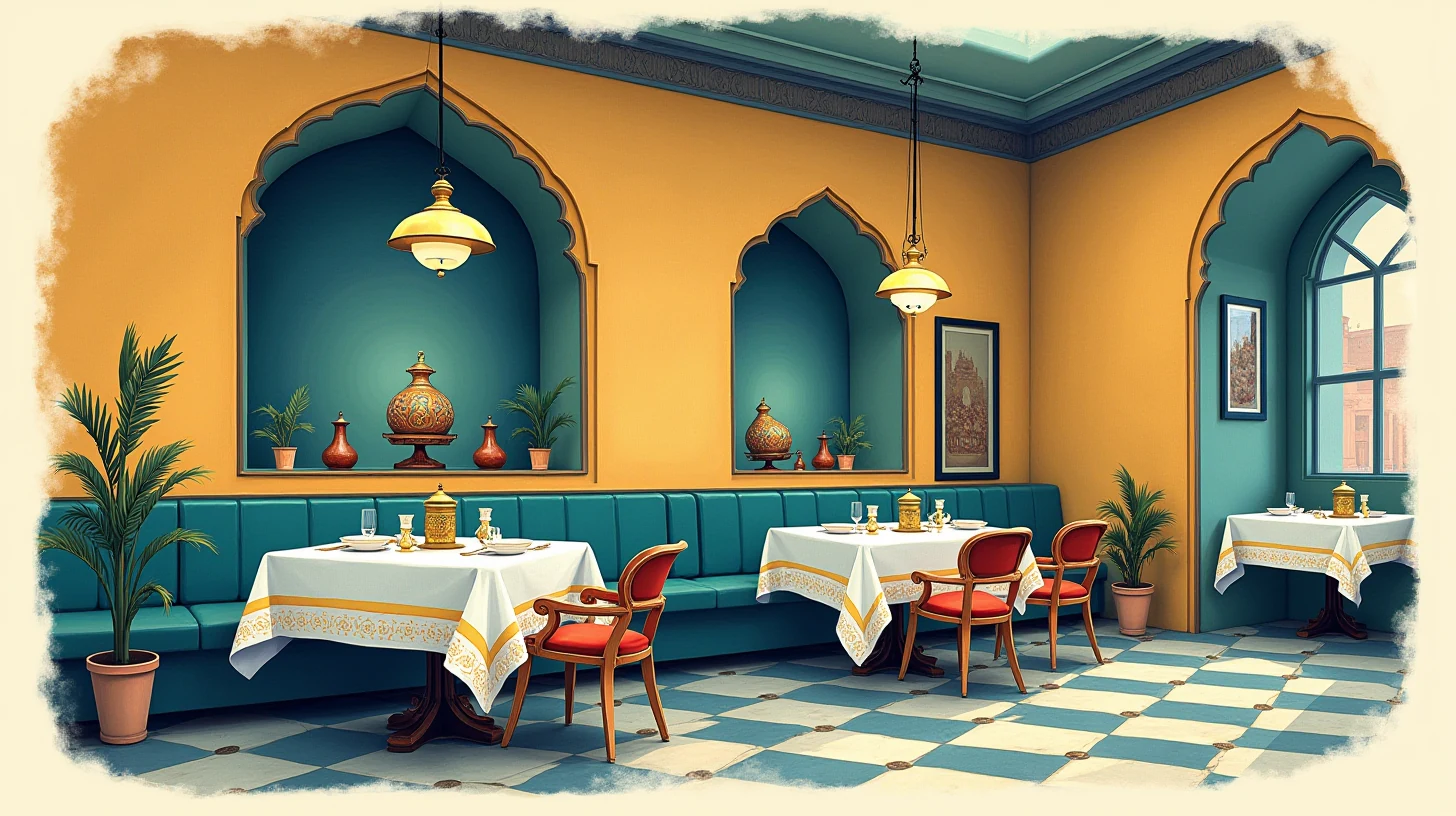
Sufia Shamsi Naqvi is forty-four years old. She runs a fifty-seat Awadhi restaurant named Sufiana Dastarkhwan in Hazratganj, Lucknow — down the lane behind the GPO where the buildings still have Lakhnawi lime-plaster arches and the evening light turns the colour of old brass. The restaurant serves galouti kebab, kakori seekh, mutton biryani cooked on dum in sealed handis, sheermal from a small tandoor she rebuilt after the 2022 floods, and a kulfi from a condensed-milk recipe her mother-in-law wrote in Urdu and which Sufia keeps laminated above the cold-storage unit. She opened in 2018 with ₹14 lakh, employs four people — Rafiq the head cook, two kitchen assistants, and Neha the server — and turns over between ₹3.2 lakh and ₹4.8 lakh a month. Her accountant Arun Mishra-ji, on Mahatma Gandhi Marg, handles her GST returns quarterly and, until February 2025, had also been managing her municipal compliance calendar.
The trouble arrived not in a single letter but across eleven days, when four unrelated things happened and none of them were good.
🗓️ The eating-house licence and the rhythm no one explained
The Lucknow Nagar Nigam requires every food establishment within its limits to hold a current eating-house licence, renewed annually before its expiry date. Sufia had first obtained the licence in 2018, when a consultant handled the paperwork for ₹8,000 and delivered the framed certificate to her door. She had renewed it herself in 2019 and 2020. In 2021 the postal notice failed to arrive — possibly delivered to the dry-goods store two doors down whose owner had the same name on his signboard — and she missed the deadline. A Nagar Nigam inspector found the lapsed certificate in January 2022 and issued a penalty of ₹3,500. She paid and renewed and resolved to be more careful.
By 2024, renewal had moved to the Nagar Nigam's online portal under a login Arun-ji had created using his own office email address. The 2024–25 renewal notice arrived in that inbox during the week Arun-ji was hospitalised with a kidney stone. His clerk moved it to a folder marked client renewals and intended to mention it on his return. The intent dissolved in the March GST rush.
The eating-house licence expired on 14 February 2025.
- ⚖️
14 February — Eating-house licence expires
The Lucknow Nagar Nigam eating-house licence lapsed on its anniversary date with no reminder reaching Sufia. Operating without a current licence exposed the restaurant to a closure notice during the Nagar Nigam's first-quarter inspection sweep.
- 📨
17 February — UPPCB consent notice arrives
A notice from the Uttar Pradesh Pollution Control Board cited the tandoor and charcoal kebab grill as sources of particulate emissions requiring a renewed Consent to Operate under the Air Act. The notice gave thirty days to respond.
- 📋
20 February — Corporate clients request Halal documentation
Three corporate accounts in Gomti Nagar emailed simultaneously for a Halal certification document before the next billing cycle. Sufia did not know whether this was a government requirement or a private one.
- 🛑
25 February — GST rate error surfaces
Arun-ji reviewing the January GSTR-3B found the restaurant had been charging 18% GST on dine-in orders, when the applicable rate for a standalone restaurant not attached to a hotel is 5%. Overcollection across four months: approximately ₹28,600.
⚠️ What very nearly happened
Sufia placed the UPPCB notice on the desk in her back-office alcove, beside the framed Urdu calligraphy of a verse whose meaning she knows — adab pehla qaida hai — and felt the particular heaviness of a person who runs a business alone and has just been handed four problems by a fortnight with no particular reason to be unkind.
The eating-house licence lapse was the most immediately dangerous. The Nagar Nigam's inspection cycle for commercial establishments in Hazratganj runs in the first quarter, and a closure notice issued by an inspector who found the lapsed certificate would take between ten and twenty-one days to reverse. Twenty-one days of closure during the February–March wedding season, when catering orders run heaviest, would cost Sufia between ₹1.8 lakh and ₹2.3 lakh in cancelled bookings alone.
The GST error was more quietly corrosive. Arun-ji's billing software had been configured under the hotel-restaurant category — the one carrying 18% with input tax credit — because Sufiana Dastarkhwan has a single window air-conditioner. It is not a hotel restaurant. The correct rate is 5%, with no input tax credit. Reversing ₹28,600 in overcollected tax required a GSTR-1 amendment and would attract scrutiny proportionate to the size of the correction.
"جتنے کاغذ، اتنی مشکل — کاغذ بنانے والوں نے کبھی ہوٹل نہیں چلایا۔"— So many papers, so much difficulty — the people who make these papers have never run a restaurant.
The Halal certification emails were the least urgent — but the most likely to paralyse her without a quick answer. Rafiq purchased meat only from the Aminabad market, from a supplier whose Qazi certification she had seen on the butcher shop wall for years. What she did not know was whether that informal assurance translated into any document a corporate procurement officer in Gomti Nagar would accept, or whether there was a government certification she had missed. The UPPCB consent, by contrast, she understood in structure: smoke, form, fee, thirty-day window. It was at least legible.
🌗 What changed
Her daughter Zara — twenty-two, studying at Lucknow University — had been using an AI assistant for semester coursework and had shown it to Sufia twice before, on occasions when Sufia had nodded and not retained much. On the evening of 25 February, with the four pieces of paper spread on the back-office desk, Zara sat down and opened the agent on her tablet.
She typed, in Hindi: "Amma ki Lucknow mein ek Awadhi restaurant hai — Hazratganj mein, fifty seats. Abhi chaar problems ek saath aa gayi hain — eating house licence lapse, UPPCB consent notice, GST rate galat lagi, aur corporate clients Halal certification maang rahe hain. Kahan se shuru karein?"
The agent replied:
"Pehle eating-house licence — yeh Lucknow Nagar Nigam ka licence hai jo har saal renew hota hai. Agar lapse hua hai toh inspection mein band ho sakti hai dukaan, isliye yeh sabse pehle. Doosra, UPPCB consent — notice mein 30 din diye hain, urgent hai lekin eating house licence ke baad. Teesra, GST correction — Arun-ji se is hafte milein, GSTR-1 amendment file ho sakti hai. Aur Halal — yeh government document nahin hai. Private voluntary standard hai — HALAL INDIA ya Jamiat Ulama jaise private bodies deti hain. Corporate clients ne maanga hai toh private certification lein; sarkar ki taraf se koi mandatory requirement nahin hai."
(Start with the eating-house licence — it is the Lucknow Nagar Nigam licence renewed every year; a lapsed licence means the restaurant can be shut in an inspection. Second, the UPPCB consent — thirty days, urgent but after the licence. Third, the GST correction — meet Arun-ji this week; a GSTR-1 amendment can be filed. And Halal — this is not a government document. It is a private voluntary standard issued by bodies like HALAL INDIA or Jamiat Ulama. The corporate clients want a private certification; the government mandates nothing.)
Sufia read the Hindi herself, then said: "Toh sarkar se kuch nahin chahiye Halal ke liye?" — So the government requires nothing for Halal? The agent confirmed: under Indian food law, halal is not a mandatory government classification; it is a voluntary mark from private certification bodies, some internationally recognised. A basic certificate for a restaurant of her size would cost ₹8,000–₹15,000, renewable annually. Sufia exhaled for what felt like the first time since 17 February.
What it does
- 🔍Identified the UPPCB regional office in Lucknow for the Air Consent to Operate application and flagged the thirty-day response deadline
- 🗂️Clarified that Halal certification is a private voluntary standard, not a government mandate, and named the active certification bodies in Uttar Pradesh
- ⚖️Confirmed the 5% GST rate for a standalone restaurant and identified the specific months requiring a GSTR-1 amendment
- 📞Calculated the penalty accrual on the lapsed eating-house licence and located the Lucknow Nagar Nigam civic portal for online renewal
What it does not do
- 🔒Never logged into the Nagar Nigam or UPPCB portals — all submissions required Sufia's confirmation and Arun-ji's credentials
- ✅Did not choose a Halal certification body — cost, client preference, and renewal logistics were Sufia's decision
- 💳Did not file the GST amendment — that required Arun-ji's DSC and professional judgement on the correction method
Arun-ji, reached the next morning, confirmed the rate error and filed the GSTR-1 amendment for January and the preceding three months within the week. The ₹28,600 overcollection would be adjusted against forward liability over two quarters — less clean than a refund, Arun-ji said, but the safer correction path at this scale. His fee for the work was ₹4,200.
The eating-house licence renewal required two visits to the Nagar Nigam civic centre on Parivartan Chowk — application on the first visit, collection of the renewed certificate eleven days later — at a total cost of ₹1,800 in renewal fees and ₹2,600 in lapse penalty: ₹4,400, paid at the counter on 4 March. The inspector scheduled for a routine Hazratganj sweep passed the restaurant on 7 March. The certificate on the wall was current.
🧭 Why we built it
There are, by official FSSAI estimates, over 1.1 lakh registered food businesses in Uttar Pradesh. The majority are single-operator establishments whose owners learned to cook before they learned to navigate a government portal, and who manage every compliance cycle through a single accountant handling forty other clients with their own deadlines.
The eating-house licence problem is structurally identical to every other annual-deadline compliance: the deadline arrives through a channel the operator does not reliably monitor, the penalty is real, and the renewal — though not technically difficult — requires undivided administrative attention that a restaurant running lunch service at noon on a Tuesday does not have.
The Halal confusion is a different shape but the same root: not knowing which problems are government obligations and which are private market preferences in official language. Three emails from corporate procurement officers asking for a "Halal certification document" look indistinguishable from a government notice until someone who knows the difference explains it.
The agent's most useful act in Sufia's fortnight was a sorting. It took four problems, named the urgency of each, and told her which one was noise. In the context of enterprise software, unremarkable. In the context of a fifty-seat restaurant in Hazratganj run by one person with four compliance clocks ticking simultaneously, it was the difference between a fortnight of paralysis and a fortnight of action.
🌱 What we hope happens
By the end of March 2025, the eating-house licence was renewed and on the wall. The UPPCB consent-to-operate application had been submitted through the regional office on Vibhuti Khand with a maintenance log for the tandoor filter that Rafiq had been keeping for years — it was simply his habit, to note the charcoal load and cleaning schedule in a small notebook in the kitchen drawer — without ever knowing it would serve a regulatory purpose. The consent was granted six weeks later. The GST amendment was filed. The Halal certification from a Lucknow-based accredited body cost ₹11,500 and took three weeks; the Gomti Nagar corporate clients resumed their weekly lunch orders.
Sufia's Udyam registration, done in 2020 and never updated to reflect current turnover, had contributed to a working capital loan rejection in 2024 that she had attributed to bad timing. The agent flagged the stale registration when she mentioned the loan in passing. An updated Udyam filing is scheduled for the next quarter. It will not recover the 2024 loan. It may prevent the next rejection on the same grounds.
The agent now sends Sufia a monthly compliance summary: FSSAI renewal date, eating-house licence anniversary, UPPCB consent expiry, ESIC contribution due. Four lines, in Hindi, on Zara's tablet forwarded to her phone. She reads it standing beside the cold-storage unit next to the laminated recipe in Urdu, while the kulfi sets and the city outside is briefly, before the lunch rush, quiet.
"یہ کاغذ کی دنیا ہے — اگر کوئی یاد دلائے، تو کام چل جاتا ہے۔"— This is a world of papers — if someone reminds you, the work gets done.
There is a verse Sufia cannot recite from memory but whose meaning she knows. Adab pehla qaida hai — courtesy is the first principle. She means it, in the context of her restaurant, as an instruction about how to treat guests. But in the months since February 2025 she has come to think it applies equally to the relationship between a small business and its paperwork: you do not fight the forms, you do not ignore them. You learn what they need, you prepare, and you show up when the window is open. Courtesy, in that sense, is simply being ready. The agent helps her be ready. The rest — the galouti, the sheermal, the brass surai on every table — she has always known how to do herself.