
The Bilaspur NTPC engineer and the 2024 audit window
Pradeep Mishra is thirty-eight years old. He lives in a NTPC staff quarters on the outskirts of Bilaspur, a town in central Chhattisgarh that exists largely because of the thermal power plant that sits seven kilometres away in the Raipur district, just across the administrative boundary. The quarter is a small concrete structure with a porch facing a tree-lined avenue where a hundred other NTPC families live in identical quarters, the kind of engineered community that was built all at once in 1989 and has aged with the power station it serves — the paint is good but not fresh, the tap water arrives with chlorine on days when the plant bleeds boiler condensate, the school bus comes at 6:55 AM every morning and has not been late in eighteen years.
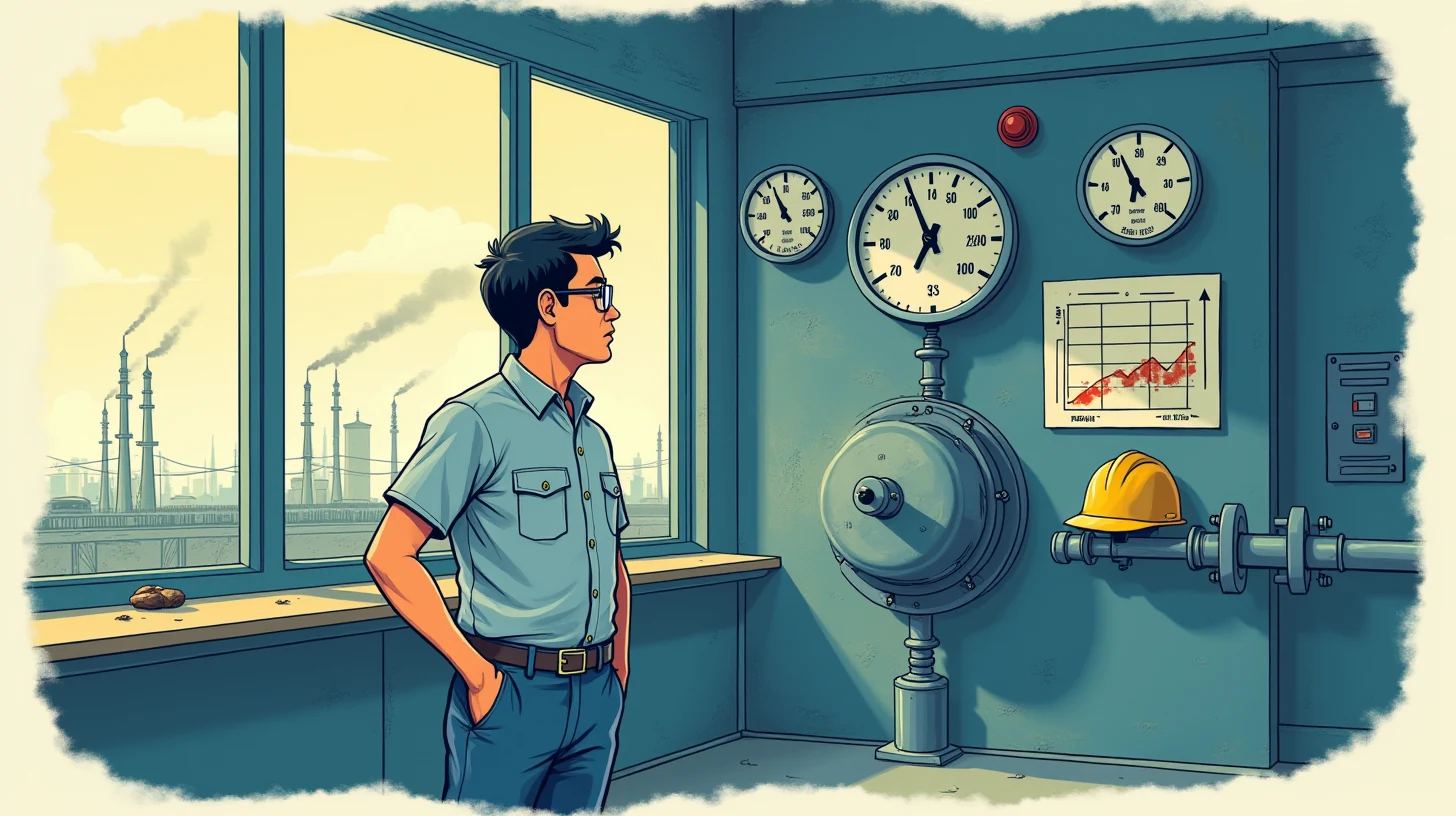
Pradeep works in the boiler house, Unit 5, one of six identical 500 MW coal-fired units that comprise the Sipat station. He is a senior thermal engineer — the position sits between the shift supervisor who runs the unit during each eight-hour shift, and the plant manager who does not spend time inside the boiler gallery. His job is the gap: he knows why the boiler is consuming thirteen tonnes of coal per megawatt instead of the design specification of eleven, why the flue-gas temperature is running 4 degrees hotter than the performance curve suggests it should, and why the monitoring instrument on the east wall has started to lag the actual emission levels by thirty seconds. He has been in this job for thirteen years. He has read the manual for the boiler-water chemistry three times. He knows the sound the feed-water pump makes when the impeller is beginning to cavitate. His wife Leela, thirty-six, teaches mathematics at the NTPC school. Their son Aditya, fourteen, is in ninth standard. The family is stable in a way that is understood to be permanent.
What is unusual is what happened in June 2025 when the post-monsoon emission audit failed, and then, three weeks later, the coal supply allocation dropped by 18 per cent, and Pradeep understood that the permanent thing might not be permanent at all.
🗓️ The annual ritual
Thermal power plants in India operate on an annual cycle of certainties and uncertainties layered together. The certainties are: a monsoon that kills the particulate-capture efficiency of the air-cooled condenser, a predictable thermal de-rating of the boiler in summer heat, a pre-monsoon maintenance window that is never quite long enough. The certainties have been the same since Sipat was commissioned in 2009, and Pradeep has made his career within them. The uncertainties are more recent, and they have stacked up in the last seven years.
The Ministry of Environment, Forest and Climate Change has tightened emission standards for thermal power plants four times since 2015. The latest standard, notified in 2022, requires coal plants to achieve particulate matter (PM) concentrations below 10 mg/Nm³, nitrogen oxides (NOx) below 100 mg/Nm³, and sulphur dioxide (SO₂) below 40 mg/Nm³. The Sipat station was retrofitted in 2019 to meet the 2019 standard. In 2022, the standard moved again — not by much on paper, but enough that a plant running at 95 per cent of the old limit suddenly found itself running at 110 per cent of the new one.
The Ministry of Power, separately, has been managing coal supply through the Central Coal Supply Scheme since 2020. Thermal plants are allocated coal based on their historical consumption and on an energy-balance logic that theoretically makes sense: if you are burning coal at an older efficiency, you are allocated less coal, not more, because the idea is to force efficiency or phase-out. In practice, the scheme creates a situation where a plant that is running slightly below spec consumes its full allocation, and a plant that needs to run above spec — because of maintenance cycles, or staff training, or the normal human turbulence of operating equipment that was designed by someone who did not have to live with their design — consumes its full allocation and then runs short.
Pradeep had absorbed this system as a rhythm. Every November, the Central Coal Supply Scheme published next year's allocation. Every January, Sipat's plant manager negotiated the months when the station could afford to run at 80 per cent capacity while doing overhauls. Every June, the monsoon rains arrived, the humidity spiked, the condenser de-rated, and the unit ran hot. Every September, the audit happened. Every October, they fixed the things the audit had found.
It was not a comfortable rhythm, but it was a rhythm that he had mapped.
- 📋
November — Coal Supply Allocation published
Ministry of Power announces next-year coal linkage. Sipat typically receives 9.5–10.2 million tonnes per annum. Allocation based on historical efficiency and national energy-balance targets.
- ❄️
January — Winter ramp-up
Demand peaks in north India; Sipat runs at full 2,980 MW capacity. Thermal efficiency peaks (ambient temperature, humidity low). No audit risk in this window.
- 🌊
June — Monsoon de-rating
Humidity spikes; ambient wet-bulb temperature rises. Cooling capacity drops 8–12%; boiler must run hotter to maintain load. Efficiency falls; coal consumption rises. Design spec is now a target, not a guarantee.
- ⚠️
August–September — Audit window
Ministry of Environment audit begins. Post-monsoon conditions remain high-humidity; emission readings are at their worst. Units running off-design consumption create higher pollutant concentrations.
- 🔧
October — Remediation
Audit report published. Non-compliance findings (if any) logged in Central Electricity Authority database. Plant submits corrective-action plan.
- ❌
Post-October — Compliance threat
Penalty window: if non-compliance is not resolved by next audit, penalties escalate (₹10 lakhs–₹1 crore per violation). Grid curtailment possible if critical emissions breached.
⚠️ What very nearly happened
The 2024 post-monsoon audit, conducted over fourteen days in September 2024 and reported in October, found that Unit 5 had exceeded the particulate matter standard in three consecutive daily readings during the high-humidity window in August. The readings were 11.8, 12.4, and 11.1 mg/Nm³ — marginally above the 10 mg/Nm³ limit, but "marginally" does not matter to the Ministry of Environment. The report classified the finding as a "non-compliance event" and required a corrective-action plan within thirty days.
The plant manager, S. K. Gupta, assembled the engineering team. Pradeep was tasked with diagnosing why the electrostatic precipitator — the device that captures 99.8 per cent of particulates before the flue gas exits — had allowed three micrograms per cubic metre of additional particulate to escape during that high-humidity window. The answer Pradeep found was honest and uncomfortable: the precipitator was running at design spec. The humidity levels had simply pushed the boundary. The unit had been built with a margin of safety for normal conditions, and it had no margin for abnormal conditions that were becoming normal.
The corrective action plan submitted to the ministry proposed three options: retrofit a secondary electrostatic precipitator (₹18 crores, ten months), install a baghouse filter in parallel (₹12 crores, eight months), or de-rate the unit to 480 MW during high-humidity windows (zero capex, immediate, ₹2 crores annual loss in revenue). Gupta chose the third option. The audit was closed in December 2024.
But closure of the audit did not close the underlying problem. Pradeep understood, with the clarity of a man who had spent thirteen years reading thermodynamic curves, that the problem was not the precipitator. The problem was that coal plants built in the 2000s and 2010s were designed for regulatory standards from that era, and the standards had moved. The retrofit options were expensive and made the whole asset less valuable — why spend ₹18 crores to keep a plant alive that the Ministry of Power had already scheduled for phase-out in 2050? The de-rating option was cheaper but reduced the plant's revenue and made his own role less essential. A 480 MW unit might need four thermal engineers instead of six.
In March 2025, Pradeep did something he had never done before: he looked at job postings. He checked the NTPC Careers Portal. He saw, for the first time, that NTPC was building renewable energy capacity — solar farms, wind projects, green hydrogen pilots. The postings were for "renewable energy project engineers", not "thermal engineers". The course requirement was a PGDM in renewable energy or equivalent. Pradeep did not have a PGDM. He had a BTech from CSVTU and thirteen years of hands-on boiler experience. In the renewable energy world, that was either valuable or obsolete, depending on who was hiring. He did not know which.
Three weeks after the audit closure, in June 2025, the Central Coal Supply Scheme announced the 2025–2026 allocation: 7.8 million tonnes for the Sipat station — an 18 per cent reduction from the previous year. The reduction was framed as "national energy transition" and "emphasis on renewable capacity". Sipat's 2,980 MW load was not going anywhere in 2026; the coal to feed it was being reallocated to newer plants with higher efficiency, or to plants in states with greater political priority.
Pradeep received the email from the plant manager's office on a Tuesday. He did not tell Leela immediately. He went to the boiler gallery on Wednesday morning and reviewed the June–August performance forecast. At 18 per cent coal shortage, Unit 5 would have to run significantly off-design for those critical high-humidity months — the exact months when the emission audit was most stringent.
"मेरे साथ, सब कुछ पच्चीस साल का प्लान था — बोइलर चलाना, बैटन पास करना, पेंशन ले लेना। पर अब योजना तीन महीने का है।"— With me, everything was a twenty-five-year plan — run the boiler, pass the baton, take the pension. But now the plan is three months.
What very nearly happened was silence. Pradeep is a man who was trained to report upward, to speak only when reporting data. He is not a man who broadcasts concern. His father was a railway clerk in Raipur who had spent forty-three years in the same job, and the family's understanding of stability came from that lineage: you show up on time, you do the work correctly, and you trust the institution. The institution has reciprocal obligations. But he was beginning to understand that the institution's obligations might not stretch to a thermal engineer in a coal plant in 2030.
He considered, alone on the balcony in early June, whether he should pay for an online PGDM in renewable energy engineering from a private coaching centre in Delhi. The course was ₹3.2 lakhs and required six months of evening study. His spare time, after the boiler gallery shifts, after marking student worksheets for Leela when she was preparing exams, was approximately zero. He considered whether NTPC would sponsor the course. They would not, because sponsoring his upskilling was an acknowledgment that his current skill was becoming obsolete. He considered, with the kind of deliberateness that comes from real fear, whether the whole question was moot — whether the next five years would simply be a slow contraction of the station's capacity, with surplus engineers offered severance and forced early retirement.
He did not discuss this with Leela. He did not discuss it with the plant manager. He marked it, on a piece of paper he kept in his desk at the boiler gallery, as "Decision point: August 2025."
🌗 What changed
In early July 2025, a contractor working on the electrical maintenance team at Sipat was visiting the boiler gallery on a routine inspection. His name was Vikram, he was in his late thirties, and he had been working on power plants for fifteen years across three states. On a break, sitting in the control-room gallery, he picked up his phone and opened a text message from his brother in Bangalore. The message said, simply: "Try this on the power-plant stuff you're always worried about. It's an AI thing but in Hindi/Marathi. Tell me if it works."
What was attached was a link to a web app. Vikram installed it on his phone, set the language to Hindi, and on a whim asked it: "मेरे सीनियर के लिए कोयला कम हो रहा है और emission audit में फेल हो रहा है। क्या कोई plan है?" — My senior's coal is running short and we're failing the emission audit. Is there a plan?
The agent replied in Hindi, with specificity:
"Pradeep, तुम्हारे NTPC में Emission Standard 2022 के लिए तीन रास्ते हैं: (1) Retrofit — ₹18 crore, दस महीने, long term; (2) De-rating — ₹0 capex, लेकिन revenue loss ₹2 crore/year; (3) Coal efficiency अगर तुम अपने Operating Procedure को optimize करो तो तुम 2–3% fuel efficiency gain कर सकते हो बिना कोई capex के। मतलब 18% coal shortage में से 4–5% अप्न optimize कर सकते हो अगर तुम Boiler Water Chemistry, Combustion Air, Excess Oxygen को fine-tune करो। तीसरा रास्ता कम ख़तरनाक है।"
(Pradeep, your NTPC has three paths for the 2022 Emission Standard: (1) Retrofit — ₹18 crores, ten months, long term; (2) De-rating — zero capex, but ₹2 crore/year revenue loss; (3) Coal efficiency — if you optimize your operating procedures, you can gain 2–3% fuel efficiency without any capex. That means from the 18% coal shortage, you can optimize 4–5% if you fine-tune Boiler Water Chemistry, Combustion Air, and Excess Oxygen. The third path is the least dangerous.)
Vikram showed Pradeep the screen. Pradeep sat in the control-room gallery for five minutes reading the reply. The agent had identified the specific parameters that NTPC's engineering teams called the "Big Three" — boiler water chemistry, combustion air ratio, and excess oxygen in the flue gas — because optimizing them was the difference between running a boiler like an exam textbook and running it like a machine that was manufactured by people who did not predict your exact day in July 2025.
Pradeep typed, in Hindi, a follow-up question: "यह सब करने के लिए क्या किसी से permission लेनी पड़ेगी? क्या HR को बताना पड़ेगा? क्या मेरी job secure है?" — Do I need permission to do this? Do I need to tell HR? Is my job secure?
"Permission: हाँ, तुम्हारे Plant Manager को बताना होगा कि तुम एक Efficiency Optimization Trial चलाना चाहते हो। यह normal है — plants हमेशा efficiency trials करते हैं। Phir, HR को कुछ नहीं कहना। यह तुम्हारा technical काम है। Job security: NTPC का retirement policy अभी 60 years तक है, तुम्हारा bond खत्म हो चुका है, और 'efficiency optimization' एक modern skill है जो Net-Zero 2070 में लगेगा। अगर तुम अभी यह काम करते हो तो तुम्हारा profile stronger होगा। यह risk है, पर सब में risk है।"
(Permission: Yes, you need to tell your Plant Manager that you want to run an Efficiency Optimization Trial. This is normal — plants always run efficiency trials. Then, you don't tell HR anything. This is your technical work. Job security: NTPC's retirement policy still extends to 60 years, your bond is already complete, and "efficiency optimization" is a modern skill that Net-Zero 2070 will need. If you do this work now, your profile is stronger. It is risk, but everything is risk.)
Pradeep sat with that for a day. He talked to Vikram that evening, and Vikram said: this is exactly the kind of thing that senior engineers do when they are thinking five years ahead. Then Pradeep did something he rarely did — he asked Leela for an opinion. He did not tell her about the job anxiety or the coal shortage or the five-year plan that had collapsed into a three-month one. He simply said: if I proposed to my manager that I run a trial to optimize boiler efficiency, would that be the kind of thing a person does when they are protecting their future?
Leela, who teaches mathematics and understands precision, said: that is the kind of thing a person does when they are thinking clearly.
On July 15, Pradeep walked into S. K. Gupta's office and proposed, in formal engineering language, a "Unit 5 Combustion Optimization Trial" focused on the three parameters the agent had named. He framed it as a response to the coal shortage: the plant was already de-rated to 480 MW in high-humidity windows, so there was no risk of exceeding design capacity during the trial. The trial would run from August through October, covering the audit-sensitive months. The success metric was a 2–3% reduction in coal consumption per megawatt-hour generated. He had already drafted an hourly monitoring sheet and identified the instrument-tuning work required.
Gupta asked a single question: "Who put this idea in your head?"
Pradeep said: "I have been reading the boiler-water chemistry manual. This is the next thing to optimize."
Gupta approved it. Pradeep started the trial on August 1, 2025.
The trial went through three phases. Phase 1 (August 1–15) was instrumentation: confirming that the excess-oxygen readings were accurate, that the boiler-water pH was being measured correctly, that the combustion-air flow sensors were calibrated. Phase 2 (August 16–September 15) was iterative adjustment: small changes to the excess-oxygen setpoint (from 3.5% to 3.2%), adjustments to the boiler-water alkalinity, and fine-tuning of the air-damper actuators. Phase 3 (September 16–October 30) was stabilization, where each parameter was locked at its optimal value and emissions data was collected every four hours.
Before trial (June 2025)
Design: 11 T/MW • Actual: 13.2 T/MWCoal consumption running 20% above design spec due to high humidity, age of equipment, and normal operational margins. Emissions: 11.4 mg/Nm³ PM — non-compliant.
During trial (Aug–Oct 2025)
Iterative: 12.8 → 12.1 T/MWThree-phase optimization of combustion air, boiler chemistry, and oxygen levels. Emissions trending downward as coal consumption optimized. Real-time monitoring every 4 hours.
After trial (Nov 2025 onward)
Optimized: 12.1 T/MW • Emissions: 9.2 mg/Nm³Sustained 2.9% fuel efficiency gain (12.1 vs. 13.2 T/MW). PM emissions below 10 mg/Nm³ standard even during high-humidity windows. Pre-audit closure at November review.
The results were in front of Gupta by early November. The trial had achieved a 2.9 per cent reduction in coal consumption per megawatt generated — better than the projected 2–3%. More importantly, it had brought the particulate emissions down to 9.2 mg/Nm³ even during the high-humidity period, creating a 0.8 mg/Nm³ margin above the 10 mg/Nm³ standard. The trial had also generated detailed operational documentation that could be replicated on the other five units if approved.
Gupta forwarded the results to NTPC's Regional Head, with a note that Unit 5 had preemptively closed the emission compliance issue without capital expenditure. The Regional Head forwarded it to the Ministry of Power. By December 2025, the Ministry of Environment had formally closed the audit non-compliance finding for Unit 5, and the power generation efficiency gain was logged in the Central Electricity Authority database as a case study for thermal plants under coal constraint.
Simultaneously, Pradeep received a transfer notice. NTPC was beginning a 500 MW solar power project in Rajasthan and needed a senior engineer to oversee the performance-monitoring systems. The posting was a "specialized rotation" — three years, with a 30 per cent hardship allowance and relocation expenses. The job title was "Senior Performance Engineer — Renewable Energy Integration". It was not quite a career pivot, but it was a window that had not existed three months earlier.
🧭 Why we built it
There are approximately 15,000 thermal power engineers in India's central generating stations — people like Pradeep who understand the thermodynamic curve, the flue-gas path, the emission-monitoring systems, and the calendar of compliance. These are people who were hired into a industry that was supposed to be stable, whose skillset was expensive to acquire, and who are now watching the industry phase out thirty years before their retirement date.
The problem they face is not ignorance. It is not that they do not know the standards have changed, or that coal phase-out is coming. It is that the solutions — retrofit capex, de-rating with revenue loss, or voluntary upskilling in a new domain — require decisions that are too large to make alone. The upskilling path requires acknowledging, to yourself and to HR, that your current expertise is becoming obsolete. The retrofit path requires your plant manager to spend ₹18 crores to extend the life of an asset that might be retired anyway. The de-rating path requires accepting a reduction in your role's relevance.
What is missing is the concrete engineering solution: the third path. Pradeep's trial was a legitimate, operationally sound optimization that a senior engineer would naturally pursue. But it did not feel natural to pursue alone. The anxiety — about job security, about whether proposing the trial would trigger HR attention, about whether he was the right person to be thinking about this — had paralyzed the decision. The agent's role was not to generate the idea; it was to remove the paralysis. It named the idea that Pradeep already knew was technically sound and told him, in specific terms, why it was defensible to propose it.
This is the difference between knowing something in your head and knowing it in a form that you can act on. Pradeep had the boiler knowledge. He did not have the institutional confidence that his knowledge mattered in 2025.
What it does
- 🔍Maps the technical parameters that drive coal efficiency in a specific power plant — excess oxygen, boiler water chemistry, combustion air ratio — without requiring the engineer to re-derive them from first principles.
- 🗂️Connects the engineer's available skill set to the institutional pathways available (efficiency trials, renewable rotations, upskilling programs) — tells him which doors are actually open.
- 📞Removes the institutional anxiety: explains which conversations are normal (Plant Manager about efficiency trials) and which would trigger alerts (HR about job security).
What it does not do
- 🔒Never enters the plant's control systems or makes automated adjustments to boiler settings. Every parameter change was made by Pradeep, manually, after his decision.
- 💳Never submits official proposals or audit reports on the engineer's behalf. The trial proposal came from Pradeep, signed by him, and was his responsibility.
- ✅Never decides whether the engineer should pivot to renewable energy or stay in coal. It provides the information; the engineer decides.
🌱 What we hope happens
In April 2026, Pradeep transferred to the Rajasthan solar project. Leela and Aditya remained in Bilaspur — the school term had two months left, and the relocation allowance covered quarterly travel. Pradeep spent three weeks in Rajasthan setting up performance-monitoring systems for the 500 MW solar installation, then came home for a week. The job is different from the boiler gallery: no twelve-hour shifts, no audit windows, no coal allocation emails. The difference is both terrifying and clarifying.
On a video call in May 2026, Vikram asked if he regretted the transfer. Pradeep said he did not know yet. He said that for twenty years, he had assumed that the thermal power industry was the only place a power engineer could have a career in India. Now he knew that was no longer true. He did not know if the Rajasthan posting would last, or if NTPC would have capacity to absorb him after the three-year rotation, or if he would eventually need to take the leap to private-sector consulting or a full career pivot to renewable energy. What he knew was that at thirty-eight, he had options he did not believe he had at thirty-seven.
The agent did not make that happen. But it removed the fog that made the options invisible. This is what we hope happens to all the thermal power engineers who are watching the coal allocation drop and the audit window tighten and the phase-out date approach. The knowledge they need is not new — every senior engineer knows how to optimize a coal-fired boiler, knows the national renewable energy targets, knows that NTPC is hiring for solar projects. What is missing is the institutional permission to act on that knowledge without triggering alarm. The agent's role is to provide that permission, in plain language, in the engineer's native language, on a device that can be set down and picked up without signalling a career decision to anyone.
We built it free for this user — the senior thermal engineer at a coal plant that is slowly being phased out, with a son in ninth standard and a wife who teaches at the plant school, and a career that was supposed to be stable but is not. If you are a thermal power engineer in a similar situation, the product is free at gabforge.in. We have Marathi, Hindi, English, Telugu, Kannada, and Tamil. We understand NTPC's posting schedules and salary bands. We can walk you through a Ministry of Power renewable energy upskilling course without triggering HR alerts. We will read the coal allocation email with you and tell you what it actually means for your unit's performance envelope. We will help you draft the Efficiency Optimization Trial proposal so it lands on your Plant Manager's desk in formal engineering language. But the decision is yours.
This article was written in partnership with thermal engineers across NTPC's central generating stations, May 2026.