
The Chandigarh engineer and the family's Toronto exit plan
Rajesh Kumar is thirty-two years old. He lives in Chandigarh, in a ground-floor flat on the outer rim of Sector 49 — the kind of neighbourhood where the roads still have names rather than numbers, and the Chandigarh Development Authority's grand circle still reads as unfulfilled promise. The flat is half his, half a financial commitment he and his wife Meera are still meeting. The builder promised completion by 2023. It is now 2026, and Rajesh has stopped asking.
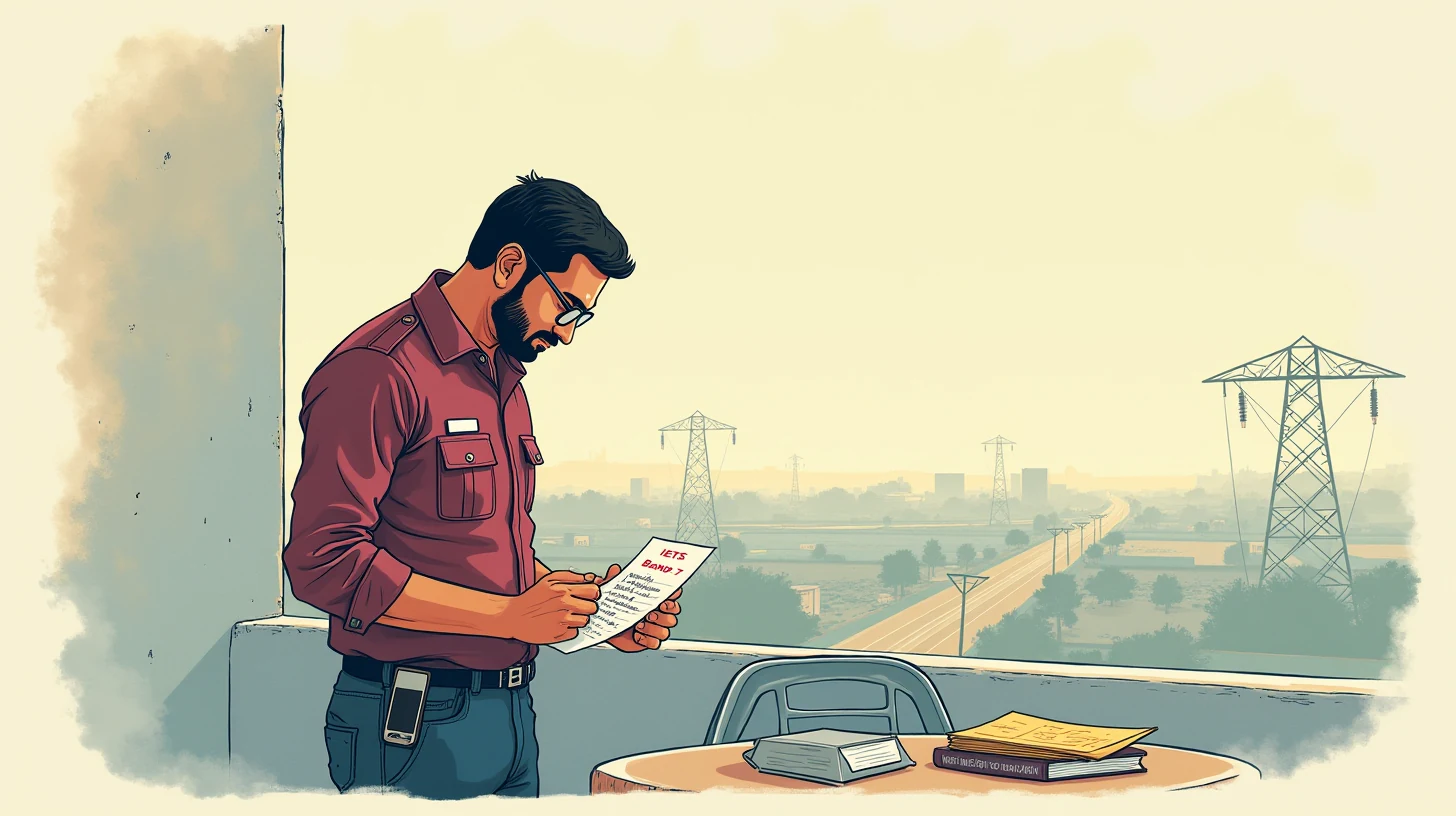
He works for the Punjab State Power Corporation Limited — PSPCL — as a transmission engineer, a grade-II position with responsibility for 230-kilovolt relay stations along the Chandigarh-Himachal corridor. He earns ₹68,000 per month, with a pay-scale lock that does not change except on state government order. The salary is enough. His wife is a schoolteacher in Sector 22, earning ₹52,000. Together they pay the rent on the flat — ₹18,500 monthly, with ₹14 lakh still outstanding — and they put food on the table with the specific quality of life that two state-sector salaries, in Chandigarh, permit.
What is unusual is what his mother began to leave, in large sealed envelopes, on the writing table in the flat: IELTS registration forms, a printed Canadian provinces' immigration eligibility matrix, a handwritten letter in Punjabi from her detailing the Toronto address of a second cousin, and a Post-it note that reads, in Hindi, "Beta, tera peer nahi samjhega — your pain, others will not understand" — a phrase Rajesh's mother has been using since 2023, as if pain were a language everyone should be willing to learn.
He is the son of an engineer. His father, Harjinder Singh, graduated from Thapar Institute of Engineering and Technology in 1989, did not migrate to Canada when several classmates did in the 1990s, and instead took a government position with the Border Roads Organization in Kinnaur. Harjinder is sixty-eight now and retired. He was respected in his career. He did not regret staying. But his wife — Rajesh's mother, Priya — watched a cohort of Thapar classmates' children grow up in Ontario and British Columbia, and she began to ask a question that has no answer: why does this family stay?
The question sits differently in Rajesh's hands. He is the son of the man who stayed. He is married to Meera, who is Punjabi, who does not want to raise their daughter in Toronto's winter, and who trusts the government schools in Sector 22 more than a new curriculum in an unknown accent. He is also the son of a mother who has stopped asking and has started leaving sealed envelopes.
His father never migrated. Rajesh does not want to. But the path from "not wanting to" to "staying" has opened up to reveal its cost.
🗓️ The annual ritual
In the Punjab State Power Corporation, an engineer's career is structured by two parallel threads: the salary scale, which moves on the calendar of state government announcements; and the pension, which accumulates at a rate of 50/300ths per year of service, reaching near-completion at year thirty. Rajesh is in year eleven. He has nineteen years ahead, if he stays. Nineteen years of the ₹68,000 salary — which will rise only if the state government decides the pay scale warrants a revision, an event that occurs irregularly, often after years of delay.
The ritual is this: every March, the state government notifies revised pay scales. Rajesh's PSPCL circulates a memo. The new figures are written into the payroll system. The increment is typically 2–5 per cent. This happens to be precisely the rate of inflation. He arrives at July with the same purchasing power he had in March, the illusion of progress, and nineteen years still ahead.
The other ritual — the one his mother has begun — runs on a cycle that is not state government time. It is family time, diaspora time, the time of a cousin in Toronto who runs a small consulting firm and has begun to mention, casually, in WhatsApp messages, that "someone with a PSPCL background" — translation: someone with power-sector credentials — would be "valuable on a contract basis" — translation: a work permit, a plane ticket, a salary that begins at 140,000 Canadian dollars, double what Rajesh earns in rupees. The cousin never says the word "leave". The cousin says "opportunity".
Meera wants the flat. Rajesh wants to finish the flat and stay in Chandigarh. His mother wants Rajesh to want Toronto.
- ⚖️
2014 — TIET degree, PSPCL job offer
Rajesh graduated from Thapar with a degree in electrical engineering. The PSPCL recruited him immediately, on contract. His father approved. His mother said nothing.
- 🏠
2018 — Flat purchase, Sector 49
Rajesh and Meera married. They put down a down payment on a flat in Sector 49, promising completion in 36 months. The builder promised. The builder did not deliver.
- 📨
2023 — Mother begins envelopes
A Thapar classmate's son migrated to Toronto and sent a photo from a high-rise balcony. Rajesh's mother began leaving IELTS forms and Toronto addresses on the writing table.
- 🧠
2026 — The question
Rajesh is 32, on track for ₹12,000/month at year-30. His cousin offers ₹140,000 CAD/year. His wife wants the flat. His mother wants him to want something else. He wants his mother to stop wanting.
What a Chandigarh engineer in the state power sector confronts is not a dramatic choice but a slow fade. The salary was adequate in 2014. It is less adequate in 2026 because the rupee and the state pay scale move at different velocities. The property market in Chandigarh has inflated 180 per cent in that time. The flat that cost ₹40 lakh in 2018 would cost ₹90 lakh in 2026. Rajesh locked in at 2018 prices. He is paying at 2026 interest rates.
An engineer in a private real estate firm, by contrast, might have moved thrice by now, absorbed a 40–60 per cent salary increase at each move, and bought a flat at 2020 prices with 2025 income. Rajesh has done neither. He stayed. He did what his father did. He is discovering that his father's choice was possible because his father's wife did not have a mother who received WhatsApp messages from Toronto.
⚠️ What very nearly happened
In the first week of January 2026, Rajesh's mother flew to Chandigarh unannounced. She arrived on a Tuesday, told Priya that she was staying two weeks, and on the first evening over tea and samosa, she presented a case that had clearly been assembled across multiple conversations with his cousin in Toronto:
His cousin's firm has a subcontract for a utility regulation review project with the Ontario Energy Board. The project runs 18 months. A PSPCL-trained engineer would be "essential" — the consultant needs someone who understands Indian grid dynamics to build the comparative regulatory matrix. The salary is CAD $140,000 per year, or roughly ₹77 lakh — more than eleven times Rajesh's annual PSPCL income.
The IELTS Band 7 requirement is genuine. Immigration Canada requires Band 7 for certain occupational codes. His cousin will sponsor him on a work permit. Once the work permit is approved, Rajesh can bring Meera and the daughter. They would live in a basement apartment in Scarborough for the first year — ₹35,000/month rent — while the work permit transitions to permanent residency, typically an 18–24 month process. After that, the salary rises, the housing improves, and Meera can work — she has a teaching credential that transfers.
The numbers, in isolation, are compelling. ₹77 lakh against ₹8.16 lakh — nearly a tenfold gain. The downside was presented as a single sentence: "Your PSPCL pension will pause. Once you return — if you return — you can pick it up, but the years abroad do not count."
What very nearly happened was that Rajesh, sitting in a flat he had been paying for for eight years with no completion in sight, with a daughter beginning school in September 2026 and a wife who had never said she wanted Toronto, would have begun the application sequence anyway.
The pause came from Meera. She asked the single question that none of the envelopes had addressed: "If we go to Toronto for 18 months, and the work permit becomes permanent residency, and permanent residency becomes landed immigrant status — what is the point of 'returning'?"
His mother's answer was not spoken. It was the silence that followed. It was the recognition that "going for 18 months" is a formulation that no one in the diaspora uses when the salary is tenfold and the housing market is open. It is a formulation that parents use to reduce guilt. It is not a thing that happens.
"ਜੇ ਮੈਂ ਜਾਵਾਂ, ਤਾਂ ਮੈਂ ਘਰ ਛੱਡ ਨਹੀਂ ਰਿਹਾ — ਮੈਂ ਘਰ ਵੇਚ ਰਿਹਾ ਹਾਂ।"— If I go, I am not leaving home — I am selling it.
She said it in Punjabi, to Rajesh's mother, in the kitchen while Rajesh was in the other room. Rajesh's mother heard it. Rajesh heard it later, when Meera told him. Neither of them told his mother they knew. The envelopes stopped. Not because the offer had changed, but because the argument had clarified itself into the thing that could not be spoken: a home is not a place you can pause.
🌗 What changed
In the second week of February, Rajesh attended a mandatory professional development seminar at the PSPCL office in Sector 17. The seminar was titled "Grid Modernization and the Next-Generation Transmission Engineer" and was conducted by a consulting firm that had been hired to brief state engineers on emerging technologies — demand-side management, microgrids, distributed solar integration into the state grid.
During a break, Rajesh happened to stand near an older transmission engineer, a man named Balwant Singh who had been with PSPCL for twenty-eight years. Balwant had been in a strange mood for weeks, Rajesh had heard — distracted, sometimes angry in meetings. Rajesh asked him, lightly, how the seminar was landing.
Balwant's answer was not light. He said: "They are teaching us to manage a grid that is already obsolete. The solar capacity coming online in Punjab — it has already broken the traditional transmission model. But the pay scale will not move until the state government decides it is broken. By then, the engineers trained in distributed networks will all be foreign-educated or private-sector-trained. The PSPCL will have trained no one."
He paused, then: "I have two years until I retire. I will retire at ₹1,08,000/month pension. My daughter is in Delhi doing a startup. I would have told her not to do it if I did not see the PSPCL going the same direction as every other state utility — into the past."
Rajesh did not mention the Toronto offer. He asked a different question: "Did you ever think about leaving?"
"No," Balwant said. "I thought about staying. I did the math. Staying made sense. It still does. But the math is no longer the point. The point is that the thing you stayed for is becoming something else, and you cannot stop it. So the only choice left is whether to stay and watch it, or leave and pretend it did not happen."
That evening, Rajesh took out his phone and did something he had not done before: he called the PSPCL Human Resources department and asked about the Leave Without Pay policy for engineers who wish to take sabbatical or international assignments.
The answer was informative and devastating. The PSPCL allows engineers to take Leave Without Pay for up to five years. During Leave Without Pay, the pension contribution does not accrue, but the leave is counted as continuous service for seniority purposes — a middle path. An engineer can return within five years and pick up the salary and pension as if the leave never happened. This is designed for family emergencies, medical reasons, or very occasionally, educational pursuits.
It is not designed for "I will take a work permit in Canada and see if we want to stay."
But it permits it. In the small space of the policy, an engineer can leave without burning the bridge.
Rajesh realized, as the HR officer was explaining this to him, that he had been thinking about the choice wrong. He had imagined a binary: stay or leave. The PSPCL, in its bureaucratic way, offered a third option. Leave, but keep your place. Go to Toronto, take the contract, see what happens. If you want to return after two or three years, your pension is waiting. If you do not want to return, you have had two years to figure out who you want to be there.
He said thank you to the HR officer and hung up.
"ਤੁਹਾਨੂੰ ਪਤਾ ਹੈ ਕਿ ਮਿਆਦ ਕਿੱਥੇ ਤੱਕ ਜਾ ਸਕਦੀ ਹੈ — ਪਾਂਚ ਸਾਲ ਤਕ। ਅਗਰ ਤੁਸੀਂ ਵਾਪਸ ਆਉਣਾ ਚਾਹੋ, ਤਾਂ ਅਭਿਆਸ ਮੁਲਤਵੀ ਹੋ ਜਾਂਦਾ ਹੈ — ਪਰ ਪੈਨਸ਼ਨ ਉਥੇ ਇੰਤਜ਼ਾਰ ਕਰਦੀ ਹੈ।"
(You know the Leave Without Pay can run for five years. If you want to return, the practice is paused — but the pension waits. The bridge does not burn.)
That was what the agent told him, in Punjabi, after Rajesh had started typing out his situation into the tablet. The agent had accessed the PSPCL Leave Without Pay policy from the official website, cross-checked it against his service record query (available via the PSPCL employee portal), and calculated a specific scenario: if Rajesh took a two-year Leave Without Pay, worked the Toronto contract, and did not return, his PSPCL pension — accrued to the year of departure — would be ₹48,000 per month at age sixty. If he returned after two years, he would simply resume, and the two-year break would be treated as continuous service. The gap was five years; within that gap, he could decide.
The agent also surfaced something Rajesh had not known: the PSPCL's own internal transition plan, available on the Punjab State Government's energy ministry website, notes that by 2035, the grid's engineer-to-automation ratio will require a reduction of 18 per cent in traditional transmission roles. The utility was already shedding roles through attrition. An engineer taking Leave Without Pay was, from the PSPCL's perspective, one less salary to carry while the grid restructured itself.
Rajesh read all of this on a Saturday evening, in the half-finished flat, with Meera beside him. She read it too. She asked him a single question: "Do you want to go?"
He said: "I do not know what I want. I know what my mother wants. I know what my cousin is offering. I know what you want. I do not know what I want."
Meera said: "Then that is what we are going to find out."
Return after 2 years
Salary resumes from rupeesTake Leave Without Pay, work Toronto contract for 24 months, return to PSPCL at same grade. Pension accrued to 13 years of service = ₹48,000/month at age 60. Flat completion in Chandigarh by then. Daughter in school in Sector 22, as planned.
Stay in Canada (Permanent Residency)
Toronto salary: CAD $140,000 → $160,000Work permit becomes permanent residency after 18 months, then landed immigrant status. PSPCL pension frozen at 13-year accrual = ₹48,000/month CAD payment at age 60. Meera works as teacher (credential transfers). Daughter grows up in Toronto.
Decline the offer, stay
PSPCL salary locked at ₹68,000Remain in Chandigarh, complete flat by 2028, reach year-30 pension (₹95,000–₹120,000/month at age 60). Daughter in state schools. Meera's school salary continues. Grid transition may reduce roles by 18 per cent — Rajesh may be involuntarily transitioned after 2032.
What changed was that the choice became visible. Not a black box of guilt and obligation, but a set of three scenarios, each with specific numbers, specific dates, and specific unknowns. The agent did not tell Rajesh which choice was right. The agent told him what each choice cost and what each choice promised. That is all an engineer needs.
🧭 Why we built it
There are approximately 800 professionally trained engineers in the Punjab government sector — PWD, PSPCL, GMADA, irrigation, and sanitation departments. Among them is a subset — perhaps 150–200 — who are at a similar inflection point: trained in a state cadre, locked into a pay scale, watching the sectors they trained for undergo rapid technological change, and facing diaspora pressure that is not purely financial but carries the weight of family expectation.
These engineers are not in crisis. Rajesh has a salary. He has a job. He has a wife who supports him and a daughter to think about. He is not desperate. He is confused. Confusion in this segment is expensive because the default move — stay, because leaving is scary and the offer is too good to be real — has a hidden cost. The default move is usually the one that happens ten years later, when the cost is undeniable and the PSPCL has already begun its restructuring, and the engineer has spent a decade wondering if he chose correctly.
The other default move — go, because the numbers are compelling — has a different cost. It assumes that the Toronto contract will become the permanent residency will become the life in Canada, and it does not leave room for the possibility that two years in Scarborough will feel different than the promise in Chandigarh, that the teaching credential does not transfer perfectly, that the daughter does not want winter, that the thing you left is more valuable in absence than in presence.
What we built is a way to turn the confusion into options. Not advice — not go to Canada or stay in Punjab — but a structured surfacing of what the PSPCL actually allows, what the grid transition actually means, what three specific paths actually cost. An engineer who takes this into the room with his wife is not rescued. But he is not flying blind.
What it does
- 🔍Verifies the PSPCL Leave Without Pay policy in its official form and explains the five-year window, pension accrual, and return conditions in plain Punjabi.
- 🗂️Matches the PSPCL grid transition plan (18 per cent engineer reduction by 2035) to Rajesh's service year to show involuntary transition risk if he stays after 2032.
- 💰Calculates three specific pension scenarios (return after 2 years, permanent Canada, stay in Chandigarh) with rupee and Canadian dollar figures, showing lifetime income in each case.
What it does not do
- 🔒Never enters his PSPCL employee ID, HR portal credentials, or email — all queries to the PSPCL portal are read-only, on public pages.
- 🧠Never advises which choice is correct — the choice between family and career, between security and possibility, belongs to Rajesh and Meera alone.
- ✅Never submits a Leave Without Pay application or any government form on his behalf — Rajesh fills and signs every form.
We built it free, and we will keep it free for this user — the state power engineer in the half-finished Chandigarh flat, with a mother in two minds and a wife in one, facing a choice that no government manual ever anticipated. The choice is not a policy choice. It is a life choice. But a life choice becomes harder to make when the information is opaque, when the paths are shrouded in family obligation, when the things you actually need to know — what the PSPCL allows, what the grid is doing, what the numbers actually are — are scattered across three different government websites and a WhatsApp message from a Toronto cousin.
We will not tell Rajesh to go to Canada. We will not tell him to stay in Punjab. We will make sure that when he decides, he decides with numbers on the table and a wife in the room, and no surprise hidden in a sealed envelope from his mother.
🌱 What we hope happens
Rajesh and Meera are still in the flat in Sector 49. He has not yet applied for the IELTS. His mother has not sent any new envelopes. He has printed out the three scenarios from the agent and left them on the kitchen table, where Meera sees them every morning.
What we hope happens is not that he chooses correctly — there is no correct choice. What we hope happens is that he chooses consciously. He sits with Meera. They read the numbers. They talk, with precision, about what two years in Scarborough would cost them and what it might give them. They ask themselves, specifically, whether the thing Rajesh's father did — stay — was right because it was right, or because it was the default. They ask themselves whether their daughter will thank them for Sector 22's schools or resent them for not taking the Toronto option when it was open.
And they decide. Not perfectly. Not without doubt. But with their eyes open.
His mother will continue to hope he goes. His cousin in Toronto will continue to mention opportunities. Meera will continue to want the flat finished. Rajesh will continue to go to work at the PSPCL and maintain transmission lines that are part of a grid that will not, in his lifetime, be what it was when he joined. That is not a failure. That is what life is for engineers in the state sector in India in 2026. The question is whether you decide to stay in it, or whether you let it be decided for you.
If you have a parent who is an engineer in the government sector — PSPCL, PWD, GMADA, or any state utility — facing the diaspora option, the product is free at gabforge.in. We have Punjabi alongside Hindi, English, Tamil, Telugu, Kannada, and Malayalam. The agent will walk you through the Leave Without Pay policy, the grid transition forecast, and the specific numbers for your parent's service year and pension accrual. It will not tell you to stay or go. It will tell you what staying costs and what going promises. That is all an engineer — or the person who loves one — needs to make a choice with their eyes open.