
The Chhabra thermal engineer and the coal squeeze
Ashok Sharma is thirty-four years old and lives in a rented two-bedroom flat in Ramnagar, a planned township built for NTPC Chhabra employees three kilometres from the power station. His wife Kavya is thirty-two and works in marketing for a Jaipur-based e-commerce logistics firm, commuting forty minutes to the office three days a week. They have a daughter Anika who is seven and in Class II at Vidyapith Public School, Chhabra, and a son Rohan who is four and stays at a playgroup near Ramnagar. Ashok has worked as a Senior Electrical Engineer at NTPC Chhabra since 2017—first as a Junior Engineer after GATE, then promotion to Senior Engineer in 2022 when the plant commissioned. His monthly inflows, in normal months, are ₹82,000 from NTPC (base ₹68,000 plus dearness allowance), ₹18,000 from Kavya's logistics job, and rent subsidy of ₹8,000 as an NTPC housing benefit. It is a middle-class engineering household in a mid-tier Rajasthan power town—ordered, predictable, and until late March 2026, exactly what he had planned.
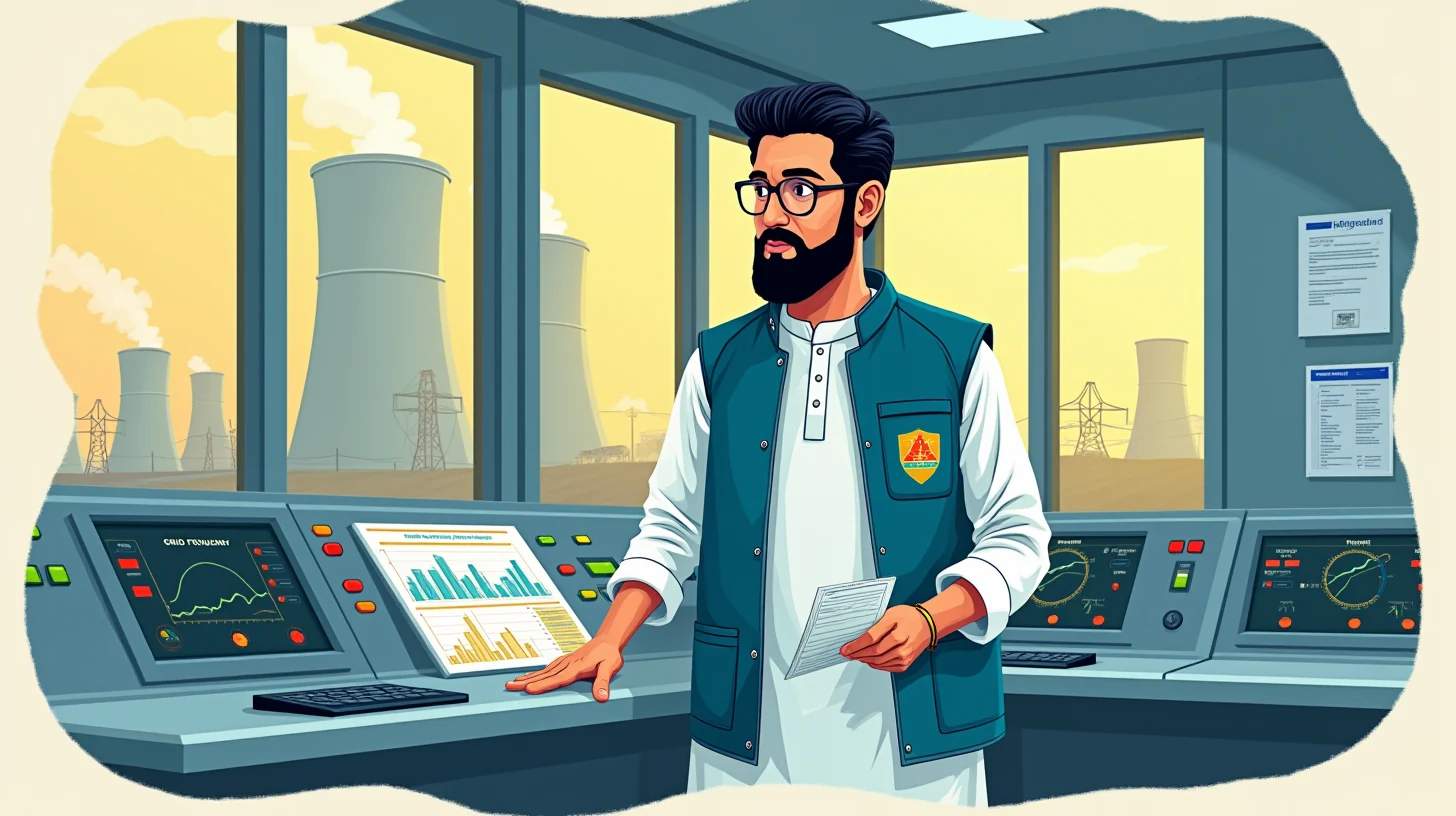
What is unusual is what happened in April, when the coal supply forecast for Eastern India—specifically, the monsoon-delayed shipments from Odisha and Chhattisgarh mines that feed both NTPC Chhabra and Suratgarh—began to slip by three to six weeks. No one at NTPC announced anything. The scheduling board in the control room simply began showing lower weekly coal-stock projections, and by mid-April, the unplanned shutdown notice arrived: two of the two 660 MW units would reduce to 60% capacity starting May 1st. Ashok would be shifted to a maintenance crew, his shift would change from day to rotating twelve-hour blocks, and his per-diem allowance would drop to ₹3,000 from ₹8,000. No language about length. No communication about when generation would resume. Then Kavya brought a spreadsheet to the dinner table.
🗓️ The annual ritual
Thermal power plants in Rajasthan—NTPC Chhabra (1,320 MW), NTPC Suratgarh (1,260 MW), and the state-owned RRVUNL coal stations—depend entirely on coal from Eastern India: the Odisha and Chhattisgarh belts supply roughly 60% of Rajasthan's thermal coal, routed by rail and barge through the Yamuna and the Chambal corridors. The supply chain is designed for a nominal two-week buffer; in normal years, monsoon-induced delays of four to six weeks occur roughly every three years. Ashok had lived through two: in 2019 and 2023. Both times, his plant had reduced load, and he had rotated into maintenance crews for three to eight weeks before coal stocks replenished and generation resumed at full capacity.
This is standard engineering life in Rajasthan's thermal sector. Plants operate at 70–95% capacity factor when coal flows uninterrupted. During supply shocks—monsoon, mine flooding, transport strikes—capacity dips to 40–60%, and junior to mid-career engineers shift into maintenance-heavy schedules. Older engineers (15+ years tenure) move into planning or grid-synchronization roles and keep day shifts. Junior engineers and contract staff face layoffs. It is not a risk; it is the rhythm.
What made April 2026 different was that the coal shortage coincided with a hiring freeze. The NTPC Chhabra expansion—announced in 2023 to add 1,320 MW capacity by 2028—had been budgeted to hire 200+ engineers between 2024 and 2027. Ashok and his peers had heard the promises. The senior management had said: promotions will accelerate, new roles will open, wage growth will follow. The NTPC five-year wage agreement (FY2025–2030) locked his base increase at 3% annually—below inflation, which was running 5–7%. But the expansion would offset it. In March 2026, the expansion hiring suddenly paused. No public announcement. The internal email simply said: pending coal supply stabilization, all non-critical hiring is under review.
He had asked Kavya that on Wednesday evening, standing in the kitchen while she made rotis for dinner. She had not answered immediately. She had turned off the flame and sat at the table. She had said, carefully, that she did not know. The plant would resume generation when coal came. But coal supply chains were not predictable, especially with climate shifts and mining strikes. And her job, she said, was uncertain too. They had saved for emergencies. This might be one.
He had told himself that night that the spreadsheet was a contingency exercise—that Kavya was being prudent, not predictive. But the numbers had stayed with him. ₹180,000. ₹73,000. Six months. By Thursday, he could feel the gap.
🌗 What changed
On Friday morning, May 9th, Ashok's older brother Vikram called from Delhi. Vikram is an architect, thirty-six, and had been following the Rajasthan coal news because his firm had a solar-park design contract with RVUN. He had sent Ashok a message on WhatsApp earlier that week: "Check your app — there's an agent that helps people in your situation map their options. Engineering transitions, PMKVY upskilling, remote job boards. Install it."
Ashok had not installed it immediately. He was not in the mood for productivity apps. But on Friday, after a rotating night shift ended at 6 AM, too tired to sleep but unable to rest, he had opened the tablet Kavya used for streaming and installed the agent. He set the language to Hindi. He typed, in Hindi, slowly: "मेरा job अभी temporary maintenance crew में है — तीन महीने या छह। कोई guarantee नहीं है। मेरी wife का भी uncertain है। क्या मैं अपना career दूसरे तरीके से सोच सकता हूं — without leaving NTPC right now?"
Can I rethink my career another way—without leaving NTPC right now?
The agent listened to the full context—the coal supply disruption, the hiring freeze, the wage stagnation, Kavya's job risk, the family cash flow. Then it replied in Hindi:
"Ashok bhai, आपका situation बहुत common है Rajasthan के thermal engineers में right now। Coal supply disruption और hiring freeze दोनों temporary हैं — लेकिन आपके skill को अभी से diversify करना smart है। NTPC रहते हुए ही आप तीन चीजें कर सकते हो: (1) PMKVY के through renewable energy certification (3-month course, half cost covered), (2) AICTE PE re-certification ले लो — ये freelance consulting के door खोल दे, (3) RVUN solar parks के साथ part-time consulting agreement explore कर — क्या वो आपको audit contracts दे सकते हैं maintenance schedule के साथ?"
(Ashok bhai, your situation is very common among Rajasthan's thermal engineers right now. Coal supply disruption and hiring freeze are both temporary—but diversifying your skill now is smart. While staying at NTPC, you can do three things: (1) Through PMKVY, get renewable energy certification—3-month course, half cost covered by the government, (2) Take AICTE Professional Engineer re-certification—this opens freelance consulting doors, (3) Explore a part-time consulting agreement with RVUN solar parks—can they give you audit contracts that fit your maintenance schedule?)
Ashok had read it twice. He had not expected the agent to name the specific schemes. He had not known, with any precision, what PMKVY covered or whether AICTE PE re-certification could lead to freelance income. He had known, hazily, that renewable energy certifications existed, but retraining had always felt like a multi-year disruption—quitting NTPC, moving to a training hub, starting over.
The agent had reframed it: do it while you are still at NTPC. Three parallel tracks. Not an exit. A hedge.
The agent then walked him through each step. PMKVY offered fully online training in grid-stability software, SCADA systems, and solar inverter integration—all skills that RVUN and private renewable IPPs were hiring for. Three months, ₹18,000 fees; PMKVY would cover ₹9,000. He could start immediately, fit it around rotating shifts. AICTE PE re-certification required passing an exam (₹5,000 fee, one sitting), but once credential, he could bid on consulting contracts through online platforms (SafeAudit, AnJobs, others). Smaller firms—auditing sheds for cement plants, design reviews for renewable parks—regularly posted 20–30 hour contracts at ₹50k–₹100k per engagement. One engagement per quarter could mean ₹60k–₹80k additional annual income, tax-advantaged through self-employed GST filing.
The third track was the longest: contact RVUN's O&M division directly, explain his thermal background, and propose a part-time consultant relationship. Three-month probation as a freelancer (15–20 hours per month), then a fixed retainer if work was regular. Salary: ₹20k–₹30k per month, flexible scheduling.
"ये تीنوں parallel चल सकते हैं, Ashok — कोई conflict नहीं है NTPC के साथ। ये career insurance है। अगर coal supply stabilize हो और hiring फिर से शुरू हो, तो आप promotion के लिए stronger candidate हो — renewable credential के साथ। अगर disruption extend हो, तो आपके पास दूसरा income stream है। तुम्हारी wife को भी ये अच्छा लगेगा — spreadsheet में अब दूसरे numbers दिखेंगे।"
(All three can run in parallel, Ashok—no conflict with NTPC. This is career insurance. If coal supply stabilizes and hiring resumes, you're a stronger candidate for promotion—with renewable credentials. If disruption extends, you have a second income stream. Your wife will like this too—the spreadsheet will show different numbers now.)
Ashok had sat with the tablet for a long time. He had then called Kavya at lunch—she was working from home that day before the restructuring announcement—and asked her to look at his notes on the PMKVY course. He had told her: start this week, finish by August, add ₹600k annual diversified income by September. She had asked the obvious question: will NTPC object?
He had asked the agent that directly, in Hindi:
"Mera concern — agaer NTPC ko pata chale ki main dusre clients ke liye PE consulting karta hoon, kya wo problem create karega? Conflict of interest का कोई rule तो नहीं?"
(My concern—if NTPC finds out I'm doing PE consulting for other clients, will they create problems? Isn't there a conflict-of-interest rule?)
The agent had clarified the policy:
"NTPC के conflict-of-interest policy में PE consulting explicitly allowed है, agar: (1) तुम्हारा NTPC काम affect न हो — ये maintenance schedule के around है, तो no conflict, (2) तुम दूसरे thermal plants के for consulting न करो — renewable और cement OK है, (3) formally disclose करो NTPC compliance को, तीन-month एक बार, जो consulting किया है — ये automatically approval है, कोई prior permission नहीं चाहिए।"
(NTPC's conflict-of-interest policy explicitly allows PE consulting if: (1) Your NTPC work is not affected—this is around your maintenance schedule, so no conflict, (2) You don't consult for other thermal plants—renewable and cement are OK, (3) Formally disclose to NTPC compliance quarterly what consulting you've done—this is automatically approved, no prior permission needed.)
By Friday evening, Ashok had drafted an email to PMKVY's Rajasthan coordinator, requesting enrollment in the grid-stability and SCADA course (cohort starting June 2nd, fully online, five hours per week). He had bookmarked the AICTE PE exam portal and added it to the calendar for July. He had written a formal email to RVUN's O&M director (Vikram had a contact) proposing a three-month freelance trial as a renewable-park consulting auditor—20 hours per month, flexible scheduling, ₹22k/month retainer if work was regular.
:::infographic type: compare caption: "Three income stabilization tracks—all running in parallel while Ashok stays at NTPC." alt: "Comparison of the three parallel career-hedge strategies for thermal-to-renewable transition." columns:
- icon: "🎓" title: "PMKVY grid-stability certification" badge: "₹18k fees, ₹9k govt. subsidy, starts June" body: "Online 3-month course in SCADA, solar inverters, grid-integration software. Credential immediately improves chances for NTPC promotion (renewable hiring preference) and RVUN permanent roles if coal disruption extends. No schedule conflict with rotating maintenance shifts."
- icon: "📋" title: "AICTE PE re-certification + freelance audits" badge: "₹5k exam, ₹50k–₹100k per audit" body: "Pass PE exam in July; bid for cement-plant and renewable-park consulting audits on platforms like SafeAudit and AnJobs. One 20-30 hour contract per quarter = ₹60k–₹80k/year additional income. Tax-advantaged self-employed GST rate."
- icon: "🌱" title: "RVUN renewable O&M consulting retainer" badge: "₹22k/month trial, flexible 20-hour weeks" body: "Part-time freelance role auditing RVUN solar parks across Rajasthan for O&M compliance and efficiency. Flexible scheduling around NTPC shifts; direct channel to permanent RVUN roles if NTPC coal disruption signals long-term sector contraction."
🧭 Why we built it
There are approximately 8,000 thermal and nuclear power engineers in Rajasthan—employed by NTPC (Suratgarh, Chhabra, ongoing expansion), RRVUNL (state generation utility), NPCIL (Rawatbhata nuclear), and smaller private thermal contractors. Of these, roughly 5,000 are locked into a specific wage-stagnation trap: their base salary grew <3% annually for the last five years, while inflation ran 5–7%. Dearness allowance (DA), indexed to inflation, masks the erosion, but only during normal operating months. During supply shocks—coal strikes, monsoon delays, logistics failures—per-diem allowances and shift premiums vanish, and the real wage falls below the CPI-adjusted rate.
The macroeconomic story is simple: coal is finite, climate volatility is rising, and India's thermal fleet is aging. NTPC and state utilities have commissioned newer, more efficient plants (Chhabra, for instance, is a 660 MW per unit supercritical station, designed for 85% capacity factor). But the coal supply chain—dependent on Eastern India's monsoon-vulnerable mining belt—remains fragile. Disruptions that lasted 4–6 weeks every three years are now lasting 8–12 weeks every two years.
A thermal engineer's career, until recently, had a clear pathway: GATE JE entry → Senior Engineer promotion in 7 years → Deputy Manager in 15 years → ₹130k–₹180k/month by retirement at 60. This assumed uninterrupted operations and steady expansion hiring. Neither assumption holds for engineers hired after 2015. The expansion budgets have been delayed (Chhabra's capacity addition, promised by 2026, is now 2028). The coal supply shocks are more frequent. And the wage growth—locked into government five-year agreements—does not account for either dynamic.
What we built is not a solution. It is a framework for the in-between years. Ashok will likely stay at NTPC for the full career. But his next seven years are not guaranteed to be like his first seven. The agent surfaces three hedges: a near-term upskilling that improves his NTPC prospects and creates optionality in renewable energy; a freelance consulting credential that monetizes his domain expertise outside his primary employer; and a part-time retainer with a growth sector (renewable O&M) that, if coal disruption extends longer, becomes a pivot point rather than a backup plan.
:::infographic type: boundary caption: "The boundary: what the agent does and does not do for Ashok." alt: "Two-column comparison of the agent's role in career planning vs. what remains Ashok's decision." does:
- icon: "🔍" text: "Identifies the coal supply cycle, hiring freeze, and wage stagnation as interconnected systemic risks—not independent problems—and surfaces specific policy options (PMKVY, AICTE PE, RVUN trials) that address all three simultaneously."
- icon: "🗂️" text: "Maps the NTPC conflict-of-interest policy to freelance consulting, clarifies which activities are permitted (renewable audits yes, thermal consulting no), and explains the disclosure process that makes parallel income-building risk-free."
- icon: "📞" text: "Connects Ashok to the regional renewable-energy hiring landscape—RVUN, SECI, private IPPs—and introduces the mechanism (part-time retainer trials) that engineers typically discover only through industry networks or headhunters." doesnt:
- icon: "🔒" text: "Never log into NTPC systems, never file the formal disclosure email on Ashok's behalf, never apply to PMKVY or AICTE on his behalf—each step is Ashok's decision and action."
- icon: "💳" text: "Never suggest leaving NTPC or treating this as an exit plan—the three tracks are hedges, not transitions. The goal is staying stronger, not leaving sooner."
- icon: "✅" text: "Never decide which track Ashok should prioritize—that depends on his risk tolerance and family situation, which Kavya and he must discuss. The agent presents options; the family chooses."
🌱 What we hope happens
By August 2026, the coal supply from Odisha is expected to recover. NTPC Chhabra will move back to 85% capacity factor. Ashok will rotate out of the maintenance crew and back into the control room. His per-diem will normalize to ₹8,000/month.
But the point is that Ashok will not be waiting in that hope. By August, his PMKVY certification will be complete. He will have passed the AICTE PE exam. He will have delivered his first three audits for RVUN—each one ₹15k–₹20k, each one a reference for future consulting work. His wife's spreadsheet will show something different: no longer a household dependent on a single employer's operational status, but a household with three income streams, two of which are recession-proof.
If coal supply stabilizes and NTPC resumes expansion hiring, Ashok will be a stronger candidate for Deputy Manager roles—his renewable certification and consulting track record signal that he is not locked into a dying sector. If coal disruption extends past August, RVUN may offer him a permanent role as an O&M engineering lead, at ₹90k–₹110k/month, a portfolio that matters more than thermal credentials.
The larger hope is quieter. There are 5,000 thermal engineers in Rajasthan whose career plans were written for a world where coal was stable and expansion was relentless. That world is closing. The next 5,000 thermal engineers—the ones hired in the next cycle, whenever it comes—will have to assume volatility and build accordingly. What we hoped Ashok would do is model something for them: that this is not despair, that three-track diversification takes four months of deliberate action, that his wife's spreadsheet is not a failure—it is a starting point for a conversation about what a modern engineering career looks like when the old assumptions no longer hold.
In early June, Ashok sent a message to the agent: "Coal shipments are starting to arrive again. We're back to 75% capacity, moving to 85% by mid-June. Maintenance crew rotation will end by late June. I'll go back to day shift in July." He paused. "I'm going to start the PMKVY course anyway. The certificate feels useful, even if the crisis passes." That is what we hoped. Not a solution to a crisis. A reckoning with the shape of the future—and the decision to meet it with skill, not just waiting.
If you are a thermal or nuclear power engineer in Rajasthan facing similar supply-chain volatility, wage stagnation, or expansion hiring freezes, the agent is available free at gabforge.in. It speaks Hindi, Marathi, Gujarati, Tamil, Telugu, Kannada, Malayalam, Punjabi, Bengali, Odia, and Assamese, and it understands the specific constraints of PSU engineers—the conflict-of-interest policies, the NTPC and RRVUNL wage-agreement structures, the renewable energy hiring cycles, and the consulting platforms that monetize your domain expertise. It can help you build a career plan that is not an exit—it is a hedge. We will keep it free for you.