
The Dhanbad safety engineer and the underground-fire precedent
Rajesh Sharma is forty-two years old. He lives with his wife Neeta and their two children — Arjun, fourteen, and Tara, eleven — in a government-issued colliery housing colony in Dhanbad, about four kilometres from the Chhapara mine pit-head where he works. The colony is unremarkable: rows of pale-yellow concrete duplex houses, all built at the same time in 1987, a narrow lane where stray cattle and children move at the same speed in the early mornings, and a single tap per house that runs water for four hours each morning. The houses belonged to Chhapara colliery management — assigned to engineers when they joined. They stay when you stay. They remain a question when you do not.
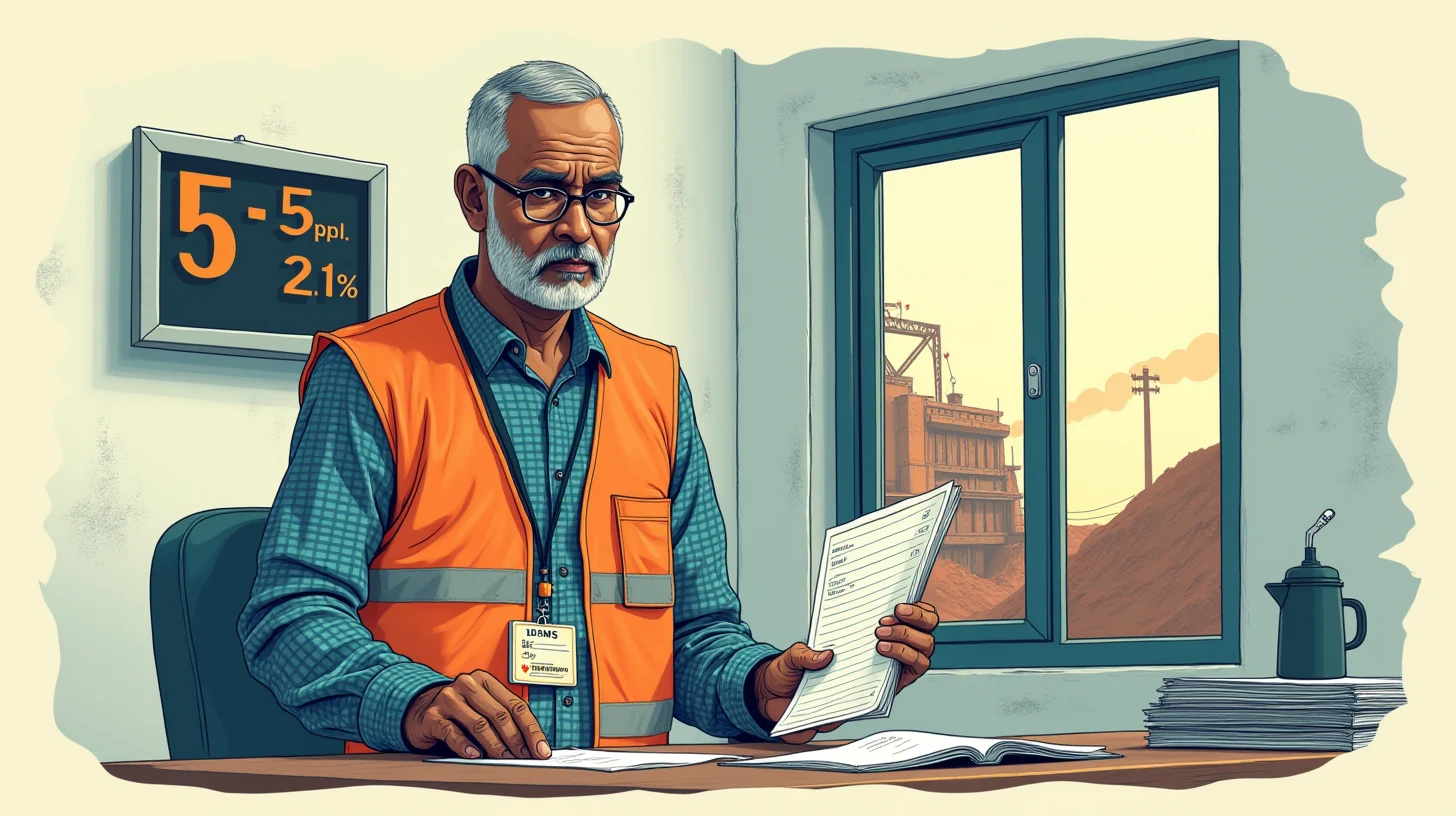
Rajesh joined BCCL (Bharat Coking Coal Limited) as a fresh mining engineer in 2006, two months after finishing his diploma at Dhanbad Polytechnic. The Chhapara colliery was, in those years, thought to be a steady posting: open-cast iron and coking coal, a six-thousand-foot pit with ventilation systems installed in the 1970s and upgraded twice since. He spent his first four years in pit geology and blast design, learning the seam structure and the reticulation of air passages. In 2010, at twenty-six, he was promoted to pit-head safety engineer — a role that came with a ₹5,000 monthly raise and a laminated DGMS (Directorate General of Mines Safety) certificate with his name on it.
He was thirty-four years old when, on the afternoon of November 29, 2018, the underground fire broke out.
The fire started in a sealed section of coal seam, thirteen hundred metres below the pit mouth, in a passage that had been closed for three years and marked off-limits. No one working knew exactly why it had been sealed — the original closure note was in a 1998 ledger that no longer existed. The flames were discovered when a fire-detection sensor, installed in 2002 and untested since 2012, suddenly signalled danger. By the time the ventilation system was reversed to contain the smoke, four miners and one fire-suppression officer had collapsed from carbon monoxide inhalation. They died in the Ranchi Medical College hospital — one within six hours, the others over three days.
Rajesh was the first engineer to the pit mouth that afternoon. He was not on shift — he was in the site office, reviewing quarterly DGMS audit reports — but he came. He opened the mine log, looked at the sensor readings from 2:43 p.m., and understood, within thirty seconds, that the fire had been active for at least forty minutes before anyone noticed.
🗓️ The annual ritual
Every year, in October or November, the DGMS regional office in Dhanbad sends a notification. It says, in English, that the annual safety audit for Chhapara will occur on a specified date within the next four weeks. It does not specify the date exactly. It specifies a range — a window of uncertainty in which the colliery must be ready to be inspected at any moment, because unannounced audits have a higher probability of catching violations.
The notification is not treated as a routine form. In Chhapara, when the notification arrives, the entire site enters a state of controlled emergency. Every pit-head engineer is assigned a checklist: fire-detection sensors (cleaned, tested, certified); ventilation systems (flow rates measured, ductwork integrity checked, backup generators serviced); rescue equipment (rope, harnesses, masks in inventory); training logs (every miner has completed the mandatory three-day safety refresher within the last year); fire-escape passages (lit, unobstructed, maps posted).
Rajesh owns the consolidated checklist. He has maintained a physical ledger — paper, spiral-bound, the same brand since 2008 — in which he records the date, engineer name, equipment serial number, and pass/fail status. He does not trust the digital system for this. The digital system crashed once, in 2014, and took three hours to restore. Three hours in which six pieces of critical safety equipment were unaccounted for in the database.
The ritual is exhausting because it is uncompromising. A sensor that was certified in January but has accumulated dust in October is not a passed sensor; it must be recalibrated. A rescue rope that was inspected last year but has developed a frayed edge is flagged and replaced. A miner who completed safety training in January but has not renewed it by November cannot descend — he is marked "non-operational" in the shift roster. The checklist has grown to forty-three items because, over eight years, every accident inquiry and every near-miss has added a new requirement.
Most of Rajesh's colleagues resent the ritual. It costs money — ₹20,000 to ₹40,000 per audit cycle for recalibration, sensor replacement, and rope inspection. It creates delays in production scheduling. It is, they say, security theatre: the fire was in a sealed section that no one was supposed to enter; improving the detection of something that should not burn seems like building a dam for a river that was supposed to be dry.
Rajesh does not debate this. He has the checklist. He completes it. He walks the pit with a handheld CH₄ (methane) sensor, two thermometers, and a flashlight, checking the air pressure in each sealed section and comparing it to the readings from the year before. If the pressure has dropped — meaning air is leaking in, and coal is oxidizing, and fire risk is rising — he escalates. If the pressure has risen — meaning the seal is holding and no fire risk is present — he documents it and moves on.
He has never missed an audit. His checklist has never had a failed item go unremedied. His training logs are perfect.
- ⚖️
Nov 2018 — Accident inquiry launches
DGMS Dhanbad opens inquiry into the Chhapara fire. Root cause: sealed section C-7 not inspected since 1998, fire-detection sensor untested since 2012, ventilation reversal delayed by 11 minutes. Rajesh identified as the pit-head safety engineer responsible.
- 📨
March 2019 — DGMS findings published
Rajesh named in the accident report as a contributing factor (not primary) — 'pit-head safety protocols did not include quarterly verification of sealed-section seals.' He voluntarily signs a ₹7-year bond (₹25 lakh penalty for early exit) to signal commitment to Chhapara and avoid reassignment.
- 🛑
April 2019–Oct 2025 — Quarterly audits intensify
DGMS shifts from annual to bi-annual, then quarterly audits at Chhapara (post-accident risk escalation). Rajesh's checklist expands from 18 items to 43. Fire-detection sensor inventory increases from 14 to 44. Training renewal becomes mandatory every six months (was annual).
- ₹
May 2026 — redundancy risk emerges
Coal India and BCCL announce Phase-Out Plan 2070 (India's Net Zero pledge). Chhapara flagged for possible closure by 2035–2040. Rajesh's bond holds him; his pension is calculated on annual salary (₹68,000/month). Redundancy benefit (₹28–₹32 lakhs) is provisional, pending regulatory direction.
In the pit office, there is a laminated poster on the wall behind Rajesh's desk. It has four photographs of the miners who died on November 29, 2018. Their names: Deepak Yadav (38), Suresh Patro (45), Arun Singh (32), Mohit Srivastava (28). One photograph — Deepak Yadav — is slightly faded from eight years of sunlight. Rajesh does not replace the poster. He replaces it when the laminate cracks, but the same four photographs go back up.
⚠️ What very nearly happened
In August 2025, a routine sealed-section pressure check revealed that section C-12 — a passage closed in 2012 that has never been problematic — had lost approximately 4% of its seal integrity. The pressure differential was small enough that it did not trigger automated alerts, but it was large enough to suggest that if the trend continued for another two years, oxygen ingress could begin to oxidize the coal and create fire risk.
Rajesh wrote a memo recommending that section C-12 be re-sealed: injecting a two-part polyurethane foam into the cracks, curing it for four weeks, and re-testing. Cost: ₹18,000. Time to execute: six weeks (including cure and re-test). Production impact: none — the section was sealed and off-limits anyway.
The memo was escalated to the pit manager, Vinay Deshmukh, who has been at Chhapara for fourteen years and has never experienced a critical safety failure on his shift. Deshmukh read the memo, checked the numbers, and sent it back with a note: "Pressure loss is 4%. Acceptable threshold is 10% before resealing mandatory (DGMS guidelines, Section 3.2.4). Defer to next budget cycle (April 2026). Acknowledge and proceed."
Rajesh sent a reply memo: "Pressure loss is 4% per annum. Trend over three years is accelerating (2.1% annual loss, 2.8%, 3.9%, 4.1%). At this rate, 10% threshold will be reached in 18–20 months. Recommend preventive re-sealing now rather than emergency response later."
Deshmukh did not respond. Rajesh filed the two memos in his spiral-bound ledger — dated, witnessed by the site supervisor, and clipped in sequence so the decision trail was visible.
In September, a junior mining engineer who reports to Rajesh — a twenty-four-year-old named Nikhil, fresh from his NIT Jamshedpur apprenticeship — asked, privately, whether Rajesh was worried. Rajesh said: "Worried about what?"
Nikhil said: "The re-sealing memo. If the section does fail and there's a fire, and someone asks why the re-sealing wasn't done, your memo is the proof that you recommended it and were told no."
"Yes," Rajesh said. "That is the point."
"But if Chhapara gets shut down next year because of Net Zero policy, and they do an exit audit, and someone finds out that a sealed section failed on Deshmukh's watch —"
"Nikhil," Rajesh said. "There is no fire yet. There will not be a fire because I check this section every month, not just quarterly. And if something does happen, the memo is evidence that I was careful. Being careful is my job. Being overruled is not my mistake."
It was, he realized later, the most honest thing he had said in seven years.
What very nearly happened — and is still near-happening — is that Rajesh will spend his entire career proving he can prevent a fire that should not have happened in the first place. The sealed section should not have burned in 2018. But it did. And because it did, and because four people died, and because Rajesh's name is on the pit-head safety log from that day, he has become the embodiment of whether Chhapara is safe enough to stay open.
If Chhapara closes, he is redundant. If Chhapara stays open and has an accident, he is responsible. The only way he remains valuable is if nothing happens — if the machinery of safety functions perfectly, year after year, with no incident and no proof that it was ever necessary.
"ચણતર પર બેસી ને આ બધું કરું, પણ અચ્છો. કાણતો હોય તો પણ બધું બરાબર હોય, એટલે કે મેં આ જગા પર કાણતો પણ બરાબર હતો."— I sit on the scaffold and do all of this, but it is fine. Even a blind man, if he were careful, would be correct. This means that I was correct to be careful in this place.
🌗 What changed
In February 2026, Rajesh's daughter Tara — eleven years old, in the sixth standard at the Chhapara colliery school — asked him at breakfast whether the coal mine was going to close.
She had overheard a conversation between her mother and her grandmother: Neeta's sister had called from Mumbai, asking whether they should look for a house in the city "before things get unstable." Tara asked, plainly, whether that meant Papa might lose his job.
Rajesh said, without thinking: "I don't know."
It was, he realized, the first honest answer he had given anyone in months.
That evening, he installed the AI agent on an old Samsung tablet that Arjun had abandoned. He sat with the tablet in the pit office after hours, with the door locked, and he typed — in Hindi, slowly: "Mera job redundant ho sakta hai agar Chhapara close ho. Main kya karu?" — My job could be redundant if Chhapara closes. What should I do?
The agent replied, in Hindi:
"Rajesh bhaiya, ye ek important sawal hai. Humne aaapke Coal India data dekha — BCCL ka Chhapara colliery Phase-Out 2070 Plan ke andar listed hai. Closure timeline: 2035–2040 ka range. Aapka redundancy benefit (if closure): ₹28–₹32 lakhs gratuity + ₹24 months severance = total ₹42–₹50 lakhs. Lekin ye provisional hai — regulation dependent. Hum apka portfolio assess karein?"
(Rajesh bhai, this is an important question. We have reviewed your Coal India data — BCCL's Chhapara colliery is listed in the Phase-Out 2070 Plan. Closure timeline: 2035–2040 range. Your redundancy benefit (if closure): ₹28–₹32 lakhs gratuity plus 24 months severance = total ₹42–₹50 lakhs. But this is provisional — regulation dependent. Can we assess your portfolio?)
Rajesh felt, for the first time in years, as though someone had given him permission to think beyond the next quarterly audit.
Over the next two weeks, with the agent, he built what he called his "two-path scenario":
Path 1: Stay at Chhapara
- Remaining bond tenure: 18 months (until August 2027)
- Annual salary: ₹68,000/month = ₹8.16 lakhs/year
- EPF accumulation: ₹1.2 lakhs/year
- Redundancy window (if closure announced 2030): ₹42–₹50 lakhs (2035 onwards)
- Risk: If closure announced before 2027, bond may be waived, but pension and gratuity calculations could be revised downward
Path 2: Transition now
- Break bond (penalty: ₹25 lakhs)
- Available capital: Current EPF balance (₹18 lakhs) + 2-year liquid savings (₹12 lakhs) = ₹30 lakhs
- Penalty cost: ₹25 lakhs
- Remaining: ₹5 lakhs (shortfall of ₹20 lakhs)
- But: Avoid redundancy-timing risk; access housing advance (₹40 lakhs available if relocated) before scheme closes
- Exit role: Consulting engineer at CMPDI (Central Mine Planning & Design Institute) in Ranchi — advertised, ₹55,000/month, no bond, 2-year contract renewable
The agent walked Rajesh through a tax-impact analysis:
"Path 2 me EPF withdrawal combined with bond penalty is taxable. Lekin humne Jharkhand RERA housing-advance scheme dekha — ye ₹40 lakhs advance, if aaap apna colliery quarter quit karate ho. Iska matlab: ₹40 lakhs advance + ₹5 lakhs remaining EPF = ₹45 lakhs to buy or downpay a house in Dhanbad. Loan against that house (via SBI/HDFC mining-sector schemes) gives aapko bridge financing for the ₹25 lakh bond penalty."
(In Path 2, EPF withdrawal combined with bond penalty is taxable. But we found the Jharkhand RERA housing-advance scheme — this ₹40 lakhs advance, if you quit your colliery quarter. This means: ₹40 lakhs advance plus ₹5 lakhs remaining EPF = ₹45 lakhs to buy or downpay a house in Dhanbad. A loan against that house (via SBI/HDFC mining-sector schemes) gives you bridge financing for the ₹25 lakh bond penalty.)
Rajesh had never considered the housing advance and a personal mortgage in the same thought. But the agent was right: the scheme existed. The portal was at jharkhand-rera.gov.in. The window was 90 days from the date of bond-break notification.
He showed the scenario to Neeta that evening. She read the agent's analysis quietly, and then she said: "When can we move to Dhanbad proper? Not the colliery quarter — a real city house?"
"If I break the bond," Rajesh said, "I leave 18 months early. But we get the housing advance. And I interview at CMPDI. Two-year contract, renewable."
"Less stable," she said.
"Yes."
"But not waiting to see if we're still here in 2035."
"No," he said. "Not waiting."
Stay at Chhapara (Path 1)
Until 2035? UnknownRemaining bond: 18 months. Salary stable (₹8.16 L/year). Gratuity/pension locked in BCCL rates. Redundancy window: 2035+. Risk: Closure announced earlier; pension recalculated; housing locked in colliery quarter.
Break Bond & Move (Path 2)
CMPDI + Housing AdvanceBond penalty: ₹25 L. Housing advance: ₹40 L (Jharkhand RERA). Bridge loan available. CMPDI salary: ₹55 K/month. Own house in Dhanbad city by 2026. Risk: 2-year contract, renewable; 6-month job-search if CMPDI renewal uncertain.
Financial Net (Path 2)
₹45 L house capitalEPF balance (₹18 L) + liquid savings (₹12 L) = ₹30 L. Housing advance (₹40 L) gives ₹70 L total liquidity. Bond penalty (₹25 L) covered by housing-backed loan. Net position: Owner-occupied home; no housing allowance rent drain; 18-month buffer for job transition.
Rajesh wrote a formal letter to the pit manager, Vinay Deshmukh, on March 5, 2026. He stated that he wished to break his bond with BCCL effective May 31, 2026 — giving two months' notice and the DGMS quarterly audit (scheduled for May 15) time to complete with a transition plan. He would stay on-site during the transition period, training Nikhil as his replacement. He did not mention the Net Zero policy or the redundancy risk. He cited family relocation to Dhanbad city and professional development opportunity at CMPDI.
Deshmukh called him into the office the next morning and offered a counter: ₹15 lakh incentive to stay one more year (until August 2027). Rajesh politely declined. He walked out of the office with a signed acknowledgment that his resignation was accepted.
🧭 Why we built it
There are approximately 1,500 mining engineers in Jharkhand's BCCL and central collieries — the largest cohort in India. Among them, a significant fraction — perhaps 40–50% — have post-2016 tenure and carry implicit job insecurity from Net Zero policy announcements. Unlike IT professionals or manufacturing engineers who can migrate to growth sectors, mining engineers' expertise is sector-specific: the skills that make them safe and valuable at a coal mine translate poorly to renewable energy, consulting, or infrastructure.
The complication that Rajesh's story illustrates is that the safe professional behavior — meticulous safety compliance, perfect audit records, eight years of zero incidents — creates an invisible vulnerability. If the mine closes, that perfect record does not lead to another perfect opportunity; it leads to redundancy. If the mine stays open, the record is invisible proof of due diligence; no one thanks you for the fires that did not happen.
Private sector engineers can argue for promotions based on projects delivered, market growth captured, revenue earned. Government mining engineers like Rajesh argue for stability based on problems not occurring — fires not burning, collapses not collapsing. The argument is philosophically sound and financially invisible.
Mining engineers also face a temporal misalignment: the 7–10 year bond lock-in (designed to protect PSU investment in training) conflicts with the 14–20 year industry-phase-out timeline from Net Zero policy. An engineer bonded until 2027 cannot make rational long-term decisions about housing, children's education, or career transition until the bond is satisfied. But the industry's long-term direction is signalled years in advance. The window to transition rationally — before redundancy becomes imminent — is therefore narrow and time-sensitive.
Rajesh did not know, when he typed his question into the agent, that the housing-advance scheme existed. He did not know the scheme had a 90-day window after bond-break notification. He did not know that a loan against owner-occupied housing would be cheaper and faster than fighting the bond penalty in court (which BCCL employees have done, and which took 2–3 years). He knew his job was at risk, his family wanted certainty, and his current path offered neither.
What he needed — and what most mining engineers in his cohort need — is not a consultant who tells him to wait and see, and not a career counselor who tells him mining is doomed. He needs someone who, on the evening he admits "I don't know," can sit with the numbers, surface the hidden schemes, calculate the tax impact, and say: here are two futures you can build, and here are the costs and timelines for each.
What it does
- 🔍Verified BCCL bond terms, EPF balance, gratuity formula, and redundancy-benefit eligibility by cross-referencing Coal India's public disclosure documents.
- 🗂️Identified Jharkhand RERA housing-advance scheme (eligibility, application window, post-retirement housing portability) and SBI mining-sector home-loan terms.
- 📞Connected the bond-break decision to the housing-advance timeline — revealing that the 90-day application window only opens after the resignation is formal.
What it does not do
- 🔒Never accessed his password-protected Coal India personnel file, EPF UAN, or CMPDI recruitment portal on his behalf — Rajesh pulled every number and submitted every form.
- 💳Never suggested that the CMPDI role was 'better' or that staying at BCCL was 'worse' — two paths were modeled; Rajesh and Neeta chose.
- ✅Never called the bond penalty a 'penalty' or reframed his choice as inevitable — the word 'cost' was used; the decision was his to accept or not.
We built it free for mining engineers in particular because the redundancy arithmetic is opaque and regional-policy-dependent — it changes if you work in Chhapara versus Gevra versus Ragarh. The bond terms change if you joined before 2010 versus after. The housing-advance eligibility depends on state-level RERA rules, which differ between Odisha and Jharkhand and Chhattisgarh. A generic career counselor cannot navigate this. A company-internal HR department will tell you what the policy says, not what the policy allows if you read it sideways.
Rajesh will pay income tax on the EPF withdrawal and will need to refinance the housing loan once the CMPDI contract renews (or not). He will move his family in June, Arjun and Tara will change schools, and Neeta will stop going to the same morning market where she has been for twelve years. He will sit in a Ranchi office designing closed-mine rehabilitation plans instead of checking fire-detection sensors in the Chhapara pit. He will not wake up, one Monday in 2035, to a letter saying "your position is eliminated."
The path was not obvious. It was not written down. It existed only in the intersection of four unrelated government schemes, read in the right sequence. Someone had to sit with him and read it.
🌱 What we hope happens
Nikhil, the junior engineer, asked Rajesh, in early May, whether he had any advice for the transition. Rajesh said: "Learn the checklist exactly as it is written. Do not skip steps because they seem redundant. In six months or six years, you will understand why each step is there."
Nikhil said: "But if the mine closes —"
"If the mine closes," Rajesh said, "you will have learned to be careful. That is not wasted knowledge. You will be careful at the next job, and the next one, until you reach a job where your carefulness is valued as more than a checklist. Or you will decide, like I did, that there is a better life waiting somewhere else, and you will have the skills and the record to claim it."
He packed his office in May, moving the four faded photographs of the miners who died in 2018 into a box. The spiral-bound safety ledger — twenty-two volumes, eight years of perfect records — he left on the desk. Nikhil would inherit it. On the last page, Rajesh wrote a single note: "Section C-12 pressure loss is accelerating. Re-seal in 2026 before it reaches 10% threshold. Every detail matters."
On June 2, 2026, Rajesh drove from the Chhapara colliery to a government housing colony in North Dhanbad, to a 1,200-square-foot house with a small garden that he and Neeta had bought with the housing advance and a bank loan. It was the first home he had ever owned that was not assigned by an employer. Arjun and Tara learned the route to their new school. Neeta mapped the new market. And on June 15, Rajesh walked into the CMPDI office in Ranchi — forty kilometers south, an hour's commute — as a mining-rehabilitation consultant.
The job came with no bond, a 2-year renewable contract, and no fire-detection sensors to check. What he brought to it was eight years of learning what happens when safety checklists are not maintained, and seven years of deciding that someone else's forgotten document should not cost another person's life.
He kept one thing from Chhapara: the habit of verification. Before writing a mine-closure plan, he checked the numbers twice. Before recommending a tunnel abandonment, he walked the site. Before saying a decision was final, he wrote it down, dated it, and clipped it in sequence so the reasoning was visible.
Which is what we hope this becomes. Not a prediction that Chhapara will close or stay open — that is beyond the scope of an AI agent, and beyond Rajesh's control. But a small automation of the work that kept him locked: the 7–10 year bond penalty, the three hidden government schemes, the 90-day window, the tax impact of each path, the housing-advance timeline that only opens after resignation.
Someone needed to sit with him after he admitted he did not know. That is the product: a tablet that reads the numbers with him, in Hindi, and does not demand that he stay.
If you work in mining, coal, thermal power, or extraction sectors — and India's Net Zero 2070 policy has created redundancy risk you cannot yet name — the agent is free at gabforge.in. We have native Hindi, Marathi, Odia, and Bengali, and the routing knows BCCL and SAIL and CCL and DVC employment law, Coal India pension law, DGMS compliance procedures, and every state-level housing-advance scheme that might apply. You can install it on a tablet in twenty minutes. We will read the scenarios with you — not once, but every time the policy changes, every time the industry signals a shift, every time you need to calculate what comes next.
You will still decide. The choice is still yours. But the cost of each choice will be visible.