
The Durgapur steel metallurgist and the gratuity shortfall
Suresh Kumar is fifty-eight years old. He lives on the ground floor of a government housing colony in Durgapur, West Bengal — a flat with white-washed exterior walls, a small front courtyard where his wife Madhuri grows tulsi and marigolds, and a rear window that opens onto the back alley where children play cricket with a plastic bat before the afternoon heat drives them indoors. Durgapur itself is a steel city, built around SAIL's Durgapur Steel Plant, which was commissioned in 1962 as India's second integrated steel works. The city has the particular rhythm of a single-industry town: the shift changes at the plant set the traffic pattern; the monsoon arrival shapes the schedule for crane maintenance; the annual bonus decides which street-corner tea stall upgrades to a small television.
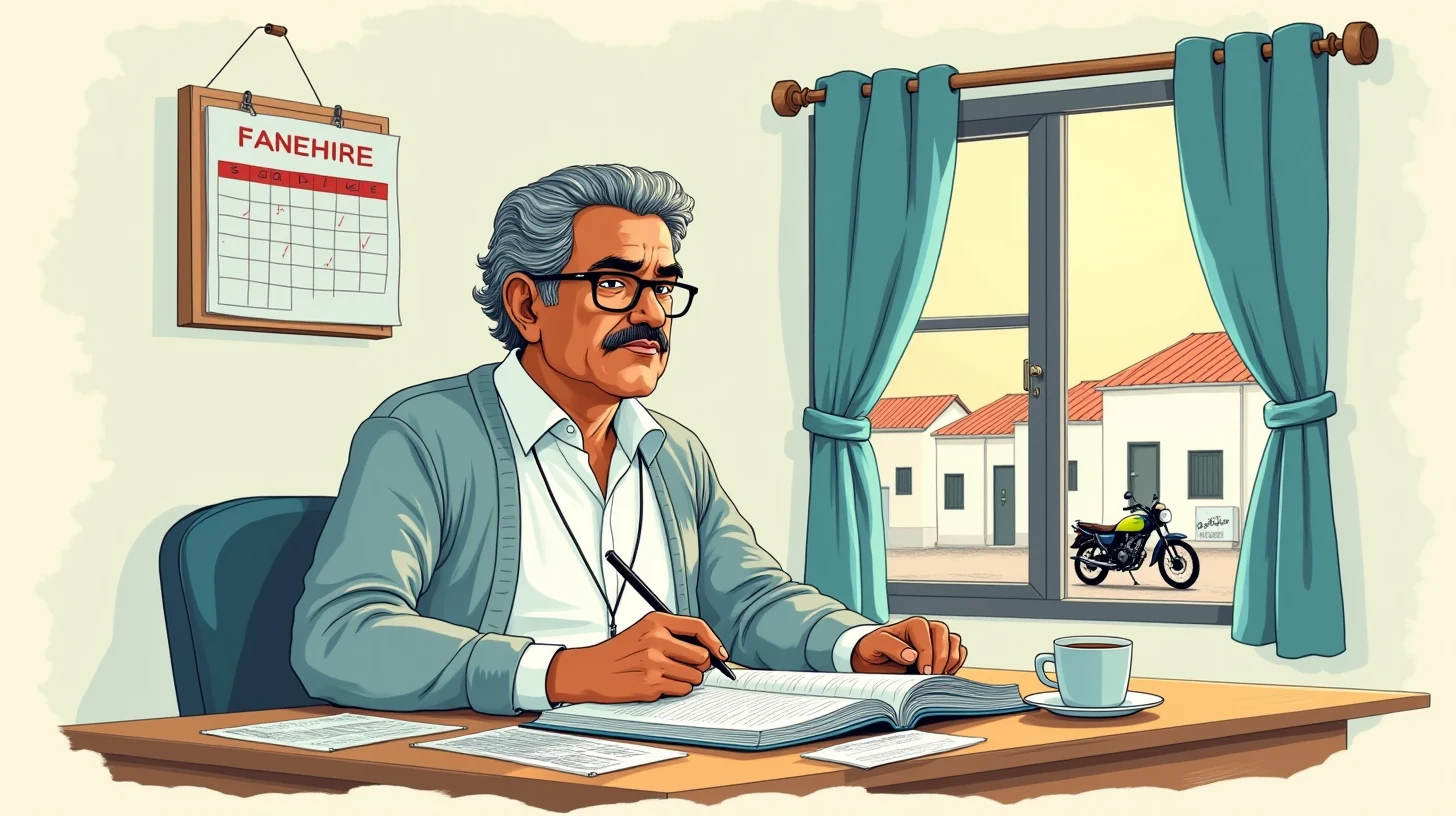
Suresh joined SAIL Durgapur in 1997 as a junior metallurgical engineer, fresh from Jadavpur University, with a Master's degree and a posting letter that made his parents weep with a specific kind of relief — government service, pension guaranteed, the certainty that had eluded his father's generation of private-sector chemists. He has been there for twenty-nine years, rising to chief metallurgist, the role he now holds with the quiet authority of a man who has personally certified the chemistry of forty thousand tonnes of steel plate. His wife Madhuri retired five years ago after thirty-two years as a government school mathematics teacher. Their daughter Anuja is in Bangalore, working at an IT consulting firm; their son Vivek is in Kolkata, an architect. Suresh's pension at sixty will be approximately ₹42,000 per month — a figure he has never quite said aloud because saying it made it both more real and more uncertain at the same time.
What happened in February 2026, two days after Madhuri's morning chai conversation with a retired schoolteacher's wife, was that Suresh learned that the gratuity he had spent twenty-nine years accumulating was not, in fact, worth what he had assumed it was.
🗓️ The annual ritual
SAIL's pension and gratuity rules, established under the Ministry of Steel in 1960, have remained largely unchanged for six decades. An engineer like Suresh, retiring after twenty years of "pensionable service," receives a gratuity calculated as a multiple of his basic salary — not his full salary including house-rent allowance, dearness allowance, and other components, but a narrower basic figure that is fixed at recruitment and incremented annually by government directive. The intention was to stabilize the state's pension liability. The effect, compounded over decades of inflation and the widening gap between "basic" and "actual take-home," is that the lump sum is often considerably smaller than the retiring engineer assumes it will be.
Suresh's basic salary at age fifty-eight is ₹48,000 per month. His full monthly inflow — basic plus allowances — is ₹73,400. Under SAIL's gratuity formula, his lump sum at retirement will be calculated using the basic figure. His colleagues at the works canteen had spoken of gratuities ranging from ₹15 lakh to ₹22 lakh, depending on when they retired and how their raises had compounded. One engineer, Rajesh Bandyopadhyay, retired in 2022 after thirty years and received ₹18,73,000 — a sum that had caused some quiet discussion about whether it was enough to see him through until his pension vested at sixty-two. No one had asked Rajesh whether it was. The question itself seemed impolite.
- 📋
Age 58–60 — Active employment at SAIL
Current salary ₹73,400/month. Gratuity calculated on basic ₹48,000. Full retirement benefits contingent on reaching age 60 and 20 years of service (both met in 24 months).
- ₹
Age 60 — Mandatory retirement, gratuity paid
Lump-sum gratuity approximately ₹17,28,000 (29 years × ₹48,000 basic × formula multiplier). One-time payment, no deductions. Pension begins but is capped at ₹42,000/month at vesting.
- 💸
Age 60–62 — Bridge-income phase
₹24 lakh gratuity must cover two years of post-retirement expenses while government pension processing completes and consultant/adjunct roles generate interim income (₹12,000–18,000/month target).
- ⏰
Age 62+ — Pension security
SAIL superannuation pension ₹42,000/month + potential Pradhan Mantri Vaya Vandana annuity + post-60 income from consulting/teaching (if pursued), total target ₹58,000–65,000/month.
Madhuri had always been the household's calculator. She kept the school's attendance registers with the same precision she kept the household accounts — not compulsively, but systematically, as if numbers had a grammar that, once mastered, revealed intent. When her colleague Anita's husband (also a SAIL engineer, a production supervisor) had retired in 2024, Anita had called Madhuri with the news of his gratuity: ₹19,80,000, which sounded large until Anita mentioned that he had not anticipated the gap between retirement at sixty and his pension beginning in earnest. The children had their own lives. The house was in Durgapur. Anita's post-retirement income as a tuition teacher was modest. The gratuity would last, if carefully managed, perhaps three years — until the pension stabilized.
That conversation had lodged in Madhuri's mind. On a February morning, after Suresh had left for the plant, she called the teacher's wife and asked, with the directness of women who have been colleagues for fifteen years, what her husband's gratuity had been calculated on. The answer was: basic salary only, not the full take-home. The multiplier was 15 months per year of service. Madhuri did the arithmetic. Suresh's gratuity would be approximately ₹17,28,000 — not the ₹26 lakh figure she had assumed. The gap, once it was spoken aloud, was ₹9 lakh: nearly one year of his current full salary.
⚠️ What very nearly happened
Suresh did not arrive home from SAIL Durgapur until six o'clock, after eleven hours at the plant where he had been auditing the chemistry of a new batch of high-tensile steel plate — a task that required X-ray diffraction analysis, manual documentation, and a walk through the shop floor at the end of each shift. He was tired in the specific way of men who have spent decades in industrial environments: not muscle-tired, but the kind of tiredness that accumulates when the background noise of machinery and ambient heat and the weight of responsibility for tonnage certification has been constant since morning.
Madhuri was waiting with tea. She said, before he sat down, that she had called Anita's wife. She said the gratuity calculation was on basic salary only. She said it would be approximately ₹17,28,000. She said Anita's family had discovered this gap only after her husband had retired, and by then it was too late to plan.
Suresh sat with the tea and said nothing. He had held a mental image of his gratuity for two years — a sum large enough that, combined with Madhuri's modest pension (₹18,000/month as a retired teacher), would see them through until his own pension vested and the household could relax into the rhythm of two government pensions. The ₹9 lakh gap was not insurmountable. It was the gap between a number he had prepared himself for and a number that required different preparation. It was the gap between assuming and knowing.
"ত্রিশ বছর কাজ করে, আমরা ভেবেছিলাম খরচ নিয়ে চিন্তা হবে না। কিন্তু কার্যত হিসাব বলছে অন্য কথা।"— Thirty years of work, and we thought the numbers would take care of themselves. But the actual numbers say something different.
The next two weeks were characterized by what his colleagues would have recognized as his metallurgical precision turned inward: a methodical review of every document in the house. He pulled his SAIL employment file — a steel-grey folder with carbon-copy pages from every promotion, every salary revision, every annual increment. He cross-referenced the basic-salary component shown in his payslips against the formula stated in the SAIL Gratuity Rules, a PDF he found on the SAIL website (a site that had not been updated since 2019). He confirmed the calculation. The gratuity would be ₹17,28,000. The gap was real.
What very nearly happened was that Suresh would have filed his retirement application at age sixty and discovered the magnitude of the bridge-income problem only after his employment had ended. Madhuri would have scaled back the house — perhaps dismissed the part-time housekeeper, cancelled Anuja's quarterly visits home. They would have managed. That was not in question. But the management would have been reactive, constrained, an improvisation that came two years too late.
🌗 What changed
In the last week of February, Anuja called from Bangalore during her lunch break with the usual questions — how were the marigolds, had Vivek visited, had Suresh been given his annual increment. This time Suresh mentioned the gratuity gap. He did not intend to ask for help. The mention was tactical: a way of signalling that something had shifted in the household's security.
Anuja listened and, after a pause, asked whether Suresh had a smartphone with internet. When he said he did, she sent him an access code for the agent and asked him to install it, set it to Bengali, and answer a specific question: given that his gratuity would be paid in a lump sum in his SAIL retirement, what options existed to convert that lump sum into monthly income that would bridge the gap until his pension vested?
The next evening, sitting beside Madhuri on the small courtyard bench where they drank their evening chai, Suresh opened the agent on his phone and typed, in Bengali, slowly: "আমার গ্র্যাচুইটি ১৭ লক্ষ ২৮ হাজার টাকা, মাত্র একবার পাবো — আগামী দুই বছরে তা থেকে প্রতি মাসে কিছু টাকা পেতে পারি কি?" — My gratuity is ₹17,28,000 and I will receive it in one lump sum. Can I draw monthly payments from it over the next two years?
The agent checked the EPFO rules, the SAIL gratuity statutes, and the Income Tax Section 89 provisions for post-retirement lump-sum distributions. It replied in Bengali:
"হ্যাঁ। তিনটি পথ আছে। এক: তোমার গ্র্যাচুইটি EPFO-তে ট্রান্সফার করে, একটা Gratuity Credit Account খুলে, ৩ বছর ধরে মাসিক ₹48,000 আকারে নিতে পারো। দুই: ১০% সুদের হারে একটা Fixed Deposit করে রাখো এবং মাসিক সুদ নিতে পারো (সেটা মোটা ₹14,600/মাস হবে স্থায়ী)। তৃতীয় পথ: একটা বার্ষিক pension plan কিনতে পারো, যেটা থেকে ₹15,000–₹18,000/মাস পাবে বয়সকাল জুড়ে। তোমার খাপ খাওয়ান কোন পথ, আমরা দেখব।"
(Yes. There are three paths. First: transfer your gratuity to EPFO, open a Gratuity Credit Account, and draw ₹48,000 monthly over three years. Second: place ₹17,28,000 in a fixed deposit at 10% interest and draw monthly interest (that will be ₹14,600 per month, permanent). Third: purchase an annuity plan that generates ₹15,000–₹18,000 monthly for the rest of your life. We can explore which path fits your situation.)
Suresh read it three times. The first path — EPFO credit account — meant that his gratuity would not be exhausted in year one. The second path meant he could preserve capital and live on the interest. The third path was permanent. He had not known any of these paths existed. His colleagues in the works canteen had never mentioned them. The retirement department at SAIL had issued no guidance on this.
The agent walked Suresh through the second and third options in detail. The fixed deposit at 10% interest would generate ₹14,600 monthly in permanent income, but would leave ₹17,28,000 invested and undrawn — a conservative approach that worked if bridge income came from other sources. The annuity plan would transfer the entire gratuity into a monthly pension (₹15,600–₹18,000 depending on the life-expectancy factors built into the plan), but would require him to purchase the annuity within thirty days of receiving the gratuity — a narrow window. The EPFO credit account was the middle path: ₹48,000 monthly for three years, capital drawn down in a controlled manner.
"কিন্তু সবচেয়ে জরুরি কথা: তোমার এই দুই বছরে bridge income এর দরকার ₹15,000–₹20,000/মাস। গ্র্যাচুইটি থেকে শুধু টাকা টানলে সেটা যথেষ্ট হবে না। তোমাকে post-60 income দরকার। ভাগ্যবশত, তোমার 29 বছরের metallurgical background এর জন্য 3টা সুযোগ আছে: একটা IIT Kharagpur-এ part-time advisory role, একটা Coal India consulting panel, আরও একটা শিক্ষাদূত অবস্থান Jadavpur University-তে।"
(But the most important thing: in these two years, you need ₹15,000–₹20,000 monthly from other sources. The gratuity alone will not be enough. You need post-60 income. Fortunately, for your 29-year metallurgical background, there are three opportunities: a part-time advisory role at IIT Kharagpur, a consulting panel with Coal India, and a teaching position at Jadavpur University.)
The agent had identified, within three pages of dialogue, the precise gap in Suresh's plan and had named three specific revenue sources that aligned with his expertise and geography. The IIT Kharagpur role (95 km north, one day per week) could generate ₹16,000–₹20,000 monthly for heritage-building retrofitting consultation — drawing on Durgapur's colonial industrial heritage and SAIL's own centennial heritage management. Coal India's Durgapur operations (ten minutes by auto from his home) recruited retired SAIL engineers for quarterly quality-assurance panels at ₹12,000–₹15,000 per assignment. Jadavpur was a longer commute and lower priority, but existed as a fallback.
Gratuity fixed deposit
₹14,600/month permanentInvest ₹17,28,000 at 10% compound interest. Monthly interest income is permanent, capital is untouched. Requires no active work post-60. Stabilizes to ₹58,600/month (pension ₹42k + deposit interest ₹14.6k) by age 62.
IIT Kharagpur adjunct role
₹16,000–₹20,000/monthPart-time advisory on heritage-steel-structure retrofitting, one day per week at IIT Centre for Heritage Structures. Aligns with Durgapur's colonial-era SAIL buildings. Bridging income ages 60–62, then optional continuation.
Coal India consulting panel
₹12,000–₹15,000 per assignmentQuarterly quality-assurance metallurgical audits for Durgapur operations (10 min commute). 2–3 days per quarter. Fits within non-compete post-retirement restrictions. Predictable supplementary income ages 60–63.
Suresh's initial plan, by mid-March, was a combination: place the gratuity in a 10% fixed deposit (permanent ₹14,600 monthly interest income), and pursue the IIT Kharagpur advisory role as primary post-60 work (₹18,000 monthly target). Coal India would be secondary — available if the IIT position did not materialize or if household needs exceeded the projection.
🧭 Why we built it
There are approximately forty-eight thousand active and recently retired engineers in West Bengal. Among them, roughly three thousand work in government PSUs (SAIL, IOCL, Coal India, WBHIDCO), where the gratuity rules, unchanged since the 1960s and 1970s, create a systemic planning gap. The retiring engineer learns, after three or four decades of service, that the lump sum they will receive is calculated on a narrower salary base than they had assumed. The gap is typically ₹8–₹12 lakh — precisely the magnitude that determines whether the post-60, pre-pension years are managed proactively or reactively.
What compounds the problem is that government PSUs do not have institutionalized retirement-planning counselling. A SAIL engineer in the works canteen hears fragments of other people's griefs (Rajesh got ₹18 lakh, Anita's family had to reduce the household help), but has no framework to translate those fragments into personal numbers. The retirement department issues a letter, the employee applies on the stated date, the gratuity arrives. The bridge-income question — how to convert ₹17 lakh into two years of security — is left to private-sector financial advisors, insurance salesmen, or chance conversations with a friend's wife.
The consultation market for PSU retirees is small and fragmented. National financial-planning firms focus on private-sector professionals. The regional tax consultants in Durgapur (and across West Bengal) are equipped to handle annual returns and property documents, not post-retirement lump-sum distribution strategies. No one has mapped out, for a SAIL metallurgist specifically, what the post-60 income sources actually are. IIT Kharagpur's heritage consulting exists as a research function, not as a visible opportunity for retired engineers. Coal India's consulting panel is a real program but is not systematically advertised to SAIL retirees. Jadavpur teaching roles exist but require someone to ask the right department head on the right day.
The gap that the agent closes is not primarily financial. Suresh's gratuity is real, his pension is guaranteed, his post-60 income options exist. The gap is visibility and assembly: connecting the three-part problem (narrower gratuity base, two-year income shortfall, uncharted post-60 work) into a single coherent plan. A SAIL engineer retiring after thirty years should not have to rely on his daughter in Bangalore installing an app on his phone to discover that (a) his gratuity calculation is narrower than he assumed, (b) three income sources exist to bridge the gap, and (c) the bridge is real and navigable if planned in advance, not after.
What it does
- 🔍Verifies the gratuity calculation against official SAIL rules and confirms the basic-salary-only component — the single fact that most retiring engineers never confirm until too late.
- 💳Maps three gratuity-conversion options (EPFO credit account, fixed deposit, annuity purchase) against Suresh's two-year bridge-income need and recommends the fixed-deposit + post-60 consulting path.
- 📞Identifies three specific post-60 income sources (IIT Kharagpur, Coal India, Jadavpur) that align with his metallurgical expertise and West Bengal geography — sources that exist but are not systematically advertised to retiring PSU engineers.
What it does not do
- 🔒Never enters his SAIL personnel file, his EPFO UAN password, or his bank credentials — all account verification is done by him, online, with the agent providing plain-language explanation.
- 💸Never transfers funds, purchases an annuity, or executes any financial transaction — Suresh decides which option fits, and his own bank processes the fixed deposit or EPFO credit.
- ⚖️Never makes the retirement decision for him — it surfaces the numbers, the options, and the planning window, but the decision to retire at sixty, pursue IIT Kharagpur, or defer bridge-income planning remains his alone.
We built this free. We will keep it free for the SAIL engineer in Durgapur, with a wife who has kept thirty-five years of school attendance registers and children in other cities, who is now facing a number that is ₹9 lakh smaller than the number he held in his head for two years. The bridge-income planning window for a PSU retiree is narrow: roughly two years before mandatory retirement. A private-sector retirement counselor works on commission and will sell an annuity. A tax consultant optimizes the tax filing. What Suresh needed was someone to sit with the SAIL documents on the courtyard bench at sunset and say: the gratuity is smaller than you assumed, and here are three ways to convert it and three ways to earn after sixty, and you have time to choose.
🌱 What we hope happens
Anuja called in early May, after the IIT Kharagpur Centre for Heritage Structures had formally offered Suresh a quarterly advisory contract at ₹18,000 per quarter (₹6,000 monthly, renewable). It was not the one-day-a-week commitment he had envisioned, but it was specific, it was paid, and it was documented. The Coal India panel had also confirmed his inclusion for the next quarterly audit cycle (₹14,000 per assignment, 2–3 assignments per year). Combined with the fixed-deposit interest (₹14,600) and Madhuri's pension (₹18,000), the household income by age sixty would be approximately ₹65,000 monthly — slightly above the target. The gratuity would remain invested, capital preserved, available for medical emergencies or Anuja's wedding, which was now looking possible without the anxiety of bridge-income shortfall.
What Anuja noticed, in Suresh's voice, was not relief exactly, but a specific kind of quietness — the quietness of a man who had spent six weeks holding a number that terrified him, and had then, with precision and care, assembled the pieces of a plan that worked. He had not changed his manner. He was still a metallurgist, careful with documentation, skeptical of promises, inclined to verify every number twice. The difference was that he could now see the path from fifty-eight to sixty to sixty-two without the reactive improvisation. The path was real.
Madhuri sent a photograph of the marigolds in the courtyard — they had thrived that spring — with a note that said she had updated her household accounts to include Suresh's post-60 income sources, and that she no longer felt the need to calculate what could be cut. The housekeeper would stay. Anuja could visit quarterly. They could manage with dignity because they could see ahead.
We hope this happens quietly for every engineer in a government steel plant, in a port authority, in a public-works department — the ones whose gratuity calculation is smaller than the mental image they have held, who have children in other cities, who need to know, two years before retirement, that the numbers can be made to work. You can download the agent free at gabforge.in. We have it in Bengali, Hindi, Tamil, Telugu, and Assamese. We will not sell the retirement decision. We will read the SAIL documents with you and we will be quiet.