
The Kakinada petroleum engineer and the offshore-rotation trap
Karthik Menon is thirty-two years old. He lives in a company-managed flat in Kakinada, a port town on the Andhra Pradesh coast about sixty kilometres south of the Krishna-Godavari basin offshore fields where he has worked for the past eight years. He is a petroleum engineer — specialization: offshore-platform production control — and for those eight years his life has been divided into fourteen-day blocks, alternating sea and land with the precision of a rotating gear.
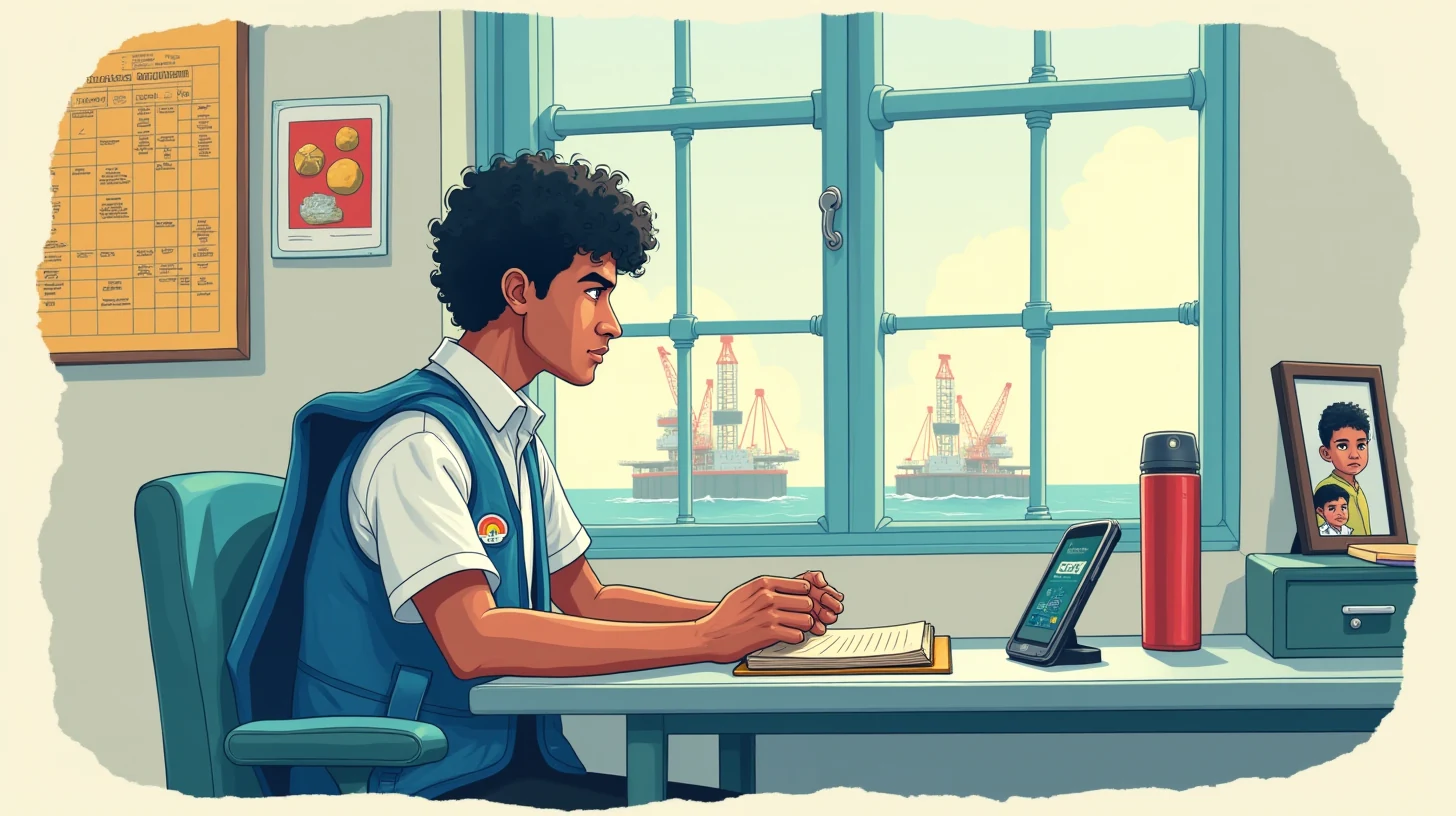
Fourteen days offshore means waking before sunrise in a helicopter from Kakinada airport, a forty-minute flight over the Arabian Sea to a fixed production platform. The platform is a city unto itself: crane operators, marine technicians, cooks, medics, and forty engineers rotating production systems across fourteen substations. At night, the sea is four hundred metres below. The work is methodical — well monitoring, pressure optimization, equipment logs — but the absence is total. His wife Divya manages alone: their daughter Isha, age six, now in first standard at a school where the morning drop-off requires a fifteen-minute auto ride. No rotation, no flexibility.
Fourteen days onshore means Karthik is in Kakinada, in a flat that is not quite home because it is owned by the company and shared with a rotating roster of offshore colleagues. He sees Divya and Isha for breakfast and dinner for two weeks, and then the phone call comes: report within forty-eight hours. The logistics of his life — school attendance, his own bloodwork, Divya's mother's arthritis clinic visits — all compress into a fourteen-day calendar. He has learned not to plan.
His monthly inflows are roughly ₹97,000 gross: ₹73,000 base salary plus offshore hardship allowance of ₹24,000. When the oil prices held in 2023–2024, he saved around ₹22,000 a month. When prices dipped in early 2025, the hardship allowance shifted to a variable component and his savings halved. Divya works part-time as a physiotherapist from a local clinic — another ₹18,000 some months — but her schedule is tied to his rotation: if he leaves, she cannot work more. They are a single-income household masquerading as two.
What nearly broke last February was the routine itself.
🗓️ The annual ritual
The offshore rotation at ONGC is not a choice; it is a condition of employment for platform-based roles. The 14–14 cycle (fourteen days on, fourteen days off) is the baseline for engineers in Kakinada and Rajahmundry. Some fields run 21–21 or even 28–7 for senior staff. The logic is operational efficiency: a platform is staffed continuously, and rotating crews of equal size minimize training and equipment downtime. For ONGC, it works. For the engineers and their families, the consequences compound quietly.
Eight years of the cycle means Karthik has been offshore approximately 1,800 days total. He has attended roughly half of Isha's school recitations and none of her last three parent-teacher meetings in person. Divya's mother fell ill in 2024 and stayed in Kakinada for three months; Karthik was offshore for all but four of those weeks. He called twice daily from the platform. It was not nothing, but the arithmetic was clear: his absence had a cost that salary could not offset.
The rotation is not invisible to ONGC. The company monitors "rotation fatigue" — a euphemism for depression, anxiety, and marriage strain — through an annual wellness survey. Karthik filled one out each December. He scored honestly: sleep disrupted, alertness degraded during long offshore shifts, wife expressing concern, daughter asking why Daddy was sometimes "not actually at home because he was thinking about the platform." The survey results aggregated into a report that ONGC shared with union representatives and senior management. The response was consistent: the rotation is non-negotiable for platform roles. Training and career advice: available. Mental health: available. Rotation itself: infrastructure-bound.
- ⚖️
2018 — Entry offshore
Hired as Assistant Engineer (Offshore), onboarded for 14–14 rotation on K-G basin platforms. Salary ₹38,000/month plus hardship. No rotation exemptions mentioned during induction.
- ⏰
2021 — Isha born
Promoted to Senior Technician; rotation unchanged. Divya stays home. Karthik calculates he has missed 14 of Isha's first 18 months due to offshore blocks.
- 💔
2024 — Fatigue signals
Divya suggests sabbatical or transfer. Karthik's onshore performance evaluations note alertness concerns during some shifts. ONGC wellness surveys flagged him as 'medium rotation-fatigue risk.'
- 🔍
Feb 2026 — Agent discovery
A colleague mentions a government scheme Karthik had never heard of: rotation sabbaticals, funded by ONGC, available to engineers 5–12 years in. Everything changed inside a single phone conversation.
The annual wellness cycle became ritual: survey, aggregate report, no action. Karthik had accepted the rotation as the price of his career. The alternative was to transfer to an onshore role — reservoir engineering, drilling supervision — but transfers required a two-year wait and a significant salary hit (onshore base ₹62,000 vs. his current ₹97,000 with hardship). A family with a daughter in school, a mortgage on a Kakinada property, and his mother-in-law's medical expenses could not absorb that drop. So the rotation continued.
⚠️ What very nearly happened
In February 2026, two things collided. Divya received a call from Isha's school — she had complained to her teacher that she felt "sad when Daddy's week came" (rotation weeks, they called them, not "Daddy's offshore weeks"). The teacher, trained to flag anxiety in children, suggested a meeting with the school counsellor. Simultaneously, Karthik's February offshore block ran into a monsoon delay: his relief helicopter could not land on the platform for an extra three days. He called Divya on the evening of day sixteen, his voice hoarse from twelve consecutive shifts covering for another engineer's absence, and said: "I cannot do this anymore. I need to transfer, or I need to leave ONGC."
Divya did not argue. She said: "Let me ask someone."
She called Karthik's senior colleague, Ravi Kumar, who works on adjacent platforms and had mentioned, months earlier, that he was considering a break. Ravi said one sentence that Karthik had never heard in eight years of rotation: "Have you asked ONGC about the rotation sabbatical?"
"అ ఆఫ్షోర్ జీవితం చెప్పడానికి కాదు — కానీ నిన్న రాత్రి నా కూతురు అడిగింది: నువ్వు నాపై ఎందుకు కోపం?"— This offshore life is not something you can explain — but my daughter asked me last night: why are you angry at me?
🌗 What changed
Ravi explained, briefly, that ONGC's HR had a rotation sabbatical program for engineers in the 5–12 year career band. Sixty days, fully funded (salary continues, pension contributions continue), available once per career, meant to address rotation fatigue before it escalated to transfer requests or burnout. Ravi himself was applying. Karthik had been at ONGC for eight years. He had never been told this program existed.
The next evening, Divya's brother sent Karthik a link and a message: "Install the AI agent. Put it in Telugu. Ask it about ONGC rotation sabbatical." Karthik did. He asked, in Telugu, on his mobile: "నా ONGC సిబ్బంది ఐడీ ఉపయోగించి నేను rotation sabbatical take చేయగలనా?" — Can I take a rotation sabbatical using my ONGC employee ID?
The agent responded in Telugu:
"హాय్ కార్థిక్, ONGC Employee Wellness & Family Support Portal లో rotation sabbatical program ఉంది — 5–12 years experience గల engineers కొరకు, 60 days వరకు, fully funded. నీ salary, pension contributions, seniority — అన్ని protected. నీ employee ID (AC-KG-2018-XXXX) ఉపయోగించి portal.ongc.co.in/wellness నుండి apply చేయవచ్చు. నీ అధిక అధికారికి advance approval కాదు — direct HR కు apply చేయవచ్చు."
(Hi Karthik, the ONGC Employee Wellness & Family Support Portal has a rotation sabbatical program — for engineers with 5–12 years experience, up to 60 days, fully funded. Your salary, pension contributions, seniority — all protected. You can apply through portal.ongc.co.in/wellness using your employee ID. You do not need advance approval from your supervisor — you can apply directly to HR.)
Karthik re-read the message twice. The second time, he called Divya from the onshore accommodation (he was in the middle of a fourteen-day onshore block) and read it to her aloud. She said: "Do it tonight."
He logged into the ONGC portal using his employee credentials. The rotation sabbatical form was buried two levels deep in the Wellness section, not linked from the main career resources. It asked for: employee ID, rotation years, current onshore supervisor approval (optional but recommended), intended use of sabbatical (dropdown: mental health, family relocation, education, other), and expected return-to-rotation date.
Karthik filled it out at 11 p.m. from the company accommodation flat:
- Rotation years: 8 years, 4 months
- Intended use: Family stress management and short-term professional development (AICTE leadership certification)
- Duration: 60 days
- Return date: 60 days from approval
The form had a warning: "Once approved, 60-day sabbatical is final and cannot be extended. Plan onshore activities accordingly." He submitted it without telling his supervisor, as permitted.
The agent walked him through what to expect next:
"అప్లికేషన్ submitting చేసిన కార్థిక్, ONGC HR 48 hours లో confirmation పంపుతారు. ఆ మధ్యలో, నీ rotation sabbatical ఆఫర్కు సరిపోయే programs చూడటానికి time ఉంది. నీ ఆఫర్ కోసం: (1) AICTE CPD program — 12-week digital plant operations course, ONGC funded; (2) Ministry of Earth Sciences rotation-fatigue counselling — quarterly peer group, Kakinada clinic, free; (3) Family relocation grant — EPF withdrawal rules allow hardship withdrawal for child's education/relocation, ₹2–3 లక్ష వరకు, rotation sabbatical period లో ఈ గ్రాంట్ ఆటోమేటిక్గా available."
(Karthik, ONGC HR will send confirmation within 48 hours. In the meantime, you have time to look for programs that fit your rotation sabbatical offer. For your profile: (1) AICTE CPD program — a 12-week digital plant operations course, ONGC funded; (2) Ministry of Earth Sciences rotation-fatigue counselling — quarterly peer group, Kakinada clinic, free; (3) Family relocation grant — EPF withdrawal rules allow hardship withdrawal for child's education/relocation, up to ₹2–3 lakh, automatically available during rotation sabbatical.)
Karthik did not know any of this existed. He had spent eight years thinking the rotation was his ceiling, not a problem with a designed solution waiting in a government portal.
The sabbatical was approved on the third day. Within a week, Karthik had enrolled Isha in a boarding school outside Hyderabad (₹1.4 lakh per year, covered by ONGC's family relocation grant and a partial EPF withdrawal authorized under the hardship clause). Divya was to manage the initial transition; Karthik would join for the first week. He signed up for the AICTE CPD course (12 weeks, online and in-person, starting mid-April), which allowed him to work at his own pace during the sabbatical while remaining "upskilled" in the eyes of ONGC's career-progression evaluations.
Isha's boarding school
₹1.4 lakh/year fundedRelocated Isha to a school outside Hyderabad with a 5-day-a-week boarding model. Weekends Karthik and Divya are together. School has a rotation-friendly calendar (holidays align with sabbatical periods). Removed the arithmetic of daily drop-offs from Divya's schedule.
AICTE CPD digital course
12-week upskilling, freeKarthik enrolled in 'Digital Control Systems in Offshore Production' — credentials recognized by ONGC for promotion track. Completed during sabbatical without disrupting offshore rotation schedule. Career ceiling raised without leaving platform.
Rotation-fatigue support group
Quarterly, MES-funded, KakinadaConnected to a peer group of other rotation-eligible engineers, facilitated by occupational health therapists. Meets every three months. Normalized the fatigue and gave Karthik a language to describe the strain that was not 'I am weak' but 'I am managing a system designed to exhaust me.'
🧭 Why we built it
There are, by ONGC's own workforce data, approximately 3,200 platform-based petroleum engineers in India, the majority in the K-G basin and Assam fields. They work rotation cycles that are infrastructure-bound — a platform must be staffed continuously, and rotating crews minimize disruption. For most of them, like Karthik, the rotation is a non-negotiable condition, and they accept it as the price of their career.
But ONGC, and the government ministries that oversee offshore energy, have built support systems for the rotation that almost no engineer knows exist. The rotation sabbatical program. The family relocation grants. The EPF hardship withdrawal clause for education. The Ministry of Earth Sciences occupational health initiative. The AICTE CPD upskilling courses. They exist. They are funded. The barrier is not money or policy — it is visibility.
Karthik could not find the sabbatical program by searching the ONGC career portal. Ravi had learned about it from a casual conversation at the chai stall. Most engineers learn by accident — a colleague's story, an HR bulletin board nobody reads. The system assumes knowledge you cannot acquire unless someone tells you. The rotation continues, the fatigue compounds, and the exit door (transfer, or burnout) becomes the plan, not the support system that was there all along.
What it does
- 🔍Verifies that rotation sabbatical programs exist in ONGC's wellness portal and explains eligibility, duration, funded components, and application procedures in Telugu.
- 🗂️Matches Karthik's 8-year rotation history and family situation to available schemes: AICTE CPD programs, Ministry of Earth Sciences peer support, and EPF hardship withdrawals for family relocation.
- 📞Identifies when separate problems — Isha's school continuity, Karthik's career stagnation, Divya's isolation — have unified solutions (boarding school relocation, funded upskilling, peer support).
What it does not do
- 🔒Never enters his ONGC employee ID password or pension account credentials — each login was completed by Karthik himself, and every form submission required his explicit confirmation.
- 💳Never submits a sabbatical application or processes an EPF withdrawal on his behalf — it walks him through the steps, but he signs and submits.
- ✅Never decides whether a sabbatical is right for him — it surfaces the option, shows the cost-benefit, and leaves the decision to Karthik and Divya.
We built it free because the rotation engineer is not a market segment. He is a man who has spent eight years accepting that his family's calendar is not his own, and that the cost of that acceptance is invisible unless someone says it aloud. Karthik's onshore accommodation is not his home. His daughter asks why her father is "angry at her" when he is actually just tired. His wife has learned to manage alone and does not complain because complaining does not change the shift schedule.
The sabbatical exists. The boarding school grant exists. The upskilling program exists. The peer-support group exists. They are in government portals and ONGC's career section and the Ministry of Earth Sciences website. The failure is not ONGC's or the government's. The failure is that Karthik, after eight years, did not know they were there.
We will keep this free for the rotation engineer in Kakinada, in Rajahmundry, on every K-G basin platform, and in the Assam fields. He does not have time to navigate a career portal. He is either at sea or at home, and when he is at home he is tired. He does not need a marketing email. He needs someone to tell him, in Telugu, that the rotation sabbatical exists, that his daughter's boarding school is covered, and that taking sixty days away does not mean abandoning his career — it means being able to come back to it.
🌱 What we hope happens
Three months after the sabbatical started, Karthik returned to the rotation schedule — but with a difference. He was back on platform, offshore, but Isha was in school with a calendar that meant weekends together and quarterly breaks that aligned with his rotation cycles. Divya had started a proper physiotherapy practice from her clinic (expanded hours, no longer constrained by school drop-off), and was earning closer to ₹30,000 a month. The AICTE certification was done; ONGC's HR had noted it in his promotion file, and he was being considered for a Senior Engineer role (platform lead, ₹1,20,000+ base, slightly fewer offshore blocks per year).
What Karthik found was not that the rotation became easier. It did not. Fourteen days offshore is still fourteen days away. But the meaning of it changed. The rotation was no longer an unexamined condition he had accepted because he could see no alternative. It was now an infrastructure choice — painful but designed, with entry and exit points, with peer support at regular intervals, with a daughter whose school understood his rotation and built around it.
When a new Assistant Engineer arrived on his platform — fresh hire, first offshore block, nervous — Karthik made a point of sitting with him at dinner on the second day and saying: "You have work to do here. But in five or six years, if it gets hard, there is a sabbatical program. ONGC does not advertise it well, but it exists. Your HR contact will help." The new engineer's face changed — not relief exactly, but the recognition that someone had thought about what he was doing.
That is what we hope happens. Not that the rotation disappears — it is infrastructure-bound, and ONGC needs it to run continuous operations. But that the engineer who is eight years in does not have to discover the support system by accident. That Divya and Isha do not have to assume that the tiredness and the absence are the price, with no alternative. That the peer group exists so that the strain has a name, and the sabbatical exists so that the name has a solution.
If you are a rotation-eligible engineer — offshore, platform-based, eight years or more in — the agent is free at gabforge.in, in Telugu and all major Indian languages. Set it on a tablet in your onshore accommodation. Ask it one question: "What rotation-fatigue support programs does my employer have that I don't know about?" The answer will surprise you. Not because the programs are new — they are not. But because someone has finally told you they exist, and they are already paid for.