
The Patna NTPC engineer and the shutdown rotation
Raj Kant Singh is thirty-eight years old. He lives in a two-bedroom flat on Boring Road in Patna, roughly midway between Kargil Chowk and the turning toward Anispur. It is a middle-income housing society from the early 2000s — the kind where the watchman knows which visitor belongs to which flat and the water tanker arrives at six every morning with the punctuality of a postal clerk. Raj's mortgage runs until his youngest daughter finishes her tenth board exams, which means until 2031.
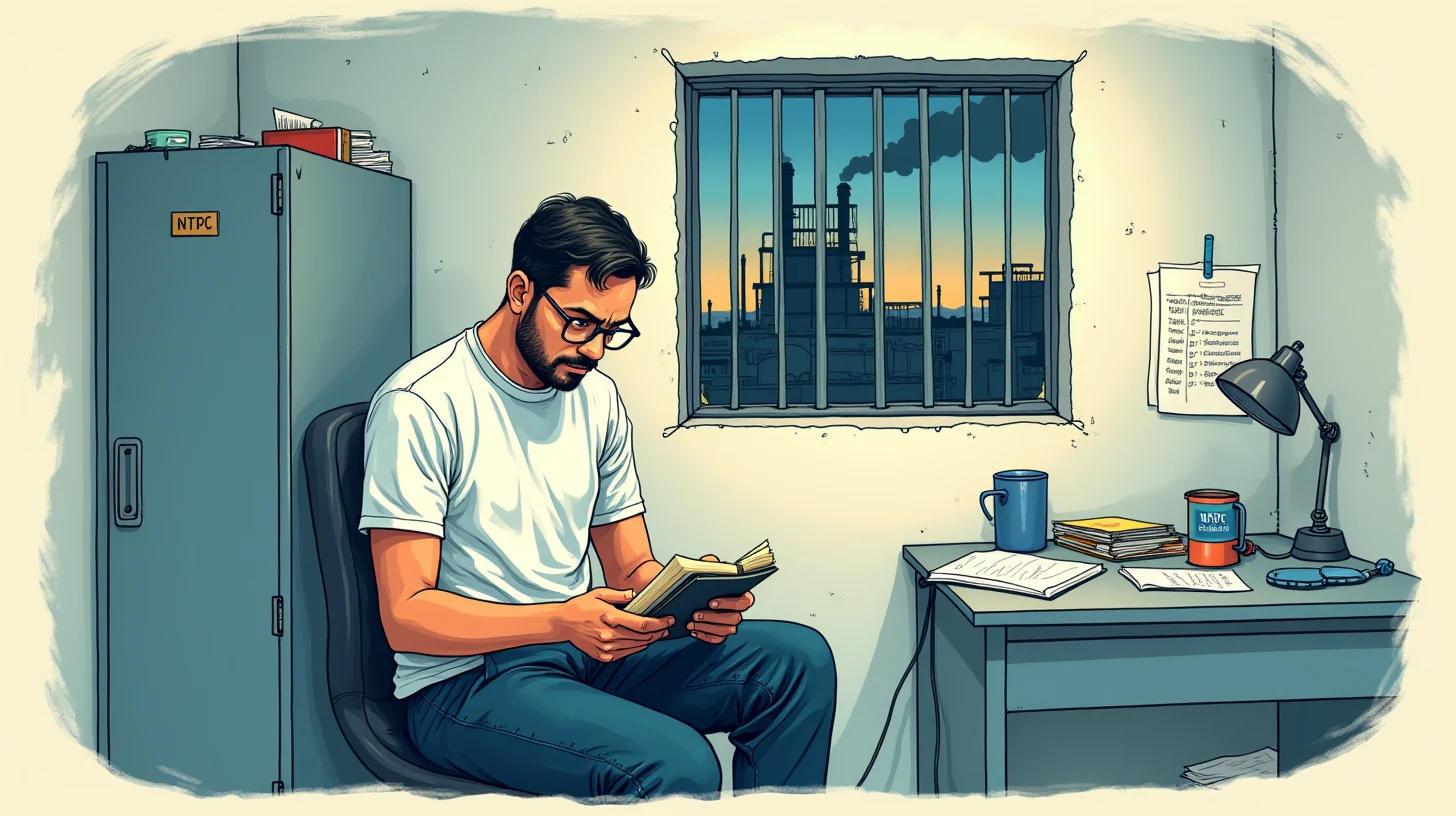
He has worked at NTPC Barauni Thermal Power Station for eight years — first as a graduate apprentice for two years, and then as a permanent mechanical engineer since 2016. NTPC Barauni is seventy kilometres south of Patna, in Begusarai district. It is a 500-megawatt coal-fired power plant built in 1984, and it supplies roughly forty percent of Bihar's electricity. Raj's job is to manage the boiler systems — the coal combustion, the steam flow, the turbine efficiency, the cooling loops — and to oversee the routines that keep a half-century-old machine burning coal reliably enough that three hundred thousand households in Patna don't wake up in the dark.
His wife Pooja, thirty-six, is a schoolteacher at St. Xavier's High School in Patna. Their son Arjun is fourteen; their daughter Anika is ten. Every morning, Pooja wakes at five-thirty to prepare breakfast while Raj drives to the plant if it is his on-site week, or wakes at six-thirty if it is his off-site week and he is working from the Patna administrative office. This rhythm has held steady for eight years. What changed last year was that the rhythm became a trap.
🗓️ The annual ritual
Every winter and summer, NTPC Barauni shuts down its boiler for planned maintenance. A winter shutdown runs December to January; a summer shutdown runs April to May. The shutdown is not optional. Coal plants age. Boiler tubes accumulate ash deposits. Turbine blades collect micro-fractures. Every three to five years, the plant requires a major overhaul: tube replacement, blade inspection, economizer cleaning. These take four to six weeks of continuous on-site work.
During a shutdown, the entire engineering team — roughly fifty mechanical engineers, twenty electrical engineers, a dozen instrumentation specialists — camps at the plant. The site has a dormitory wing with narrow single-bed rooms and a shared kitchen. The work schedule is nominally eight hours a day, but in reality, it is continuous: a team works around the clock in rotating shifts. Boiler tubes are opened during the day for visual inspection and replacement; night shifts manage the logistics of preparing new tubes, organizing heavy equipment, keeping the temporary workshops running. No one sleeps more than four hours at a stretch. Most engineers lose two to four kilos over the six-week period.
Raj had managed this routine since 2016 — three shutdowns a year, four to six weeks each, roughly four to six months of cumulative on-site time annually. It was exhausting in the way that forest fires are exhausting: intense, bounded, and necessary. The plant runs most of the year. The shutdown is an understood interruption.
In 2024 and 2025, something shifted. Raj came home from shutdowns quieter. His lower back began to hurt — sitting in the cramped on-site engineer's room for eighteen hours a day, reviewing valve specifications and boiler maintenance schedules, will do that. In March 2025, after a six-week summer shutdown, he developed a peptic ulcer that sent him to a private clinic in Patna, where a gastroenterologist prescribed omeprazole and a strict diet. The clinic visit cost ₹4,200 including the consultation and blood work.
- 🗓️
2016–2021 — The routine holds
Three shutdowns per year, four to six weeks each. Exhausting but bounded. Raj advances from apprentice to junior engineer (JE), earns ₹6–7 LPA, manages the rhythm with Pooja's support and three days' recovery time between shutdowns.
- ⚠️
2023–2024 — Inflation hits
Education costs escalate (school fees ₹1.2 lakh/year). Mortgage payments tighten. Raj volunteers for extra on-site shifts to increase overtime pay. Shutdown recovery time drops from three days to one. Back pain begins.
- 🔴
March 2025 — First crisis
Peptic ulcer diagnosed after summer shutdown. Clinic costs ₹4,200. Omeprazole prescribed. Raj dismisses it as stress. Returns to same schedule for winter shutdown.
- ⏰
April 2026 — Pattern emerges
Summer shutdown looms. Sleep troubles, joint pain, emotional flatness. Before he boards the minivan to the plant, the agent identifies a three-year burnout trajectory.
He had looked at the clinic report, nodded, taken the tablets, and returned to the same schedule. The shutdown was not optional. The overtime pay was necessary for the mortgage and the school fees. The pain and fatigue were, he assumed, the cost of being a forty-something engineer with two children in an inflationary economy.
⚠️ What very nearly happened
The winter shutdown of 2025–26 ran from December through January. By mid-January, Raj had been on-site for four weeks. His sleep was fragmented — he would fall asleep around ten at night in the narrow dormitory room and wake at one in the morning, his mind running through next day's boiler-inspection checklist, unable to return to sleep until the shift alarm at six. He had lost three kilos. His lower back pain had spread into his right hip. He was grinding his teeth at night; in the morning, his jaw felt locked.
In the final week, the lead structural inspector, Ravi Nath, asked him if he was all right. Raj said he was fine. The shutdown was nearly done. Ravi did not push.
He came home on a Saturday in late January and spent the first forty-eight hours in a kind of hollow fatigue — not asleep but not awake, moving through the flat, eating the food Pooja had prepared, nodding at Arjun's story about a cricket match. On Monday, he returned to the Patna office for a week of administrative work before the next on-site stretch began.
The engineer tasked to coordinate the summer shutdown schedule — April through May 2026 — sent around the draft rotation list in late March. Raj was assigned to lead a major boiler-tube-replacement project that would begin in late April. The role was a promotion of sorts: it meant higher pay but also meant he would be on-site for the full six weeks with only two days off. He saw the assignment and agreed without hesitation.
"मुझे लगता है कि मैं अपने आप को हर साल खरید सकता हूँ — यानि ज़्यादा काम करूँ, अधिक पैसे लूँ, और दर्द मेरी समस्या है।"— I thought I could buy my way out of this every year — work harder, earn more, and live with the pain.
What very nearly happened was the summer shutdown of 2026, on the same schedule and the same trajectory. Raj would have arrived on-site in late April, managed the boiler-tube project for six weeks on fractured sleep and back pain, returned in June with another ulcer or worse. By autumn 2026, he would have logged twenty-two months of accumulated on-site time over eight years, an average of nearly three months per year in industrial dormitories, sleeping four hours a night, eating irregular meals, managing a job where one mistake in the boiler tubes could cause equipment damage worth crores.
He had not yet cancelled the assignment. He had not yet told Pooja. He was waiting for the next shutdown to be, somehow, different. The pattern had been clear for three years. He was not seeing it.
🌗 What changed
In the first week of April 2026, Pooja's brother Ashok visited from Delhi. Ashok works as a product manager at a venture-backed healthtech startup; he is the kind of person who reads research papers on sleep deprivation and thinks about preventive care. On the first evening, he asked Raj about the summer shutdown, and Raj explained the rotation and the boiler-tube project and the extra pay. Ashok listened and said nothing.
After dinner, Ashok asked to install the GabFORGE agent on Raj's phone — not to lecture him, but to try something. Raj agreed, skeptical. Ashok set the language to Hindi and typed a question into the agent's search bar: "Mechanical engineer, 8 years at power plant, 3 shutdowns per year, 4–6 weeks on-site each, sleep 4 hours per night during shutdowns, back pain since 2024, peptic ulcer in 2025, next shutdown April 2026 for 6 weeks. Burnout risk?"
"राज, ये डेटा 2023 से देखने से स्पष्ट है: तीन साल से, हर साल आप ज्यादा थक जा रहे हैं, कम सो रहे हैं, और शारीरिक दर्द बढ़ रहा है। ये सिर्फ 'बुरी बात' नहीं है — ये burnout का trajectory है। अगर आप अप्रैल 2026 में छः हफ्तों के लिए जाते हैं — वो भी lead role के साथ — तो चिकित्सा समस्या ना रहकर एक crisis बन जाएगी।"
(Raj, the pattern is unmistakable if we look at data from 2023 onward: for three years, each year you are becoming more exhausted, sleeping less, and experiencing more physical pain. This is not just "a bad thing" — this is a burnout trajectory. If you go on-site for six weeks in April 2026 — especially in a lead role — the medical issue will escalate from chronic stress to a crisis.)
Raj read it slowly. He read it again. He showed it to Ashok, who said nothing, just nodded.
The agent then walked him through an alternative. Instead of April's six-week lead role, Raj could request a reassignment: two weeks on-site in an advisory capacity (₹25k extra), paired with remote work from Patna during the remaining four weeks. This would reduce his on-site load from thirty days to fourteen days, preserve most of the overtime pay, and allow him to recover between on-site periods.
"बोझ कम करने का ये तरीका 2024 में भी काम कर सकता है — अगर आप इसी तरीके से सोचते हैं तो NTPC Barauni में आप अगले 15 साल काम कर सकते हैं बिना crisis के। Alternative: BSPHCL जाने का भी रास्ता है, जहाँ shift work नहीं है, लेकिन rural hardship posting की शर्त है। दोनों रास्ते मिल सकते हैं अगर आप 3–6 महीने की planning करें।"
(This reduced schedule could work in 2024 as well — if you think through this approach, you can work at NTPC Barauni for the next fifteen years without a crisis. Alternatively, there is a path to BSPHCL, where there is no shift work, but rural hardship postings are a condition. Both paths are viable if you plan three to six months ahead.)
Ashok left on Wednesday. Before he left, he asked Raj to send him a message once the reassignment request had been submitted.
What it does
- 🔍Surfaced the burnout pattern by connecting three separate medical and sleep problems (ulcer, back pain, fractured sleep) to the shutdown schedule. Named what Raj was experiencing as a trajectory, not a coincidence.
- 📊Quantified the cost: projected forward showing that a six-week shutdown at 38, following a three-year escalation, would likely result in serious health consequences and potential medical leave that would cost his salary entirely.
- 🧭Presented two concrete alternatives: the modified two-week rotation for summer 2026, and the longer-term BSPHCL transfer option, with specific timelines and financial trade-offs.
What it does not do
- 🔒Never told Raj what to decide — it named the pattern and offered options. Raj chose the modification himself, after reading what the agent showed him.
- 💼Never contacted NTPC management or Raj's supervisors. Raj prepared the request himself and submitted it through the standard reassignment channels, with Ashok's encouragement.
- ⚕️Never replaced medical consultation. It identified a burnout trajectory based on Raj's own data; for ongoing back pain and ulcer management, Raj saw a gastroenterologist and physiotherapist.
Raj submitted the reassignment request to his section head, Ram Lal, on Friday of the same week. He framed it as a request to lead a smaller project (tube-inspection advisory role, two weeks on-site) while continuing to contribute design input remotely. He mentioned that the back pain had been worsening and that a reduced on-site stretch would help him manage it.
Ram Lal, who had been supervising engineers at Barauni for twelve years, said yes without hesitation. He said that Raj was not the first engineer to burn out on the shutdown cycle, and that a two-week rotation was more sustainable than six. The project would still get oversight; Raj would preserve his health; the overtime pay would remain (roughly ₹80k instead of ₹120k, a trade-off Raj accepted). The reassignment was approved in late March, two weeks before the shutdown began.
In April 2026, Raj went on-site for fourteen days. He stayed in the engineers' dormitory, reviewed the boiler-tube specifications, performed visual inspections, and gave technical guidance to the junior engineers doing the hands-on work. At night, he slept in his own bed in Patna. He came home for dinner with Pooja, Arjun, and Anika four nights a week. The shutdown completed on schedule. He did not develop an ulcer.
🧭 Why we built it
There are roughly fifty thousand thermal-power-plant engineers across India — boiler specialists, turbine mechanics, instrumentation engineers, operations managers — in plants operated by NTPC (the largest state-owned thermal operator), private utilities, and state power companies. Among them, a large but uncounted population who are in the second half of their career (35–50 years old), managing shutdowns that still follow the old patterns: four to six weeks on-site, night shifts, family separation, and the compounding physical wear of a job that was designed for engineers in their twenties.
The shutdown cycle is necessary. Coal plants age. Maintenance cannot be deferred. The safety and reliability of the grid depend on engineers like Raj managing these shutdowns well. But the cost of managing them well while aging is a problem that individual engineers solve badly because they cannot see the pattern. Raj's peptic ulcer and back pain were real medical events; they were also data points in a three-year burnout curve. He could not see the curve from inside it. Most engineers in his position cannot.
What is less visible is that the reassignment he chose — fourteen days on-site instead of forty-two, with remote-work alternatives — is not a special privilege. It is a standard option at large power plants once someone asks for it. It exists in NTPC's policies. It exists because other engineers before Raj had burned out badly enough that the organization learned to offer flexibility. But the information that this option exists, and that it is available to someone before the crisis, does not travel well through the informal networks where Raj works. He had not known.
The alternative Raj did not choose — transferring to BSPHCL, where shift work is not a feature of electrical engineer roles — is also available, but it would require him to accept a rural hardship posting (Munger, Katihar, or Motihari) for three to five years, and his family would not relocate. So he stayed at NTPC, but he changed the terms.
Modified rotation (chosen)
14 days on-site per shutdownTwo weeks on-site per shutdown, four shutdowns annually. On-site work is advisory and oversight, not continuous hands-on. Sleep intact, back pain stabilized, ulcer risk drops. Overtime pay ₹80k instead of ₹120k, accepted trade-off. Sustainable for 10–15 more years.
Internal transfer to planning
No shift work after 3–5 yearsMany NTPC engineers transition from operations to planning/training/administration roles after 10–12 years on-site. Salary drops minimally; pension remains unchanged. Pooja and the children stay in Patna. Raj could apply in 2027–2028 once he has stabilized the modified rotation.
BSPHCL transfer (hardship posting)
No shift work, rural posting requiredBSPHCL grid-operations roles do not include shutdown shift work. But the condition is a hardship-zone posting (Munger, Katihar, Motihari) for 3–5 years. Family would need to relocate. Raj deferred this option; it remains viable if the shutdown cycle accelerates again.
We built this for the thermal-power-plant engineer who is in year six or seven of a job that is aging him faster than the calendar. The pattern is visible in other safety-critical, on-site-intensive work — oil-rig drilling, chemical-plant operations, nuclear power — but the power-plant shutdown cycle is specific: it is necessary, it is brutal, and it is not going to become less necessary. What changes is whether someone, sitting with the engineer and looking at his own data, names the pattern early enough that he can choose a different terms instead of waiting for a medical crisis to choose it for him.
Raj chose his modification in March 2026 — before the shutdown, before the crisis, with time to request and be approved for a change. That is the outcome we wanted. The specific form of the change matters less than that it happened early.
🌱 What we hope happens
Ashok sent us a message in mid-May, after the shutdown had ended. He said Raj seemed lighter — less burdened in the jaw, sleeping better, able to sit through a meal without his back seizing up. He had started physiotherapy for the back pain, seeing a specialist twice a week in Patna. The gastroenterologist had taken him off omeprazole; the ulcer had not recurred. Pooja had mentioned that Raj was coming home at a reasonable hour on non-shutdown weeks, reading a newspaper over breakfast instead of checking emails. These are small things. They are what a sustainable career looks like.
What we hope happens is that Raj continues to work at NTPC for another decade or more — not in a state of managed crisis, but as the experienced engineer he is, contributing expertise without sacrificing the structure of his life. For Arjun and Anika, it means a father who is present on most weekday evenings, not someone who disappears into a dormitory for six weeks at a time, multiple times per year. For Pooja, it means a husband who is not grinding his teeth at night or coming home with a new physical complaint each quarter.
The coal plant still needs to shut down. The boiler tubes still need to be replaced. Raj's expertise is still needed. What changes is that he is not destroying himself to provide it.
There are fifty thousand engineers like Raj across Indian thermal plants. Many of them will face this choice between the shutdown cycle and their health in the next three years. The product is free at gabforge.in — it works in Hindi, English, Marathi, Telugu, Kannada, and Bengali, and it knows the structure of power-plant shutdown schedules, the medical consequences of chronic sleep deprivation, and the reassignment options at NTPC, NTPC-SIL, NTPC-REL, and state power companies. Set it up on a phone in the dormitory. Ask it about the pattern you have noticed in the last three years. We will not speak for you; we will read the pattern with you, and show you the options that were there the whole time but did not travel through the informal networks.
It is free forever for this user — the mechanical engineer in Patna, managing a job that is necessary and aging him too fast — and it will remain free.