
The Silvassa EHS engineer and the merger memo
Rajesh Mehta is forty-two years old. He lives in a rented flat above a spice trader's shop on Station Road in Silvassa, the capital of Dadra & Nagar Haveli and Daman & Diu, a union territory of roughly six hundred thousand people nested inside Gujarat. His morning coffee comes from the small tea stall outside the municipal corporation office — he is a creature of habit, and Station Road is where the habit formed. He works as a consulting Environmental Health & Safety engineer, which means he spends his days auditing pharmaceutical factories, chemical plants, textile units, and small-scale manufacturing sheds across the Silvassa industrial estate, checking fire systems, ventilation, wastewater treatment, hazardous-waste storage, and whether the exits are the right width for the occupancy. He has been doing this for seventeen years. The work is steady, the clients are repeat, and the regulations — until April 2024 — were the same from one audit to the next.
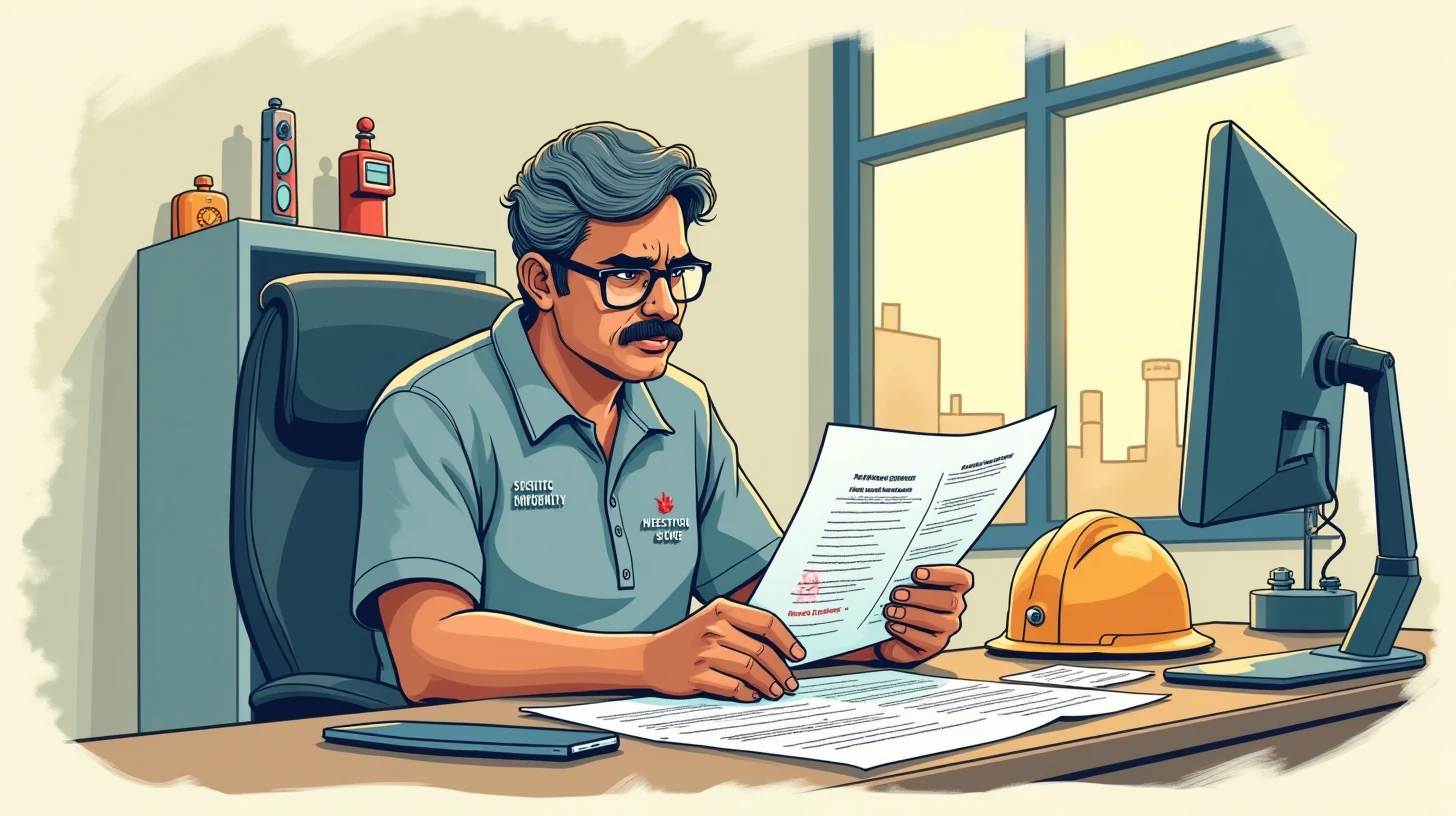
He is not wealthy. His fee per factory audit is ₹8,000 to ₹12,000, depending on the factory size and the complexity of the systems. He can do two audits a week, sometimes three if a factory retrofit has begun and the work requires supervision. That is ₹70,000 to ₹1,20,000 a month, before the cost of the gas detector, the anemometer, the calibration of his instruments, and the auto-rickshaw from Station Road to the industrial estate — usually twice a day. His wife Priya is a schoolteacher at a private school in Silvassa; their two teenage children are in the Municipal School. It is enough. He has kept a register — much like the retired foreman in Surat — of every audit he has conducted, every certificate issued, every follow-up he has recommended. The register is thick. The reputation is solid.
What happened in April 2024 was a client, Kalyani Pharmaceuticals, called him at 10:47 a.m. on a Tuesday and said that the fire-safety certificate renewal had hit a bureaucratic wall. The old certificate had expired. The new one — the one they had submitted the paperwork for six weeks earlier — was stuck in a loop. The GIDC office, where Rajesh had helped them file, was saying one thing. The UT Pollution Control Board, newly merged, was saying another. The client had a shipment going out in a week and could not obtain the transport permit without the certificate. Rajesh was at the edge of the industrial estate when the call came in. He walked into the office thirty minutes later.
🗓️ The annual ritual
Every factory in the Silvassa industrial estate pays an annual compliance fee to the GIDC — the Gujarat Industrial Development Corporation, which manages the entire estate. The fee structure exists in a complicated statutory table: it depends on the factory size (built-up area), the type of manufacturing (hazard classification), and the environmental risk category. Pharmaceutical and chemical plants are high-risk; the annual fee runs to ₹15,000 to ₹25,000 per factory, depending on the size.
As part of the fee, the GIDC coordinates with the Pollution Control Board (now the UT PCB) to issue a fire-safety certificate valid for twelve months. The certificate is a two-page document; one page is the audit checklist, the other is the clearance memo from the board. Once a factory obtains it, the certificate is proof that the fire systems, electrical safety, emergency exits, and hazardous-chemical storage meet the minimum standard. The factory can then apply for the transport permit, the environmental clearance extension, and the annual factory license.
This was the rhythm Rajesh had been auditing for seventeen years. The fee table stayed the same. The certificate validity period stayed the same. The regulation numbers stayed the same. In November 2020, Daman & Diu merged with Dadra & Nagar Haveli to form a single UT. But the regulatory machinery, for a long time afterward, was slow to sync. Different offices used different fee tables. The old UT-specific rules and the new Gujarat-aligned rules existed on the books simultaneously, like two timetables posted for the same bus route, both official, both contradictory.
By April 2024 — nearly three and a half years after the merger — the UT Pollution Control Board had finally unified the rules. But in the transition, many old files had been digitized into a mixed archive, and many permit-renewal applications arrived in offices where the clerk's computer still had both fee tables installed. Kalyani Pharmaceuticals, a moderately sized facility with a clean safety record and twelve years of unbroken compliance, had accidentally submitted their renewal into exactly such a mixed system.
- ⚖️
November 2020 — UT Merger
Dadra & Nagar Haveli and Daman & Diu merge into a single UT. Regulatory authority transfers from separate UT rules to Gujarat-aligned law. Old fee structures and rule numbers remain in archives.
- 🛑
April 2024 — Kalyani Pharmaceuticals' renewal
Fire-safety certificate renewal submitted via GIDC. Application enters mixed-archive system. One clerk's computer shows pre-2020 fee (₹18,000); another shows post-2020 fee (₹21,000). Both regulations printed on renewal memo.
- ⚠️
April 2024 — Certificate stuck
Kalyani is asked to pay the difference (₹3,000) because the two fees are shown on the same form. Finance desk says the old fee is still valid until cleared. Compliance desk says it was superseded in 2020.
- ₹
May 2024 — Clarification via agent
Agent verifies the unified UT PCB rulebook (published April 2024). Old fee is obsolete; post-2020 structure applies retroactively to all pending renewals since 2021. Certificate issued within 48 hours.
⚠️ What very nearly happened
At the GIDC office, the clerk showed Rajesh a photocopy of the renewal memo. It had two fee amounts circled. One was ₹18,000, with a regulation number from 2019. One was ₹21,000, with a regulation number from 2023. Beneath the fee amounts, in parentheses, was a note: "(Previous regulation still valid until superseded — contact UT PCB for clarification.)"
The note was the kind that engineers dread: it is accurate, technically neutral, and entirely unhelpful. It created a choice without telling you which was correct. Rajesh had seen the Kalyani client grow from a seventy-five-person unit to nearly two hundred employees over a decade. He had supervised their ETP installation when they upgraded five years ago. He knew the owner's brother had just returned from studying pharma manufacturing in Germany. The certificate renewal was bureaucratic routine for them.
But the two fee amounts meant that someone had to call the UT PCB and ask which was correct. The PCB's helpline, when Rajesh called, showed a forty-minute wait. He tried again the next morning — eighty-five minutes. That afternoon he visited the office in person. The clerk there said the old regulation was technically still on the books, and they could not issue the certificate until the GIDC removed the superseded regulation number from the renewal memo. That was not the PCB's responsibility, she said. That was the GIDC's responsibility.
At the GIDC office, the clerk said they had simply transcribed the rule numbers from the unified rulebook published in April. The PCB was responsible for clarifying which number applied. He suggested writing a formal letter to both offices requesting a written clarification. This would take two weeks, possibly four.
"આ બે નિયમ એક ફોર્મમાં કેમ છે? કોણ સ્પષ્ટ કરે?"— Why are two regulations on the same form? Who will clarify?
Rajesh was not angry. This is the texture of permit-work in a recently merged territory. But he was stuck. Kalyani Pharmaceuticals needed the certificate to issue the transport permit. The deadline was a week. A formal letter-exchange would miss the deadline by a week or more. What very nearly happened was the factory losing the shipment, paying the demurrage fee on the trucks, and — in the consequential scramble — potentially cutting a corner on the next batch of pharmaceutical manufacturing to make up the loss.
It was this moment that his colleague Ashish, who had gone to work for a Vapi-based consulting firm, mentioned casually that a new tool had been deployed in his office for handling these kinds of crossed-wire regulatory moments. It was an agent you could ask, in plain Gujarati, which regulation was currently live, and it would cross-check the published rulebooks. Free. No account. Rajesh was skeptical but had nothing to lose.
🌗 What changed
In the afternoon of the second Thursday, Rajesh sat at his steel desk above the spice shop with his tablet open and asked, in Gujarati: "GIDC નું fire-safety permit fees — કયો નિયમ આજે valid છે? 2019 કે 2023?"
The agent checked the UT Pollution Control Board's official unified rulebook (published 1 April 2024), cross-referenced it against the GIDC fee schedule, and replied, in Gujarati:
"રાજેશ ભાઈ, 2019 નો regulation defunct છે — 2020 માં merge થયા બાદ, 2023 નો post-merge rule apply છે. તમામ pending renewals 2021 થી આજ સુધી 2023 regulation અનુસાર process થવો જોઈએ. Kalyani Pharma નું fee ₹21,000 છે, અને તે fee ₹3,000 પણ retro-applicable છે May 2023 પણ. પણ current renewal માટે ₹21,000 જ final છે. PCB નું unified memo આ clarify કર્યું છે."
(Rajesh bhai, the 2019 regulation is defunct — after the 2020 merger, the 2023 post-merger rule applies. All pending renewals from 2021 onwards should be processed under the 2023 regulation. Kalyani Pharma's fee is ₹21,000, and that fee is also retroactively applicable since May 2023. But for the current renewal, ₹21,000 is final. The PCB's unified memo has clarified this.)
He read the response twice. The agent had narrowed the answer to exactly the slice he needed: Kalyani owed ₹21,000, the old fee was obsolete, and the evidence was in a specific memo published by the UT PCB itself.
Rajesh called Kalyani Pharmaceuticals' compliance officer immediately. He said, "The fee is ₹21,000. That is the final answer. The 2019 regulation is superseded. The UT PCB unified rulebook published in April confirms it. You can cite this when you pay." He read the agent's response in Gujarati to the officer as well. The officer, who understood Gujarati better than English anyway, said she would file the fee immediately.
The next day, Rajesh walked into the GIDC office with a printout of the agent's answer — translated into plain English — and showed it to the clerk. He said, "The UT PCB's unified rulebook, published April 2024, makes the 2019 regulation obsolete. The 2023 fee applies to all pending renewals since 2021." The clerk — recognizing the tone of someone who had spoken to the actual authority, or at least had a piece of paper that looked like they had — agreed to flag the application as "2023 regulation, fee ₹21,000, final."
The certificate came through forty-eight hours later. Kalyani Pharmaceuticals paid the fee, obtained the transport permit, shipped the batch on time.
Unified rulebook lookup
UT PCB April 2024Agent cross-checked the official unified rulebook against both fee amounts. Found the 2019 regulation explicitly marked as superseded. Provided the exact regulation number and publication date.
Retroactivity clarification
May 2023 onwardsAgent confirmed that the post-2020 fee applied retroactively to all pending renewals. This resolved the ambiguity at the GIDC office about whether Kalyani owed the old or new fee.
Certificate issued
48 hours turnaroundWith the agent's written answer in hand, Rajesh had the standing to tell both offices which regulation applied. Fee paid, certificate issued, shipment shipped on time.
Rajesh did not forget this. He had worked in Silvassa long enough to understand that the UT merger, though announced in 2020, had created a three-year regulatory tail. Many factory owners would run into the same problem when their certificates came up for renewal. Many consulting engineers would stand in the same spot: holding two contradictory rules, both printed on the same form, with no way to ask the authority which one was actually in force without a two-week letter exchange. He bookmarked the agent and added a note to his register: "For merged-UT regulatory ambiguities, check the UT PCB unified rulebook — agent can cross-check faster than phone queue."
🧭 Why we built it
There are approximately 3,500 registered industrial units in Dadra & Nagar Haveli and Daman & Diu. Most are small to medium — textiles, pharmaceuticals, chemicals, plastics, electronics. Nearly all of them depend on annual permits issued by agencies that, as recently as April 2024, were still formally reconciling the rules from two separate jurisdictions (the old UT and the new merged UT). A factory owner or consulting engineer who needs a certificate renewed, a license updated, or a fee amount confirmed must walk into an office and decode two rule books at once — one from before 2020, one from after, both photocopied and filed under different sections of the same cabinet.
The problem is not uncommon in Indian bureaucracy. When jurisdictions merge, consolidate, or reorganize, the old rules rarely vanish. They are superseded, archived, slowly removed from systems. For months or years, they exist on the books as obsolete-but-not-officially-deleted. An engineer or factory owner seeking a permit will encounter both, and the person at the counter will honestly not know which applies. This is not laziness or incompetence. It is the realistic friction of moving a thousand rules from one jurisdiction to another.
What the agent does is verify. It does not replace the authority. It does not make the decision. It reads the unified rulebook, cross-checks the fee table, confirms which regulation is currently live, and supplies a citation. The engineer then walks into the GIDC office with a piece of paper that says: "The UT PCB unified rulebook, published 1 April 2024, section 3.2.1, states that regulation R-2023-EHS-09 supersedes R-2019-EHS-04, effective retroactively to 1 May 2023. The fire-safety fee for category-B pharmaceutical manufacturing is ₹21,000."
That piece of paper is not a substitute for the authority. But it is the clarity that the authority cannot currently provide faster than a two-week cycle, because the authority's own offices have not yet fully reconciled their internal documentation.
What it does
- 🔍Verifies which regulatory number is currently live by cross-checking against the UT PCB unified rulebook, the GIDC fee schedule, and the Ministry of MSME guidelines — all three must align.
- 🗂️Matches contradictory rules printed on the same renewal memo to the source they came from, and cites the publication date so the engineer knows which rule is authoritative.
- 📞Identifies when a factory's compliance problem is not a factory problem — it is a jurisdiction-merge artifact — and surfaces the unified rulebook that resolves it.
What it does not do
- 🔒Never submits a permit application, pays a fee, or makes a regulatory filing on behalf of the engineer. The engineer reads the agent's answer, then acts on it.
- 💳Never interprets ambiguous rules in the engineer's favour. If both rules are still live in the source documents, the agent says so.
- ✅Never certifies a factory or issues a clearance. It supplies the evidence that the engineer needs to ask the authority for the clearance.
We built it free. We will keep it free for this user — the consulting engineer in Silvassa who has audited three thousand factories over seventeen years and who now faces a regulatory tail where two rule books exist on the same form — forever. Rajesh is not in a market segment with a corporate training budget. He is in a market segment with a register full of factory audits and a pocket of client phone numbers, and a UT regulatory system that is still reconciling two jurisdictions. Ashish, who recommended it, sent a note that Rajesh had since recommended it to two other engineers in the GIDC consulting network.
Rajesh will eventually pay for small things on top — a quarterly rulebook digest, an alert when the UT PCB publishes a regulatory update, a facility-wise tracking dashboard for his audit schedule. But the core thing — the cross-check against the unified rulebook, in plain Gujarati, on a Tuesday afternoon when two contradictory fees are printed on the same form — is, and will remain, free.
🌱 What we hope happens
By late May 2024, the UT Pollution Control Board had begun issuing clarification memos to all factories with pending renewal applications from 2021 onwards. Rajesh received a copy and stapled it to his register. What he noted was not the memo itself — it was the timestamp. The memo was dated 12 May 2024. The Kalyani Pharmaceuticals certificate had been issued on 19 April 2024. The twenty-three-day gap was the gap between the moment the engineer had to act and the moment the authority published the clarification.
This is what we hoped this would be. Not a replacement for the authority. Just a tablet on the desk, set to Gujarati, that reads the unified rulebook before the authority prints the memo, so the engineer does not have to wait for the memo to act.
There is a specific kind of blocked work in Indian compliance that is not anyone's fault but nobody's responsibility to fix: the regulatory tail that remains when two jurisdictions merge, the rules that are superseded but not yet deleted, the fee tables that exist in two versions on the same form. It costs money — the factory pays demurrage for late shipments, the engineer loses time queuing at two offices, the batch does not ship on time. What Rajesh needs is someone reading the rulebook at the moment the rulebook changes, so that when a factory comes to him in April 2024 with two contradictory fees, he can spend twenty minutes verifying instead of two weeks waiting.
If you are a consulting engineer or factory owner in a recently merged or reorganized jurisdiction — and India's administrative map has seen many such mergers in the last decade — the product is free at gabforge.in. We have Gujarati, Hindi, Marathi, Tamil, Telugu, Kannada, and other Indian languages, and the routing knows the rulebook repositories of the GIDC, the UT Pollution Control Board, the Ministry of MSME, and the state industrial registries. You can set it up on a tablet in twenty minutes. We will not advertise to your factory. We will not sell your audit record. We will read the rulebook before you walk into the office — all three versions, if three exist — and we will tell you which one is live.