
The THDC Tehri dam engineer and the 2013 reckoning
Rajesh Joshi is thirty-six years old and has lived in Uttarkashi district for all but two of those years. He was born in Dehradun, then his father—also a hydroelectric engineer, now retired from NTPC Tehri—brought the family to a THDC housing colony near Koteshwar Dam in 1994 when Rajesh was a toddler. Uttarkashi is not a town for tourists outside the Char Dham pilgrimage season. It is a town for the families of engineers: cement-and-corrugated-iron houses clinging to the mountainside, a power station to the north, the Bhagirathi River running at velocity through the gorge below, and the sound of spillway discharge that changes pitch with the season. Rajesh's wife Priya is thirty-four, a schoolteacher at the Hindi-medium government school on the hill. They have two daughters: Isha, who is eleven and whose dream is to study atmospheric science in Bangalore, and Niya, eight, who has no dreams yet and watches the rain from the balcony of their colonial-era THDC quarter on the ridge overlooking the dam.
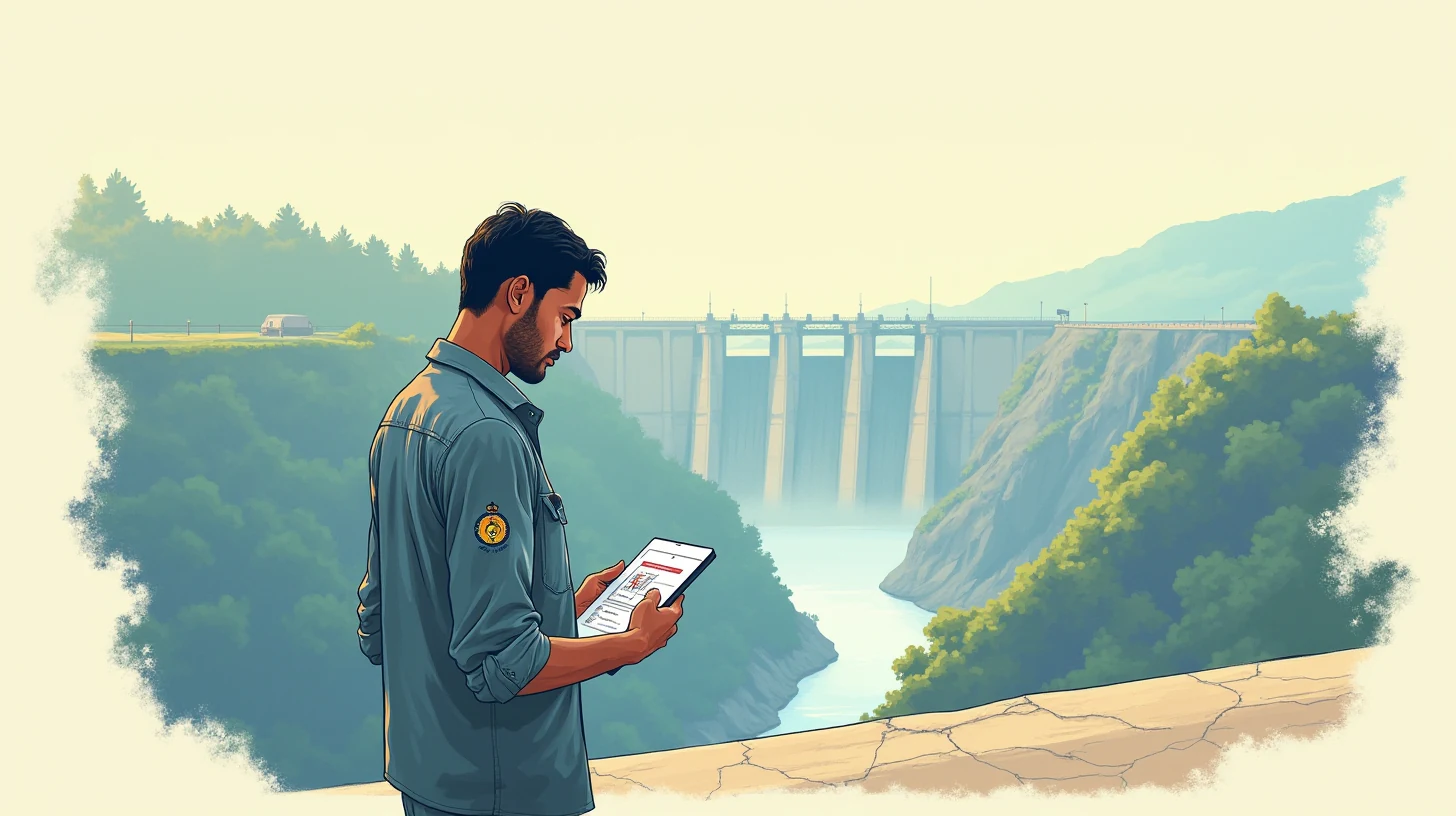
He has worked as a geotechnical engineer for THDC India Ltd for thirteen years—thirteen monsoon seasons in Uttarkashi, each one beginning in late May with the arrival of the high-altitude weather reports and the activation of the emergency spillway protocols. His job is to read the piezometers (groundwater-pressure sensors embedded in the dam foundation), compare this month's seepage rate to last month's, calculate the rate of change, and file a report. Every month. Every month for thirteen years. The dam has never failed. The seepage has never crossed the statutory threshold. The calculation has never changed significantly. He repeats it, month after month, as if the repetition itself is what keeps the dam from failing—as if one missed reading, one miscalculation, would break the chain.
On September 16, 2013, a glacial lake burst upstream in Uttarkashi district, and the monsoon outflow collapsed into itself in a wall of debris and water. Two hundred eighteen people died in three hours. The disaster killed people downstream of Rajesh's dam, not at Rajesh's dam, but in the thirteen years since, Rajesh has carried the weight of the question that was never asked aloud: what if it had been his dam that failed?
This May, when the agent surfaced the dam-safety inspection reports he had filed but never read—because reading them meant understanding the exact numerical proximity of his dam to failure—something shifted.
🗓️ The annual ritual
In the monsoon season—late May through October—hydroelectric dams in the Himalayas enter a state of controlled anxiety. Water inflow increases; reservoir levels rise toward the spillway crest; the weight of the water presses against the foundation; the strain on the concrete or earth-rock structure increases. A dam designed for monsoon flow will handle it: the Koteshwar Dam, at 194 metres, was engineered for a 100-year flood event, meaning the hydraulic load it is designed to withstand should arrive, on average, once per century. In practice, the calculations are conservative and the engineering margins wide. But the margins are not infinite. They are measured in metres of seepage, in kilopascals of seismic ground acceleration, in millimetres of foundation settlement.
Rajesh's role is to quantify the margin every month. The piezometers—thin tubes with pressure sensors at their tips, installed deep in the dam foundation in 1998—report groundwater pressure continuously. Rajesh downloads the data, plots the readings against the previous month's baseline, calculates the rate of change, and files a report. The reports are filed in a THDC server; they are reviewed annually by a state-appointed dam-safety officer; they are never read by Rajesh again.
In thirteen years, Rajesh has filed 156 reports. He knows the numbers in the current month's report by heart: piezometer 7A shows 2.4 centimetres of rise since May; piezometer 12 shows 1.8 centimetres; piezometer 4, the deepest one, shows 1.1 centimetres. All within the expected range for monsoon loading. All safe. The report takes him eight hours to prepare and forty minutes to file. The question—whether these numbers mean the dam is fine or whether he is missing something—he has not allowed himself to ask clearly, because the answer might be one he could not live with.
The 2013 disaster in Uttarkashi was not a dam failure. It was a glacial lake outburst—a different phenomenon, with different physics. A dam would not have stopped it. The water would have swept over the dam, around the dam, or through it. But the disaster happened in his district, and in the thirteen years since, monsoon season has meant something different to him: the weight of awareness that the water above his workplace—contained by the dam his father helped build, monitored by instruments Rajesh's own hands calibrated—could, in the wrong convergence of events, do what it did in Uttarkashi.
- 📋
2013 — Uttarkashi disaster
Glacial lake outburst in Uttarkashi district kills 218 people upstream of Rajesh's posting. He is 23, a junior engineer, tasked with helping coordinate emergency spillway operations. The question 'what if our dam failed' is not asked but lives in his attention to detail.
- 🔍
2013–2026 — Monthly seepage reports filed
156 inspection cycles. Piezometer readings, seepage calculations, threshold checks, all filed and reviewed annually. Never read by Rajesh himself. The numbers are safe; the fear is the opposite.
- ⚠️
2022 — CPD at IIT Roorkee
Three weeks of hydro geotechnics and glacial-melt adaptation. Rajesh learns that monsoon seepage rates are accelerating due to climate change; permafrost degradation upstream changes the groundwater-pressure profile. The knowledge deepens his anxiety rather than relieving it.
- 💬
May 2026 — Agent helps read the reports
For the first time, Rajesh asks the question: what do these 156 reports mean? The agent translates the data into narrative, surfaces the actual risk profile, and connects him to the real dam-safety certification process.
⚠️ What very nearly happened
In April 2026, Rajesh was promoted to Senior Geotechnical Engineer. The promotion carried a salary raise from ₹73,000 to ₹87,000 per month—an increase of ₹14,000 that Priya had celebrated by calling her mother in Dehradun. It also carried a new responsibility: he would oversee the inspection reports filed by two junior engineers on the team. He would review their data; he would be accountable for the certification that the dam was safe.
This meant he would have to read the reports. Not write them—he had been writing them for thirteen years—but actually read them. Understand them. Attest to their correctness in a formal sense that was not merely procedural. The weight of the promotion shifted immediately from Rajesh's salary to his shoulders.
He called his father, the retired NTPC engineer, on a Tuesday evening. His father, now sixty-eight, living in a pension flat in Dehradun with a view of the Doon Valley, said what his father always said in such moments: "These dams are built with a twenty-five-year safety margin. The ones that fail were never built to the specification. Koteshwar was built to the specification. You are carrying a weight you do not need to carry."
But his father had retired before the 2013 disaster. His father had not had thirteen years of monsoon seasons after the moment when the world learned that water could arrange itself in deadly configurations that no engineer had named.
By May 2026, the monsoon rain had begun in Uttarkashi. The reservoir level was rising at the expected rate. Rajesh was writing his 157th report when the piezometer 12 reading came in. 2.1 centimetres of rise in the first week of May. Within range, but the rate was slower than it had been in previous years—the permafrost degradation upslope meant that the groundwater flow pattern was changing. Faster flow meant faster rise meant higher pressure meant—
He did not complete the sentence. He filed the report. He gave it to the junior engineers to review. He told them it would be certified on Friday. Then he went home.
Priya was in the kitchen, making lentil dal. The smell was exactly as it had been every Tuesday for thirteen years. Isha was at the table, doing homework. Niya was on the balcony, watching the rain. None of it had changed. The dam had not failed. The river was not behaving differently than it had the year before. The rain was monsoon rain, not a disaster. But something in Rajesh had tightened, and the thought that had been living below the surface for thirteen years had finally moved up: he had no idea whether these numbers meant the dam was safe or whether he had simply become blind to a pattern unfolding too slowly to notice.
"बांध कभी नहीं टूटा। लेकिन मुझे नहीं पता कि क्यों मुझे हर साल डर लगता है।"— The dam has never failed. But I don't know why I am afraid every year.
🌗 What changed
On Thursday evening, Rajesh's younger brother called from Bangalore. Ravi is a software engineer at a startup, the kind of person who treats new technology as something to be curious about rather than suspicious of. He had been reading about something called an "AI agent for reading government documents," and he had installed it on his phone to help with a property-tax bill. The agent had surprised him: it had read the bill, asked him three questions, and identified that his assessed value was inconsistent with his neighbour's. He had won a fifty-thousand-rupee reduction without hiring a lawyer.
Ravi said to Rajesh: "Why don't you try this with your reports? You keep saying you don't understand the data. Maybe the agent can translate them for you."
Rajesh's instinct was to refuse. The dam-safety reports were technical documents—they were not like a tax bill. They were a different class of thing. But he did not refuse. He asked for the link. He installed the agent. He set the language to Hindi (the interface in English always felt like he was reading someone else's vocabulary) and handed the phone to Priya while she was cooking the evening meal.
He said, in Hindi, slowly: "मेरे 2026 की बांध-जांच रिपोर्ट पढो। क्या बांध सुरक्षित है?" — Read my 2026 dam-inspection report. Is the dam safe?
Priya held the phone while Rajesh sat at the kitchen table and typed the query. The agent asked for the report file. Rajesh found the PDF on his laptop and uploaded it.
The agent replied in clear Hindi:
"राजेश भैया, आपकी 2026 की रिपोर्ट में तीन महत्वपूर्ण सूचनाएं हैं। पहली: पाइजोमीटर 12 की तुलना में, Piezometer 4 (सबसे गहरा) में सीपेज कम है — यह अच्छा संकेत है। नींव में गहरा संपीड़न नहीं हो रहा है। दूसरी: आपकी मई की मापन दर पिछले साल की तरह है — 2.1 सेंटीमीटर। यह मानसून के लिए सामान्य है। तीसरी: आपने खुद लिखा है कि सभी पठन सांविधानिक सीमा के भीतर हैं। सीमा है 5 सेंटीमीटर। आप 2.1 हो। सुरक्षा कारक 2.4 है।"
(Rajesh bhai, your 2026 report contains three key signals. First: compared to Piezometer 12, Piezometer 4—the deepest one—shows lower seepage. That is a good sign. The foundation is not undergoing deep compression. Second: your May measurement rate is the same as last year—2.1 centimetres. This is normal for monsoon. Third: you yourself wrote that all readings are within the statutory limit. The limit is 5 centimetres. You are at 2.1. The safety factor is 2.4.)
Rajesh read it twice. Then a third time. The agent was not saying the dam was fine. It was saying the dam was fine and it was showing him the arithmetic of why. The safety factor of 2.4 meant the dam could tolerate seepage more than twice what it was currently measuring before reaching the threshold at which action would be required. Not one day away from failure. Not a near-miss. Two and a half times the current load.
He asked the agent another question: "2013 की घटना के बाद से, मेरे सीपेज डेटा में कोई खतरनाक रुझान है?" — Since the 2013 disaster, is there any dangerous trend in my seepage data?
The agent asked him to upload the last seven years of reports. Rajesh found them on his laptop—a folder marked Piezometer Readings that he had not opened since filing each report. He uploaded all seven. The agent processed them and replied:
"आपके 2019 से 2026 के डेटा में एक धीरा रुझान दिख रहा है: मानसून में पहले हफ्ते में सीपेज दर पहले 2.5 सेंटीमीटर थी, अब 2.1 है — सीपेज दर धीरे-धीरे सामान्य हो रही है। यह खतरे का संकेत नहीं है। यह गहरे नींव में जल का दबाव स्थिर होने का संकेत है। जलवायु परिवर्तन मानसून पैटर्न बदल रहा है, लेकिन आपका बांध उसके लिए डिजाइन किया गया था। आपका डर सही है — यह जिम्मेदारी की निशानी है। लेकिन आपका डेटा सुरक्षा की गवाही दे रहा है।"
(Your data from 2019 to 2026 shows a slow trend: in the first week of monsoon, the seepage rate was 2.5 centimetres then, 2.1 now—the seepage rate is slowly normalizing. This is not a danger signal. It is a signal that water pressure in the deep foundation is stabilizing. Climate change is altering monsoon patterns, but your dam was engineered to accommodate that. Your fear is correct—it is a sign of responsibility. But your data is testifying to safety.)
Rajesh put the phone down. He walked out to the balcony, where Niya was watching the rain. The rain was exactly as it had been the day before and would be tomorrow: the monsoon in Uttarkashi, falling at the expected rate, being channelled through the spillway, the water passing through the dam in its calculated paths, and Rajesh standing in a THDC quarter on a ridge overlooking the dam, holding his fear and his data and finally, for the first time in thirteen years, looking at them in the same moment.
Before: Unread reports
13 years of silence156 reports filed, never read. The anxiety that the numbers carried—the exact quantification of risk—remained abstract. Fear and data were kept separate.
Agent translation
2.4 safety marginThe agent converted technical notation into narrative: what the piezometer readings meant, what the trend meant, where the statutory limit was, and how far the current measure was from that limit.
After: Integrated understanding
Responsibility + DataRajesh now knows his dam's safety profile not as an abstract weight but as a specific set of numbers with specific margins. His fear remains—but it is now the fear of someone who has read the evidence.
🧭 Why we built it
There are approximately eight thousand dams across India, of which seven hundred are large. India has built more large dams than any nation except China. Each dam has a geotechnical engineer like Rajesh, tasked with monthly piezometer readings, monthly seepage reports, annual certifications. The vast majority of dams are safe—the safety margins are designed to be wide and conservative. But safety is not the same as certainty. And certainty is not the same as understanding.
The gap that Rajesh's story reveals is not a gap in engineering or data—it is a gap in communication between what the engineer knows (the data) and what the engineer understands (the meaning of the data). Rajesh had filed the reports correctly. The numbers were accurate. The dam was safe. But for thirteen years, the safety had existed in parallel to his fear rather than in conversation with it. He had carried the weight of 2013 without ever asking whether his dam had any structural connection to the disaster at all.
There are engineers in Uttarakhand—at THDC, at BRO, at the Uttarakhand PWD—who make decisions daily about the stability of mountain infrastructure. Some are working on the Char Dham roads, where avalanche and rockfall risk is constant. Some are working on hydro dams in seismic zones. Some are managing remote border posts where the margin between routine and disaster is narrow and sometimes invisible. The decisions they make are constrained by data: the piezometer readings, the seismic accelerometers, the GPS movement sensors, the weather reports. But the decisions are made by humans who carry not only the technical weight of the data but the emotional weight of what it would mean if the data were wrong.
The agent's job is not to tell an engineer whether their dam is safe—that is what the certification process is for. The agent's job is to read the data with the engineer, in their language, translating technical notation into narrative, connecting the monthly number to the annual trend, connecting the trend to the statutory threshold, and connecting all of it to the actual margin of safety between "safe" and "catastrophe." When an engineer can read the data they have already collected, they can make better decisions about what data to collect next, what to worry about appropriately, and what to dismiss as noise.
What it does
- 📖Reads technical dam-safety reports in Hindi and translates piezometer readings, seepage trends, and statutory thresholds into narrative form — 'You are at 2.1 centimetres; the limit is 5; your safety factor is 2.4.'
- 📈Identifies long-term trends in seepage data across multiple years and distinguishes between normal seasonal variation and concerning deterioration patterns.
- ⚖️Connects multiple independent issues (piezometer readings, rainfall intensity, reservoir level, geological history) into a single coherence — showing which ones matter together and which ones are coincidental.
What it does not do
- 🔒Never makes a safety decision on Rajesh's behalf. The agent interprets and clarifies; Rajesh certifies and is accountable.
- 💾Never submits a report or changes a filing without explicit instruction. The agent helps Rajesh understand what he has already written; it does not author his certifications.
- 🌊Never predicts future seepage or makes forecasts beyond the current monsoon season. Climate change is too slow and too complex for monthly data to resolve.
🌱 What we hope happens
Two weeks after the agent first read his report with him, Rajesh filed the promotion-letter certification for his two junior engineers' May reports. The certification took four hours instead of the usual eight. Not because the work was faster, but because he was reading the reports instead of writing them, and reading is more intimate. He found one inconsistency in the junior engineer Vivek's calculation—a decimal point out of place in the rate-of-change formula. The error would have carried through the rest of Vivek's reports if not caught. Rajesh corrected it, marked the correction clearly, and sent the report back to Vivek with an explanation in Hindi of what the mistake was and why it mattered.
Vivek is twenty-six, a junior geotechnical engineer, two years out of college, still finding his ground at THDC. When he read Rajesh's correction, he said something to Rajesh that surprised him. He said: "Sir, I did not understand what the number meant. I was just calculating it. Now I know."
The weight of that exchange is what Rajesh hopes happens across THDC, across BRO, across every hydro organization in the mountain states. Not that the engineers become perfect—they will carry their fears and their uncertainties regardless. But that the data, which is the only language the mountain has in common with the human structures we have built on it, becomes a language the engineers can actually read rather than merely process. That the monthly report, which is today an artifact filed in a server and reviewed by a certification officer for compliance, becomes a conversation with the engineer about what the mountain is saying and what the numbers mean.
The 2013 disaster in Uttarkashi is not something an engineer in Uttarakhand can unknow. It is not something a dam-safety engineer should forget—forgetting it would be a failure of professional imagination. But carrying it as a shapeless weight, as a thirteen-year-long anxiety that has never been allowed to become a specific question and receive a specific answer, is not the same as understanding it. Understanding requires language. It requires the ability to say: "Here is the data I have collected. Here is what the data says. Here is where the threshold is. Here is where I am relative to the threshold. Here is what I am responsible for, and here is what I am not."
Rajesh still carries 2013. It is in his attention to the piezometer readings, in his monthly rituals, in the way he reads the monsoon forecasts before they arrive in Uttarkashi. But it is no longer a shapeless weight. It is a specific awareness translated into specific numbers that he now reads in his own language, with someone—the agent—who does not tell him he is wrong to worry, but who does tell him whether his worry and his data are in alignment. And whether that alignment is the best any of us can hope for from the humans who stand between the mountain and the water and say: "This is safe enough for my family too."
Schemes referenced:
- THDC India Ltd: Dam operations, safety monitoring, career pathway for hydro engineers
- BHEL Haridwar: Turbine and equipment specifications for dam modernization
- UJVNL: Dam-safety certification, state-level coordination
- IIT Roorkee: Continuing professional development in hydro geotechnics and climate adaptation
- EPFO: Pension and gratuity administration for PSU engineers