
The Alappuzha toddy-shop kitchen owner and the dual-license tangle
Rajan stood at the slotted counter of his Kallu Shaap on a Thursday morning in March, watching palm fronds drift across the grey water of the Vembanad backwaters, and he was angry in the way only a tired man becomes angry—not sudden, but deep and worn, like rope fraying at the edges.
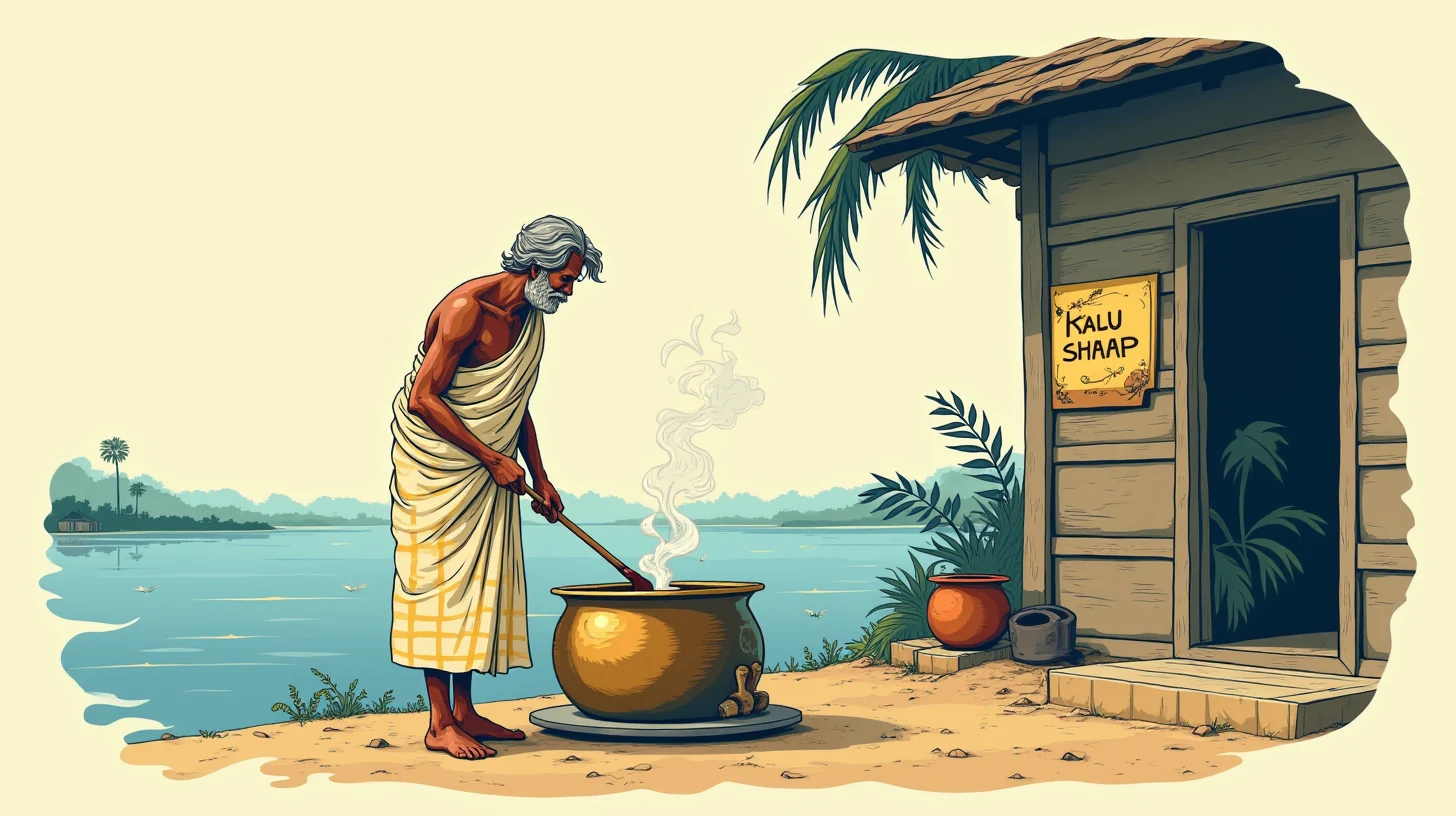
He had been running the shop for twenty-three years. His father had opened it in 1982, when the Vembanad was still a drinking man's geography, when every labourer from the coconut groves and the coir factories stopped by at sunset for a tumbler of kallu (the sap-fermented toddy, murky and sharp) and a plate of salted fish. The shop was a wooden shack with a corrugated-iron roof, a seven-by-nine hole in the wall on the Alappuzha-Kottayam road, two minutes' walk north of the boat jetty at Kumarakom.
The kitchen had arrived by accident. One evening in 1998, a migrant cement-worker asked Rajan for karimeen—Kerala's prized pearl-spotted fish—pollichathu, wrapped in banana leaf and fire-roasted. Rajan's mother, visiting from her house two hundred metres away, had made it in fifteen minutes. The cement-worker told six friends. The friends told their families. By 2005, food revenue had crept to forty percent of the till. By 2010, it was sixty percent. By this March—this morning—it was seventy-five percent.
The karimeen pollichathu was legendary now. Tourists on backwater-boat tours knew about it by name. Tourists. People with hotel phones and review apps. Rajan had started buying whole karimeen by the kilogramme from the Alappuzha fishwives, at ₹650 per kilo, cleaning them himself on a plastic board behind the counter, while the toddy jars—sealed in dark glass, ₹90 per litre, margin of ₹18—sat in the corner, untouched.
The trap had closed on him quietly, the way the best traps do.
In January, a health inspector had arrived unannounced. Not rude. Not looking for a bribe. Just factual. A young man, maybe thirty, with a clipboard. He had looked at the kitchen—the stainless-steel counter, the brick stove, the water-filter in the corner, the register where Rajan tracked food sales by hand—and he had said, very clearly: "You are operating a food business without a Food Safety and Standards Authority license. The penalty is ₹2 to ₹5 lakh, and the kitchen can be sealed."
Then he had waited.
Rajan had asked the obvious question: "What do I need to do?"
The inspector had said: "Apply to the FSSAI for a State License. You are turning over more than ₹12 lakh in food revenue per year. Registration is not enough."
So Rajan had visited the FSSAI office in Alappuzha, a concrete building behind the collector's office. He had taken the day off. He had brought the register. He had found a woman at a desk who had looked at his numbers—₹24 lakh in food revenue for the financial year—and had said the same thing: State License, FSSAI.
Then she had said something else.
"But the Excise license says the toddy bar can have incidental food sales. If you separate the two, which one is your primary business?"
Rajan had not understood the question.
"Because," the woman continued, "if your primary business is the toddy bar, and the food is incidental, the Excise Department says you don't need an FSSAI license. But if your primary business is the kitchen, Excise will say you can't sell toddy from a food establishment."
Rajan had sat in the plastic chair outside that office, in the humidity of the Alappuzha afternoon, and he had understood the trap.
He had not applied for anything.
Instead, he had called his nephew in Kottayam, who worked at a cable office and had a smart phone and could search the internet. The nephew had visited one Saturday. Together, they had searched for "toddy shop and food business license" and "FSSAI and Kerala Excise" and had found nothing but old news articles and a blog post from 2014 that seemed to say the same thing the woman had said: you cannot be both.
By February, Rajan was sleeping poorly. He had stopped buying premium karimeen. He was serving a thinner beef curry, reusing stock, buying cheaper coconut oil.
Then, on a Tuesday in late February, his sister's daughter had visited. She was studying at the Central University in Thiruvananthapuram and had recently downloaded an app called GabFORGE on her roommate's suggestion. The app was free. It was designed to help people understand Indian government schemes and licenses. She had shown it to her uncle.
Rajan had typed a question into the tablet—slowly, with two fingers: "Toddy bar with food business—what license do I need?"
The agent had paused. Then it had responded with a set of documents. Not answers. Documents. Official PDFs from the Ministry of Food and Public Distribution, from the Kerala Excise Department, from the FSSAI portal itself.
One of the PDFs was titled: "Dual Registration Framework for Alcohol and Food Retail."
- 🗓️
1998 — Karimeen pollichathu added, by accident
Rajan's mother makes a single karimeen for a cement-worker at his request. The dish spreads by word of mouth. By 2005, food is 40% of revenue.
- 📈
2010 — Food becomes 60% of revenue
Rajan invests in a stainless-steel counter and a brick stove. He begins buying whole karimeen from the Alappuzha fishwives. The kitchen is now a distinct operation.
- 🚨
January 2026 — First health inspection
An FSSAI inspector arrives without warning. He examines the kitchen and issues the warning: ₹2–₹5 lakh penalty, closure possible, unless Rajan applies for a Food Safety license.
- ⚖️
January-February 2026 — Regulatory ping-pong begins
FSSAI directs Rajan to apply for a State License. Excise says food is incidental under the toddy license. Each office implies the other has no authority over him.
🗓️ The annual ritual
The Vembanad backwaters operate on two rhythms: the monsoon and the tourist season. Between June and September, the water rises, coconut workers make good wages, and the Kallu Shaap's weekday traffic is steady—labourers stopping at dusk for toddy and fish curry. Between November and April, the water drops, tourists arrive by the boat-load, and the kitchen becomes the shop's true revenue engine.
Rajan's year had structured itself around this dual rhythm. May through August: forty percent of revenue from toddy, sixty percent from food. November through February: toddy barely moves, food is seventy to eighty percent. April and September-October are the grey months, when both streams are active and competitive.
The Excise license for the toddy bar had arrived in 2001, after he had paid ₹8,000 for application fees and had navigated three visits to the Alappuzha Excise office. The license was valid for five years, then renewed every three years for ₹4,500 per cycle. On the back of the license, in Malayalam and English, it stated: "The licensed proprietor may sell toddy within the permitted hours (6 AM to 10 PM) and incidental food items necessary for the consumption of alcohol on the premises."
No one had ever defined "incidental."
Rajan had assumed it meant a pickle, maybe some roasted peanuts, a onion. By 2015, when karimeen pollichathu was becoming famous enough that boats would divert their routes, the word "incidental" had stretched to mean a ₹1,800 plate of fish wrapped in leaves and fire-roasted for forty-five minutes. But Rajan had never questioned it. The Excise inspector came once a year, checked the storage, looked at the liquor register, and left. No questions about the kitchen.
The FSSAI had never come at all—until that January morning.
In informal food sectors across Kerala, this silence is the default. Dhabas on highways, food stalls in markets, small restaurants in side alleys—many operate without any formal food license, partly because the application feels impossible, partly because the line between "catering" and "retail" is blurry, and partly because the cost and time feel disproportionate to the margin. A typical FSSAI State License application requires layout drawings (hire an engineer, ₹5,000–₹10,000), water testing (₹2,000–₹5,000), and multiple inspections (₹1,000–₹2,000 per visit), across a timeline of six to eight weeks. For a shop earning ₹24 lakh per year, that upfront cost is a punch.
But silence breaks when revenue crosses a threshold—and revenue had clearly crossed it.
⚠️ What very nearly happened
By mid-February, Rajan had made a decision: he would let the kitchen shrink. He would stop buying premium karimeen. He would dial back the beef curry to once or twice a week. He would lean into the toddy sales, try to recapture the original business model, and stay below the FSSAI notice threshold.
It was a losing plan, and he knew it. The tourists would stop coming. The reputation would fade. The kitchen would be worth ₹0 within two seasons.
But it was the only plan that didn't involve a government office.
One afternoon, he had sat with his accountant, a man named Suresh who filed his informal taxes (₹3 lakh declared income, ₹0 actual ITR filed, a handshake with a local CA). Suresh had said: "You could close the kitchen officially on the Excise license and reapply to the FSSAI as a pure food business. But then the Excise might say you have abandoned the primary business and revoke the license. The liquor license is worth ₹50,000 if you ever want to sell."
Another accountant, a woman named Sheila, had suggested the opposite: "Maybe you stay under the Excise license and don't apply to the FSSAI. The inspector will come back sometime, but maybe not for a year. By then, you could have paid a fixer ₹20,000 to make it go away."
Rajan's sister had advised him to ask a lawyer. Lawyers in Alappuzha charge ₹1,500 per hour minimum. A licensing question would take three to four hours, maybe more. ₹6,000 at the low end.
So instead, he had downscaled. In the third week of February, he had started posting smaller portions on Facebook—a photo of the karimeen with a caption: "Limited today — thank you for patience." He had removed the beef curry from the chalkboard. He had begun closing on Wednesdays (ostensibly "cleaning day," actually cost-cutting).
Food revenue had dropped from ₹24 lakh annually to a projected ₹18 lakh.
This was the moment his sister's daughter brought the tablet.
🌗 What changed
The agent opened the "Dual Registration Framework for Alcohol and Food Retail" PDF, and it took Rajan's breath away.
The document was brief—four pages—and it was dated July 2023. It was published by the Ministry of Food and Public Distribution's FSSAI section and had been released to answer a specific problem that was occurring in multiple states: small toddy bars, beer shops, and retail alcohol establishments that also served food, and vice versa.
The framework was clear on a single point: a proprietor could hold both an Excise license (for alcohol retail) and an FSSAI license (for food business) simultaneously, provided the two revenue streams were separately accounted for and separately licensed.
The key phrase was: "The food operation must maintain a distinct billing system and inventory from the alcohol operation. The kitchen may operate under the same physical premises, but the FSSAI license issued shall be specific to the food operation and its turnover. The Excise license shall remain valid for the alcohol retail operation and its turnover."
In other words: Rajan was not choosing. Rajan was both.
The agent read the document aloud to him, in Malayalam, using a synthesized voice:
"നിങ്ങൾ രണ്ട് വ്യത്യസ്ത ലൈസൻസ് നടത്താനാകും—ഒന്ന് മദ്യത്തിനും, ഒന്ന് ഭക്ഷണത്തിനും. ഭക്ഷണ വരുമാനം ഈ വർഷം ₹24 ലക്ഷമാണെങ്കിൽ, നിങ്ങൾ FSSAI സ്റ്റേറ്റ് ലൈസൻസ്നായി അപേക്ഷിക്കണം. മദ്യ വരുമാനം വേണ്ടത്ര വേറിട്ടായിരിക്കണം. രണ്ടും നിയമവുമായി പൊരുത്തപ്പെടും."
(You can hold two separate licenses—one for alcohol, one for food. If your food revenue is ₹24 lakh this year, you must apply for an FSSAI State License. Your alcohol revenue must be kept separately. Both will comply with the law.)
Rajan had read the framework three times that evening. Then he had slept through the night for the first time in six weeks.
The next morning, he had sat with his sister's daughter and the agent on the tablet, and he had typed a new question:
"How do I apply for the FSSAI State License? What does it cost? How long will it take?"
The agent had retrieved the official application form from the FSSAI portal (FoSCoS), filled in the fields it could infer (shop name, location, type of food), and flagged the fields that Rajan would need to complete himself:
- Annual food revenue (₹24 lakh)
- Kitchen layout drawing (he would need to hire an engineer or draw it himself—₹5,000 if hired)
- Water quality test report from an accredited lab (₹3,000)
- A copy of the Excise license (as proof of the premises' legality)
- A copy of the property lease or ownership deed
The agent then connected him to the FSSAI portal directly and showed him the list of accredited water-testing labs in Alappuzha district. There were two. He could visit either one, pay ₹3,000, and have results in two days.
The layout drawing was trickier. Rajan had drawn one himself on graph paper—a rough diagram of the counter, the stove, the storage area, the water filter. The agent had suggested he photograph it and upload it. It was not a substitute for an engineer's drawing, but the FSSAI inspector would likely accept it on first submission. If not, he could hire the engineer after approval in principle.
Total cost to apply: roughly ₹8,000 to ₹13,000, depending on whether he hired an engineer upfront.
Timeline: six to eight weeks from submission to certificate (if no additional inspections were required).
Rajan had stared at the number ₹24 lakh on the form. This was the first time he had written it down officially. This was the first time he had named the kitchen's revenue in a government document.
He had felt afraid and relieved simultaneously—the feeling of crossing a Rubicon.
Excise License (Toddy Bar)
₹4,500 every 3 yearsCovers alcohol retail (toddy and beer). Valid under Kerala Excise rules. Permits incidental food sales. Rajan continues to pay annual renewal. Hours: 6 AM to 10 PM daily.
FSSAI State License (Food Business)
₹1,000–₹5,000 per 1–5 yearsCovers food preparation and retail. New application cost: ₹8,000–₹13,000 for layout and lab fees. Annual turnover: ₹24 lakh. Valid for 1–5 years; renewal required before expiry.
Separate Accounting (Both)
Manual or digital registerFood sales and alcohol sales must be tracked separately. GST filing separates the two. The FSSAI inspector can audit food-only revenue. The Excise inspector can audit alcohol-only revenue. No overlap.
🧭 Why we built it
Rajan's story is a specific story about a specific shop on a specific water in a specific state. But the trap he almost stepped into exists everywhere in India's informal food sector.
Across Kerala, there are an estimated 12,000 to 15,000 small eating establishments—dhabas, roadside stalls, small restaurants, and yes, toddy bars with kitchens. The vast majority operate without a formal FSSAI license. Not because they disrespect food safety. Not because they are reckless. But because the bureaucratic landscape treats the informal food business as a binary choice: either you are a pure food business (full FSSAI compliance), or you are incidental and invisible.
A husband-and-wife team running a small Kerala-style restaurant from a lean-to behind a garage does not think of themselves as a "food business." They think of themselves as a cooking team serving neighbours. They do not track turnover formally. They do not have letterhead. They do not have a GST number. The word "license" feels abstract.
But as soon as reputation spreads—as soon as tourists start arriving, as soon as reviews start appearing on Google Maps, as soon as a neighbour reports them—they become visible. And visibility means an inspector arrives, and an inspector means a penalty notice.
The trap is that the rules exist, but the pathway to compliance is invisible.
Rajan's case is cleaner than most because his primary business (the toddy bar) had an existing license. So the question was not "should I get a license" but "what kind of license applies when I have two simultaneous businesses?" The Dual Registration Framework answers that: both. But almost none of the small proprietors in Kerala know that both licenses can coexist.
The FSSAI website mentions it. The Excise department mentions it. But they mention it in separate PDFs, in separate sections, using different terminology (FSSAI calls it "concurrent licensing"; Excise calls it "dual authorization"). No single point of entry connects them.
This is where the agent becomes essential. Not as a lawyer—the agent is not a lawyer. Not as an accountant—the agent cannot file taxes. But as a translator. The agent reads both sets of rules, finds the intersection, and says: "Here is where you belong."
The agent also handles what Rajan would otherwise have to do manually: visit two separate government offices, ask the same question twice, get two answers, reconcile the contradiction, and eventually find the small print that resolves it. The time cost alone is enormous. The psychological cost—the fear, the uncertainty, the nights spent sleepless—is incalculable.
For a proprietor earning ₹24 lakh per year, and working twelve-hour days, six days a week, the mere fact of being able to stay compliant while operating a food business is the difference between growth and collapse.
"ഭരണകൂടം ആളുകളെ കുരുതിയിൽ നിന്ന് കാത്തിരിക്കുന്നതായി തോന്നുന്നു. എന്നാൽ വികാസം വേണ്ടത്ര മൾഡ പൂർണ്ണമായി നിഷേധിക്കപ്പെടുന്നു."— The government seems to think it is protecting people from danger. But it ends up denying growth itself.
🌱 What we hope happens
Three months later, in May, Rajan's FSSAI State License arrived. It was printed on watermarked paper, in English and Malayalam, and it bore a certificate number and an expiry date in 2028. The fee had been ₹2,500. The total cost—layout drawing, water test, application fees, a site visit—had come to ₹11,200. The timeline had been seven weeks.
He had framed the certificate and hung it next to the Excise license on the wall behind the counter.
The kitchen had reopened at full capacity. He had started buying premium karimeen again, at ₹650 per kilo, and had added a lunch shift—something he had never done before. The food revenue trajectory had reset to ₹26 lakh annually (projected), up from the ₹18 lakh downscaling. The toddy sales had remained stable.
He had also opened a separate register for food, as the Dual Registration Framework required. A different ledger from the alcohol sales. Different columns. Different totals. The FSSAI inspector could read one. The Excise inspector could read the other. Both would see compliance.
What Rajan hopes is that other proprietors in similar situations—and there are thousands—do not have to spend six weeks of dread before they find the answer. That the two offices (FSSAI and Excise) send a single coordinated letter explaining the framework, rather than leaving proprietors to discover it by accident in a PDF.
That a woman running a small Onam feast-catering service from her home, selling under a toddy retailer's umbrella because her husband holds the license, knows that she can have her own FSSAI Registration without triggering a revocation of his.
That a small restaurant in Kottayam that also sells beer does not spend two years paying a middleman ₹1,500 per month to keep inspectors at bay, when a simple dual-licensing structure would make everyone legal.
The structures exist. The rules exist. What is missing is the moment when someone—a tablet in the hands of a young woman, a neighbour, an agent—says: "You belong here. Both of you. Separately and simultaneously."
And the shop begins to grow in the light, rather than hide in the dark.