
The Bastar mahua-laddu SHG and the PM FME window
Sukmati's hands moved through the mahua flour with the rhythm of forty-two years. Two kilos of dried mahua nuts, ground that morning on the single hand-mill that served all twelve members of the Jagdalpur Mahila Swayam Sahayata Samuh — the women's self-help group she had founded seven years ago in the compound behind the Bastar forest-products market. She mixed the flour with ghee, cardamom powder, and crushed cashews, rolling each ball by hand, pressing them gently against her palm until they held their shape. By noon, she had filled two woven baskets with fresh laddus. By evening, her daughter Latika would carry them to the weekly market at Jagdalpur town center, where they sold for ₹180 per kilo.
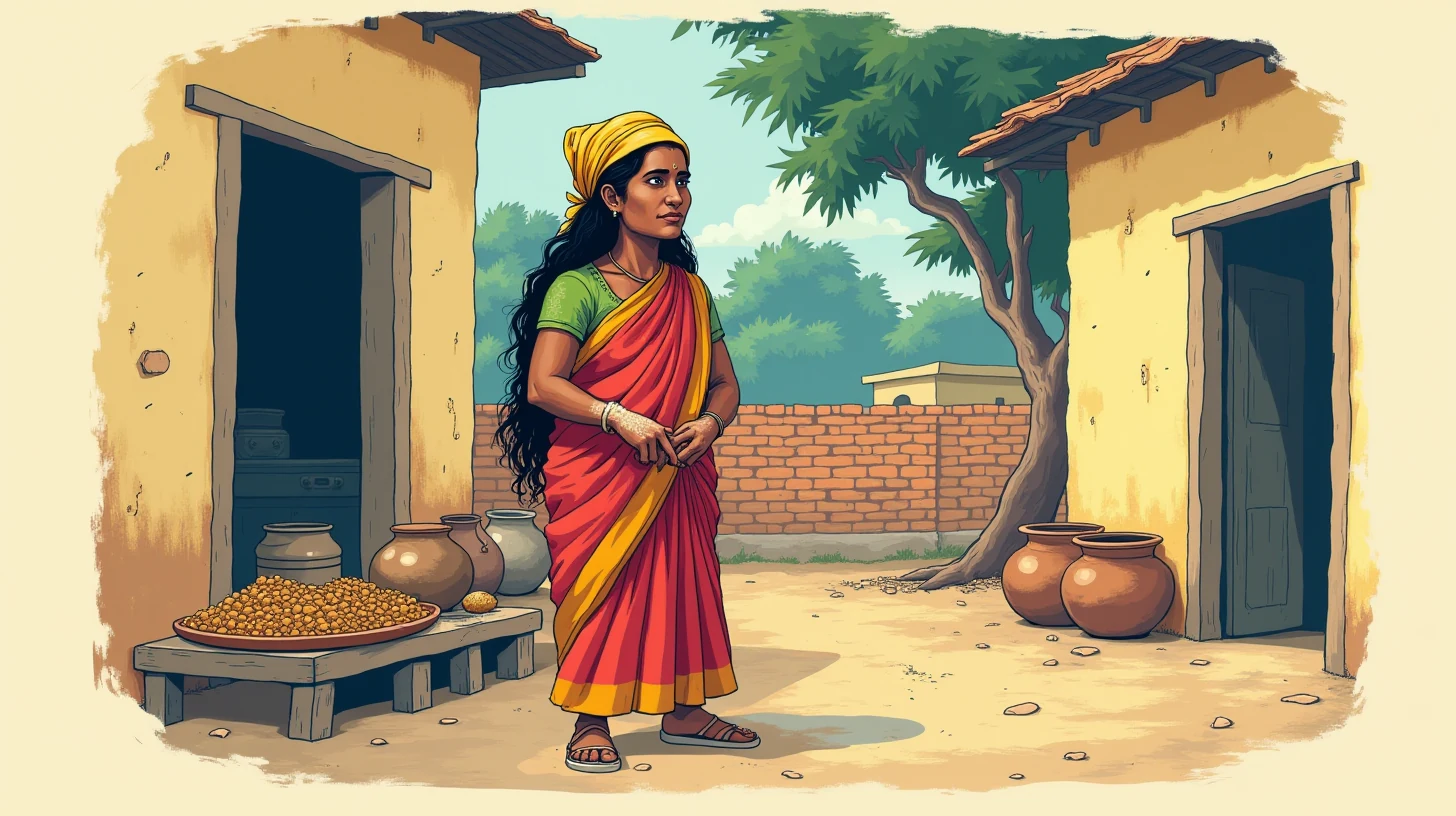
The collective made ₹18,000 to ₹24,000 per month during the mahua season — mid-May through September — when the sal and mahua forests of Bastar yielded their annual harvest. The rest of the year, they pivoted to amla candy, made from the gooseberries that grew wild on the scrub hills around their village. In the six months of amla season, they netted another ₹12,000 to ₹16,000. The money was split twelve ways after costs: each woman received between ₹1,000 and ₹2,500 per month, which she pooled into the SHG's monthly savings — ₹60 to ₹80 per woman — and a small emergency fund. For women in Jagdalpur's Gond tribal settlement, where daily-wage work paid ₹150 to ₹250 per day, this was stability.
But stability was not growth. And growth required a grinder.
Hand-milling sixty kilos of mahua nuts consumed six hours. A mechanical grinder, with a capacity of twenty kilos per hour, would free time for packaging, labeling, and compliance. Packaging, specifically: the laddus were sold loose or wrapped in newspaper, not sealed or labeled with any nutritional information. That was the difference between an informal food operation and a registered one. That was the difference between ₹18,000 per month and ₹50,000 per month. That was the gap between survival and the possibility of hiring a tenth and eleventh woman in the next two seasons.
On the afternoon of May 2nd, a block development officer from Jagdalpur's KVIC office visited the compound. She arrived with a tablet and a list of schemes. She explained PM FME — Pradhan Mantri Formalization of Micro Food Processing Enterprises. She explained that the government would subsidize 35 percent of the cost of equipment, up to a maximum of ₹10 lakh, if the collective applied by June 1st.
Sukmati did the arithmetic in her head. A commercial grinder cost ₹1,20,000. A small hand-operated sealer, ₹8,000. Biodegradable packaging, ₹15,000 per thousand units. Labels with nutritional information, ₹6,000. Raw material buffer for the first month, ₹30,000. Total project cost: ₹1,79,000. PM FME subsidy at 35 percent: ₹62,650. The collective would need to contribute ₹1,16,350, which it did not have.
But that conversation — that possibility — shifted something in the room. The KVIC officer said the subsidy could also cover working capital, provided the collective met four conditions: FSSAI Food Business Operator registration (currently: none), bank statements for the SHG for the past two years (currently: a hand-written ledger), detailed project cost breakdown (she provided a template), and proof of KVIC membership (which Sukmati now realized the collective had never formally joined).
"How long do we have?" Sukmati asked.
"The application portal closes June 1st," the officer said. "Twenty-eight days."
- 📋
May 2nd — KVIC Officer Visit
Block development officer explains PM FME scheme and three prerequisites: FSSAI registration, SHG bank statements, KVIC formal membership. Window closes June 1st (28 days).
- 🏥
May 10th — FSSAI Registration Attempt
FoSCoS portal requires annual turnover declaration. Sukmati's collective has no formal turnover records, only a hand-written ledger. Application stalls at verification step.
- 🗂️
May 18th — Bank Statement Compilation
SHG savings ledger converted to typed bank statement format. But KVIC portal also asks for audited financials — the collective has no auditor. Alternative: affidavit from gram panchayat. Takes four days to obtain.
- ⏰
May 25th — Final Push
Application submitted May 26th with all four documents: FSSAI certificate (pending), bank statements, KVIC membership form, project cost detail. Status: awaiting verification. Six days to deadline.
🗓️ The annual rhythm
For seven years, Sukmati's collective had operated in the shadow economy. They had no formal business registration, no FSSAI license, no bank account in the SHG's name. They had a ledger — a bound notebook with entries in Halbi, the tribal language Sukmati and five of the women spoke, though most transactions were recorded in Hindi numerals. Each woman contributed ₹60 to ₹80 per month. The collective's treasurer, Gangabai, kept the cash in a metal box in her home. The box held approximately ₹32,000 at any given time.
This was not recklessness. This was the rational response to a system that seemed designed to exclude them. Formal FSSAI registration required proof of kitchen facilities — government documentation that showed electrical supply, water connection, and waste disposal. The collective worked in a rented compound courtyard where all cooking happened in the open. The water came from a hand pump. Waste went into a pit at the edge of the property. The documentation did not exist because the kitchen did not exist as the government imagined it.
The collective could have registered informally — Sukmati had heard of food vendors in town who had paid middlemen ₹8,000 to ₹12,000 to obtain fake facility certificates and FSSAI registrations. But the principle bothered her. If they were to scale, they should scale honestly.
Instead, they stayed small. Honest and small.
The market operated on a weekly cycle. Sukmati and two others — Gangabai and Kamla — traveled to Jagdalpur market on Wednesday evenings and Thursday mornings, carrying the laddus in woven baskets. They set up a small mat in the vegetable section of the weekly bazaar, near the goat-meat vendors and the dried-chili stalls. They sold for three to four hours. Repeat customers knew them by name. A woman named Priya, who worked in the municipal office, bought ₹400 worth every Thursday. Another customer, a man named Ramesh who owned a small dhaba near the transport yard, had been buying in bulk — ₹2,000 per week — for two years, reselling them through his shop.
This was their distribution: the weekly market and Ramesh's dhaba. No Zomato. No packaging. No online reviews. No algorithm deciding whether they lived or died. The economics were fragile but clear.
The PM FME announcement disrupted that clarity. The subsidy suggested a different model: formalization, packaging, a supply chain. But the portal — when Sukmati finally sat down at a customer's computer in an internet café in town — was built for a different kind of business.
⚠️ What very nearly happened
The application portal for PM FME opened with a form titled "Micro Food Processing Enterprise Subsidy Application." It asked for:
- Applicant name and PAN (Personal Account Number)
- FSSAI FBO Registration Number
- Project description and equipment list
- Detailed Project Cost (format: rupees, GST rate, total)
- SHG bank statements (past 24 months)
- Proof of KVIC membership
- Copies of relevant certifications and licenses
Sukmati had none of these except her name. She had no PAN. She had no FSSAI number. She had no project cost breakdown — only an estimate scribbled on the back of a shop receipt. She had no bank statements. The SHG had no bank account. The KVIC membership form, when she requested it at the block office, required proof of existence: incorporation documents, registration with the state cooperative department, or a resolution passed by the panchayat.
The panchayat resolution had taken three weeks.
A smaller problem emerged first. The FSSAI FoSCoS portal required an annual turnover declaration. The form had three options: Under ₹12 lakh (Food Business Operator Registration), ₹12 lakh to ₹20 crore (State License), or above ₹20 crore (Central License). Sukmati estimated the collective's annual turnover at ₹2.4 lakh in mahua season plus ₹1.8 lakh in amla season: ₹4.2 lakh total. This qualified for Food Business Operator Registration.
But the form asked for "audited financial records proving the stated turnover." The collective had a ledger. No audit. No official income documents. The form provided an exception: "For SHG applicants, group membership certificate and bank statements are acceptable in lieu of audited records."
The problem: the form required a bank account. The SHG had none.
FSSAI Requirement
Must haveAudited financial records or bank statements proving annual turnover. FoSCoS portal requires documentation within 15 days of application. Sukmati had a hand-written ledger in Halbi and Hindi.
SHG Banking
Does not existA formal SHG bank account requires cooperative society registration and a resolution from the gram panchayat. The resolution took 21 days. The bank account took another 14 days.
PM FME Timeline
28 days to deadlineThe collective needed FSSAI registration before submitting the PM FME application. FSSAI processing takes 10–15 days. The buffer: five days. Any delay in bank account opening would push the application past the deadline.
The agent — Sukmati came to think of the tablet this way, because the KVIC officer had left it with her for one hour to try the online forms — flagged a critical insight. The FSSAI form had a line item: "For applicants without historical bank records, FoSCoS accepts a statutory affidavit signed by the SHG's accountant or a panchayat officer confirming the turnover estimate."
An affidavit was not a bank account. An affidavit was a notarized statement that the panchayat could issue.
"Sukmati, aapke SHG ke liye, bank account se pehle, gram panchayat se affidavit le lo. Affidavit mein likha hoga — 'This group's annual food production is approximately ₹4,20,000.' Isse FSSAI form fill kar sakte ho."
(Sukmati, for your SHG, before opening a bank account, get an affidavit from the gram panchayat. The affidavit will state — "This group's annual food production is approximately ₹4,20,000." With this, you can complete the FSSAI form.)
The instruction had come not from a human officer, but from the tablet's search results. The KVIC officer, when Sukmati asked her later, confirmed it: an affidavit would work. The gram panchayat secretary issued it in two days.
🌗 What changed
On May 10th, Sukmati sat in a café in Jagdalpur with Latika, her daughter, who worked in a health clinic and had some familiarity with official forms. They opened the FoSCoS portal on a borrowed laptop. The agent on the tablet — Sukmati called it "the tablet" because that's what it was, a physical object the KVIC officer had left — had been pre-loaded with the PM FME application form by the officer as a template.
Sukmati typed slowly in the Hindi-script input field:
"Hamare SHG mein 12 mahilayen hain. Hum mahua ke laddus aur amla ke candy banate hain. Bastar ke jungle se mahua nuts aur amla fruits le kar."
(Our SHG has 12 women. We make mahua laddus and amla candy. We source mahua nuts and amla fruits from the Bastar forests.)
The form's next field asked for "Kitchen Facility Compliance Status." The agent — the tablet — displayed a checklist:
- Water supply (hand pump: acceptable)
- Waste disposal (pit: acceptable for food processing, not for dine-in)
- Food storage (airtight containers: required)
- Handling area (paved surface: required for processing; the collective's courtyard was concrete and brick)
The collective met most of these. But the form asked for a "Kitchen Facility Inspection Certificate" signed by a food safety officer. This certificate did not exist. The collective had never been inspected.
Sukmati asked the agent, through a search on the tablet: "Does the inspector have to visit before registration, or after?"
The agent returned a search result from the FSSAI website: "For SHG-based food processing operations in rural areas, FoSCoS allows provisional approval with photo documentation of the facility in lieu of official inspection. The inspection may follow within 30 days of registration."
This was a bridge. Sukmati and Latika took photographs of the kitchen courtyard — the hand pump, the concrete floor, the covered storage area where they kept the dried mahua nuts and amla fruits in large clay pots. They uploaded the photos to the FoSCoS portal.
The application progressed to the next step. It asked for the SHG bank account details. The collective's bank account was opened on May 14th at the Jagdalpur Grameen Bank branch. The account required a minimum balance of ₹500 and a monthly average balance of ₹2,000. The collective met both: they had ₹32,000 in the metal box. Gangabai, the treasurer, deposited ₹25,000 into the new account.
By May 16th, the FSSAI FoSCoS application was submitted. The certificate came back as "Provisional Approval" on May 19th — the FSSAI had issued a temporary FBO registration number valid for 30 days, pending the official inspection.
The collective now had an FSSAI FBO number. They could proceed to PM FME.
"Sukmati, ab aapke paas FSSAI hai. Ab PM FME application ke liye, project cost detail likho. Grinder ka daam, sealer ka daam, packaging ka daam, all rupees mein. GST add karo. Total likho. KVIC ko isko print karke de do."
(Sukmati, now you have FSSAI. For PM FME application, write down the detailed project cost. Grinder cost, sealer cost, packaging cost, all in rupees. Add GST. Write the total. Print this and submit it to KVIC.)
The project cost sheet took two days. Sukmati went to a hardware shop in Jagdalpur and asked about grinder prices. A commercial grinder cost ₹1,20,000 new, but a second-hand model, still functional, cost ₹70,000. A hand sealer: ₹8,000. Biodegradable packaging rolls (500mm x 800mm, 500 units per roll): ₹12 per unit = ₹6,000 for 500 units. Labels with nutritional information (printed, 1,000 units): ₹5,000. A steel table for packing (required for food-safety compliance): ₹18,000. Raw material for first month (mahua nuts and sesame): ₹25,000. Total: ₹1,52,000. PM FME subsidy at 35 percent: ₹53,200. Collective contribution: ₹98,800.
"Hum ₹98,800 jagah se kaise laye hain? Yeh saal bhar ka kamaya tha. Agar yeh laga diya, toh baaki mahine ka kya khayenge?"— How would we find ₹98,800? That is our year's income. If we spend it on equipment, what will we eat with for the rest of the months?
This was the core constraint. The PM FME subsidy was designed for entrepreneurs with some capital. The collective had survival capital, not expansion capital. Sukmati raised this with the KVIC officer when she returned to the compound on May 20th to check progress.
The officer suggested a hybrid approach. The PM FME subsidy would cover the equipment (grinder, sealer, table): ₹1,46,000, with the collective contributing ₹53,800 — a more manageable amount. The labeling and packaging could be phased: start with basic hand-written labels, upgrade to printed labels in the second season when cash flow improved.
The collective agreed. The project cost detail was revised. Sukmati entered it into the PM FME portal on May 22nd.
The application asked for one final piece of documentation: "Cross-check with PMEGP database to ensure no duplicate subsidy." The PM FME portal checked automatically if any SHG member had previously received a PMEGP subsidy. The check came back clear. The application was complete.
Submitted: May 26th. Status: Under Review.
🧭 Why we built it
The food processing SHG landscape in India is vast and invisible. Across rural India, an estimated 1.2 million SHGs are engaged in food processing — making pickles, snacks, jams, dried fruits, and traditional sweets. They operate in Chhattisgarh's tribal settlements, in Maharashtra's sugar cane villages, in Odisha's coconut forests, in Kerala's spice gardens. They are mostly women. They operate mostly on cash, with no formal accounting, no bank relationships, and no access to credit or subsidies.
The government has created pathways: PM FME for microprocessing, PMEGP for larger processing units, MUDRA for working capital. But the pathways are designed for applicants who already understand the bureaucracy. An entrepreneur with formal accounting books can complete a PM FME application in a day. A tribal woman with a hand-written ledger in a regional language faces a month-long excavation just to translate her business into the government's language.
The agent — the tablet, the search results, the structured guidance — did not fill out the form for Sukmati. It did not submit the application. It did not approve the subsidy. What it did was translate. It said: "Your ledger counts as financial records, provided you get an affidavit." It said: "Your courtyard qualifies as a food-processing kitchen, provided you photograph it." It said: "Your collective can qualify for this subsidy, and here are the four documents you must gather."
The cost of translation, measured in time and confusion, is what keeps rural food SHGs informal. A month of back-and-forth with officials, a middleman who charges ₹8,000, a daughter who takes time off work to fill forms — these are not trivial costs. They are often larger than the subsidy itself. When an SHG leader can say, "The tablet showed me that my hand-written ledger is acceptable, so I don't need to hire a middleman," the calculus shifts.
Across India's 7.5 million food businesses, the overwhelming majority are small collectives and home-based operations in the informal economy. Of these, perhaps 2–3 percent have any formal registration. Not because they lack intent, but because the compliance burden is higher than the revenue. PM FME and PMEGP exist. The money exists. But the translation layer — the guide that connects a woman's actual business to the government's actual forms — is nearly absent.
This is where the agent can shift the surface. Not by replacing the official, but by making the official's process navigable to someone who has never navigated it before.
🌱 What we hope happens
On June 2nd, one day after the PM FME deadline, Sukmati's collective will know the subsidy's status. If approved, the ₹53,200 subsidy will arrive as a cheque to the SHG's bank account within 60 days. The collective will buy the grinder, the sealer, and the steel table. They will begin processing mahua nuts at a rate of twenty kilos per hour instead of two.
The processing capacity will increase five-fold. Currently, the collective can produce 240 laddus per day. With the grinder, they can produce 1,200 per day. But production is not the constraint. Distribution is. The weekly market in Jagdalpur can absorb perhaps 300 laddus per week. Ramesh's dhaba can absorb 200 to 300 per week. Beyond that, the collective needs packaging, shelf life, and a way to reach customers beyond the market and the dhaba.
The FSSAI registration — provisional now, permanent after inspection — is the key that unlocks this. A sealed, labeled, traceable product can be sold to restaurants, hospitals, schools, and online platforms. An unsealed, hand-wrapped product cannot. Sukmati's daughter Latika has already spoken to the manager of a small school near Jagdalpur about supplying laddus for midday meals. The school currently buys from a vendor in Raipur. If Sukmati's collective can provide FSSAI-registered, nutritionally labeled laddus at a competitive price, the school is interested.
That would be ₹8,000 per month for 200 laddus per week.
But the deepest hope is different. Sukmati is 42 years old. Her daughter Latika is 20. In Bastar, as in much of rural India, young people leave. They migrate to cities for factory work, for domestic service, for the promise of a monthly wage. Latika has a clinic job in Jagdalpur town and a small apartment shared with two other women. She is not coming back to the compound to make laddus by hand.
The scaling that PM FME enables — from hand-grinding to mechanical processing, from weekly market sales to school contracts to shelf-life products — is the scaling that might retain the next generation. If the collective can grow to ₹50,000 per month in revenue, split twelve ways, that is ₹4,000 per woman per month. That is comparable to a clinic job. That is enough to stay.
The tablet did not make this possible. The subsidy made it possible. But the tablet — the search, the guidance, the translation of bureaucratic language into the collective's actual need — was the link between the subsidy and the first step. Sukmati did not know that her hand-written ledger could count. She did not know that her courtyard could qualify as a kitchen. She did not know that she had 28 days to ask.
Now she does. And the compound in Jagdalpur, where women have been rolling mahua flour by hand for the past seven years, is waiting to hear if the grinder is coming.