
The Bengaluru three-brand cloud kitchen operator and the algorithm collapse
Nikhil was 27 when he quit Flipkart. He had been a product engineer — not senior, not junior, somewhere in the careful middle of a growth company, watching orders flow through his API and earning ₹1.2 lakh per month, benefits, stock options that vested in two years. But he had started cooking seriously at 25, meal-prepped for his coding friends, watched their faces change when the biryani arrived in glass boxes. At 26, he had a Gmail account overflowing with "can you make this for my colleague" messages. At 27, he opened a cloud kitchen.
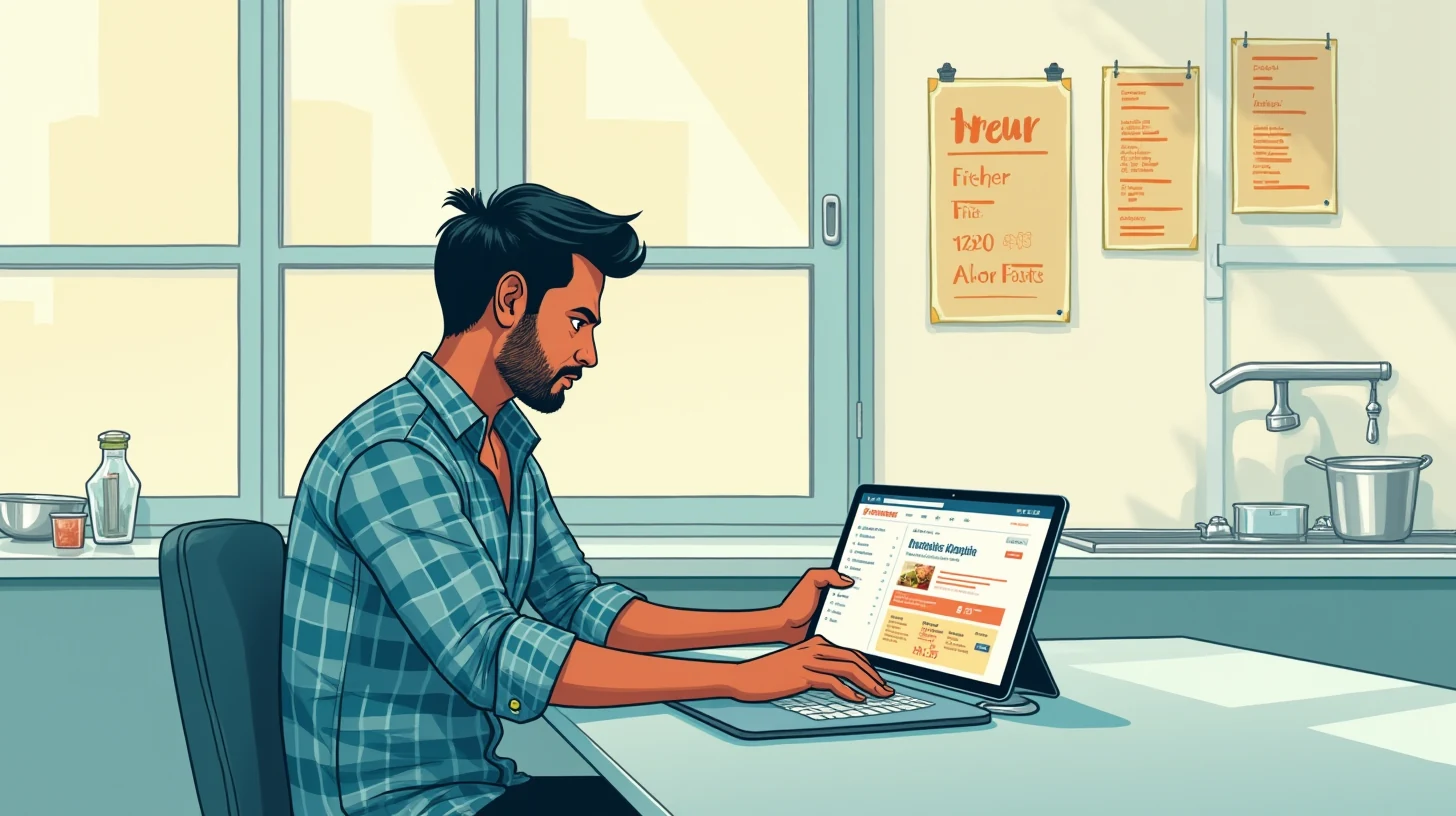
It was April 2023. The cloud kitchen landscape was hot—young engineers and MBAs were spinning up three-brand darkish operations out of cramped 800-square-foot kitchens in HSR Layout, Marathahalli, Bellandur. Zomato's algorithm was still forgiving then. Swiggy paid in four days. A biryani that cost ₹65 to make could sell for ₹450. Margins were there. Nikhil sank ₹11 lakh of his savings and a ₹8 lakh MUDRA loan into kitchen setup, stainless steel tables, a commercial convection oven, a three-basin sink, blast chiller. He registered three virtual brands on Zomato and Swiggy: "Biryani Brothers" (Hyderabadi, mutton-forward), "Keto Bowls" (salads, grilled chicken, no rice), "North Lights" (Tandoori roti, Punjabi curry). Same kitchen. Three supply chains. Three menus. Three rating systems.
For eighteen months, it worked. "Biryani Brothers" hit 4.6 on Zomato. "Keto Bowls" hovered at 4.5. "North Lights" was steady at 4.4. Orders were consistent: 120 per day across the three brands, about ₹45 per meal in ingredient cost, ₹300–₹450 sale price. Nikhil was pulling ₹60,000–₹70,000 in net profit some weeks. He had hired a head chef, two junior cooks, a packer. He was no longer cooking himself—he was running a business.
Then, on a Friday evening in November 2024, something shifted.
🗓️ The annual ritual
Cloud kitchens in Bengaluru operate under a deceptively quiet regulatory architecture that Nikhil had largely outsourced to intuition and a middleman he paid ₹2,000 per month.
An FSSAI State License was required for any food business with annual turnover between ₹12 lakh and ₹20 crore. Nikhil's three brands, combined, were clearing about ₹27 lakh per year in gross revenue—well into State License territory. The license came from BBMP (Bruhat Bengaluru Mahanagara Palike), the city's municipal body, not directly from FSSAI. It required a health inspection every 18 months, cost ₹1,500 per application, and expired in two years if unrenewed. Nikhil's license was valid through March 2025. GST was 5% on delivery orders, no input tax credit (non-AC, delivery-only, no dine-in). MSME Udyam registration was optional but he had registered "Biryani Brothers" as a micro enterprise, earning him theoretical priority lending and some protection under the MSMED Act if anyone cheated him. He paid his Swiggy commission (25%), his Zomato commission (20%), his rent (₹55,000 per month), his staff, his ingredients. The algorithm was the only thing he did not pay. It was free. Or so he thought.
The algorithm—Zomato's delivery sorting and visibility system—was not a rule written anywhere. It was an invisible hand that pushed orders toward restaurants with high ratings, fast delivery times, and "consistency." It was also, unwritten, a market. Competitors could game it. And Nikhil, a former software engineer, should have known this. But he did not.
- ⭐
Friday, 8 November — The weekend before
Biryani Brothers rating was 4.6, with 45 orders per day. The other two brands were steady. Net profit: ₹62,000 for the week.
- 🔄
Saturday–Sunday, 9–10 November — The collapse begins
Within 24 hours, three one-star reviews appeared on Biryani Brothers, all citing 'stale meat' and 'cold packaging'. Zomato's algorithm penalised the rating drop instantly. Rating fell to 4.1. Visibility on the platform fell. Orders dropped 60%.
- 🛑
Monday–Friday, 11–15 November — The cascade
Orders remained low across all three brands. The algorithm, seeing one brand's collapse, began de-prioritising the kitchen overall. Orders halved to 60 per day combined (from 150).
- ❓
Friday, 15 November — The panic
Nikhil called Zomato support. They said: 'Improve your service quality.' No appeal mechanism. No dispute window. The reviews were permanent. The algorithm was invisible. Revenue fell from ₹62,000 to ₹18,000 in one week.
⚠️ What very nearly happened
If Nikhil had done nothing, the following would have unfolded:
His average weekly revenue would have stabilised at ₹18,000–₹22,000 (from ₹62,000). Ingredient cost remained ₹45 per meal. Fixed costs—rent, salary, utilities—were ₹68,000 per month. Staff of three people could not justify the kitchen's footprint. Within eight weeks, he would have laid off the head chef. Within twelve weeks, he would have manually prepared orders himself, reducing quality, inviting more one-star reviews. Within six months, the business would be insolvent. His ₹8 lakh MUDRA loan would remain, his personal reputation with lenders destroyed, his LinkedIn profile silent about his exit.
He was also vulnerable to what restaurants call "review warfare." Competitors—other cloud kitchen operators in HSR Layout running their own three-brand operations—knew that a coordinated attack on rating was essentially free. A single dollar spent on recruiting fake reviewers could tank a rival. Zomato's flagging system was designed for obvious spam (100 five-star reviews in one hour), not sophisticated attacks (5–7 one-star reviews over 36 hours, spaced geographically, citing plausible grievances). Nikhil had no formal recourse. He had no contract guaranteeing fair algorithm access. He had no dispute window. He had no evidence of coordinated attack, only suspicion and a chart that fell off a cliff.
The deeper threat was structural. A cloud kitchen operator—especially one running three brands to diversify—was entirely dependent on Zomato and Swiggy's visibility algorithms. No direct customer base. No phone orders. No walk-in traffic. Ninety-eight percent of orders came through the app. The operator had no negotiating power, no fallback, no insurance. If Zomato's algorithm changed tomorrow to favor chains, or to favor cash-back deals Nikhil could not afford, he would disappear.
This was not uncommon. In late 2024, the cloud kitchen industry in Bangalore was consolidating. Smaller operators—those running single brands or without venture capital backing—were folding. The ones that survived had either scaled to 15+ brands and enough order volume to absorb algorithm fluctuations, or they had pivoted to private catering and corporate meal-prep contracts. Nikhil was too small for scale. He had not planned for direct-to-B2B. He was about to learn that your margin, your lease, your staff—none of it mattered if the algorithm decided to look away.
🌗 What changed
On Thursday evening, 14 November, Nikhil was in the kitchen checking inventory when his cousin called. She worked in HR at a hospitality startup in Whitefield. She had recently set up a complaint-system for her company and mentioned, casually, that there was a new online portal—something called "GabFORGE," a tablet-based agent—that helped small business owners decode government grievance pathways.
Nikhil did not think he had a government grievance. He thought he had a Zomato problem.
But he loaded the agent on his phone, filled in a few fields (business name, annual turnover, location, the specific problem), and something interesting happened. The agent began mapping.
It pointed out that Nikhil's business—a food business with turnover ₹27 lakh, operating under BBMP jurisdiction, registered as an MSME—had a formal grievance pathway he did not know existed. Not with Zomato (no contract, no leverage). But with the marketplace, the supply chain, the formal economy. The FSSAI's grievance-redressal system, under the Food Safety and Standards Act, included provisions for "deficiency of service" by food establishments. Zomato, as an intermediary hosting food businesses, was arguably a "food business facilitator" and thus liable for complaints of unfair delisting or algorithmic penalties without appeal. The MSMED Act, Section 18, explicitly covered "deficiency of service" and "unfair commercial practice" by suppliers and service providers. A cloud kitchen operator could file a dispute with the MSME Facilitation Council if they could demonstrate that Zomato's algorithm had caused financial harm without notice or recourse.
The agent typed out the relevant text:
"आपका व्यवसाय MSME है। MSME Act, Section 18 में 'अनुचित व्यावसायिक प्रथा' के खिलाफ शिकायत दर्ज की जा सकती है अगर Zomato का algorithm ने बिना सूचना के आपके ऑर्डर में कटौती की। FSSAI का Grievance Redressal Portal भी खुला है — आप 'deficiency of service' की शिकायत दर्ज कर सकते हैं अगर आप साबित कर सकते हैं कि algorithmically de-prioritised food business ने आपको नुकसान दिया।"
(Your business is an MSME. Under Section 18 of the MSME Act, you can file a complaint for "unfair commercial practice" if Zomato's algorithm has cut your orders without notice. FSSAI's Grievance Redressal Portal is also open—you can file a "deficiency of service" complaint if you can prove that algorithmic de-prioritisation has caused you financial harm.)
Nikhil stared at the screen. He was not going to win a legal case against Zomato. But he was no longer just standing there. There was a name for what had happened. There was a system that acknowledged it. There was a way to document it formally, even if the outcome was uncertain.
The agent walked him through the next steps: filing an MSME Udyam complaint through the MSME facilitation portal, gathering screenshots of his rating and order volume across the two-week collapse, cross-referencing them with timestamps of the reviews, and drafting a submission to FSSAI's Grievance Redressal system describing the pattern. It was not a court. It was not a guarantee of reimbursement. But it was friction. It was formal record. It was a way to say: this happened, and someone institutional has acknowledged it.
"मुझे लगा कि मैं अकेला था। पर यह portal ने मुझे दिखाया कि मेरी समस्या का नाम है, और एक व्यवस्था है जो सुनती है।"— I thought I was alone. But this portal showed me that my problem has a name, and there is a system that listens.
🧭 Why we built it
Nikhil's problem is not unique to cloud kitchens. It is endemic to the small business ecosystem. An operator is caught between three systems: the formal regulatory machinery (FSSAI, GST, BBMP), the informal cash economy (rent, suppliers, staff), and the algorithmic marketplace (Zomato, Swiggy) that has zero obligation to them.
The regulatory system assumes the operator knows which license they need, when to renew it, which rate of GST applies, and what to do when someone flags a complaint. They do not. The cash economy has rules—"if you pay rent on time, the landlord does not evict you"—but those rules are spoken, not written. The algorithmic marketplace has no rules at all. It is a black box with a commission and a rating and an invisible hand that pushes you up or crushes you without explanation.
GabFORGE was built because this gap is real and it is expensive. When a cloud kitchen operator's rating tanks, they do not think: "I should file a complaint with the MSME Facilitation Council." They think: "Zomato hates me." They do not reach for the FSSAI Grievance Redressal Portal; they reach for their personal savings. And by the time they realise there was a formal pathway, the 30-day complaint window has closed or the reviews are buried in the platform's history.
The agent's work in Nikhil's case was modest. It did not file the complaint. It did not dispute the reviews. It did not change Zomato's algorithm. What it did was translate: it took a business operator's intuition of unfairness and mapped it onto the formal systems that exist to address unfairness. It said: "Your problem exists in the world of rules, not just in your kitchen." And that was enough to change what happened next.
What it does
- 🔍Verify which FSSAI license category applies based on actual turnover
- 📋Identify MSME Udyam eligibility and map Section 18 provisions for unfair commercial practice
- 📊Document rating collapse timeline with screenshot evidence and order-volume data
- 🗂️Draft FSSAI Grievance Redressal and MSME complaint templates with relevant sections cited
- ⏰Flag complaint window deadlines and portal submission requirements
What it does not do
- 🔒Never submits complaints on the operator's behalf or enters credentials
- 💬Never contacts Zomato, FSSAI, or any regulatory authority directly
- 📞Never guarantees that filing a complaint will restore the rating or orders
- ⚖️Never provides legal representation or litigation advice
- 🎯Never decides on the operator's behalf whether to pursue the complaint
🌱 What we hope happens
Nikhil has filed the MSME complaint. He documented the timeline, the screenshots, the revenue impact (₹44,000 lost in one week). FSSAI's Grievance Redressal Portal received his submission on 18 November. The response time is 30–60 days, according to their website. He does not expect Zomato to be ordered to restore his rating. Regulatory bodies move slowly. They have limited enforcement power over private algorithms. But he has moved the problem out of the realm of pure speculation and into the realm of record.
His three brands have stabilised. "Biryani Brothers" is still at 4.1. But he has started investing in his own direct customer base—a WhatsApp group for repeat orders, a Google Business Profile with a link to a simple order form, a small paid search campaign on Instagram targeting HSR Layout locals. The algorithm is no longer his only route to customers. It is one route, and it is less trustworthy now.
He is also reading. He has reviewed FSSAI's FoSCoS portal (his turnover is above ₹12 lakh, so he needs a State License, not a Registration). He has mapped his GST liability more carefully—5% on delivery, 0% on cancelled orders, reconciling monthly. He has registered for MSME Udyam (formally, not just informally). He is thinking about a MUDRA Kishore loan (₹5L–₹10L, collateral-free) to diversify: a small catering wing for office meal-prep contracts, something less dependent on the Zomato algorithm's moods.
The deeper hope is quieter. We hope that small business operators stop living in the space between two worlds—the informal and the formal—and start seeing them as one. The formal world has grievance pathways. It has rules. They are often invisible, buried in a portal or a PDF, written in the language of the regulatory system. But they exist. A cloud kitchen operator in Bengaluru is not powerless against a collapsed algorithm. They have an MSME registration. They have an FSSAI license. They have a city municipality. They have, formally, a right to be heard.
The algorithm is still a black box. But the operator is no longer alone in front of it.