
The Daman seafood packer and the FSSAI central-license jump
Manish is forty-two years old and runs a dry-prawn and Bombay-duck export business from a rented warehouse near the Daman fishing jetty, about three kilometres south of the Daman town centre. The warehouse is two hundred square metres — corrugated-iron walls, concrete floor with a drainage channel, an open courtyard where the sun does the primary work of the business. His supplier is the fishing cooperative at the jetty, twenty minutes by motorbike downhill. His customers, until last year, were three small retailers in Daman and Nani Daman town markets who bought in bulk and sold to households. His wife Priya keeps the accounts on a ledger; his brother-in-law Arun handles the drying racks and the weight-scale.
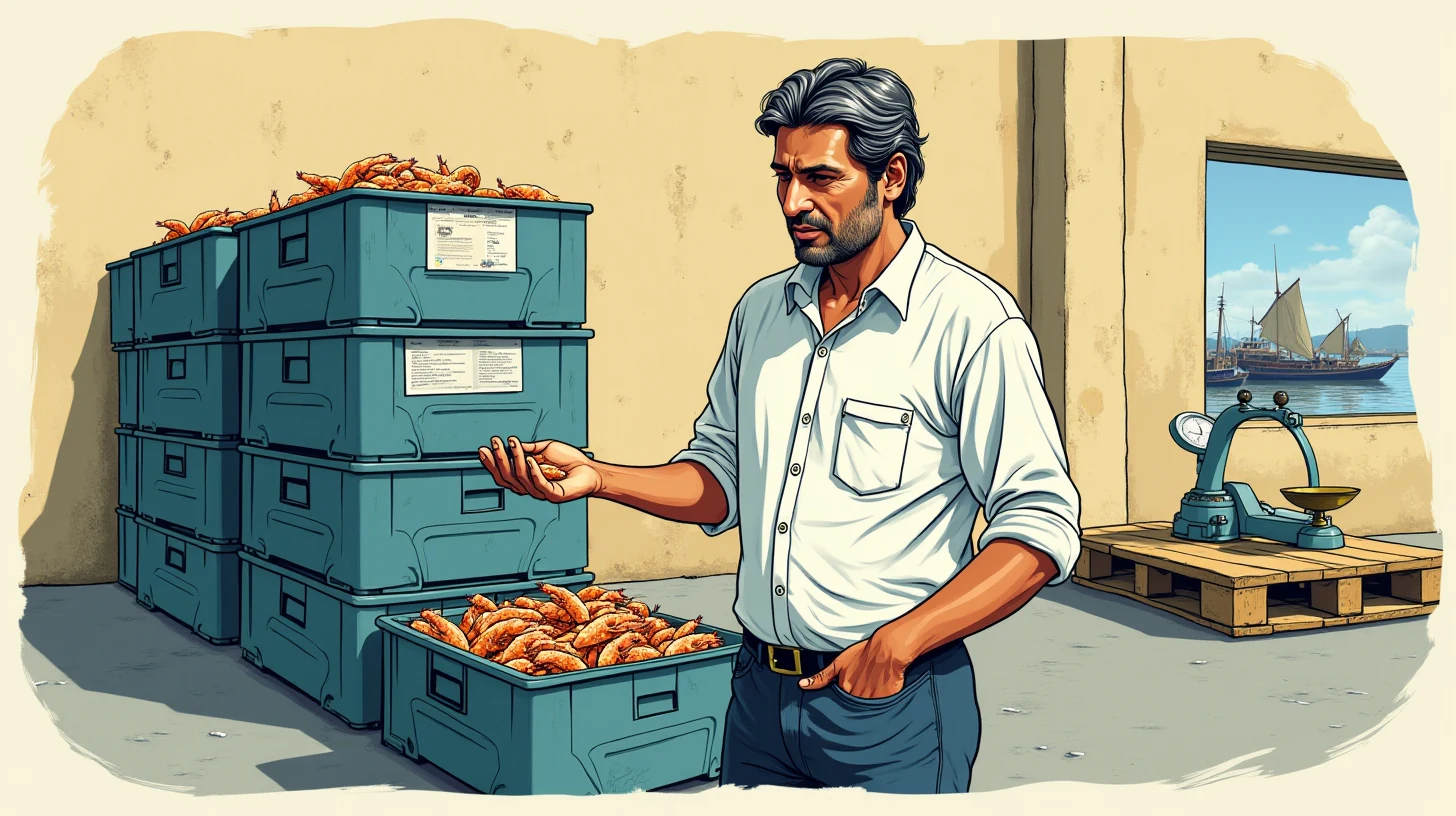
He came to Daman in 2001, at eighteen, from a Sindhi trading family in Ahmedabad. His uncle ran a textile commission business; Manish was supposed to apprentice and eventually inherit the ledger. Instead, he walked down to the fishing jetty one evening and asked the cooperative manager if anyone needed help sorting catch. Six months later he had rented a corner of a fish-trader's stall and was buying reject-grade Bombay-duck and prawns — the fish that broke the fresh-sale standard but dried cleanly — sorting them, spreading them on cotton racks in the warehouse courtyard, selling the dried product to the same retailers his uncle supplied textiles to. The margin was small. The work was methodical. He was not made for the textile ledger.
By 2022, he had formalized: incorporated as a one-person proprietorship under GST, filed his first Income Tax return showing ₹8,50,000 in turnover, and applied for FSSAI Registration through the FoSCoS portal. The registration came through in three weeks. Certificate number, three-year validity, ₹0 cost. He printed it, laminated it, and pinned it above the weight-scale. It said he was a microentrepreneur in the food-business sector, authorized to handle and sell non-perishable fish products within Gujarat.
Last year, turnover crossed ₹22 lakh. Not from retail. From a conversation at a market in Vapi where a Gujarat distributor asked if Manish could supply Bombay-duck in bulk to a catering co-op in Mumbai. Manish said yes. He was, he realized only after the first delivery, now crossing state lines. His three retail customers accounted for ₹5 lakh of turnover. The Mumbai distributor wanted ₹18 lakh per year. That same month his FSSAI Registration showed a renewal-notice popup: "Turnover exceeded ₹12L threshold. Mandatory tier review for continued compliance."
He ignored it. For three months he ignored it, turning over the numbers in his head without touching the portal. ₹22 lakh turnover meant he had crossed the microentrepreneur ceiling. The registration he had was still valid for eight months. The renewal notice was probably an error. He paid his GST, filled his invoices, delivered to Mumbai, and waited.
What very nearly happened was the thing that happens to five out of seven informal food businesses in India: the unannounced inspection.
🗓️ The annual ritual
The FSSAI license system in India is built on three discrete turnover tiers, each with a different issuing authority, a different inspection cadence, and a different cost structure. The tiers are not suggestions. They are thresholds.
Tier One: FSSAI Registration. Turnover under ₹12 lakh per annum. Issued by the FSSAI directly through the FoSCoS online portal. No physical inspection required. Cost: ₹0. Validity: three years, auto-renewable if turnover stays below the threshold. For a dhaba, a home chef, a single-city retailer, a street food vendor — this is the gate.
Tier Two: State License. Turnover between ₹12 lakh and ₹20 crore. Issued by the State Food Safety Authority (here: Daman and Diu FDA). Requires a physical inspection of the premises, documentation of hygiene standards, and equipment compliance. Cost: ₹500–₹2,000 depending on the state. Validity: one to five years. Processing time: two to six weeks. This tier is where the formal restaurant, the packaged-food company, the catering operation, the food processor lives.
Tier Three: Central License. Turnover over ₹20 crore, or any operation that supplies food across state lines. Issued by the FSSAI directly, but only after the operator has first obtained a State License and demonstrated compliance for at least six months. Cost: ₹3,000–₹5,000. Validity: one to five years. This tier requires a physical inspection by a central FSSAI team, HACCP documentation, and a full traceability system.
The distinction between Tier Two and Tier Three is, on paper, based on turnover and geography. Manish, at ₹22 lakh turnover and one supplier (Daman fishing cooperative) selling into one state (Gujarat) and one state (Maharashtra), lived in a grey zone. The documents he read on the FSSAI website said clearly: "Central License is for operations exceeding ₹20 crore or inter-state food business." He was inter-state. But the turnover rule said: under ₹20 crore, you do not need it. The state rule said: between ₹12L and ₹20Cr, you need the State License. So which was he?
In June 2025, three days after Arun ran out of warehouse space and Manish contracted a storage facility in Vapi to hold excess stock, an FSSAI inspector arrived at the warehouse without notice. He was a middle-aged man in a khaki shirt with a clipboard, very efficient, and he looked at the pinned laminate registration — valid until August 2025 — and said: "This is expired registration. You are operating above ₹12L, you need State License. Where is it?" Manish showed him the renewal notice. The inspector made a note and said: "You are operating under an expired tier. Penalty is ₹5,000. You have seven days to upgrade to State License."
The penalty was sharp. The seven days were shorter. Manish paid the ₹5,000, went to the Daman FDA office, and filed a State License application the next day, listing his annual turnover as ₹22 lakh. The FDA officer took the application, told him the inspection would happen within two weeks, and said: "But I should tell you: you are inter-state. Some inspectors, they will say you need Central License first, and the Central License people will say the State License is the first step. It is political. Depends on the inspector."
The inspection happened in the third week of June. A different inspector, a woman, came with a checklist. She examined the drainage channel, the storage racks, the cleaning log, the pest-control records, and took photographs. She filed a compliance report. Then she said: "Your operation is inter-state. State License alone may not be sufficient. You should apply directly for Central License."
Manish asked: "But the other inspector said to get the State License first. And the FDA office told me the same. Which is it?"
The woman said: "The rules say State License is the tier for your turnover. But because you are exporting — inter-state — the Central License gives you access to the inter-state distributors' compliance teams. Mumbai distributors, they often want Central License on their suppliers. You can get either. But the distributors will ask for the higher tier. Your choice."
What she did not say, but what Manish understood, was that the two rules were not contradictory — they were incomplete. The turnover rule got him to State License. The geography rule — inter-state supply — was a separate layer that changed the commercial requirement even if the legal requirement stayed at State.
- 📋
June 2022 — FSSAI Registration (₹8.5L turnover)
First three-year certificate filed through FoSCoS. Micro-level, zero cost. Pinned above the warehouse scale. Covers single-state retail.
- 📈
Jan 2025 — Turnover crosses ₹12L (₹22L run-rate)
Mumbai distributor contract adds ₹18L annual supply. FoSCoS renewal notice flags mandatory tier review. Manish does not act immediately.
- ⚠️
June 2025 — Unannounced inspection, ₹5K penalty
FDA inspector finds FSSAI Registration expired. Manish files State License application same week. Woman inspector suggests Central License for commercial viability.
- 🤔
July 2025 — The contradiction
State License approved (turnover tier). Central License available (geography tier). Two inspectors, two opinions. Manish has State License in hand but distributor asks for proof of higher tier.
His State License came through by mid-July, valid for two years, showing his operation as a food processor of non-perishable fish products, authorized for supply within Gujarat. The same week, Arun mentioned that the Mumbai distributor — the one supplying the ₹18L annual volume — had sent a message through their contact: "Suppliers to our co-op must have FSSAI Central License for inter-state certification."
Manish sat with the license in his hand and the message on his phone and understood, finally, what the woman inspector had meant. The law said State License was sufficient for his turnover. The market said Central License was necessary for the distributor contract.
⚠️ What very nearly happened
By August, the situation was this: Manish had a State License valid through 2027. The turnover rule was satisfied. The compliance rule was satisfied — the FDA woman's inspection had marked him clean. But the Mumbai distributor's co-op wanted proof of Central License. Without it, the ₹18L annual supply contract was at risk.
He called the FDA office. The officer said: "For Central License, you must first hold a State License for six months and demonstrate zero violations. You have had the State License for six weeks. Wait until mid-January 2026, then apply for Central License with your compliance history attached."
He called the FSSAI FoSCoS helpline. The helpline said: "Central License is for turnover above ₹20 crore or operations exceeding FSSAI's definition of small-scale. If you are exporting to another state, you fall under the inter-state definition, but the turnover rule says under ₹20 crore you don't need Central License. Apply for it anyway. We will review the application."
He called a consultant he knew in Vapi who had a catering business. The consultant said: "I have State License and I have been asking for Central License for two years. The cost is ₹3,500, the paperwork is simple, but the processing takes three months because they want to verify your supplier traceability. You need to have FSSAI-registered suppliers. Are your suppliers FSSAI-registered?"
Manish's supplier was the Daman fishing cooperative. He called them. They had no FSSAI registration.
"હું સમજું છું કે મને ક્યાંક ઝંઝટ આવશે, પણ કોણ કહે કે ત્યાં બે રાસ્તા હોય અને બંને ચાલતા હોય?"— I understand there will be some trouble somewhere, but who says there are two paths and both of them work?
The arithmetic of the situation was this: the distributor contract was ₹18 lakh per year. His total turnover was ₹22 lakh. If he lost the distributor, his turnover would drop to ₹4 lakh and he would cascade back to needing only FSSAI Registration. But the work of a food business, once it starts exporting, does not easily cascade back. The momentum went one direction. He needed the distributor. The distributor needed Central License proof. Central License needed either turnover over ₹20 crore or a State License held for six months without violations. He had the second criterion but would not meet it until mid-January 2026.
What very nearly happened was that he waited. He filed the State License properly, made no violations, kept the warehouse clean, answered the FDA's random spot-check in November with zero remarks, and sat through November and December watching the distributor's co-op decide whether to wait for his Central License application or switch to another supplier who already had it.
🌗 What changed
In the last week of October 2025, Arun's son Rohit — twenty-three, studying business management at Daman College — visited the warehouse with his laptop and said he had installed an AI agent on it for reviewing the business. He set the language to Gujarati and asked Manish to type his question into the agent.
Manish typed: "મને ફ્રેમોન સ્ટેટ લાયસેન્સ છે. ડિસ્ટ્રિબ્યુટર સેન્ટ્રલ લાયસેન્સ માંગે છે. હું તે પામી શકું એમ નથી કારણ કે હજુ છ મહીનો થયો નથી. બીજો રાસ્તો છે?" — I have State License. The distributor wants Central License. I cannot get it because it has not been six months. Is there another way?
The agent read the question, and then replied:
"તમારી પરિસ્થિતી આ છે: તમારું વર્ષવાર turnover ₹22 લાખ છે. ₹20 કરોડ સુધી કે ગણતરી માટે State License કાફી છે. પણ તમે inter-state export કર છો. Rule બે છે: (1) State License + six months waiting period, પછી Central License માટે અર્જ, અથવા (2) Central License માટે સીધો અર્જ કર અને લખ કે તમે inter-state food business છો. બંને રુટ valid છે। Rule-દર-rule બતાઉં?"
(Your situation is this: your annual turnover is ₹22 lakh. Up to ₹20 crore, State License is sufficient according to the turnover rule. But you are exporting inter-state. There are two rules: (1) State License plus six-month waiting period, then apply for Central License, or (2) apply directly for Central License and state that you are an inter-state food business. Both routes are valid. Shall I explain rule by rule?)
Manish typed yes. The agent walked through the FSSAI regulations — the full text, field by field. The key paragraph was in the FSSAI Food Safety and Standards (Licensing and Condemnation of Food) Regulations, 2011, Section 2.1.1: "Central License is required for any food business operating in more than one state, regardless of turnover, provided the applicant has held a prior food-safety certification from FSSAI or FDA."
Manish had held a prior certification: his Registration from 2022. That certification had lapsed into a State License, which was also an FSSAI-issued certification. The rule did not explicitly say Central License required a State License held for six months first. The six-month rule applied only if you were coming from a lower tier (Registration to State License). If you were already in State License, you could apply for Central License immediately if your business was inter-state.
The agent then said:
"તમે ખોટો તમે નહીં. State License holders માટે Central License application માટે બે રૂટ છે: (1) ₹20 કરોડ threshold breach કર્યો તો wait કરી શકો. (2) Inter-state business છો તો તે જ્યાં માટે central authority (FSSAI national) jurisdiction સુધી જાય છે. તે બે અલગ provisions છે. તમારા supplier ની FSSAI registration પણ જરુર નથી જો તમે self-attest કર કે તમે quality-compliant supplier work કર છો। Daman cooperative ને letter જાવ કે તમે તેમના મત્સ્ય-ગુણવત્તા ધોરણ comply કર છો તે statement જોઈ લો. પછી તમે Central application આજ જ કર શકો."
(You are neither wrong nor right. For State License holders, there are two routes for Central License: (1) if you breach the ₹20 crore threshold, you can wait. (2) If you are inter-state, that falls under FSSAI's national jurisdiction. These are two separate provisions. Your supplier does not need FSSAI registration if you self-attest that you work with quality-compliant suppliers. Get a letter from Daman cooperative that their fish-quality standards comply with your specifications. Then you can apply for Central License today.)
Manish had a conference call with the agent, Rohit, and Arun. They pulled up the FSSAI application form for Central License. The form had a field: "Justification for Central License eligibility." The agent helped Manish fill it with a paragraph in Gujarati: "I operate an inter-state food business exporting dried fish products from Daman to Maharashtra, Gujarat, and potential future multi-state supply. My business is governed by FSSAI regulations as an inter-state exporter. I hold a valid State License (valid through 2027) and meet all compliance standards as verified in the June 2025 FDA inspection. I am applying for Central License to enable compliance certification for downstream supply chains requiring inter-state food-business certification."
He submitted the application on October 28th, 2025. He uploaded his State License, his GST certificate, his FDA inspection report (marked clean), and a signed attestation letter from the Daman cooperative manager confirming fish-quality sourcing.
The FSSAI acknowledged the application within forty-eight hours. The reply said: "Application received for Central License under Section 2.1.1 (inter-state operation). Review timeline: four to eight weeks pending supplier verification. You will be contacted for clarification if needed."
By mid-December 2025 — less than seven weeks later — the Central License arrived. Validity: two years. Turnover tier: ₹22 lakh (below the ₹20 crore threshold, but inter-state operation). Issue category: Food Processor.
FSSAI Registration
Under ₹12L turnoverZero cost, online, three-year validity. Manish held this from 2022 to mid-2025. Covers single-state retail operations. No inspection required.
State License
₹12L–₹20Cr turnoverIssued by state FDA, ₹500–₹2,000 cost, one- to five-year validity. Requires physical inspection. Manish obtained this in July 2025 after the unannounced inspection penalty.
Central License
₹20Cr+ OR inter-state operationIssued by FSSAI directly, ₹3,500–₹5,000 cost, one- to five-year validity. Requires State License hold plus inter-state operation proof, or turnover over threshold. Manish obtained this in December 2025.
The day the certificate arrived, Manish forwarded it to the distributor co-op contact. The reply came back within two hours: "Certificate received and confirmed valid. You are cleared to supply to our catering contracts effective immediately. We can increase your allocation from ₹18L to ₹28L annual volume starting January 2026."
Three months later — May 2026 — Manish had delivered ₹32 lakh worth of dried fish to the Mumbai distributor, well ahead of the revised ₹28L pace. His total turnover was projected to close the fiscal year at ₹36 lakh. Arun had hired a second assistant to manage the drying racks. Priya had shifted from a paper ledger to a digital GST accounting system. The warehouse that was full six months ago now had plans for a second location in Vapi to handle the expanded volume.
🧭 Why we built it
There are, by FSSAI data, approximately eighteen lakh food businesses registered in India across all three tiers. Of these, a specific and growing category — food exporters, food processors, packaged-food producers going multi-state — live in the gap that Manish lived in: they have met one criterion for their license tier but are uncertain whether a second criterion has been triggered.
The FSSAI regulations are published in plain English and Hindi on the FSSAI website. They are comprehensive. They are also written for compliance auditors and state-level FDA officers, not for a seafood-packing proprietor in Daman. The distinction between "inter-state food business" and "inter-state food supplier" is clarified in a sub-paragraph of a sub-paragraph. The rule allowing self-attestation for supplier quality is buried in a different section. The possibility of applying directly for Central License from State License without waiting six months exists but is not explicitly highlighted in the FAQ.
Most food businesses in this category do what Manish did: they hire a consultant (₹5,000–₹15,000), or they wait out the clock (six months of lost revenue), or they abandon the opportunity (like Manish nearly did). The gap is not the regulation. The gap is the translation.
The agent's role in Manish's story was to read the full regulation, identify the two valid pathways (the six-month-wait path and the direct-application path), extract the specific subsection that authorized immediate Central License application for inter-state operations, and explain in Gujarati why both rules were true and why both paths led to the same outcome. The agent never filled the form. The agent never submitted the application. The agent did not decide for Manish. It clarified — clearly and in his language — what the law actually said versus what the consultant's common-practice suggested.
The reason this matters is economic. A food business operating at ₹22 lakh turnover has perhaps ₹4–5 lakh in net annual profit. A consultant fee of ₹10,000 is a 2-3% margin haircut. A six-month delay in closing a ₹28L supply contract is a lost ₹14L in potential revenue that year, and the relationship downside of being unavailable when the distributor is actively sourcing. Neither is catastrophic. Both are exactly the kind of unspectacular cost that grinds small food businesses down: not the crisis, but the friction.
What it does
- 🔍Reads FSSAI regulations and interprets section-by-section which tier Manish qualifies for, and whether multiple tiers are simultaneously valid.
- 📋Identifies that inter-state operation is a separate criterion from turnover, and that two different pathways (six-month-wait vs. direct application) both exist in the regulations.
- ✍️Helps Manish draft the justification paragraph explaining his inter-state eligibility to FSSAI, in his language, without legal jargon.
What it does not do
- 🔒Never fills the FSSAI form without his explicit direction on each field.
- 💳Never submits the application or handles the registration fee payment.
- ⚖️Never advises which pathway to choose — it presents both, explains both, and lets Manish decide.
We built this feature free. We will keep the core licensing-interpretation free — reading the regulation with the business owner, in their language, explaining which tier they qualify for and which rules apply — forever. The food business itself is the bottleneck. The regulation is public. The agent's job is to make the regulation legible to the person running the business without requiring them to pay for an intermediary.
🌱 What we hope happens
Two months after the Central License arrived, Rohit called to say his uncle was planning to hire a third employee — not just for the warehouse, but for what he called "the other-state coordinations." The business was no longer just Daman-based. The distributor had introduced Manish to a catering company in Pune that wanted bulk supply. Another buyer in Ahmedabad had approached through a local business chamber. The FSSAI Central License had, paradoxically, made the business smaller in one way — more regulated, more documented, more formal — and larger in every other way.
Manish had printed the Central License and pinned it next to the State License and the original Registration. The three certificates, framed together, now sat in a glass case Arun had hung above the warehouse office desk. Rohit said his uncle stood there sometimes, just looking at the progression, the way a jeweller might look at a set of weights that finally, after a year of adjustments, all balance.
What we hoped for was exactly that: not a shortcut, not a rescue, not permission to skip the rules or the inspection or the compliance. Just clarity. A food business owner should not need a consultant to understand whether they qualify for a tier or whether two seemingly contradictory rules both exist. The regulation is written in the public interest — it is there. The agent's job is to read it with the owner, in their language, on an October evening when a distributor's message arrives asking for a license they think is unreachable, and to say: actually, it is reachable, and here is exactly why.
If you have a food business — a seafood packer in Daman, a cloud kitchen in Bengaluru, a home catering service in Mumbai, a packaged snacks producer in Kolkata — and you are crossing a turnover or supply-geography threshold that you are uncertain about, the agent is available free at gabforge.in. It reads the FSSAI regulations directly. It has Gujarati, Hindi, Marathi, Tamil, Telugu, Kannada, and English. It knows the state FDA portals and the FSSAI application procedures. It will not fill your form for you. It will read the regulation with you until the rule that applies to your business is no longer hiding in a sub-paragraph.