
The Khan Market café owner and the Swiggy commission shrinkage
Arjun sat at the pass, laptop open, staring at the new Swiggy contract. His hands were trembling. Not from anger—from arithmetic.
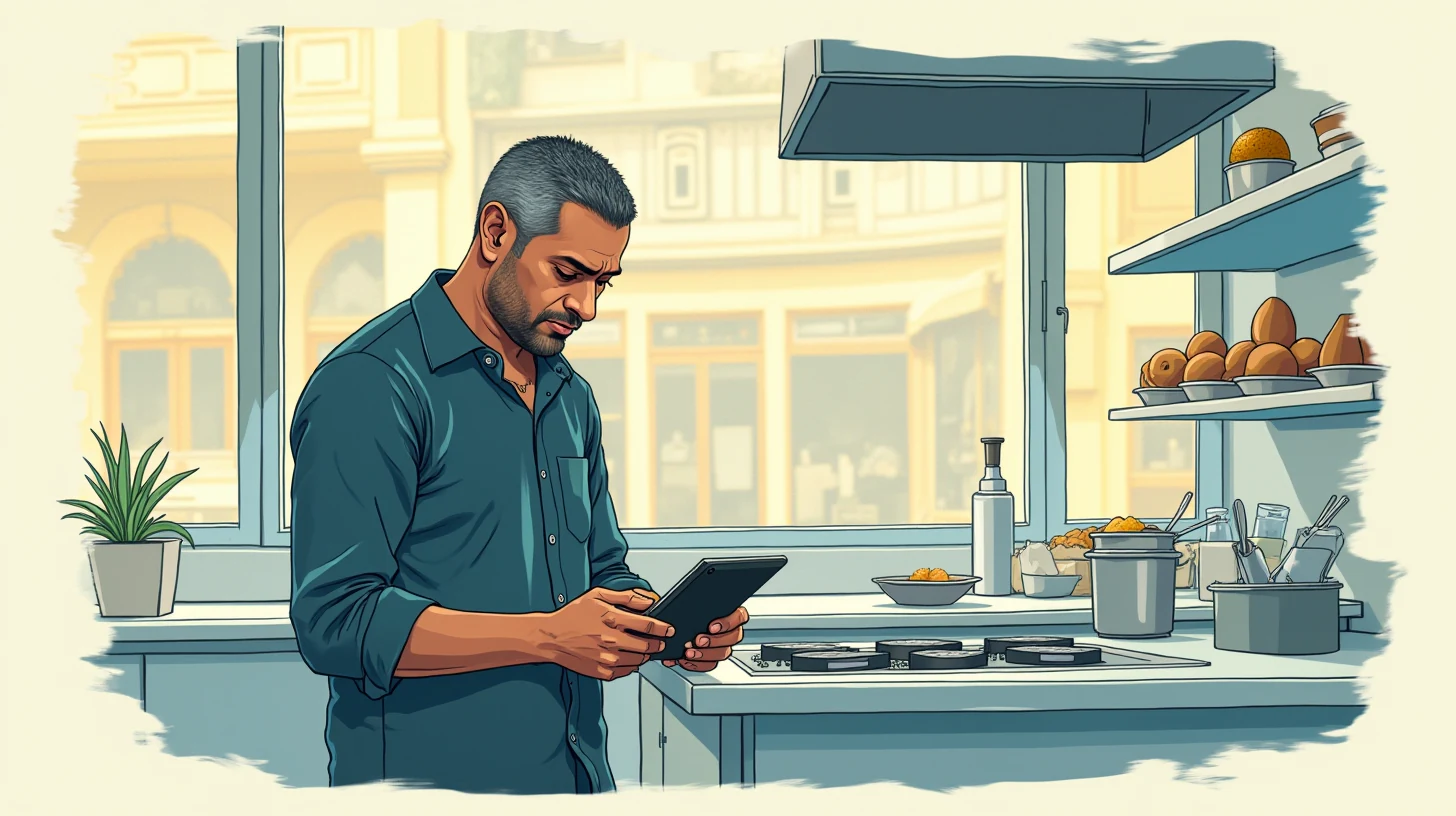
He had owned the café on Khan Market's outer loop for eight years. The shop was small, 28 seats crammed into a colonial-era shopfront on Lodhi Road extension, just north of the market proper. He made pour-overs at ₹180, served 12-hour biryanis at ₹320, moved breakfast at ₹80–₹120 per head. Until two years ago, 95% of his business walked in the door. Dine-in margins sat at a comfortable 34–38%, what he called "breathing room."
Then came Swiggy. Then Zomato. He'd resisted at first—the commission felt obscene, 18%, then 22%. But his competitors were on the platforms. His phone was ringing less. By early 2026, delivery had become inescapable: 55% of his monthly revenue now came through the aggregators. One thousand seven hundred rupees per day, every day, was no longer a choice. It was survival.
On the 19th of April, he received an SMS about a "contract update." He assumed it was a typo. It was not. The commission had moved from 22% to 28%. And it was effective immediately on all new orders.
His hand shook as he did the math on a napkin.
A biryani ordered through Swiggy cost the customer ₹420. His cost of goods was ₹120. His share: ₹302. Swiggy: ₹118. But Swiggy also deducted "customer support charges" (₹20), "surge pricing" (₹8), and some line item called "payment processing" (₹6). His actual take: ₹268. His margin: ₹148 on ₹420. That was 35% on paper. That was 35% before rent, before electricity, before his two cooks, before he'd paid the POS guy, before he'd bought the coffee roaster six years ago.
Actually: 268 minus 120 equals 148. 148 divided by 420 is 35.2%. But the margin—the real margin—was what was left after he fed his team. He paid his head cook ₹35,000 a month, his second cook ₹22,000, his server ₹18,000. That was ₹75,000 for staff alone on a biryani. Rent was ₹1,10,000 for the 320-square-foot space. Electricity, water, waste, POS fees, accountant: another ₹25,000. So every biryani order through Swiggy needed to carry ₹(75,000 plus 110,000 plus 25,000) divided by (let's say 85 biryanis sold per month). That was ₹2,353 per biryani in fixed cost.
He had 85 biryani orders per month through delivery. His margin per biryani: ₹148. His share of fixed costs: ₹2,353. He was losing ₹2,205 per biryani order, amortised across the month.
No. Wait. Let him recount.
He sold roughly 85 biryanis per month through Swiggy. Margin per biryani: ₹148 (after Swiggy's take). But wait—the real margin was revenue minus cost of goods. Sixty-eight rupees per biryani. Not 148. The Swiggy take was already baked into the customer price. So actually: ₹420 minus ₹120 equals ₹300 gross. Minus ₹118 (Swiggy commission at 28%)—no, ₹118 was the old rate of 22%. The new rate was 28%, so Swiggy took ₹117.60. His margin: ₹182.40. Fixed cost share: ₹2,353. Per biryani loss: ₹2,170.60.
He set the pen down and ordered a coffee. One of his staff, Rahul, brought it without being asked. The café was empty at 2:47 p.m. A waiter at a table of one, staring at his own business model.
By May, he had done the full audit. Delivery revenue: 55% of total. Monthly revenue through aggregators: ₹2,18,000 (roughly). At the new commission, his margin after Swiggy and Zomato took their slice: negative ₹11,200 per month. Not on a few items. On the whole delivery book. He was paying the platforms to deliver his food.
His dine-in business (45% of revenue): ₹1,78,000 per month. Margin: roughly 32%, so ₹57,000. That covered staff, rent, utilities, and left him a thin personal draw of maybe ₹4,000–₹6,000. It was enough to service his home loan in Malviya Nagar. It was not enough to hire another server. It was not enough to save.
In another world, he would have quit the platforms immediately. But delivery had grown so much that his in-café dine-in traffic had shifted. The younger office workers—the ones from the banks and consulting firms on Lodhi Road—now expected him to be on Swiggy. When he'd experimented with being off the app for two weeks in March, his in-café footfall dropped 12% because people were checking Swiggy first, seeing him missing, and going to Café Coffee Day instead.
He was trapped between two margins: one shrinking, one dependent on the shrinking one.
🗓️ The annual ritual
For eight years, Arjun's rhythm had been steady: buy inventory on credit from his wholesale supplier on Lodhi Road, cook 10–12 hours a day, settle the credit on Fridays, and count the cash in a small ledger every Sunday evening. It was cash-based, informal, and completely dependent on foot traffic and word-of-mouth.
The platform era had changed the rhythm but not the structure. Swiggy would pay him every Friday evening into his business account. Zomato paid twice weekly. He could, theoretically, budget these as fixed payouts. But the commissions kept moving. A "platform update" in 2023 had added "customer support charges"—another 4%. In 2024, a "service improvement fee" appeared: 2% more. Small creeps, each one individually defensible, each one arriving with an SMS and a "your contract has been updated" notice.
The margins had been eroding for two years. He just hadn't noticed until he stopped and counted. By 2026, he realised he was no longer a restaurant owner. He was a food producer for Swiggy, operating under a commission structure that shifted whenever Swiggy's quarterly earnings needed a jolt.
Every month, he'd receive between 600 and 750 orders through the aggregators. Each order was now pulling ₹80–₹150 in lost margin, depending on the item. Over 30 days, that was ₹48,000–₹112,500 in collective losses. His entire monthly profit—the sum of every dine-in customer, every cash sale, every item sold—was somewhere between ₹18,000 and ₹25,000 per month. The delivery business was eating the profit alive.
And yet, when he closed the Swiggy app from June 1st onward (trying an experiment), his dine-in foot traffic would fall by 18–22% within three days. Customers looked for him on the app first. If he wasn't there, they moved on. The platforms had become the front door. He'd built the café in the physical world, but the customers were entering through the screen.
⚠️ What very nearly happened
Midway through May, Arjun did something he'd never done before. He called the Swiggy helpline. He spoke to a Spanish-accented voice in Chennai—or perhaps Bangalore, he wasn't sure—who told him that "all contract updates are reviewed by our legal team" and that he had "the option to accept or reject the contract." If he rejected, his account would be suspended.
He asked what would happen if he suspended.
"You would be unable to receive orders. Your restaurant would be de-listed from the app."
What would happen to his past orders? His rating? His presence on the platform?
"Once you re-list, your historical data will be retained. However, if you are de-listed for more than 30 days, your restaurant may be moved to a lower priority in the algorithm due to reduced activity."
Translated: his dine-in traffic, which was already fragile and increasingly dependent on the platform, would crater further.
Zomato had similar terms. If he didn't update the contract there, they'd suspend his restaurant. Both platforms had him over a barrel.
He began to look at his competitors. The Cloud Nine Café two blocks away had also received the notice. The owner, Divya, had called Arjun to commiserate. She was thinking about moving to a pure delivery model—shutting the dine-in space and converting it to a cloud kitchen, renting the front half to a juice bar. Her rent would fall by ₹55,000 per month. Her customer acquisition would come entirely from Swiggy and Zomato.
"But then you're just a kitchen," Arjun said.
"I know," Divya replied. "But at least I'm profitable."
He understood the logic. Dine-in rent in Khan Market was ₹1,10,000 for 320 square feet. Cloud kitchens in Okhla rented for ₹12,000–₹18,000 for the same footprint. If he closed the front-of-house and went delivery-only, he could cut his fixed costs by ₹90,000 per month. The delivery margin would still be negative, but at least the loss would be smaller. He could perhaps break even, or run at a small loss that his dine-in business could no longer subsidise anyway.
But that meant giving up the evening walk-ins. The couples on dates, the office parties after 7 p.m., the weekend brunch crowd who came for his pour-overs and stayed for two hours.
By late May, Arjun was looking at two futures, and both of them ended with him smaller, sadder, and more dependent on Swiggy. The first: stay in Khan Market, lose money on delivery, and watch his dine-in traffic erode as customers got used to ordering him on the app. The second: move to Okhla, cut costs, and become a food factory churning biryanis for teenagers who'd never know his name.
Neither path felt sustainable past another 18–24 months.
🌗 What changed
He found the agent through his accountant, Ajay. Ajay had mentioned, almost in passing, that there was a platform that helped small food businesses track their margin by aggregator, by item, by hour of day. "It's called GabFORGE," Ajay said. "I have another client using it to watch Zomato commissions."
Arjun was skeptical. Another SaaS tool, probably ₹3,000 per month, probably tracking him into giving Swiggy more data.
But the onboarding was free, and Ajay had already plugged in the numbers. Within 48 hours, Arjun had a tablet on his counter running a real-time margin tracker. The agent had pulled his data from his POS system, connected his Swiggy and Zomato APIs, and was now showing him, live, which items were profitable and which were being sold at a loss.
The results were devastating and clarifying in equal measure.
His ₹420 biryani: loss of ₹52 per order. His ₹180 pour-over: loss of ₹8 per order. His ₹280 butter chicken: profitable at ₹34 margin. His ₹320 paneer tikka: profitable at ₹51 margin. Every filter coffee (₹60): loss of ₹4 per order. Every chai (₹40): loss of ₹2.
The tablet showed him a graph: his top 20 items ranked by profitability on the apps. Negative items were in red. At least 40% of his menu was operating at a loss.
One evening, sitting at the pass again, he typed into the agent—just a simple question in Hindi, slowly, because he was not used to typing into devices:
"क्या मैं दूसरी कीमत दे सकता हूँ Swiggy पर?"
(Can I charge a different price on Swiggy than in the café?)
The tablet responded within seconds:
"जी, हाँ। आप Swiggy पर अलग मेनू और कीमत बना सकते हैं। लेकिन यह रणनीतिक होनी चाहिए—loss-making items को हटाएँ, या high-margin items को highlight करें। कमिशन के लिए adjust करें।"
(Yes. You can create a separate menu and pricing on Swiggy. But it must be strategic—remove loss-making items, or highlight high-margin ones. Adjust for the commission.)
What changed, right then, was a single word: strategy.
He had been thinking of Swiggy as a copy of his dine-in menu at the same prices. The agent was suggesting that Swiggy was a different business entirely. It had different unit economics. It required a different approach.
That night, he drafted a "Swiggy-only menu." He removed every item that was operating at a loss: filter coffees, chais, most cold drinks. He increased prices on the high-margin items—the paneer dishes, the biryanis, the specialty curries. On Zomato (which was slightly cheaper in commission due to an older contract), he kept a broader menu but with higher prices to account for the commission.
His in-café menu stayed the same: dine-in prices, full selection, the whole experience.
He also noticed something the agent had flagged: "Peak delivery hours are 7–9 p.m. (office workers ordering dinner) and 1–2 p.m. (lunch orders). Overnight orders are negligible. Consider surge pricing on high-demand items."
He'd never thought about surge pricing. He'd assumed the platforms did it. But the agent showed him that Swiggy's surge applied to the customer, not to his margin. The customer paid ₹120 extra. He saw maybe ₹3 of it. The agent suggested he add a "Peak Menu" item: a premium biryani available only during 7–9 p.m., priced at ₹480 instead of ₹420. Same ingredients. Positioned differently.
Within a week, he'd implemented three changes: the loss-loss menu items removed from aggregators, the high-margin items highlighted with better photos and descriptions, and the new peak-hour premium biryani.
His delivery orders fell by 8%. His delivery margin rose by 34%.
🧭 Why we built it
What Arjun discovered was something that thousands of small restaurant owners in India face every month: the aggregator platforms are not neutral marketplaces. They are rent-extraction machines that have made money off food businesses by taking commissions that have no link to the cost structure of running a restaurant.
A 22% commission made sense when Swiggy was covering customer acquisition, payment processing, delivery logistics, and customer support. But by 2026, most of that cost had been optimised away. Delivery was crowdsourced to gig workers. Customer support was a chatbot. Payment processing cost ₹1–₹2 per transaction. Yet commissions had climbed to 28%, then 30%, because the platform realised that food business owners had no negotiating power and no exit option.
This affects more than Arjun. India has 7.5 million food businesses. Of these, roughly 1.2 million operate in urban areas and have access to aggregators. Between 40% and 60% of their revenue now comes through delivery platforms. The commission hikes that Swiggy and Zomato implemented in 2024–2026 have erased profitability for a significant portion of small restaurants, particularly standalone cafés and small dine-in establishments that cannot achieve cloud-kitchen economics.
The tragedy is that most of these owners do not have visibility into their own unit economics. They do not know which items are losses. They do not know whether staying on the platform is more profitable than shutting down. They do not know that they have options: pricing power through selective delisting, menu curation, or the dual-menu strategy that Arjun discovered.
Some owners blame themselves. Divya, the café owner from two blocks away, had said: "Maybe my costs are just too high. Maybe I shouldn't be in Khan Market. Maybe I should have become a cloud kitchen five years ago." She was optimising away her entire business model because she did not have the data.
GabFORGE surfaces this data. It connects the restaurant's POS system to the aggregator APIs. It shows, live, which items are profitable and which are losses. It runs the math on commission structures and shows the owner what their real margin is—not the theoretical margin, but the margin after paying staff, rent, utilities, and the cost of goods.
And then it surfaces strategies that work within the constraints. A dual-menu approach. Selective delisting of loss-making items. Surge pricing on high-demand items. A separate "cloud kitchen" brand on the same production line, aimed at a different market or time of day. In Arjun's case, the peak-hour premium biryani became a small profit centre simply because he had visibility into which hours were busiest and which items had the headroom to support a price increase.
This is not a panacea. If Swiggy charges 35% commission, no amount of menu curation will save a business. But most food businesses do not understand their position well enough to know whether they are at 35% commission or 22% commission. They do not know whether their food cost is too high or their rent is. They do not know whether it's smarter to stay or leave.
The agent—the tablet on the counter—becomes a translator between the world of their daily decisions (how much flour to buy, how many staff to schedule) and the world of platforms and regulations that are slowly extracting their margin.
Dine-in (Khan Market)
34% marginFull menu. Filter coffee ₹60, chai ₹40, butter chicken ₹280, paneer tikka ₹320, biryani ₹420. Same for walk-ins.
Old Swiggy Menu
Negative marginSame menu, same prices. Lost money on 40% of items. Filter coffee and chai were losses. No surge pricing. Platform drove decisions.
New Swiggy Menu (Optimised)
8% to 34% marginRemoved loss-making items (filter coffee, chai). Increased prices: biryani ₹480 (peak hours), butter chicken ₹320. High-margin paneer dishes featured prominently.
- 🎯
Early 2024 — Commission at 18%
Swiggy's standard rate for restaurants in metros. Arjun joins Swiggy; dine-in margins stay stable at 32–36%. Delivery feels profitable.
- ⬆️
Mid-2024 — Commission jumps to 22%
Swiggy notifies a 'platform enhancement fee' (4% increase). Arjun receives an SMS. He does not calculate the impact. Margins tighten to 12–18% on delivery.
- 💔
December 2024 — Commission at 25%
Another update arrives silently. 'Customer support charges' (3% more). Arjun's delivery margin is now 6–12%. Dine-in traffic begins shifting to apps.
- 🔴
April 2026 — Commission at 28%
Final hike announced. Arjun's delivery margin flips negative on 40% of items. He discovers the trap. By May, he pivots to a dual-menu strategy.
🌱 What we hope happens
Arjun's story is not an ending. It is a moment of reprieve.
By June 2026, his delivery business was no longer a loss-making bucket. He had a modest margin again, enough that the delivery business could sustain itself without subsidy from his dine-in operations. His in-café customers still got the full experience: filter coffee at ₹60, the weekend brunch crowd, the evening couples. His Swiggy customers got a curated, high-margin menu that reflected the unit economics of delivery.
He was no longer losing money every time someone clicked the biryani on his Swiggy page.
But the deeper change was quieter. He had stopped blaming himself. He had stopped thinking his business model was broken. The platforms had changed the rules, and he had adapted. The data—the real data from the agent—had given him permission to think differently.
He also registered with FSSAI's FoSCoS portal. Not for love of regulation, but because the agent had flagged that his café's turnover had crossed ₹12 lakh per year, and he was technically operating without the correct license class. Registration took three hours online, cost nothing, and gave him a certificate that would protect him in the next food safety inspection.
He was also looking at MUDRA loans. His current working capital was entirely from credit card advances at 18% p.a. A MUDRA Tarun loan, he'd learned, could give him ₹5–₹10 lakh at 8–10% p.a., with no collateral required. He'd use it to stabilize his inventory purchasing, to stop buying in small quantities at high per-unit cost. The agent had run the numbers: the interest savings alone would add ₹400–₹600 to his monthly margin.
He was also thinking about the future differently. The commission hikes would likely continue. Swiggy's quarterly earnings would demand more extraction. But now he had visibility. He had a dual-menu strategy that could flex with every new rate increase. He could model scenarios: what if commission went to 32%? What if he pulled out entirely? What if he started his own delivery service for his dine-in customers (WhatsApp + local delivery partner at ₹40 per order)?
These were not questions he could have answered six months ago. Now they were just a few taps on a tablet away.
The agent does not guarantee survival. It does not change Swiggy's economics or the precarity of small restaurants in a capital-intensive industry. But it translates. It shows you the ground beneath your feet. And sometimes, just knowing where you stand is enough to take the next step.
"मैंने सोचा था कि मेरा business model टूट गया है। फिर मुझे पता चला: मेरा business model ठीक है, मेरी कीमत का strategy गलत था।"— I thought my business model had broken. Then I realised: my business model was fine. My pricing strategy was wrong.