
The Gangtok organic cardamom processor and the NPOP cross
Phurba stood in the wooden drying shed behind his home near Kanyam, in the Kanyam block of East Sikkim, holding a handful of dried large cardamom pods between his weathered palms. The pods were bleached grey-brown, spiky, each one slightly smaller than a walnut. He was forty-two when he inherited the three-acre plot from his father in 2011, just as Sikkim's organic mandate was taking root. The plot had grown cardamom—elaichi, large cardamom—for two generations, always without synthetic pesticides or fertiliser. When the state began issuing NPOP certificates (National Programme for Organic Production), Phurba applied. His papers came back in 2013. For thirteen years, his cardamom carried the organic seal.
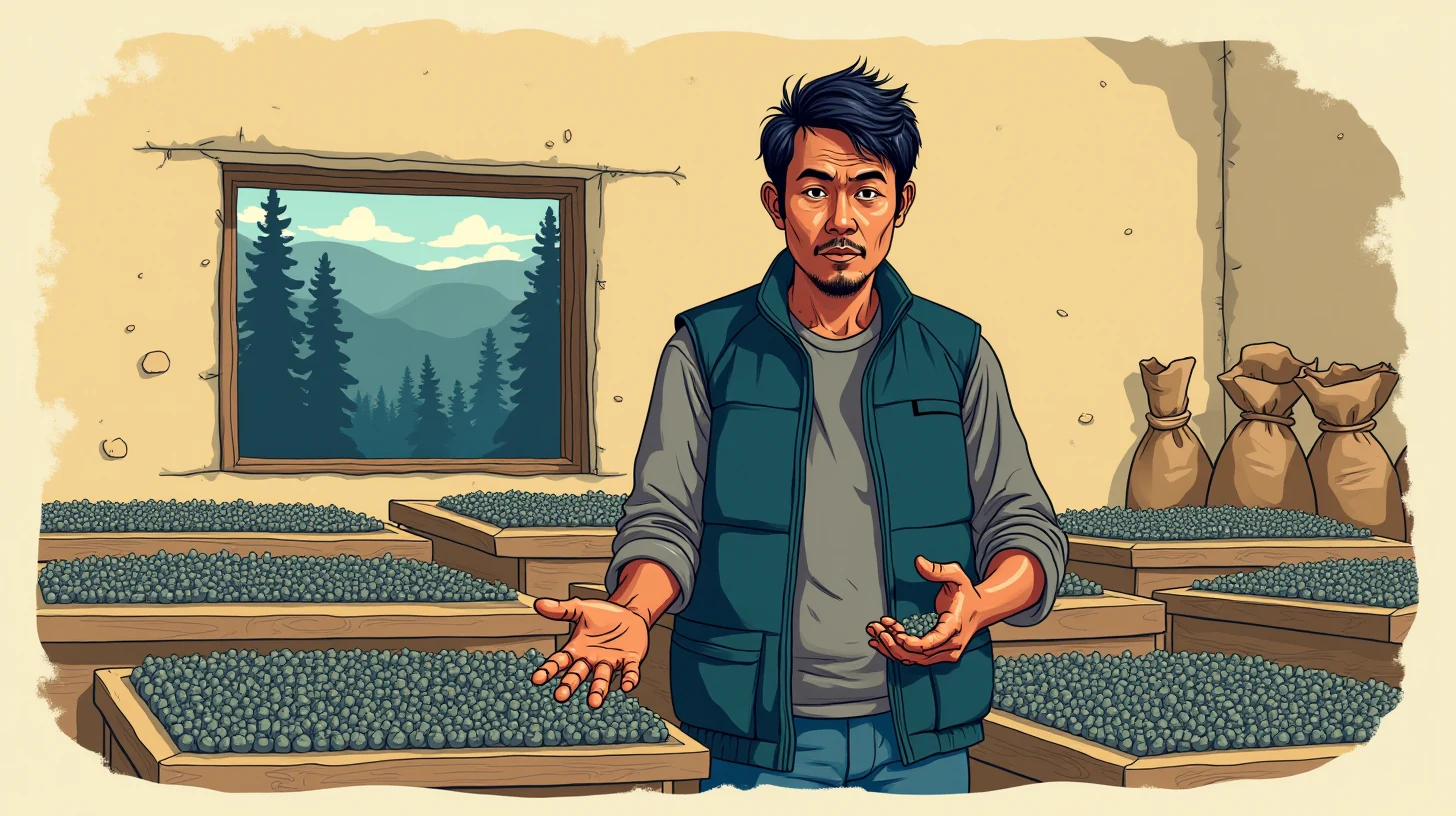
Then, in March 2026, his longest-standing buyer—a second-generation spice house in Delhi called Puram Masalas, established 1997—stopped returning his calls. When Phurba finally reached the owner, Rajesh Puram was apologetic but firm. "Phurba-ji," he said over the phone, "NPOP is agriculture. FSSAI is food. My wholesaler now insists on both. Your cardamom is certified organic by the government. But when it is processed, dried, and powdered, it becomes food. The food safety authority has a separate database. FSSAI says your processed cardamom does not exist."
An order for ₹8 lakh—five tonnes of dried and powdered cardamom for the spring curry-powder season—went into suspension.
Phurba had built his processing operation deliberately. After the 2013 certification, he purchased a mechanical dryer, a grinding mill, and hand-sealing equipment. In 2019, he registered his unit with the FSSAI under the Fosterer of Safe Food scheme (FoSCoS), the online portal for micro operators. The certificate came in under ₹200, valid for three years. Phurba felt compliant. He had paid his fee. His unit had a number. The certificate hung in his shed.
But the certificate said nothing about organic. FSSAI FoSCoS is a turnover-based registry; it certifies that a unit exists and that the owner has attended a one-day food safety workshop. It does not validate the origin of the raw material or certify that the processed output is organic—even when the raw material is held by a state government NPOP certificate.
The two databases—agriculture (NPOP) and food (FSSAI)—do not speak to each other.
🗓️ The annual ritual
Sikkim's organic certification is statutory. In 1999, the state became the first in India to declare a fully organic agriculture standard, codified in the Sikkim Organic Certification Act. Every farmer who grows vegetables, spices, or cash crops without synthetic inputs must register annually with the State Agricultural Certification Agency (SACA)—a division of the Department of Agriculture, Horticulture & Soil Conservation—and have their plot inspected. The inspection is free. The certificate costs ₹300. For thirteen years, Phurba had renewed his NPOP certificate every spring. The inspector, a young agronomist from the Kanyam block office, would walk through the three acres, look for any evidence of synthetic pesticide bottles or chemical fertiliser bags, and ask Phurba to sign the renewal form. No issues. No questions. The certificate came by post in May, always by May.
In his village of Kanyam—population roughly 4,200, scattered across the valley at 4,000 feet elevation—organic cardamom is the dominant cash crop. Every third house is a cardamom plantation. Every family with more than an acre grows it. The land itself is volcanic, nitrogen-rich from centuries of decomposed pine and oak leaf-fall. The monsoon is fierce and reliable. The climate is near-perfect for large cardamom. Phurba's neighbours—Tshering, Pemba, Sonam—all held NPOP certificates too. None of them had sold cardamom outside Sikkim. The spice was dried, bulked, and sold to Sikkim-based middlemen who knew Delhi wholesalers. The middleman took 15%. The Delhi wholesaler took another 12%. Phurba was accustomed to a split margin. What he had not contemplated was that once he began processing the cardamom himself—drying it in the mechanical dryer, grinding it into powder, sealing it in polyethylene packets labeled with his unit name—the regulatory boundary would shift.
Spices in India are subject to the Food Safety and Standards Authority of India (FSSAI), a union authority under the Ministry of Health and Family Welfare. The FSSAI defines food safety. Organicity—the claim that food is free of synthetic residues—is a separate category. A farmer can be organic under the Ministry of Agriculture (NPOP framework). A processor can be food-safe under the Ministry of Health (FSSAI framework). But a processor cannot claim that their processed food is organic unless they hold both credentials separately.
Phurba's FSSAI certificate proved his unit was operational and his owner (him) had taken a food safety course. It did not state that his cardamom powder was organic. The NPOP certificate proved his raw material came from an organic plot. It did not state that his processing followed food safety protocols. A Delhi buyer like Rajesh Puram, selling to institutional clients—hotels, catering companies, Ayurvedic manufacturers—had to declare "organic" on the label only if he could produce a proof document that integrated both. If he declared it without proof, he risked FSSAI penalties of ₹2–₹5 lakh per violation.
That is when the gap appeared.
- 🌱
2011 — Family plot inherited
Three acres of large cardamom on family land in Kanyam, East Sikkim. No synthetic inputs used for two generations. Eligible for NPOP certification.
- 📋
2013 — NPOP certificate issued
Sikkim State Agricultural Certification Agency issues organic certification for the plot. Valid for 12 months; must be renewed annually. Covers raw cardamom only.
- 🏭
2019 — FSSAI FoSCoS registration
Phurba purchases drying and grinding equipment. Registers processing unit with FSSAI under Fosterer of Safe Food scheme. Certificate valid for 3 years. Covers food safety protocols only, not organicity.
- 🛑
March 2026 — Delhi buyer requires dual certification
Puram Masalas demands proof that processed cardamom is both food-safe AND organic. Single certificates insufficient. ₹8 lakh order suspended.
⚠️ What very nearly happened
By March 2026, Phurba had already advanced the cardamom harvest. He had employed six seasonal workers—Tshering's daughter, Pemba's son, two women from the adjacent village of Singtam—to hand-pick the ripe pods from the three acres. The harvest is done in October and November, but drying takes time. He had stored the dried raw cardamom in sealed burlap sacks in his shed, stacked five high. The mechanical dryer ran October through January. The grinding mill ran February through mid-March. By March 15, he had 4.8 tonnes of cardamom powder sealed in 1-kilogram polyethylene packets, each packet heat-sealed and labeled with the text: "Phurba's Organic Cardamom Powder, Kanyam, Sikkim, FSSAI Registered Unit 10008472, Packed: March 2026."
The label omitted "organic" in the first line. Phurba had been cautious. But the packets were in his shed. Storage was not free; he paid ₹1,200 per month to rent the shed. He had already incurred ₹42,000 in labour, diesel for the dryer, and electricity. The raw cardamom had cost him nothing—it was his own harvest—but the processing had required outlay. He expected to recover ₹4.2 lakh on the Puram Masalas order. The margin on cardamom powder (retail sells for ₹600/kg in Delhi; his wholesale was ₹420/kg to Puram) was thin, but reliable.
When Rajesh Puram said no, Phurba had no Plan B. He could not sell to retail consumers—the scale was too large, the direct-to-consumer channels (WhatsApp, Amazon, small e-commerce) were unfamiliar to him. He could not return the powder to the raw state. The Delhi wholesale market required someone with both certifications or a middleman who could vouch. A middleman would take 18–22% commission. At those rates, the ₹4.2 lakh margin would become ₹3.2 lakh. He would still be profitable, but the economics would be strained.
By late March 2026, he had a shed full of product, a buyer with a hard requirement, and no visibility into what the requirement actually meant.
Sell to Puram Masalas with dual cert
₹4.2 lakh gross marginIf Phurba obtains FSSAI organic endorsement + maintains NPOP, he can supply Puram directly at ₹420/kg. Storage: one month. Labour: his own time.
Sell through Delhi middleman
₹3.2 lakh gross margin (22% comm)Middleman does not claim organic on label. Puram buys as 'conventional' spice. Phurba loses organic premium but clears inventory in weeks.
Unsold in shed
₹1.2 lakh/year storage costPowder degrades in stored cardamom; flavour fades. Risk of mold in monsoon humidity. Each month of storage erodes value by 3–5%.
🌗 What changed
On March 28, Phurba's nephew Tenzin—who had moved to Bangalore for a software job three years prior—called from his apartment. Tenzin had been visiting for the Holi break and had listened to Phurba describe the Rajesh Puram situation during a family meal. "Uncle, I think I can help," Tenzin said. "My company uses an AI agent for regulatory compliance. It is designed for restaurants, but the database logic might work for food processors too. Let me talk to the team. Can you send me a photo of your FSSAI certificate and your NPOP certificate?"
Two days later, Tenzin had set up a tablet in Phurba's shed, logged into the GabFORGE agent on the FSSAI portal, and walked Phurba through a basic query: "What does a processed food operator need to claim 'organic' on a label in India?"
The agent searched the FSSAI database, cross-referenced the Ministry of Agriculture's NPOP rules, and returned a three-part answer in a voice note played aloud in Nepali:
"उर्जमा प्रशोधित खाद्यमा 'जैविक' दावी गर्नको लागि, प्रशोधकले दुई दस्तावेज राख्नु पर्छ: पहिलो, NPOP प्रमाणपत्र कच्चा सामग्रीको लागि। दोस्रो, FSSAI को जैविक अनुमोदन, जो अलग आवेदन हो। FSSAI को खाद्य सुरक्षा मान दलिलले प्रशोधन को स्थान र विधि आवश्यक छ। तपाई पहिले आफ्नो स्थानीय FSSAI अधिकार को लिखित अनुमति लिन सक्नुहुन्छ। त्यसपछि, अनुमति कागजपत्र र NPOP को हकसँग, केन्द्रीय FSSAI आवेदन गर्न सक्नुहुन्छ।"
(To claim "organic" on processed food in India, the processor must hold two documents: first, an NPOP certificate for the raw material. Second, an FSSAI organic endorsement, which is a separate application. FSSAI's food safety standard document requires documentation of the processing location and method. You can first obtain written permission from your local FSSAI authority. Then, with the permission letter and the NPOP certificate, you can apply to the central FSSAI portal.)
Phurba listened twice. He had never heard of an "organic endorsement" as distinct from basic registration. When Tenzin asked, "Does this make sense?", Phurba replied slowly, in Nepali: "यो दुवै सरकार हो, तर फरक अफिस, फरक फारम।" — "It is both government, but different office, different form."
He was right.
"यो दुवै सरकार हो, तर फरक अफिस, फरक फारम।"— It is both government, but different office, different form.
The agent continued. It provided Phurba with a step-by-step pathway:
Write to the local FSSAI office (East Sikkim District, Gangtok) with a letter on his letterhead, enclosing his existing FSSAI FoSCoS certificate, his NPOP certificate copy, and a one-page description of his processing method (drying in mechanical dryer at max 65°C, grinding in sealed mill, hand-sealing in food-grade polyethylene). Request a written confirmation that his processing meets FSSAI hygiene standards.
Once he receives the confirmation letter, log into https://foscos.fssai.gov.in and apply for an "organic-food endorsement add-on." The system would ask him to upload the confirmation letter, the NPOP certificate, and a declaration that he maintains separate storage for organic vs. non-organic cardamom (he did—one corner of the shed was reserved for organic only).
The endorsement, if approved, would generate a new certificate (issued within 45 days, the agent said, citing FSSAI process timelines). The certificate would read: "Unit 10008472 — Organic Food Processor, Large Cardamom, NPOP-certified raw material."
With the new certificate, Phurba could print labels that claimed "Certified Organic" and show both the FSSAI endorsement number and the NPOP certificate number. That dual documentation would satisfy Rajesh Puram's buyer, the Delhi wholesaler, and any institutional client.
The agent also flagged a secondary opportunity: with the FSSAI endorsement in hand, Phurba could apply for PM FME (Prime Minister Formalization of Micro Food processing Enterprises) subsidy—a ₹10 lakh grant (at 35% rate) toward equipment upgrade or cold storage. His current turnover (~₹18 lakh per year, below the ₹20 crore threshold) made him eligible.
Tenzin took notes on the tablet. Phurba asked one question: "How long?"
"Eight to twelve weeks," Tenzin replied, summarizing what the agent had said. "Letter to FSSAI, wait for confirmation (15 days). Upload to portal, wait for endorsement (45 days). Total: nine weeks if everything is on time."
Nine weeks was May 22 to August 6. The Delhi market opened again for new spice season in September. It was tight, but feasible.
🧭 Why we built it
Phurba's story is the food processing narrative in India scaled down to a single plot and a single buyer, but it represents a systemic blind spot.
India has approximately 2 million registered food processors—from cloud kitchens to pickle makers to cardamom grinders. Of these, roughly 200,000 claim "organic" status. But only a fraction of those 200,000 hold the combined certifications that allow them to legally label and sell as organic. The rest exist in a regulatory gap. They are certified organic as farmers (NPOP, under Agriculture). They are certified food-safe as processors (FSSAI, under Health). But they are not certified as organic food processors—the intersection category.
This gap emerges because organicity and food safety are regulated by two separate government ministries that do not share databases. A farmer's NPOP certificate lives in the state agricultural department. A processor's FSSAI certificate lives in the central health authority's portal. A buyer checking the validity of "organic cardamom powder" must manually verify both documents independently. One certificate in hand appears incomplete. The buyer asks for both.
Small processors like Phurba typically do not know that a dual requirement exists until they hit it. They complete FSSAI registration, assume they are compliant, and are shocked when a buyer insists on additional proof. The cost is not the paperwork—the additional FSSAI organic endorsement is free, and the NPOP renewal is ₹300. The cost is time. Nine weeks is a quarter of the annual trading cycle. An unsold inventory in a humid shed is a liability. A margin compressed by middleman commission is a slow leak.
The agent surfaces this complexity upfront. It maps the dual-authority structure, explains why both are required, provides the specific portal links and process timelines, and identifies the secondary subsidy that becomes available once the primary bottleneck is cleared. It does not remove the bottleneck—that requires Phurba to write a letter, wait for a response, and file an online application. But it removes the discovery cost. Phurba does not have to call three officials or hire a consultant. He knows, in nine weeks, what his pathway is.
The same logic applies to every small food processor in India who claims any food-specific certification: organic, gluten-free, halal, vegan. Each claim may require a second certificate outside the base FSSAI registration. Each connection between databases is a potential gap. The agent does not solve the gap; it makes the gap visible.
🌱 What we hope happens
Two outcomes were possible when Phurba received the agent's guidance.
The first was mechanical: he follows the steps, writes the letter, uploads the endorsement, and in twelve weeks, his cardamom powder is legally labeled and sold to Rajesh Puram. The ₹4.2 lakh margin is recovered. The three-acre plot remains viable. His seasonal workers have a job next October. The story closes with a solved transaction.
The second outcome is slower and quieter. Phurba gets his FSSAI organic endorsement. He does apply for PM FME and receives a ₹3.5 lakh subsidy toward a small walk-in cold storage unit. In 2027, with better storage, he expands his processing: not just cardamom powder, but also cardamom-infused honey (a small specialty product), and dried whole cardamom for export-facing buyers who demand traceability. His turnover rises from ₹18 lakh to ₹35 lakh. He hires one permanent worker. His nephew Tenzin, on a Bangalore salary, becomes less of a lifeline. Phurba owns the regulatory mapping; he can teach his workers the renewal cycle. He does not need the agent anymore. He becomes, in his own way, formalized—not because a rule changed, but because he could see the rule.
We cannot guarantee the second outcome. The first outcome—the transaction completing—is what the agent directly enables. But the philosophy underneath both is the same: the rule is not the enemy. The blindness to the rule is.
Phurba's plot will grow cardamom for as long as the monsoon comes to East Sikkim. His cardamom is organic because the land is organic and he does not poison it. But the label will say "organic" only when he bridges two databases that do not know they are the same rule applied to different bureaucracies. The agent is the bridge-maker, not the builder. Phurba is the builder.