
The Imphal eromba pickle maker and the inter-state checkpoint
Bina sat at the wooden counter in her kitchen in Imphal East, Manipur, staring at the clipboard in her hands. It was the morning of 12 March 2026, a Tuesday, and the WhatsApp messages from her Bangalore customers had begun arriving at 6:47 a.m.
"Didi, where is the shipment? Our order was supposed to arrive yesterday evening."
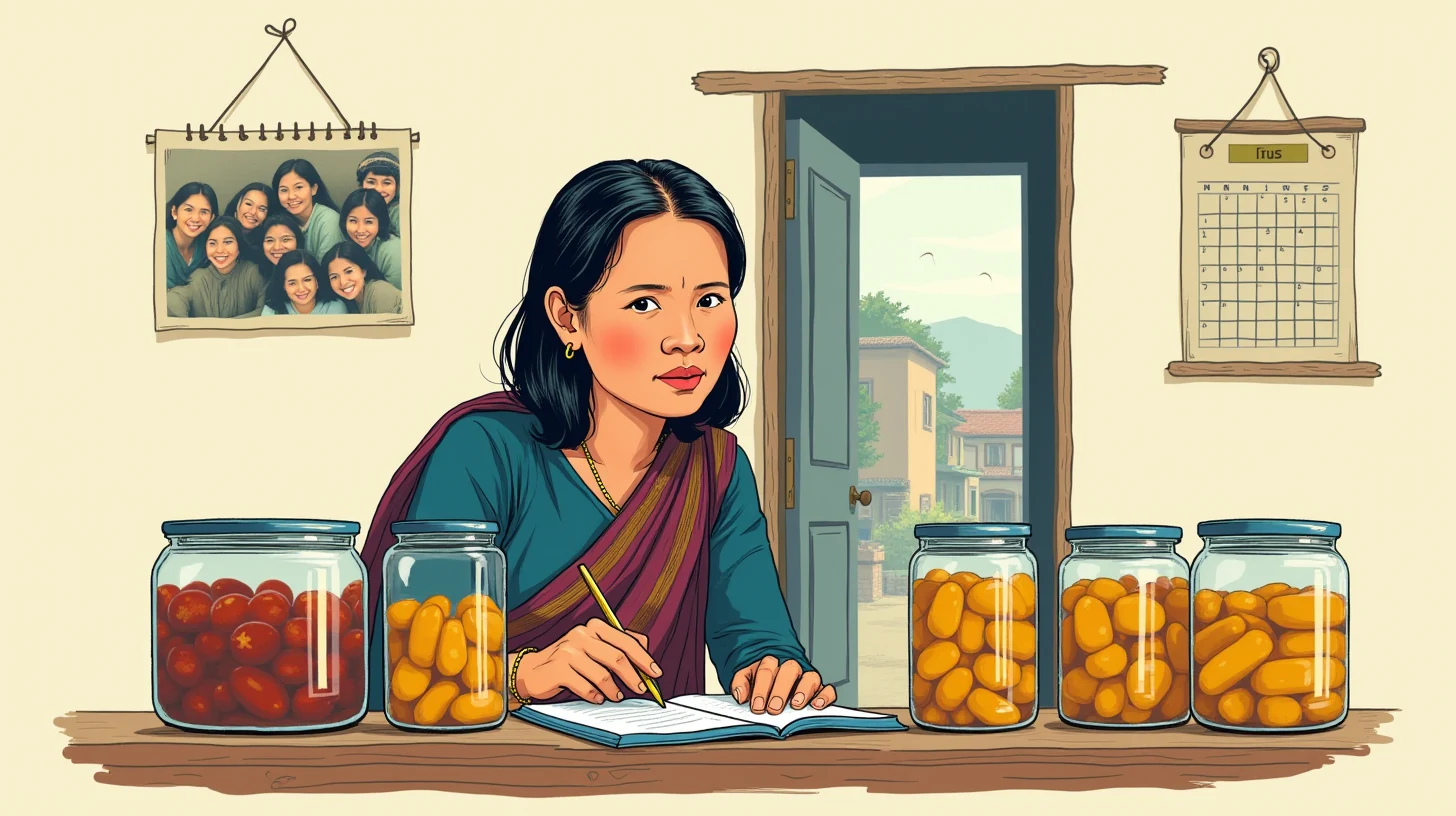
She had already sent two shipments successfully to Bangalore and one to Delhi. Her 9-member SHG—self-help group of women from the neighbourhood—had been making eromba pickle for three years now, along with bamboo-shoot pickle and ngari, the fermented fish paste that sits at the heart of Manipuri cooking. The women worked together in the rented kitchen space in a narrow lane off Sangai Street, measuring out fish and salt, binding the jars with wax paper, packing them into cardboard boxes.
The SHG turned over about ₹18 lakh annually. It was small enough that every customer was a repeat customer, every order carried the weight of nine households' rent. Bina's daughter was in Form 11. Rani, the youngest member of the group, had just bought a scooter with her share of the profits. The business was not a hobby. It was breath.
But on the morning of 12 March, the goods had not reached Bangalore. Instead, a message had come from the transport company: "Goods held at Assam checkpoint (Nalbari). Port Authority says FSSAI species-origin certification missing. Ngari cannot cross state line without Central License. Release pending ₹5,000 processing fee + documentation."
Bina's stomach had dropped. She had never heard of species-origin certification.
🗓️ The annual ritual
In the state of Manipur, food businesses operated under a quiet assumption: if your local municipality knew your name and your kitchen was clean, you were fine. Bina had a municipal license from Imphal East Corporation. She had paid ₹800 for it three years ago. The inspector had come once, eaten a free pickle jar, signed the form, and never returned.
But that was Manipur. When the pickle crossed into Assam—and then into Karnataka—the entire regulatory universe shifted.
FSSAI, the Food Safety and Standards Authority of India, existed in three tiers. At the bottom sat Registration—for tiny operators under ₹12 lakh annual turnover. In the middle was State License, for businesses between ₹12 lakh and ₹20 crore turnover. At the very top was Central License, for either businesses exceeding ₹20 crore turnover or businesses selling across multiple states.
Bina did not know this. She had a municipal license. She assumed that was enough.
Three years of shipping to Bangalore and Delhi without incident had reinforced the assumption. The transport company had never flagged her. The customers had received their orders. The money had come back into the SHG bank account. The system had worked.
What Bina had not understood was that she was operating in a regulatory blind spot—not quite formal enough to have paperwork, not quite small enough to be ignored. The checkpoint at Nalbari on the Assam-Meghalaya border did not care about her Imphal East municipal license. It cared about FSSAI's Central License. And when the checkpoint opened the cardboard box and saw the jars of ngari—a fermented fish product with a specific species composition and salt percentage—it wanted species-origin certification to prove that the fish was ethically sourced, that the salt was food-grade, that the fermentation was deliberate and documented, not accidental and unlicensed.
The checkpoint held the shipment. The customers in Bangalore waited. And Bina sat in her kitchen, with ₹80,000 of inventory locked on the other side of a border she did not know how to cross.
⚠️ What very nearly happened
By the evening of 13 March, Bina had done what most small food business operators do when they encounter a brick wall: she had called a middleman.
The middleman's name was Kumar, and he lived in Guwahati. For ₹8,000 he had promised to "handle the checkpoint." Bina had heard his name from another food vendor in the Imphal market. He had a reputation for getting things unstuck.
What she had not understood was that Kumar did not get things unstuck. He paid the checkpoint ₹5,000 in undocumented fees, added ₹3,000 as his own cut, and told Bina the shipment would be released. It would be released. But the next shipment would face the same hold. And the next one. Until Bina either gave up the inter-state business or paid Kumar a monthly retainer.
The alternative was worse. If the checkpoint had decided to be thorough, it could have seized the shipment, fined the SHG ₹2–₹5 lakh for operating without proper FSSAI compliance, and shut down the kitchen.
Bina was forty-eight hours away from choosing between paying a permanent bribe and losing her livelihood.
🌗 What changed
On the morning of 14 March, one of the women in the SHG, Deepika, came into the kitchen and said: "My cousin is using something called a tablet. It has a woman's voice. She types the questions into it and it tells her about government schemes. Maybe it can help with the pickle problem."
The tablet was a GabFORGE agent running locally on a phone. Deepika's cousin had used it to apply for Ayushman Bharat. Bina was skeptical. She had no smartphone. But Deepika had one, so on the evening of 14 March, the two women sat in the kitchen after the day's batch of eromba was done, and Bina typed, in Meitei, slowly:
"ইমাফেল পূৰ্বত খোজা সাঞ্চয় সমিতি। নগৰী ভৰি যোগান দেওয়া হয় বাঙ্গালোরে আৰু দিল্লীত। এতিয়া অসম সীমান্তত এফএসএসএআই লাইচেন্স চাইছে।"
(A savings group in Imphal East. We send fermented fish pickle to Bangalore and Delhi. Now the Assam checkpoint wants FSSAI license.)
The agent's response came back in Manipuri within seconds:
"খোজা সমিতি এৰা ১৮ লাখ টকাৰ ব্যবসা করে। দুই অথবা বেছিও অঙ্গত বিক্রি কৰি আছে। তাহান সেন্ট্রাল লাইচেন্সৰ প্রয়োজন। দুই ধাপ আছে: প্রথমে এফএসএসএআই-ত নিবন্ধন করি, পরে স্পেসিজ-অরিজিন সার্টিফিকেট পাবো মৎস বিভাগত।"
(Your group does ₹18 lakh in business. You sell across two states. You need a Central License. There are two steps: first, register with FSSAI online, then get species-origin certification from the Fisheries department.)
Bina leaned back. Two steps. A Central License was not a thing you paid a middleman ₹8,000 to unlock. It was a process. She could do a process.
She typed again:
"স্পেসিজ-অরিজিন সার্টিফিকেট কিদে পাবি?"
(How do I get species-origin certification?)
"এই সার্টিফিকেট মৎস বিভাগ দেয়। মণিপুৰত মণিপুৰ আর্ট অফ ফিশারিজ-এ যোগাযোগ করি। তোমাৰ নগৰীৰ উপাদান লিস্ট, সল্ট পার্সেন্টেজ, ফার্মেন্টেশন টাইম দেখাই। সেই বিভাগ চেক করবে, তারপর পেট্রোলিয়াম কমিটি-ত ডক্যুমেন্ট পাঠাবে।"
(The Fisheries department issues this. Contact the Manipur Department of Fisheries. Show them your ngari ingredients list, salt percentage, fermentation time. They will verify, then forward documentation to the Foods and Drugs Authority.)
Over the next two hours, sitting in that kitchen with the smell of fermented fish and cumin in the air, Bina and the agent worked through the entire inter-state compliance roadmap. The agent walked her to FSSAI's FoSCoS portal and showed her that while her turnover was too high for FSSAI Registration, she was eligible to apply directly for Central License—a form that existed, but which no one in Imphal East seemed to know about.
It showed her the Central License application form (Form 2), the required attachments (proof of address, facility diagram, personnel qualifications, process flow chart), and the fee: ₹5,000, paid online, with approval typically coming within 30 days.
But that Central License required, as a prerequisite, proof that every ingredient in her ngari had been sourced and handled according to food safety standards. The species-origin certification was that proof. It said: this fish came from a regulated source, it was handled at the right temperature, the salt was food-grade.
Bina learned that the Manipur Department of Fisheries had an office in Imphal East, on Sanjenthong Road, 2 km from her kitchen. She would need to submit a sample of her ngari along with her process documentation, wait for their lab analysis (₹500, five working days), and then request a certification letter.
Only then could she fill out FSSAI's Central License form, upload the species-origin cert as an attachment, and send it in.
Only then would the checkpoint in Nalbari have the documentation it needed to let her shipment pass.
The agent also flagged something else: Bina's SHG had never registered as an MSME.
What it does
- 🔍Traces the inter-state compliance chain: FSSAI Central License plus species-origin cert from Fisheries.
- 🗂️Verifies that ₹18L turnover qualifies for PM FME subsidy (35%, max ₹10L) and MSME priority lending.
- 📞Generates email templates for contacting Fisheries department and FSSAI, with specific reference numbers.
What it does not do
- 🔒Never submits forms on Bina's behalf; she remains in control of every signature and submission.
- 💳Never promises the checkpoint will release the shipment; only maps the pathway that makes release possible.
- ✅Never decides whether Bina should apply for PM FME or MUDRA loans; only surfaces the eligibility criteria.
🧭 Why we built it
Bina's problem was not a problem of food safety standards. FSSAI's regulations are sound. The standards for species-origin certification exist for good reason—to prevent mis-labeling, to protect consumers from undeclared allergens and contaminants, to ensure fermented foods are handled at safe temperatures and salt percentages.
The problem was that Bina had no visible pathway between where she stood (a 9-member SHG with a municipal license and three years of repeat customers) and where she needed to be (a FSSAI-licensed operator with inter-state credentials).
This gap—the "regulatory blind spot"—is where millions of food businesses in India live. They are too formal to be ignored by law enforcement, and too informal to have access to the regulatory machinery. A checkpoint inspects them because they exist. They pay a middleman because the official pathway is invisible.
The agent's role is to make the pathway visible.
Across India, 4-5 million home chefs and small food operations operate without proper FSSAI licensing. Not out of disrespect for food safety, but because they do not know which license they need or how to apply. A home chef in Mumbai thinks she needs a "State License" when the form is actually called "FSSAI Registration." A dhaba owner on NH-48 does not know that fermented products require species-origin certification before inter-state transport. A pickle-maker in Imphal thinks a municipal license is sufficient.
When the checkpoint comes—and it always comes eventually—they are caught. They pay a middleman, or they shut down.
The agents map these pathways. They translate the regulatory system into the language of the operator. They turn an opaque bureaucracy into a checklist.
Bina was not unique. Across Manipur, Assam, Meghalaya, and the rest of the Northeast, there are hundreds of SHGs making fermented fish, bamboo pickles, and other traditional foods, shipping to diaspora communities in Bangalore and Delhi. Each one faces the same invisible checkpoint. Each one has been forced to either pay a middleman or exit.
The agent allows them to do neither. It allows them to comply.
- 🧪
14 March — Fisheries sample submission
Bina takes a sample of her ngari to the Manipur Department of Fisheries (Sanjenthong Road, Imphal East), along with her process documentation. Lab analysis cost: ₹500. Timeline: 5 working days.
- 📋
21 March — Species-origin certificate received
The Fisheries department returns the sample analysis and issues a species-origin certificate confirming salt percentage (18%), fermentation time (21 days), and fish species (local hilsa). Cost: included in ₹500.
- 📨
22 March — FSSAI Central License application
Bina registers on FoSCoS portal and submits Form 2 (Central License) with supporting documents, including the species-origin certificate. Application fee: ₹5,000 (online payment). Processing time: 15–30 days.
- ✅
7 April — Central License approved
FSSAI approves the Central License and issues a digital certificate valid for 5 years. The license is tied to the SHG's GST number and can be renewed online before expiry.
- 🛣️
15 April — Checkpoint clearance
Bina's next shipment crosses the Nalbari checkpoint with the Central License and species-origin certificate attached. No processing fees. No middleman.
🌱 What we hope happens
On 21 April 2026, seven weeks after the first checkpoint hold, Bina stood in the kitchen in Imphal East and held the FSSAI Central License in her hands. It was a PDF on Deepika's phone, but her cousin in Guwahati had printed it out and laminated it—a glossy certificate with the FSSAI logo and Bina's name.
The SHG had sent four shipments since then. All of them had crossed the Nalbari checkpoint without incident.
But the license was only the first door. Across those same seven weeks, the agent had also surfaced something else: the PM FME scheme.
Pradhan Mantri Formalization of Micro food processing Enterprises is a ₹10,000 crore government programme that gives SHGs like Bina's up to ₹10 lakh as a 35% capital subsidy. The agent had flagged that Bina was eligible: female operator, SHG member, annual turnover between ₹10–₹25 lakh, food processing business, located in a priority state (Manipur).
She was eligible for ₹6 lakh subsidy toward a cold storage unit and professional labeling machinery. The remaining ₹4 lakh would come from her own SHG funds.
She had already started the PM FME application. She had also registered the SHG as an MSME—a two-minute online process that unlocked access to MUDRA Tarun collateral-free loans up to ₹10 lakh. The agent was now tracking her eligibility for a ₹8 lakh MUDRA loan to match the PM FME subsidy and cover the full cost of the cold storage unit.
If she accessed both, the SHG would have a professional cold chain. The eromba pickle would not just survive the checkpoint. It would arrive in Bangalore at the correct temperature. The shelf life would extend from four months to two years. The Bangalore customers had already asked if Bina could supply them with volume—they wanted to wholesale the pickle to restaurants in Bangalore, to diaspora grocery stores in the city.
The SHG had gone from a checkpoint emergency to a growth pathway in seven weeks.
"আমরা নিজের ব্যবসা রক্ষা করতে পারি। পুরো তালিকা মনে নেই, কিন্তু প্রতিটি ধাপ আছে এবং প্রতিটি ধাপ সম্ভব।"— We can protect our own business. I do not remember the whole list, but each step exists and each step is possible.
The checkpoint had taught Bina something. The regulatory system was not corrupt. It was just invisible. Once you saw it—once someone translated it—you could move through it. You did not have to pay a middleman. You did not have to close down.
You just had to know which door to knock on.
That, the agent had shown her.