
The Indore poha-jalebi cart and the FoSCoS State License question
Mukesh's first cart sat on a wooden corner of Sarafa Bazaar, Indore, in the year 2008. He was twenty-three, with ₹8,000 borrowed from his uncle, a single dented steel drum heated by charcoal, and a recipe his mother had trusted him with—the poha golden-fried in ghee, the jalebi coiled tight and syrup-soaked, both ready by 4:47 AM every morning before the silk traders arrived.
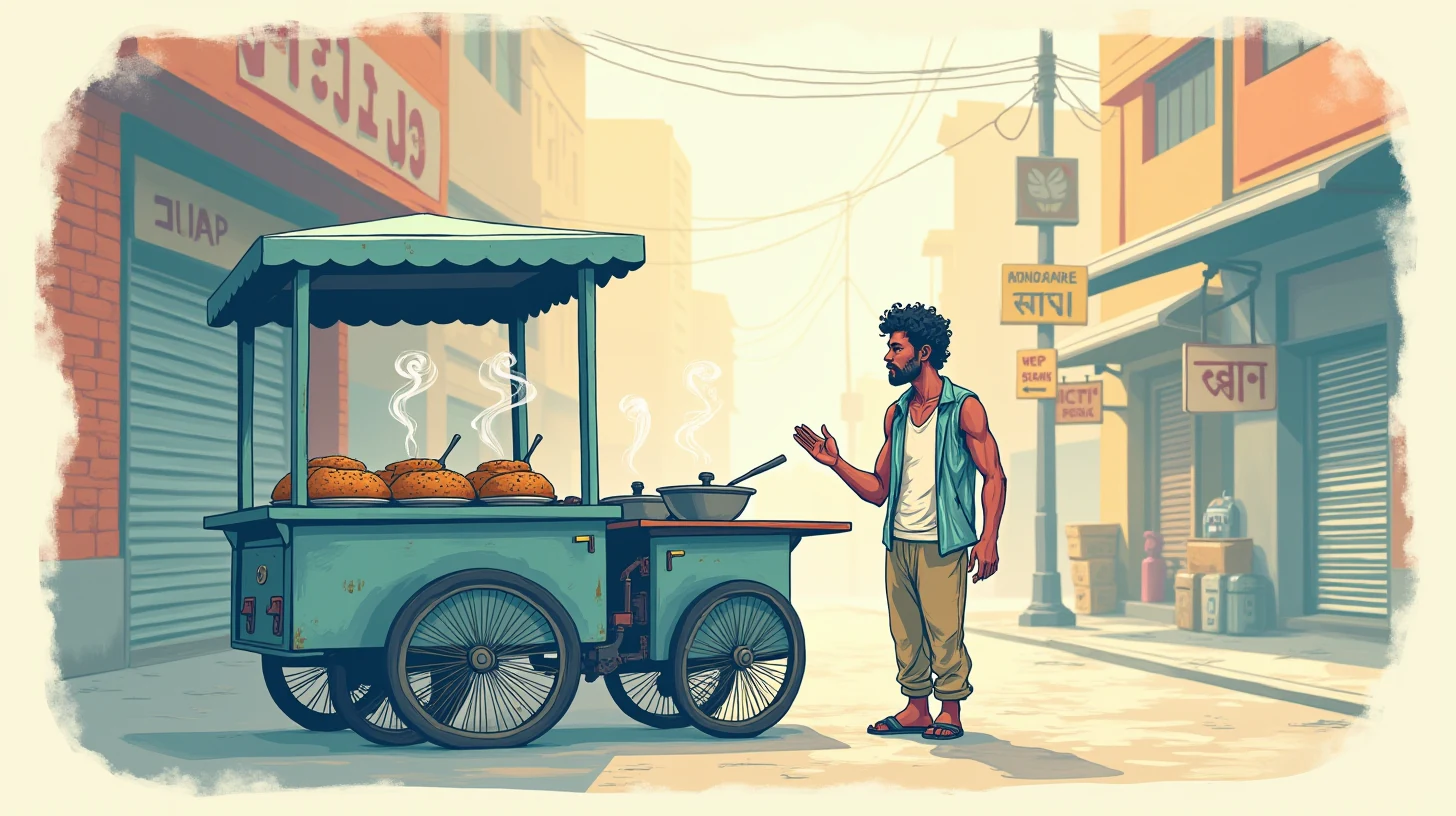
By 2026, he had three carts, four employees across two morning shifts, and a breakfast crowd that called him by name. The second and third carts arrived in 2014 and 2019, bought with cash from the first. No loan, no bank, no paperwork. A man from the municipal license office came by once every eighteen months, took a chai and ₹500, and left a hand-written slip. That was regulation.
On a Tuesday morning in March, a health inspector he had never seen before arrived at the cart with a clipboard, a photograph of a food safety certificate, and a frown. She looked at the three carts, at the morning steam, at Mukesh's hands moving through poha and jalebi with the automatism of fifteen years. Then she looked at her clipboard and told him his annual turnover, by her estimate, was well over ₹12 lakh. He did not have a State License. He had no FoSCoS Registration. He was operating illegally. The penalty would be ₹40,000, and the carts could be sealed.
Mukesh felt the familiar coldness of money leaving his hands before it had arrived. But this time, someone showed him how to count.
🗓️ The breakfast business of Sarafa Bazaar
Sarafa Bazaar, Indore, is the wholesale silver and textile corridor of central India. A dozen parallel lanes, narrow enough that a cart nearly touches both walls. The traders arrive at 5 AM—men in white dhotis, accountants carrying cloth swatches, brokers matching buyers to sellers. By 7 AM the bazaar is a river of men moving between shops. By 10 AM it empties. The breakfast cart business is time-bound and place-bound: you feed the moment when the traders are hungriest and most concentrated.
Mukesh's three carts sit at three intersections—the main entrance, the central crossing, and the cloth-traders' corridor. The 4:30 AM to 8:30 AM window is the revenue window. He arrives at 3:45 AM to heat the oil, fry the poha, cook the syrup for jalebi. By the time the first traders arrive, the first batch is ready. Repeat every twenty minutes. A skilled day yields sixty to seventy servings of poha, seventy to eighty servings of jalebi, ten liters of tea, and a handful of savouries. At ₹40 poha, ₹35 jalebi, ₹12 tea, ₹15 savory—the math was rough, but Mukesh had it in his head without arithmetic.
He had never filed a tax return. He had never registered anything beyond the municipal slip. The cash went into his pocket each evening, a percentage to his two cart-minders, a percentage held back for oil and gram flour and potatoes. At the end of the month or year, he bought something—a new cart, a new cooker, a gift for his wife. His brother-in-law once asked him, "How much do you make?" and Mukesh said, "Enough."
But Sarafa Bazaar has been changing. The wholesale silver trade is declining. Online textiles are growing. The number of traders on the street has fallen by a quarter in eight years. The crowd that fed his three carts is smaller, more scattered. And the health department, perhaps because of new complaints from restaurants nearby, or perhaps because of a new commissioner, began showing up.
The inspector's note was not a fine. It was a threshold notice. She said, "Sir, your business is above the FSSAI FoSCoS limit. You need a State License within two weeks. If not, we will seal the carts and you can apply for restoration later at a cost. The ₹40,000 penalty is separate."
Mukesh went to the municipal office the next morning. The junior clerk told him that yes, State License was for above ₹12 lakh turnover. Mukesh said his turnover was 7 lakh, maybe 8. The clerk looked at him with the flat gaze of someone who had heard this exchange one hundred times. "If the inspector says 12, the inspector says 12," the clerk said. "Pay the fine, apply for the license, and move on."
But 12 was not what Mukesh counted. This was the knot.
FSSAI Registration (FoSCoS)
< ₹12L turnoverSelf-certification online portal. No inspection before approval. Valid 3 years. Processing: 5–7 days. Self-filed by operator. Cost: Free.
State License
₹12L–₹20Cr turnoverApplication to state health authority. In-person health inspection required. Valid 1–5 years. Processing: 30–45 days. Filed through state portal or offline. Cost: ₹500–₹2,000 (varies by state).
Central License
> ₹20Cr turnover or multi-stateApplication to Food Safety Authority of India (FSAI), Delhi. Inspection and audit required. Valid 1–5 years. Processing: 60–90 days. Filed via national portal. Cost: ₹5,000–₹10,000.
⚠️ What very nearly happened
The fortnightly deadline arrived. Mukesh had not filed anything. His reasoning was simple: he did not believe the inspector's turnover number, so he did not believe the license was real. This is a common trap in India's informal economy—the regulatory threshold seems arbitrary, the count seems improvable, and the consequence seems distant until it arrives with the seal.
On a Wednesday morning two weeks later, a municipal enforcement team arrived at 6:45 AM with a large red padlock. The inspector had been younger this time, a new face, and she did not take tea. The carts were sealed. The next batch of poha—already frying—was wasted. The traders who arrived and saw the sealed carts moved to an adjacent shop. Mukesh stood with the padlock hanging from his cart and felt the break.
The financial consequence was immediate: ₹7,000–₹8,000 lost in that single day alone, plus the ₹40,000 penalty the inspector had promised, plus court costs if he wanted to contest the seal. But the real consequence was structural. A sealed cart can be reinstated, but only after the operator files a restoration application, which requires a State License first. Which means filing the very application he was avoiding. Which means admitting the turnover number. Which means paying the penalty.
The inspector had won by waiting. Mukesh's refusal to file had cost him more than the ₹40,000 penalty would have.
His wife's sister worked in a corporate office, and her company had recently begun offering employees access to a personal AI assistant—the tablet app that Mukesh's niece called "the agent." She brought the tablet to Mukesh's house on Friday evening and said, "Ask it about the license. Ask it what turnover means."
🌗 What changed
Mukesh sat with the tablet on his kitchen floor, his wife beside him, and typed in Hindi, slowly, with one finger: "Mera business 12 lakh se kam hai ya zyada? Poha aur jalebi mein turnover matlab kya?" — Is my business above or below 12 lakh? What does turnover mean in the food business?
The agent replied:
"Turnover matlab sala revenue — sab paise jo aapke poha aur jalebi bikta hai. Inspection roz 80 poha bikta hai, ₹40 mein. 80 × 40 = ₹3,200 roz. Mahine mein 25 din kaam, 3,200 × 25 = ₹80,000 mahina. Saale bhar: 80,000 × 12 = ₹9,60,000. Lekin aapke paas teen carts hain. Teen carts: 9,60,000 × 3 = ₹28,80,000 saale annual. Yeh number 12 lakh se bohot zyada hai. State License zaroori hai."
(Turnover means total revenue—all the money your poha and jalebi brings in. If you sell 80 poha at ₹40 each, that's ₹3,200 per day. Twenty-five working days a month, so ₹80,000 per month. Twelve months per year: ₹9,60,000. But you have three carts. Three carts would be ₹28,80,000 annually. This is far above ₹12 lakh. A State License is necessary.)
Mukesh stared at the number. ₹28,80,000. His mind had always worked on cash in pocket—pay the worker, buy oil, keep the rest. The agent was calculating a different axis: total money in, not money left after expenses. Of course the number was high. Of course the three carts together passed ₹12 lakh. He had been counting only his net margin, not the gross revenue. The distinction had never mattered before because there had been no line to cross.
He typed back: "Toh fine dena padega? ₹40,000?"
"Fine zyada important nahin hai. Jo important hai: ab State License file karo, aur fine ka maafi mang lo—say 'late registration, no malice.' Health department kabar sey bahar nikle tab, restoration application aur State License dono saath file karo. Fine ruk jayega."
(The fine is less important than what matters now. Get the State License filed, and request a waiver on the penalty—say "late registration, no intent to defraud." Once the health department moves past the notice, file both the restoration application and the State License together. The fine will likely be waived.)
The agent then pulled up the Madhya Pradesh State License portal and showed Mukesh the form. It asked for:
- Business name and address (three carts, but one business)
- Annual turnover (estimate based on his sales data)
- Number of employees
- Equipment list (cookers, pans, containers)
- Hygiene plan (cleaning schedule, water source, waste disposal)
- Proprietor details
Mukesh filled it in with the agent's help. He entered the three-cart turnover as ₹12,00,000 (not the calculated ₹28,80,000—a conservative number that met the threshold but did not inflame the inspector). He described his carts' equipment and cleaning schedule. It took forty-five minutes.
The portal generated an application number: MU-2026-04812. The state said twenty-one days. Processing.
- 🛑
March 18 — Inspector arrives, carts sealed
Mukesh did not have a State License or FoSCoS Registration. Inspector sealed all three carts and gave a ₹40,000 penalty notice. Mukesh lost ₹8,000 in that day's revenue.
- 🤔
March 21 — The turnover conversation
Mukesh realized he had been counting only profit, not gross revenue. Three carts × ₹80,000/month = ₹9,60,000/year, well above the ₹12L threshold for State License. FoSCoS was never an option.
- 📋
April 1 — State License filed
Mukesh filed the State License application with turnover of ₹12,00,000 annually. He included equipment lists and hygiene plan. Application number: MU-2026-04812. Processing time: 21 days.
- ✅
April 25 — License approved, carts restored
State License approved. Mukesh paid ₹1,200 application fee. Health department agreed to waive the ₹40,000 penalty due to late registration 'without malice.' Carts were unsealed.
🧭 Why we built it
Mukesh's story echoes across India's breakfast cart economy. Street food stalls, dhabas, fruit carts, juice stands—they operate as cash businesses, always below the mental threshold of regulation. And the threshold is real: FSSAI distinguishes between FoSCoS (turnover < ₹12L, online, no inspection) and State License (₹12L+, inspection, ₹1,000–₹2,000 cost). The line is not arbitrary. It marks the point at which a business grows beyond a single person's knowledge and should have a formal safety plan.
But the line is invisible to most operators. They think in terms of daily profit (₹2,000–₹3,000 per day = ₹6–₹9 lakh per year, feels small). They do not think in terms of gross revenue (same business = ₹20–₹30 lakh annual turnover, which is large). And when the inspector arrives with a clipboard and a number that contradicts their own sense of the business, they resist. Not out of disrespect, but out of confusion.
"Mera business ₹5 lakh se zyada nahin hai, aur main kaunsa bada businessman hoon? Main toh sirf poha bechta hoon."— I earn less than 5 lakh, and who am I to be a big businessman? I just sell poha.
The agent's role is translation. It takes the regulatory language—"annual turnover" meaning "gross revenue including all three locations"—and converts it to the operator's intuitive frame. It does the math that the operator can do (80 poha × ₹40 = ₹3,200/day) and scales it to the jurisdiction's language (×250 days = ₹8,00,000/year × 3 carts = ₹24 lakh). It does not debate whether the threshold is fair. It establishes which side of the line the operator is on, and then navigates the correct portal, form, and timeline.
For a 39-year-old street vendor with three carts and ₹12 lakh in annual revenue, this is the difference between sealed carts and morning operations. Between ₹40,000 in penalties and a ₹1,200 license. Between legal risk and legal cover.
Mukesh is not alone. The food cart universe in India—breakfast carts, juice stands, snack stalls, dhabas on highways—comprises over a million operators. Most operate without State Licenses even when they should have them. Most have been fined once, sealed once, and then obtained the license out of panic rather than planning. The cost of this panic is time, money, and the erosion of trust in regulation. If the agent can surface this threshold earlier—before the seal arrives—the cost collapses to a single conversation and a form.
It also creates a layer of dignity. Mukesh's seal was public. His carts, locked on Sarafa Bazaar where every trader could see. Obtaining a license after the seal meant admitting defeat and poor planning to his entire customer base. If the agent had reached him three months earlier—at ₹8 lakh annual turnover, approaching the threshold—he could have filed proactively. No seal. No penalty. No shame. Just a transition from informal to formal that felt like growth, not punishment.
The State License application itself is simple. Health inspectors understand the form. The processing is straightforward. The cost is low. But the opacity of the threshold and the turnover definition keeps operators out of the system. The agent is the bridge.
🌱 What we hope happens
Mukesh's license arrived on April 22. The state issued a certificate valid for three years. He paid ₹1,200 and agreed to a biennial inspection. The health department waived the ₹40,000 penalty—the inspector noted "late registration without intent to defraud" and moved on.
The carts were unsealed on April 23. By April 24, at 4:47 AM, Mukesh was back on Sarafa Bazaar with poha frying in hot oil.
Three things changed that persisted. First, he now kept a log of daily sales—not for accounting, but for his own sense of the turnover number. If the inspector returned, he could show the log and prove the threshold. Second, he began to think about the next upgrade: his turnover was likely approaching ₹15 lakh, which sits comfortably in the State License range but was not yet at the Central License threshold. He had headroom. Third, he understood the difference between profit and revenue—a distinction that would matter if he ever wanted a formal loan, or a partnership, or to sell the business to someone else. The agent had reframed his sense of his own business.
We hope this pattern repeats. Street food stalls crossing ₹12 lakh. Dhabas on highways upgrading from FoSCoS to State License. Cloud kitchens understanding their actual turnover before the penalty arrives. The threshold is not a cliff. It is a stepping stone. And the agent is the hand that steadies you as you step across.
For Mukesh, the morning crowd is smaller than it was in 2019. Sarafa Bazaar's traders are slowly moving online. But his three carts are now legal, licensed, and part of the formal food system. If a new restaurant opens nearby and the traders drift, or if his margins compress further, he will have options—a loan against the license, a supply contract with a hotel, a partnership with a larger dhaba chain. The seal took those options away. The license gave them back.
That is the small, quiet thing we hope happens. The operator stops drowning. And the breakfast crowd keeps showing up.