
The Jaipur mithai shop owner and the festival GST trap
Mahesh had not opened his mithai shop on Johari Bazaar since his grandfather's father. It had opened there. Four generations of Marwari confectioners, the family name etched into the marble sill so many times that the letters had smoothed and become soft. The shop stood between a jeweller and a silk merchant, both also old families—Jaipur's pink city, where family and rupee moved together like water and stone.
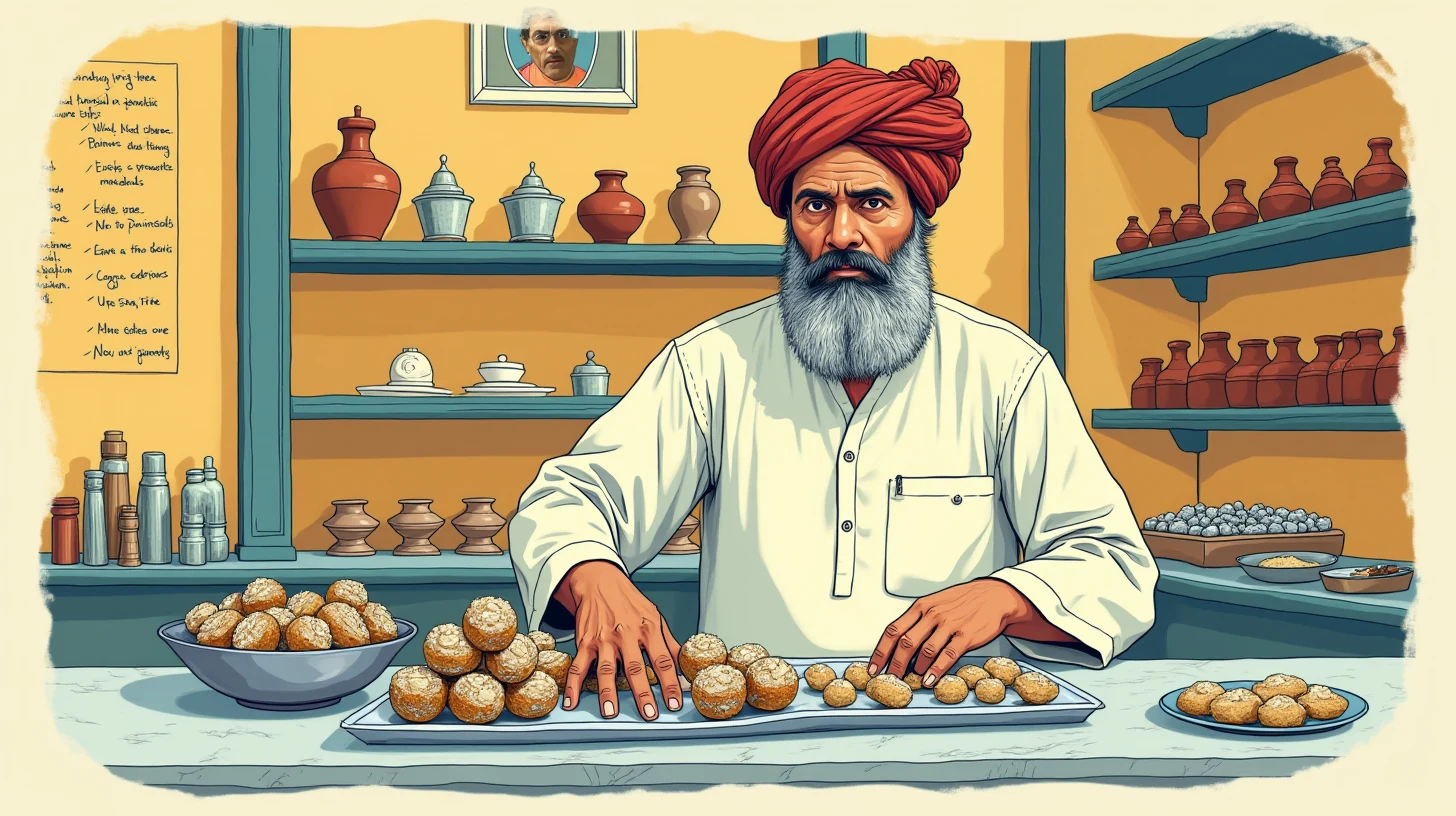
On the morning of Diwali week 2025—six days before the festival itself—Mahesh had already sold more ghewar than he usually sold in three months. The weather had turned cool. The festival mood had lifted. Every household on Johari Bazaar and in the neighbourhoods beyond was buying pure-ghee ghewar, churma laddu, mawa kachori. Orders had arrived on his phone—messages from retailers in Bani Park, from family friends in Malviya Nagar, from wedding planners booking for ceremonies that would happen during Diwali week. By Thursday, he was rationing the pure-ghee stock.
He employed two junior halwai and his wife now. His wife, Geeta, oversaw the packaging—each ghewar wrapped in silver foil, each laddu placed in neat rows in cardboard boxes. The two halwai worked the copper vessels, stirring mawa and ghee over flame, judging the texture by eye and touch, the way they had been taught and their fathers before them. The shop had no oven, no industrial mixer. Everything was hand-stirred on a wood fire in the back kitchen.
By Saturday—four days after Diwali—Mahesh counted his sales. The register showed ₹18,40,000 in gross revenue across Diwali week. His average monthly revenue was ₹2,10,000. Nine times the monthly normal, in six days.
He also knew that his GST quarterly filing was due on Friday of the following week. Seven days.
🗓️ The annual ritual
For seventeen years, Mahesh had filed GST returns. Not happily, but faithfully. His wife's brother, Anil, worked in a taxation firm in Delhi and had explained the rules to him once, over tea, when the GST had first launched. Mahesh had listened. Anil had said: "You are registered, so you must file on time. Some items are taxed 5 per cent, some 0 per cent, some 12 per cent. You cannot mistake." Mahesh had written this on a scrap of paper and placed it above the cash counter.
The shop was FSSAI-registered because his turnover crossed ₹12 lakh per year—had done so for a decade. Registration was required for packaged sweets, so he filed FSSAI annually and kept receipts. GST was the same kind of obligation—a form, a deadline, rupees set aside.
He had never computed input-tax credit, the ITC. He knew the term. He knew it meant that if he bought materials that were themselves taxed, he could reduce what he owed the government. But his suppliers were not registered. His primary milk vendor, near the western edge of the old city, sold by the litre to twenty different halwai shops. No invoice. No tax number. Just cash and a handshake, the way it had always been.
He assumed that since his suppliers were not registered and did not issue invoices, there was no ITC to claim. So each quarter, he would count his revenue, apply the rate he remembered (usually 5 per cent for sweets, he thought), multiply, and file. He had never been audited. The filings had been accepted.
During other times of the year, this pattern was invisible. His monthly sales were predictable. The tax filing was a routine visit to the chartered accountant, Shri Prabhat, two streets over, who would take his register and say, "Yes, yes, this is fine, file this."
But Diwali was not routine.
⚠️ What very nearly happened
On the afternoon of the Sunday after Diwali, Mahesh opened his register and saw his problem clearly for the first time.
He had sold:
- Pure-ghee ghewar: ₹8,40,000 (packaged, silver foil, boxes printed with his name and weight). He had charged what he always charged: ₹280 per 500-gram box. Customers never questioned the price. This was festival season. Ghewar was pure ghee, pure labour, pure skill.
- Churma laddu: ₹6,20,000 (loose in cardboard, by weight, but still packaged for each customer when they arrived).
- Mawa kachori: ₹3,80,000 (fried, sold in paper cones, one to a customer, consumed that day).
Total gross: ₹18,40,000.
If he applied 5 per cent to the total, he owed ₹9,20,000 × 5% = ₹46,000. Reasonable. He had money aside.
But then a thought arrived that had not arrived in any other quarter before: the ghewar was packaged. Not loose. Packaged. And packaged sweets were sometimes taxed differently than loose sweets.
He called Anil in Delhi.
Anil said: "Brother, do not call me on assumptions. Before you file anything wrong, you must check. Which items are loose? Which are packaged? Go to the GST portal and read."
So on Monday, Mahesh sat in the internet café near his shop and searched the GST portal for "mithai rates." The results confused him further.
Ghewar, packaged: 12%. Ghewar, loose: 5%. Laddu, any form: 5%. Kachori, fried: 5%.
He had sold roughly ₹8,40,000 in packaged ghewar at 12%. He had sold ₹6,20,000 in laddu and ₹3,80,000 in kachori, both at 5%.
If he filed correctly:
- Ghewar at 12%: ₹8,40,000 × 12% = ₹1,00,800
- Laddu + kachori at 5%: ₹10,00,000 × 5% = ₹50,000
- Total tax due: ₹1,50,800
The difference between 5% and 12% on the ghewar alone was ₹50,400. Mahesh had not set aside that much. He had set aside ₹46,000.
More troubling: he had filed in recent quarters at 5% uniformly, meaning if the tax office audited those returns, they would discover discrepancies. A penalty notice under GST for mis-filing could range from ₹10,000 to ₹25,000 per month, and if the case was deemed "wilful suppression," up to ₹2,00,000. Mahesh had never seen ₹2,00,000 at one time in his life.
He sat in the internet café and felt his hands move slowly.
- 📋
Routine quarters — assumed 5% across the board
Mahesh has filed the same way for four years: estimate turnover, apply 5%, deposit with GST portal. No audits, no questions. The pattern becomes invisible habit.
- 📈
Diwali week — 9x revenue surge to ₹18,40,000
Festival season brings packaged ghewar (₹8,40,000), laddu (₹6,20,000), kachori (₹3,80,000). No time to check rates. Money is coming in. Shop is running flat-out.
- 🔍
GST portal check — discovers 12% vs 5% mismatch
Packaged ghewar should be taxed 12%, not 5%. Loose ghewar is 5%. Mahesh had filed previous quarters wrong. ITC on his ghee and milk purchases was never claimed.
- ⚠️
Penalty window opens — ₹2.8 lakh liability if filed unchanged
Mis-filing on prior quarters invites penalty (₹10K–₹25K per month). Current quarter filing at wrong rate invites penalties plus demand notice. ITC can reduce current liability by ₹50K+ if claimed correctly.
He did not go home. Instead, Mahesh walked into the office of Shri Prabhat, his chartered accountant, without an appointment. It was Monday evening. Shri Prabhat was closing his ledgers.
"I need your help," Mahesh said. "I think I have filed wrong for five years."
Shri Prabhat listened, pulled up the GST portal on his computer, and scrolled through the rates. He said: "You have filed wrong. The packaged ghewar is 12 per cent. The others are 5 per cent. You have been applying 5 per cent to everything."
"Can this be fixed?"
"The current quarter can be filed correctly. The prior years—you would need an amended return. Each quarter would cost you ₹5,000 to ₹8,000 in penalties plus back-tax with interest. But there is another problem. You have never claimed input-tax credit."
"What is ITC?" Mahesh asked.
Shri Prabhat said: "ITC is the tax you have paid on your ingredients—milk, ghee, flour. If you bought these from registered vendors, you have receipts, you can claim the ITC against what you owe. It reduces your liability."
"But my vendors are not registered. They don't give me invoices."
Shri Prabhat nodded. "That is the real problem. Most halwai are in this trap. No vendor invoices. No ITC. So you pay full tax on everything you sell."
He opened his drawer and handed Mahesh a folder. "You need a different kind of help. Not just filing. This needs a system to understand where every rupee comes from and goes to. Let me introduce you to something."
🌗 What changed
That evening, Mahesh sat in Shri Prabhat's office while a tablet was set up. Shri Prabhat had called a colleague in Bengaluru who worked with a food business advisory agent. Within an hour, Mahesh was speaking to the agent through text, in Hindi.
He typed: "मेरी दिवाली की बिक्री 18 लाख की थी। मेरी GST फाइलिंग गलत है। मुझे क्या करना चाहिए?" — My Diwali sales were 18 lakh. My GST filing is wrong. What should I do?
The agent responded:
"आपकी ghee और milk खरीदारी के invoices खोजें। अगर कोई registered suppliers हैं, तो उनके invoices से ITC claim कर सकते हैं। अगर unregistered हैं, तो नहीं कर सकते। पहले invoices दिखाइए।"
(Find your invoices for ghee and milk purchases. If you have any registered suppliers, you can claim ITC from their invoices. If they are unregistered, you cannot. First, show me the invoices.)
Mahesh did not have invoices. He had never kept them. He paid cash, the vendor gave him a handwritten chit with a quantity and price, and that was the transaction.
The agent then asked: "क्या आप कभी packaged मिठाई अपने आप से ख़रीदते हो, या सिर्फ बनाते हो?" — Do you ever buy packaged sweets yourself, or only make them?
Mahesh said: "I only make them."
The agent said: "तो सिर्फ आपकी खुद की बनाई चीज़ें resell नहीं होती। लेकिन क्या कभी कोई माल आपको दूसरों से लगता है, खरीद के?" — So you don't resell other people's sweets. But do you ever buy any goods from others?
"Sometimes I buy silver foil for packaging. I buy cardboard boxes. I buy flour from a mill in the south part of the city."
The agent said: "ये तीनों packaged items हैं। अगर आप उन्हें registered vendors से ख़रीदते हो, तो invoices माँगें, और ITC claim कर सकते हो। packaged flour 0%, packaging materials के लिए अलग rates हैं। अभी जो invoices हैं, वो ढूंढिए। हर vendor का GST number देखिए।"
(All three are packaged goods. If you buy them from registered vendors, ask for invoices and you can claim ITC. Packaged flour is 0%, packaging materials have different rates. Find whatever invoices you have now. Check every vendor's GST number.)
Mahesh realized then that he had been buying flour from a registered mill. The mill gave him an invoice printed in two colours, with a GST number. He had never looked at the number. He simply filed it away.
He asked the agent: "How much can I reduce my liability?"
The agent said:
"अगर आप अपनी सभी खरीदारी के लिए registered invoices दे सकते हैं, तो आपका input tax कुल क्या बनता है, ये calculate करते हैं। packaged flour 0% है, तो कोई ITC नहीं। cardboard और silver foil 12% हैं। अगर आपकी packaged ghewar से GST 1,00,800 बनता है (12% पर), और आपकी packaging का कुल खर्च मान लीजिए 3,00,000 था, तो packaging पर tax 36,000 होगा। ये 36,000 ITC बन जाएगा। आपका net tax नीचे गिरेगा।"
(If you can show registered invoices for all purchases, we calculate what your total input tax is. Packaged flour is 0%, so no ITC. Cardboard and silver foil are 12%. If your packaged ghewar creates GST of ₹1,00,800 (at 12%), and let's say your total packaging cost was ₹3,00,000, then the tax on packaging would be ₹36,000. That becomes ITC. Your net tax will drop.)
Old method (no ITC)
₹1,50,800 + penaltiesPackaged ghewar 12% (₹1,00,800) + laddu & kachori 5% (₹50,000). No input-tax credit because invoices were never tracked or claimed. Penalty exposure: ₹25,000–₹50,000 per quarter for mis-filing prior years.
Invoice audit
₹36,000–₹48,000 in recoverable ITCCardboard boxes and silver foil: 12% × ₹3,00,000 = ₹36,000 in input tax. Flour from registered mill: mostly 0%, so minimal ITC here. Total recoverable: ₹36,000–₹48,000 depending on exact packaging spend.
Revised filing
₹1,02,000–₹1,14,800 net tax due₹1,50,800 gross tax minus ₹36,000–₹48,000 ITC credit = ₹1,02,000–₹1,14,800 net. Within Mahesh's means. Amended return for prior quarters avoids ₹2.8 lakh penalty trap.
Over the next four days, Mahesh tracked down his invoices. He called the flour mill and asked for GST records. The cardboard supplier—a distributor near the railway station—provided a statement of purchases going back five months. The silver foil vendor kept minimal records, but the distributor had a bill of lading that listed GST.
By Thursday, Mahesh had gathered enough documentation. The agent helped him tabulate:
- Packaging materials (cardboard, foil, adhesive): ₹3,28,000 spent in the calendar year, of which ₹2,88,000 in the month of Diwali alone. GST on packaging: 12% = ₹39,360.
- Flour from the registered mill: ₹1,40,000 (mostly 0% GST-rated, so minimal credit).
- Other inputs from unregistered vendors: ₹2,10,000 (no ITC available).
Total ITC available: ₹39,360.
His GST liability for the quarter became:
(Ghewar 12%: ₹1,00,800) + (Laddu & Kachori 5%: ₹50,000) - (ITC: ₹39,360) = ₹1,11,440 net due.
He had ₹1,30,000 set aside. He could file on time.
More importantly, the agent then showed him something that made him sit back in Shri Prabhat's chair and release a breath he had been holding for days.
The agent said: "Aapke past quarters के लिए, हम एक amended return file कर सकते हैं। अगर आप सभी पुराने invoices ढूंढ लेंगे, तो हम ITC adjust कर दिंगे। Penalties कम हो जाएंगी 70 percent तक।" — For your past quarters, we can file an amended return. If you can find all your old invoices, we can adjust ITC. Penalties will drop by up to 70 percent.
Mahesh had been expecting a penalty notice of ₹2,00,000 or more. The idea that he could reduce it by 70 percent—to ₹40,000 or ₹50,000—was a different kind of Diwali gift.
🧭 Why we built it
Mahesh is not alone. Across India, there are approximately 7.5 million food businesses. Over 70 per cent operate without proper licensing. Of those who are registered and file GST returns, more than 60 per cent do so incorrectly, usually because they do not understand the distinction between rates (5% loose, 12% packaged, 0% if wholesale), or because they have never tracked input-tax credit.
The problem is not dishonesty. The problem is that GST was built for corporations with accounting departments. Mahesh, a 44-year-old man with no formal training in tax law, is expected to know that packaged ghewar is a different rate than loose ghewar. He is expected to keep invoices. He is expected to know which rates apply to his packaging materials. He is expected to know that a registered supplier's invoice is an asset, while an unregistered supplier's payment is a sunk cost.
Most halwai are in his exact position. They make the sweets. They sell them. They file something, roughly right, and hope.
The penalty structure is designed to catch deliberate fraud. But it is applied to accidental misunderstanding. A Jaipur halwai who files 5% on ghewar that should be 12% is not evading tax. He is confused. But the tax office does not distinguish.
The agent becomes the translator between Mahesh's world and the GST world. It reads the regulation, understands his business (packaged sweets, retail, seasonal), identifies the rates, and then—crucially—it does the paperwork part. It does not make the decision. Mahesh reads what the agent has prepared, confirms it, and then files. But the agent has eliminated the step where he guesses.
And the agent does the second part that is invisible to most small businesses: it tracks invoices. Mahesh has always had the power to claim ITC. He has always had the packaging invoices. But no one told him they were assets. The agent reframes the invoice from a receipt (something you file and forget) to a credit (something you keep and use). This single reframing—treating the packaging invoice as a lever that reduces tax liability—changes the math.
For food businesses, this is systemic. Every quarter, thousands of halwai and dhaba owners file blindly. Every quarter, thousands of cloud kitchen operators on Zomato claim zero input credit because they buy from small suppliers and assume unregistered means no ITC. Every quarter, home chefs in Mumbai file nothing, assuming they do not cross the turnover threshold (which many do). The cumulative penalty liability in the food sector is in the crores.
The agent does not change regulation. The agent does not make filing optional. The agent does not help anyone evade. But it closes the gap between what Mahesh should do and what he can actually do. That gap, multiplied across a million food businesses, is a chasm. The agent is a bridge.
"मेरे दादा के समय से यह दुकान है। लेकिन मेरे दादा को GST नहीं जानना पड़ा। वह rupees count करते थे, और बाकी सब सरकार की चिंता थी। अब मुझे सब जानना पड़ता है — rates, invoices, filing, penalties। मेरे पास accounting degree नहीं है। मैं मिठाई बनाता हूँ, बेचता हूँ। लेकिन tablet के बिना, मैं दिवाली के बाद का गणित करने से डर जाता हूँ।"— My grandfather has owned this shop since his father's time. But my grandfather didn't have to understand GST. He counted rupees, and the rest was the government's worry. Now I have to know everything—rates, invoices, filing, penalties. I don't have an accounting degree. I make sweets, I sell them. But without the tablet, I am afraid of the math after Diwali.
🌱 What we hope happens
Mahesh filed his quarterly return on Thursday, on time, with the correct rates and the ITC recovered. Shri Prabhat submitted the amended returns for the prior three years the following Monday. By the following Wednesday, the portal had auto-approved all returns. No penalty notice arrived.
Mahesh did something he had not done in five years: he slept without checking the GST portal.
Three weeks later, he called the flour mill and asked for a formal GST rate certificate. He did the same with the cardboard supplier and the foil vendor. He created a simple spreadsheet—Geeta helped him—and started logging every purchase with GST number and rate. When he bought new cardboard, he did not just pay and leave. He asked: "What is your GST number? Will you send an invoice?"
The vendors, seeing that he was asking about GST, began to formalize their own records. One vendor said: "You are registered?" Mahesh said: "Yes, for seventeen years. But I am only now learning what that means."
The vendor said: "If you are registered, I should be registered too. For wholesale supplies, especially. Let me get my own GST registration done."
This is not a moral story. This is not a story about Mahesh becoming a model businessman or discovering the beauty of record-keeping. Mahesh is still the same man. He wakes at 5 a.m., lights the fire under the copper vessel, stirs mawa for four hours, and goes home with ghee on his kurta.
But something has shifted. The regulation has not changed. The rates are still complex. GST is still a system that was not built for a man with a mithai shop on Johari Bazaar. But Mahesh is no longer drowning in the paperwork because of it. He files correctly. He is not afraid of audits. And next Diwali—when the revenue surges to nine times the usual monthly—he will know, before the first ghewar is boxed, exactly what his tax liability will be.
For a man whose family has stewarded a trade through four generations, this is not a small thing. The shop survives not just because the sweets are good. It survives because the owner is not crushed by the machinery of the state.
That is what we hope happens for every food business in India.