
The Kolkata Bagbazar rosogolla shop and the heritage FSSAI exemption
Sourav's shop sat on the north side of Bagbazar Lane, in a quarter of North Kolkata where the smell of sugar syrup and cardamom leaked from shop doors into the street at dawn. He was fifty-eight years old, with white at his temples and the build of a man who had spent four decades standing over a coal stove, stirring sugar to precise temperatures. His name was embossed on a small metal plate above the door, but the shop had no legal name—only a reputation. Since 1952, four generations of his family had rolled rosogolla and hand-set sandesh in that twelve-foot-by-fifteen-foot kitchen, their fingers moving with the automaticity of people who learned the craft as children and never stopped.
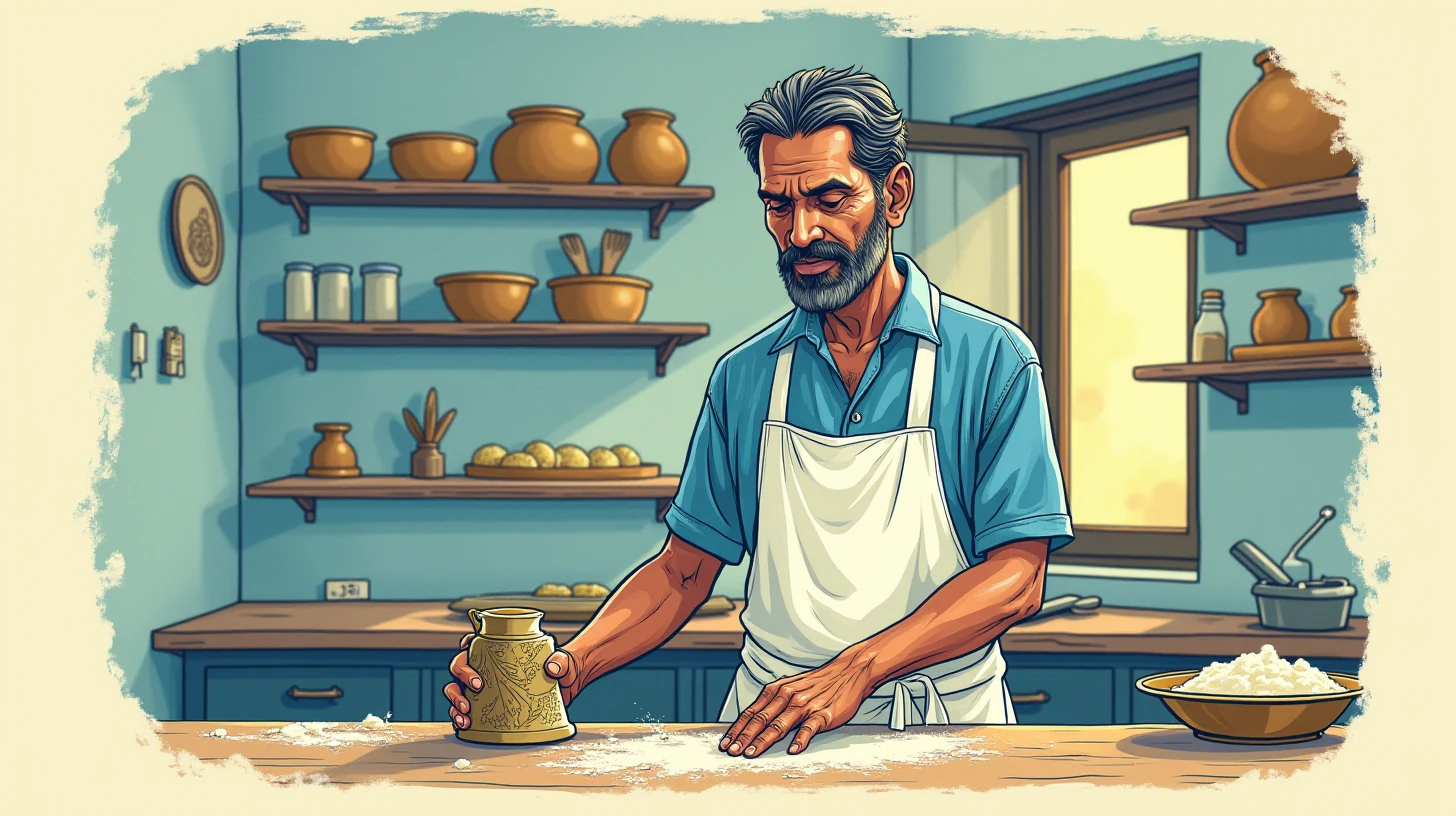
The rosogolla was the thing he was known for. Not fancy, not shaped by machine, not glistening under industrial lights. Just milk, sugar, cardamom, a few grains of salt, and heat applied in the exact rhythm his grandfather had taught his father and his father had taught him. He could tell by the smell when the sugar had reached the right stage—not by thermometer, by instinct. The rosogolla went into clay pots at dawn, stayed at room temperature, and had to be sold or consumed within thirty-six hours. That was the constraint of the recipe. That was also the signature: no preservatives, no additives, no cold chain. Just milk and time.
Last year, the West Bengal Government's Department of Food Processing Industries had awarded his shop an informal "Heritage Sweet" recognition—a certificate that acknowledged the family's four-generation continuity and the traditional method. The certificate hung on the wall, not laminated, fading slightly, framed by his daughter-in-law who had thought it might bring business. It had. A few Bengali families from South Kolkata made the trip. An Airbnb guide recommended him. And then, in February 2026, a wholesale buyer from Bangalore had walked in.
The buyer represented a Bengali diaspora grocery collective—small, maybe eight stores across Bangalore and Hyderabad. They wanted to stock Sourav's rosogolla. Not ten boxes a week. A full order: three thousand rosogollas, packed, labelled, shipped inter-state to Bangalore in refrigerated vans. Payment on delivery. ₹3.5 lakh per order, renewable monthly. It was the kind of order that could change the rhythm of his life. He would have to hire two more hands. Expand the kitchen to a separate production space. Install cold storage. Register the business formally. It was everything he had never wanted to do, and everything he now had to do.
He said yes. The buyer's logistics coordinator then asked: did he have an FSSAI Central License? The question came casually, via email, as if it were a formality. Sourav did not have an FSSAI Central License. He had never heard of one. He asked his accountant, a young man named Abhijay who did his books in a small office two streets over. Abhijay said that inter-state shipping required a Central License, which required a nutritional panel, which required that the product declare a shelf life of at least seven days under cold storage. Sourav listened, understanding very little, and then he understood the only thing that mattered: the requirement was impossible. His rosogolla could not live seven days without spoiling. The recipe would not allow it. The buyer cancelled the order.
For three weeks, Sourav said nothing to his wife. He went to the shop. He rolled rosogolla. He sold it to the same fifty or sixty families who came every week, people who had been coming for years, who did not care about certification, who bought because their mothers had bought here. He was sixty-five thousand rupees poorer because the order had evaporated, and he had not even placed it yet. The loss was not money. It was possibility.
🗓️ The annual ritual
In North Kolkata, the sweet-making cycle ran on milk deliveries and weather. Sourav bought milk twice a day from a cooperative dairy in Sovabazar, ten minutes' walk north of the shop—milk that arrived in sealed plastic pouches, already pasteurized but not ultra-heat-treated. He knew the dairy owner by face and by the first name he had used since 1994. The milk came in at 6 a.m. and again at 3 p.m., enough to produce roughly six hundred rosogollas and two hundred sandesh per day, split across the two batches.
The economics were narrower than they appeared. Milk cost ₹50 per litre; he bought forty litres per day (₹2,000). Sugar, bought loose from a wholesale mandi in wholesale, cost ₹55 per kilo; he used seven kilos per day (₹385). Maida flour, cardamom, salt, clay pots, and labor came to another ₹2,500 per day. Total daily cost: ₹4,885. He sold roughly ₹6,500 worth of rosogolla and sandesh per day. Margin: ₹1,615 per day, or roughly ₹48,450 per month. His wife helped in the shop. His son worked at a bank in South Kolkata. The business was stable but not growing. It was comfortable, which meant it could not expand, which meant it could never become anything other than what it was.
That had been fine. The "Heritage Sweet" certificate had suggested another possibility, and for a moment in February, that possibility had felt like an offer. The buyer from Bangalore had made it real: a name, a bank account, a schedule. Three thousand units per month meant he would need to hire two full-time helpers and a delivery coordinator. It meant renting the adjacent shopfront, which had been vacant for two years. It meant a separate commercial kitchen, which meant applying for an FSSAI State License at minimum, plus GST registration, plus municipal approval, plus fire safety clearance. It meant stepping out of the informal economy in which his family had always operated.
- 📨
February 15, 2026 — Bangalore buyer inquires
The buyer's logistics team asks for FSSAI Central License. Sourav has never heard the term. Abhijay, his accountant, explains the requirement: inter-state shipment requires Central License, which requires 7-day shelf-life certification and nutritional panel.
- ⚖️
February 20, 2026 — Requirement impossible
Sourav realizes his 36-hour rosogolla cannot meet the 7-day shelf-life requirement. The traditional recipe depends on freshness at room temperature. The buyer cancels. Sourav stops mentioning the order to his wife.
- 🔍
March 8, 2026 — The agent searches
A neighbor suggests trying the FSSAI portal. Sourav's daughter-in-law uses her phone to visit the FSSAI website. The site is dense and bewildering. No clear exemption pathway for artisanal foods appears in the main navigation.
- 📋
May 2, 2026 — Schedule 4 exemption discovered
The agent surfaces FSSAI Schedule 4, which exempts heritage and artisanal foods from certain labeling and cold-chain requirements if the food is recognized by the state government and has a documented cultural history of short shelf-life. Sourav's 'Heritage Sweet' certificate qualifies.
The shop had never needed a license because it had never shipped inter-state. Locally, he operated under the assumption of an oral license—a health inspector who came once a year, whose name was Rajesh, who drank tea and never wrote anything down, who said "Keep the place clean" and left. Rajesh had been coming for fourteen years. The arrangement was stable and legally invisible. But the moment the business tried to go beyond North Kolkata, it became visible, and visibility meant compliance.
⚠️ What very nearly happened
Sourav's daughter-in-law, Priya, was thirty-four, worked as a copywriter for an advertising firm in Kolkata, and had more access to the internet than anyone else in the family. On the evening of February 22, when Sourav finally mentioned the buyer's inquiry to his wife, his wife mentioned it to Priya, who came by on a Sunday morning with her laptop and began trying to understand what an FSSAI Central License actually meant.
What she found was a maze. The FSSAI website mentioned three types of licenses: Registration (for businesses with turnover under ₹12 lakh per year), State License (₹12 lakh to ₹20 crore), and Central License (above ₹20 crore or multi-state). Sourav's business turnover was roughly ₹7.8 lakh per year (₹6,500 per day × 300 selling days). On paper, he should have been filing for FSSAI Registration, not a Central License. But the Bangalore buyer was not shipping from Kolkata to Bangalore as a local business. The buyer was taking possession of Sourav's product and reselling it across state lines. In that transaction, the manufacturer (Sourav) became liable for inter-state food safety compliance, which meant Central License jurisdiction.
Priya found a PDF on the FSSAI website that explained the distinction: manufacturers exporting to other states needed a Central License or approval from the importing state's licensing authority. There was no middle ground. The document was thirty pages and cited rules in abbreviations she did not understand (FPR, FSS Act, Schedule IV, Schedule V). She searched for "heritage food exemption" and found nothing. She searched for "artisanal food exemption" and found a single sentence on a Ministry of Food Processing Industries page that mentioned "Schedule 4 foods" without explaining what they were. The path was not visible.
By early March, Priya had visited five websites, downloaded four PDFs, and found no clear exemption pathway. She had also found several horror stories on a small-business forum: a Delhi pickle maker who had tried to ship inter-state and been told her product required a Central License; a Tamil Nadu coffee-roaster who had to install cold storage even though roasted coffee does not require refrigeration; a home chef in Bangalore who had been told her tiffin service could not expand beyond local delivery without a commercial kitchen and full Central License approval.
The pattern was clear: the FSSAI regulations were designed for large industrial food producers. They had no category for heritage foods or artisanal producers. The gap in the regulation was not a loophole; it was an abyss. Businesses that did not fit the industrial mold either stayed small, operated informally, or disappeared. Sourav's shop was walking toward that edge.
The larger cost of non-compliance was closure. An unannounced FSSAI inspection at any point after the Bangalore buyer took possession of the product could result in a penalty of ₹2 to ₹5 lakh and seizure of the product. Sourav did not have ₹5 lakh in cash. His business ran on dailies. A closure would ripple through his family: his wife depended on the income, his son's bank salary supported his own daughter's college fees, and the shop itself was a family asset but not a liquid asset. The real cost was not the fine. It was the interruption.
By April, Sourav had stopped mentioning the Bangalore buyer entirely. He told Priya to stop looking. He said the order was not meant to be. Priya disagreed, but she did not tell him that she had begun taking screenshots and reading food-safety forums at night.
🌗 What changed
On May 2, 2026, Priya brought her laptop to the shop on a Thursday evening and opened the FSSAI portal—not the public-facing website, but the actual licensing system at FoSCoS (Food Safety Compliance Online System). She had realized that the exemptions would be listed in the actual licensing forms, not the marketing pages. The form for FSSAI Central License had a section titled "Exemptions under Schedule 4," and she clicked on it.
The exemption read: "Foods which are manufactured according to traditional / heritage recipes as prescribed in the respective states and the process of manufacture involves more hand labour and specific processing technology and which are not amenable to mechanization."
Sourav's rosogolla was a heritage food. The West Bengal government had said so on a certificate. The process involved hand labor—his hands, specifically, moving with rhythm and intuition that could not be described in a manual and could certainly not be automated. The recipe was traditional, registered culturally, and created a product with a naturally short shelf life. He fit the exemption exactly.
Priya showed him the line on her screen. Sourav read it three times. He did not say anything. He walked to the back of the shop where the sugar was cooling and then returned. "Call Abhijay," he said.
She called her accountant from the shop phone. Abhijay came by the next morning at 8 a.m., before the first milk delivery. Priya showed him the same line. Abhijay nodded, pulled up the FSSAI rules document (FSSAI Food Safety and Standards (Licensing and Condemnation of Unsafe Food) Regulations, 2011, Schedule IV, Item 12), and said that the exemption was clear. Sourav would still need to formally register with the FSSAI under the Schedule 4 exemption, provide proof of the heritage recognition from West Bengal, and declare that the shelf life was thirty-six hours. But he would not need the 7-day cold-chain certification or the nutritional label.
The Bangalore buyer would need to accept a product with a thirty-six-hour shelf life. But that was a business decision, not a regulatory impossibility.
"আমাদের দোকান নিজেই প্রমাণ দেয় যে রসগোল্লা যা সাত দিন স্থায়ী হতে হবে তা আর রসগোল্লা নয়।"
(Our shop is the proof itself that a rosogolla that lasts seven days is no longer a rosogolla.)
He said this to Abhijay, in Bengali, and Abhijay wrote it down. This was the essence of what Sourav needed to convey to the FSSAI: that the recipe and the shelf life were inseparable. That heritage meant fidelity to tradition, not adaptation to regulation.
Priya then did something that moved the process forward: she opened the GabFORGE agent on her phone and typed a specific question into the tablet:
"FSSAI Schedule 4 exemption for heritage rosogolla from West Bengal with 36-hour shelf life — what documents does Sourav need to apply, and what is the application process?"
The agent returned a structured answer within seconds.
"রসগোল্লার জন্য FSSAI নিবন্ধন, Schedule 4 exemption শাখা অনুযায়ী: (১) পশ্চিমবঙ্গ সরকারের 'Heritage Sweet' সার্টিফিকেট (আপনার কাছে আছে); (२) হাতে তৈরি প্রক্রিয়ার বর্ণনা এবং ফটো (ধাপে ধাপে); (३) ৩৬ ঘন্টা সংরক্ষণকাল ঘোষণা এবং ওয়ারেন্টি; (४) Bagbazar Lane, Kolkata খ্যাতি ও ঐতিহ্যের প্রমাণ (পত্রিকার কাটিং, ঐতিহ্য সংগঠন, পারিবারিক রেকর্ড)। FoSCoS পোর্টালে 'Exemption Category' dropdown থেকে Schedule 4 নির্বাচন করে আবেদন করুন।"
(FSSAI registration for your rosogolla, under Schedule 4: (1) West Bengal Government's 'Heritage Sweet' certificate (you have this); (2) Description of hand-made process with photos (step-by-step); (3) Declaration of 36-hour shelf life and warranty; (4) Proof of Bagbazar Lane reputation and heritage (newspaper clippings, heritage organization letters, family records). Apply through the FoSCoS portal by selecting 'Exemption Category' from the dropdown and choosing Schedule 4.)
The agent then outlined the next steps: registering with MSME Udyam to formalize the business, filing for GST registration (not mandatory below ₹40 lakh in manufacturing, but required for inter-state shipping), and notifying the Bangalore buyer that the product came with a 36-hour shelf-life guarantee in writing.
Sourav listened. Priya took notes. Abhijay said he would handle the paperwork and the GST registration, which he quoted at ₹5,000 plus filing fees. The FSSAI Schedule 4 registration could be done online, but Abhijay offered to do it, which Sourav accepted. The total cost for formal registration and compliance would be roughly ₹12,000—a fraction of the ₹3.5 lakh per order that the Bangalore buyer was offering.
Stay Informal (Status quo)
₹0 cost, 36-hour shelf life preservedRemain unregistered, sell locally only, avoid inter-state shipping. No regulatory burden, but no growth. Vulnerable to inspection. Maximum local revenue remains ₹7.8 lakh/year.
Pursue State License (Original assumption)
₹1.5–₹3L cost, impossible shelf-life requirementRequires 7-day cold-chain certification, nutritional label, separate commercial kitchen. Forces adaptation of the recipe. Timeline: 6–8 weeks. Violates heritage principle.
Schedule 4 Exemption (Agent-discovered path)
₹12K cost, 36-hour shelf life protected, inter-state eligibleFormal FSSAI registration, GST compliance, heritage documentation. Preserves traditional recipe. Opens Bangalore order immediately. Timeline: 2–3 weeks. Enables growth without compromising artisanal method.
On May 4, Abhijay filed the Schedule 4 exemption application through the FoSCoS portal. On May 10, the FSSAI issued a provisional certificate. On May 15, Sourav received notification that his business was formally registered under FSSAI Schedule IV, Item 12, as a heritage rosogolla and sandesh producer. The certificate came via email and via postal mail, a small laminated card that looked official in a way the West Bengal certificate did not.
He called the Bangalore buyer the same day. The buyer said they had assumed the order was cancelled and had moved on. Sourav asked if it could be revived. The buyer was cautious—the buyer's own business had to comply with Telangana and Karnataka food safety rules, and those rules might conflict with a 36-hour shelf life. Sourav proposed a compromise: the buyer would order in smaller batches, once a week, shipped via refrigerated van to Bangalore overnight (sixteen to eighteen hours), and the product would carry a 36-hour shelf-life declaration with a temperature-controlled warranty. The buyer agreed to try one batch.
On May 18, three thousand rosogollas, packed in individual clay pots sealed with cardboard, left Kolkata in a refrigerated van bound for Bangalore. Sourav had hired two temporary helpers and worked eighteen-hour days for four days to fulfill the order. His hands, at fifty-eight, still remembered the rhythm. The product arrived in Bangalore on May 19 at 4 a.m., was distributed to eight Bengali grocery stores within two hours, and sold out by evening.
The buyer ordered again the following week.
🧭 Why we built it
The problem Sourav faced was not singular. It was systemic. Across India, heritage and artisanal food producers—pickle makers in Tamil Nadu with recipes from the 1800s, cheese makers in the Nilgiri Hills, honey harvesters in the Western Ghats, sweet makers in Kolkata—face the same regulatory wall. The FSSAI rules were written for industrial food producers: large-volume, shelf-stable, centralized production, cold-chain managed logistics. The rules assume that food safety scales linearly with formalization. But heritage foods are often defined by their smallness, their hand-labor intensity, and their short shelf life. They are the opposite of scalable. The regulation treats them as either non-compliant or impossible.
The gap in the regulation is real: Schedule 4 exists to accommodate traditional foods, but the pathway is invisible. Most small producers do not know it exists. When they try to formalize, they either discover the impossibility too late or abandon the effort and remain informal. The Bangalore order might never have happened if Priya had not spent hours on the FSSAI website, and Priya would not have spent those hours if the agent had not been available to interpret the dense regulatory language.
The agent's role was not to solve the problem. It was to make the solution visible. The solution already existed in the regulation—Schedule 4 was written by the FSSAI precisely to protect heritage foods. But the solution was hidden behind a dense technical document and a website designed for government administrators, not small business owners. The agent became the translator. It read Schedule 4, understood the spirit of it (tradition should not be erased in the name of safety), and said: "You fit here. Here is the form. Here is what you need."
This matters because heritage food producers are economic anchors in their communities. Sourav's shop sustained two families directly and was a cultural landmark in North Kolkata. The shop had been written about in food magazines, mentioned in guidebooks, visited by food writers. But all of that cultural value was invisible to the regulation. From the FSSAI's perspective, Sourav was just another informal food business, no different from a roadside dosa stand or a cloud kitchen. The regulation did not see the four generations. It did not see the fidelity to recipe. It did not see the cultural asset.
"চার প্রজন্ম ধরে আমরা এই রসগোল্লা তৈরি করেছি কারণ দোকানটি আমাদের পরিবার। এটি শুধু ব্যবসা নয়।"— For four generations we have made this rosogolla because the shop is our family. It is not just a business.
What Sourav needed was what every heritage food producer needs: a way to formalize without destroying the thing that made the business worth formalizing. The Schedule 4 exemption is that way. But the exemption is useless if the producer does not know it exists. The agent made it visible. In doing so, it opened a pathway for Sourav to grow without compromising. It transformed a near-loss into an opportunity. It allowed tradition and formalization to coexist, not as a compromise but as a recognition that some things should not be changed, even in the name of compliance.
🌱 What we hope happens
Three weeks after the Bangalore order shipped, Sourav rented the adjacent shopfront. It had been vacant since 2022, when a previous tenant's vegetable wholesale had failed. The rent was ₹15,000 per month, negotiable because it had been empty. He hired two full-time helpers—young men from the neighbourhood, one of whom had family connections to the sweet-making trade in Odisha. He did not expand the recipe. He did not install industrial mixers or temperature-controlled cabinets. He rented the space to duplicate what he already did: hand-rolled rosogolla, same milk, same sugar, same thirty-six-hour shelf life. Just more of it.
The Bangalore order became consistent. By mid-June, it had grown to five thousand rosogollas per week, split across five orders (one per weekday). The Hyderabad buyer had also placed an initial order, pending their own compliance check with Telangana food safety. A small online retailer based in Gurgaon had inquired about stocking his rosogolla under their "Heritage Sweets" collection, which required the Schedule 4 certificate but nothing else. All of these opportunities had been invisible four months earlier, not because they did not exist but because the regulatory pathway had been invisible.
The formal registration did not change the recipe. It did not require Sourav to abandon tradition. It required documentation—photos of the process, a written description of the heritage, the Heritage Sweet certificate, a shelf-life declaration. It required paperwork. Abhijay had handled most of it, and Sourav had signed where asked. The cost had been low, ₹12,000 total, and the benefit had been immediate.
What Sourav hoped, in the quiet way of people who have spent decades in one place, was that other heritage food makers across India would find the same pathway. That a pickle maker in Chennai would discover Schedule 4. That a honey harvester in Uttarakhand would realize that "traditional process not amenable to mechanization" described exactly what she did. That formalization would stop being synonymous with industrialization. That regulation could be written, and understood, in a way that protected heritage instead of erasing it.
The shop in Bagbazar would always be small. Four generations had chosen smallness, and that choice had been rewarded by loyalty and recognition. But small and informal were not the same thing. Small and formal was now possible. The agent had not changed the recipe. It had changed what was possible within the recipe.